
Villa chandelier maintenance is a preservation job, not routine housekeeping, because a $20K+ fixture can lose value through one careless cleaning method, one unstable access route, or one unmatched replacement part.
The hidden risk is that cleaning looks simple after the chandelier is installed. In reality, the service team may need lift access, floor protection, piece maps, approved cloths, spare crystals or glass, electrical isolation, and a record of what was removed or adjusted.
Kinglong Lighting can help villa owners and designers specify maintenance before handover, so the chandelier remains clean, safe, and visually consistent after years of service.
Key Takeaways
- Access first: Cleaning risk begins with how the team reaches the fixture.
- Piece maps protect value: Crystal, glass, and custom modules need a removal and replacement record.
- Methods must match material: One cleaner or cloth should not be used across every finish.
- Electrical service matters: Drivers, lamps, and connectors should be checked with product evidence.
- Records prevent drift: A service log protects future appearance and spare-part matching.
Cleaning a luxury chandelier starts with access risk
The first maintenance question is not what to wipe; it is how the fixture will be reached without damage.
OSHA’s aerial lift guidance is not a decorative lighting manual, but it is a strong reminder that elevated work requires trained people, hazard recognition, equipment checks, and attention to overhead conditions. For villa owners, the practical takeaway is to plan access rather than improvising it under a fragile chandelier.
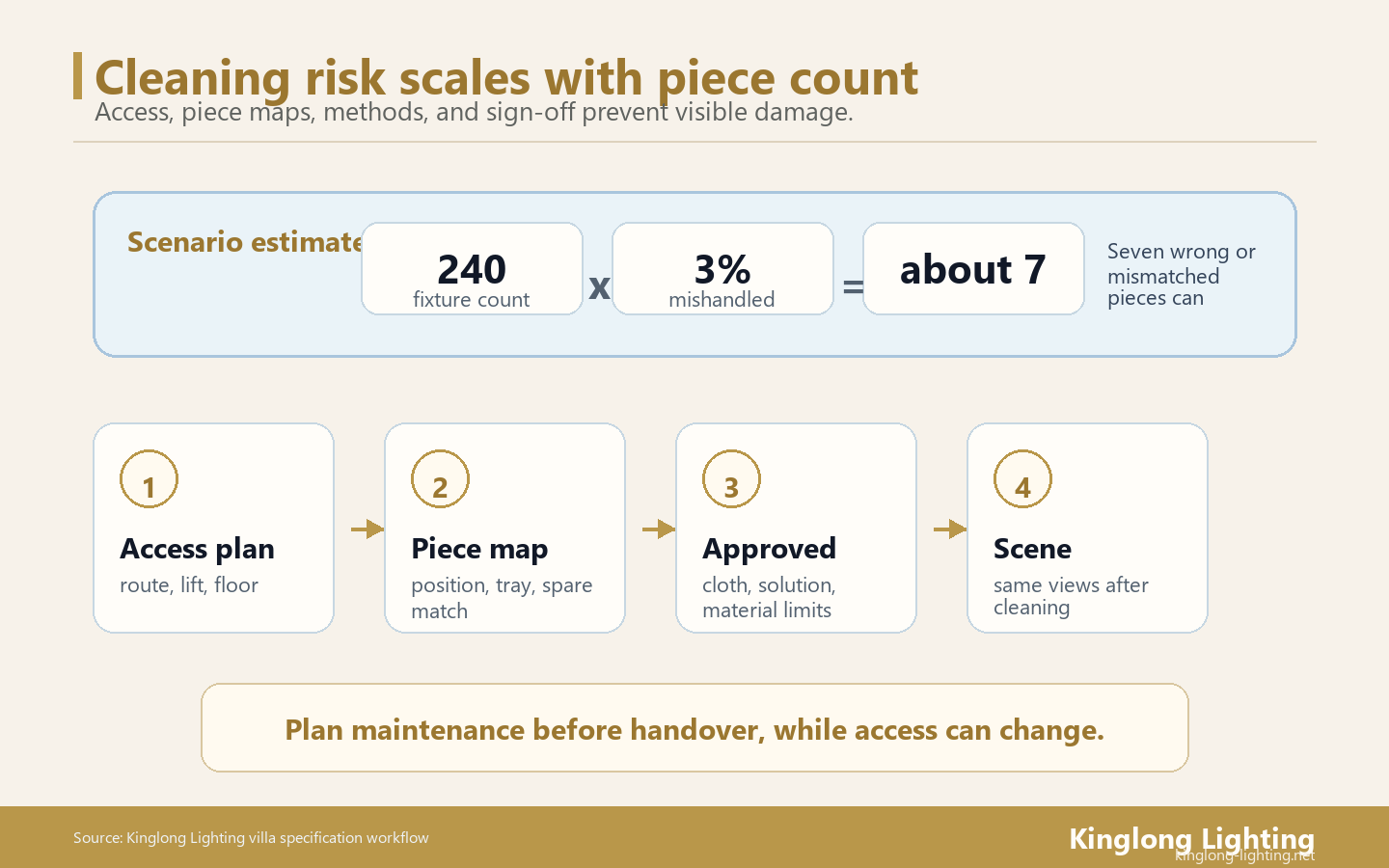
A tall foyer, stair void, dining room, or double-height living room can make cleaning difficult after furniture, flooring, art, and final finishes are installed. The service plan should be approved while the project team can still decide lift route, floor protection, access timing, and whether some decorative parts should be removable.
The owner should never be left with a fixture that can only be cleaned by risky ladder improvisation or by partially dismantling the chandelier without a map.
Damage often begins before anyone touches the fixture
Chandelier damage can start with moving furniture, placing a lift, crossing polished stone, or working near ceiling details. The maintenance plan should name floor protection, route width, ceiling clearance, access equipment, and whether the fixture must be partially lowered or cleaned in place. If the access route is not realistic, the fixture may be too complex for the room even if it looks perfect in the render.
Piece count turns cleaning into inventory control
A villa chandelier with hundreds of glass drops, crystal pieces, или на заказ modules needs a piece map. Without a map, a removed strand can return to the wrong position, a replacement can mismatch, or a minor chip can be missed until the next cleaning. The maintenance file should show location, quantity, spare part, and handling rule for critical decorative elements.
Separate cleaning method, electrical check, and visual inspection
Cleaning is not one action. It is at least three: remove dust or film, verify electrical and mechanical condition, and restore visual alignment. Treating all three as one wipe-down creates unnecessary risk.
Calculated from a 240-piece chandelier, a 3 percent mishandling rate affects about seven pieces. That may sound small, but seven wrong, chipped, loose, or mismatched pieces can be enough to make a premium fixture look neglected.
| Maintenance layer | Damage risk | Required proof | Service decision |
|---|---|---|---|
| Access | floor, ceiling, or lift damage | route and protection note | plan before furniture |
| Surface cleaning | scratches or streaks | approved cloth and solution | separate by material |
| Piece handling | wrong position or chip | piece map and tray rule | track removals |
| Electrical check | loose driver or lamp issue | qualified service note | do not hide access |
| Visual reset | fixture looks uneven | photo record and alignment marks | compare after service |
UL indoor and decorative lighting page and ANSI UL 1598 page reinforce that decorative luminaires still involve product safety and component evidence. A maintenance plan should respect electrical access and product documentation, not only visible cleaning.
DOE TM-30 FAQ is relevant when cleaning changes optical behavior. Dust, film, fingerprints, and dulling can affect how material and color appear, so post-cleaning inspection should include the approved lighting scene, not only a bright work light.
Use a service log to prevent slow visual drift
The first cleaning is rarely the problem. Visual drift appears after several visits when one team tightens a part differently, another team replaces a piece without matching, and a third team uses a different cleaning method. The fixture slowly stops looking like the approved sample.
A service log should record date, access method, cleaning materials, removed pieces, damaged or replaced parts, driver or lamp notes, photos before and after, and the person responsible for approval. This is not paperwork for its own sake; it is how a custom chandelier keeps its original design language.
For high-value fixtures, the service log should sit with the spare-part box and production file. The next technician should not have to guess which crystal, glass, clip, or finish note belongs to the fixture.
The log should also make small corrections visible while they are still cheap. A loose strand, changed cloth, missing clip, or different driver note may look minor on one visit, but repeated unnoticed changes create the visual drift that owners usually notice too late. Treat the log as a design protection record, not only a maintenance receipt.
For a villa team, the most useful log is brief enough to complete during the visit and strict enough to prevent memory-based service. It should include a repeatable photo angle, a note for any part removed, the approved cleaning material used, and a short acceptance line from the owner, designer, or facility manager. That keeps accountability close to the work instead of recreating it months later.
How Kinglong Lighting can prepare maintenance before handover
Kinglong Lighting’s customization workflow can include cleaning access, spare parts, material handling, and replacement logic in the custom release file. That is especially useful for large foyer, stair, dining, and living room chandeliers.
The practical next step is to send fixture height, room access, material list, expected cleaning team, floor finish, and desired spare strategy through the project inquiry page. Ask Kinglong Lighting for a maintenance note before the chandelier ships, not after the first cleaning problem.
Create a maintenance-safe cleaning packet
The cleaning packet should be usable by the owner, facility manager, interior designer, and service contractor. It should be more specific than a generic care label but lighter than a factory manual. Its job is to prevent damage during ordinary cleaning and make specialist service easier when needed.
For a $20K+ fixture, the packet is part of value protection. It keeps the chandelier from becoming a fragile object that everyone is afraid to maintain or, worse, an expensive object cleaned with guesswork.
The packet should also say what the service team must stop doing. Stop if a lift cannot be placed without floor risk, if a cleaner is not listed for the material, if a removed part cannot be mapped, or if electrical access requires improvisation. A clear stop rule is often more useful than another general care tip because it prevents the first bad decision from becoming permanent damage.
Include an access plan with floor and furniture protection
The access plan should show how the service team reaches the chandelier, what equipment is assumed, which furniture must move, and how floors, walls, and ceiling details are protected. If a lift is required, the plan should say whether the room can accept it. If ladders are inappropriate for the height or reach, the plan should not pretend they are a normal option.
Include a material-specific cleaning table
The packet should separate glass, crystal, metal, acrylic, resin, leather, fabric, and painted finish. Each material should have permitted cleaning tools and prohibited methods. This prevents a single all-purpose solution from damaging plated metal, staining porous surfaces, scratching acrylic, or leaving residue on hand-blown glass.
Include a piece map and spare-part box
A piece map does not need to be beautiful; it needs to be clear. It should identify where custom drops, strands, shades, arms, clips, screws, and drivers belong. Spare parts should be labeled against that map. When a service team removes pieces, the map protects both position and matching, especially when handmade or batch-sensitive parts are involved.
Include a post-cleaning scene check
After cleaning, the chandelier should be reviewed under the approved scene, not only under a service light. This catches misaligned parts, glare changes, dimming issues, missing pieces, and finish damage. A quick photo record from the same viewpoints used at approval can reveal drift before it becomes permanent.
Control cleaning damage with a service chain of custody
High-value chandelier cleaning should have a simple chain of custody. The team should know who approved access, who handled parts, where removed pieces were placed, what method was used, which parts were replaced, and who accepted the final scene.
This may sound formal for a villa, but it prevents a familiar pattern: everyone assumes someone else tracked the parts, then a small mismatch or scratch becomes impossible to trace. A chain of custody is how a decorative object stays accountable after installation.
Use a 4-step service record for every major cleaning: before photos, removal log, method log, and after-scene sign-off. For fixtures above USD 20,000, even 1 unrecorded replacement can make future matching harder than the original cleaning.
Take before-service photos from repeatable viewpoints
Before-service photos should be taken from the same viewpoints used in approval: entry, seated, stair, underside, and any mirror or long-view position. These photos protect the owner and service team because they show pre-existing dust, misalignment, chips, or missing parts. After cleaning, the same views reveal whether the fixture returned to its approved visual balance or whether a piece shifted during handling.
Use trays and labels for removed decorative elements
When glass, crystal, clips, or shades are removed, they should be placed into labeled trays that correspond to the piece map. This avoids the common mistake of grouping parts by convenience and then guessing during reassembly. Handmade glass, tinted pieces, or cut crystal can vary slightly by position. The tray system protects both matching and rhythm, especially on fixtures where small differences are visible.
Separate service materials from household cleaning supplies
The cleaning packet should name permitted cloths, gloves, solutions, brushes, and drying methods. These should be stored or specified separately from general household supplies. A housekeeper may reasonably reach for a normal cleaner unless the maintenance packet makes the rule visible. High-value finishes, plated metal, acrylic, resin, leather, and hand-blown glass can all be damaged by methods that are harmless elsewhere in the villa.
Require owner or designer acceptance after the scene check
Final acceptance should happen under the approved scene, not only under work lights. The owner or designer should check alignment, sparkle, dimming, missing parts, fingerprints, and visible finish changes. This sign-off does not need to be bureaucratic. It simply closes the service visit while the access equipment, cleaning team, and piece map are still available to correct small issues.
Maintenance action card
- Plan access before furniture and floor finishes lock the room.
- Separate cleaning methods by material and finish.
- Create a piece map before the first service visit.
- Store labeled spare parts with the maintenance packet.
- Inspect the fixture under the approved lighting scene.
Related Guides
- Hotel Chandelier Maintenance Schedule
- Tropical Villa Chandeliers
- Double-Height Foyer Chandelier Selection
Frequently Asked Questions
How often should a villa chandelier be cleaned?
Frequency depends on height, room dust, humidity, material, and owner tolerance. Many luxury fixtures need light routine dusting plus periodic specialist service, but the final rhythm should be written into the maintenance packet.
Can housekeepers clean a $20K chandelier safely?
They can handle limited dusting only if the method, access, and material rules are clear. Complex cleaning, removal of parts, electrical checks, or high-access work should be handled by trained service professionals.
What is the biggest cleaning damage risk?
The biggest risk is usually uncontrolled access and handling, not the wiping itself. Moving equipment, removing pieces without a map, using the wrong solution, or replacing parts incorrectly can damage value quickly.
What should Kinglong Lighting provide for maintenance?
Kinglong Lighting should provide material notes, cleaning cautions, piece maps, spare-part recommendations, access assumptions, driver location notes, and post-service inspection points when the fixture is custom or high value.