
A contractor can coordinate the most detailed lighting enquiry on a project and still lack the right to award the supplier or change a specified fixture. The confusion starts when a supplier treats active coordination, a request for prices, or a preferred-supplier name as one combined authority. For a hotel or commercial fit-out, verify the exact power requested, the current document that grants it, and the person who can release the line before a quotation becomes a commercial commitment.
Which records change a lighting enquiry from exploratory to purchase-ready?
Four separate powers require four separate record checks before a supplier assigns a response state.
- Nomination can identify a preferred source; it does not by itself show who will place the order.
- Buying authority needs a current supply-package record and an authorized release route for that revision.
- A changed item needs its own documented approval path, even when the contractor is managing samples and drawings.
- Coordination can be essential project work without creating commercial authority for a supplier.
A contractor title is not a lighting procurement scope
A contractor title is not proof of lighting procurement scope. A fit-out firm may hold a supply package, work under a nominated route, coordinate interfaces for an owner-appointed buyer, or perform a mixture of those roles by package. Start with the scope of work: the defined supply and work obligations in the governing project documents. Then ask which party owns the current fixture schedule, which party can accept a changed finish, and which person may issue the purchase release. Those answers are more useful than a company title because they apply to the exact decorative-lighting line a supplier is being asked to price.
Test four powers separately before pricing a supply package
Fit-out contractor lighting procurement scope should be tested as four separate powers: nominate, buy, substitute, and coordinate. The test is deliberately narrow: a supplier is not deciding who is legally right; it is deciding what type of response is safe to send today. A contractor may show strong evidence for one power and no evidence for another. Separating them prevents a detailed drawing review from silently becoming a release instruction.
| Requested power | What it can mean | Useful current record | Supplier response |
|---|---|---|---|
| Nominate | Recommend or identify a source | Approved supplier list, tender instruction, or nomination note | Budget or tender response |
| Buy | Place the supply order | Supply-package scope plus named PO release route | Purchase-ready quotation |
| Substitute | Propose a different item, finish, or specification | Approved revision or written change instruction | Conditional changed-line price |
| Coordinate | Manage drawings, interfaces, samples, or comments | Coordination responsibility and current review record | Technical response without commercial release |
Once the buying role is confirmed, the supplier still needs the project context that affects a decorative package: application area, fixture family, current drawings, finish references, and review route. For Kinglong Lighting, the same record set helps distinguish a budget enquiry from a controlled decorative-lighting brief. Teams preparing that handoff can review hospitality lighting project inputs before asking a manufacturer to turn an open request into a controlled proposal.
Nominate: recommend or identify a supplier without assuming award power
Nominated supplier and competitive tender are distinct FF&E procurement routes, and a specialist lighting package may sit outside a builder or main contractor contract. The British Institute of Interior Design’s FF&E guidance makes that distinction in its discussion of procurement routes and notes that light fittings can sit outside the builder or main contractor’s contract. For the supplier, a nominated name therefore supports a targeted price or technical conversation, not an assumption that the contractor can award the package. Ask who will issue the order and whether the current package schedule includes the fixtures.
Buy: confirm the supply package and release route
Public construction procurement can require contractor documentation at named procurement gateways rather than infer a buying right from the contractor title. A current UK public-framework example sets contractor deliverables and proposals at defined procurement milestones. It is not a rule for private fit-outs, but it demonstrates the useful question: what record currently connects this contractor to this package and release point? A purchase order is the authorized document used to place the order; until the project identifies who may issue or authorize it for the current revision, a supplier should not label the quote as awardable.
Substitute: treat a different lighting item as a documented change
A proposed lighting substitution should be treated as a documented deviation whose approval route is explicit. Here, a substitution means a proposed alternative to the currently specified item, whether the difference is a finish, construction detail, light source, or complete fixture. A sample comment may identify a preference, but it may not identify the party who accepts the price effect or scope change. A Philippine public-construction authority FAQ is one jurisdiction-specific example that requires written owner approval for substitutions; use it as a documentation boundary, not as a universal fit-out rule.
In the cited AIA model, a contractor is not relieved of responsibility for a deviation unless it was specifically notified and separately approved in writing or authorized by a change order or directive. The relevant AIA A201 comparative document is a contract-model example, not the governing document for every project. Its practical lesson is precise: keep the original specified line and the proposed alternative distinct until the project supplies the applicable approved revision or written change route. That protects the supplier from making an informal finish request look like a settled commercial instruction.
Coordinate: keep interface work distinct from commercial authority
In the cited AIA example, contractor submittal review includes checking and coordinating information against work and contract documents. AIA’s explanation of its A201 submittal provision frames that review as checking, approving, verifying, and coordinating against the work and contract documents. This is valuable interface work: it can clarify mounting, dimensions, samples, and drawing conflicts. It does not, on its own, prove that the contractor may move a commercial line from enquiry to order. Let coordination records guide technical responses while the supply-package record and release contact govern price commitment. The division needs an explicit commercial release record.
Ask for one current record for each requested power
A fit-out lighting request is supplier-ready only when the requested power, current scope record, and named decision owner agree. Apply that rule line by line, rather than treating the whole enquiry as either approved or blocked. For example, a contractor may coordinate all 26 fixtures, request a budget figure for a new finish, and still need an owner-side contact to release seven changed pendants. In that case, the scope record answers what is included, the approval record answers whether the substitution is accepted, and the release contact answers who can convert the price into an order. That is the four-power check in practice.
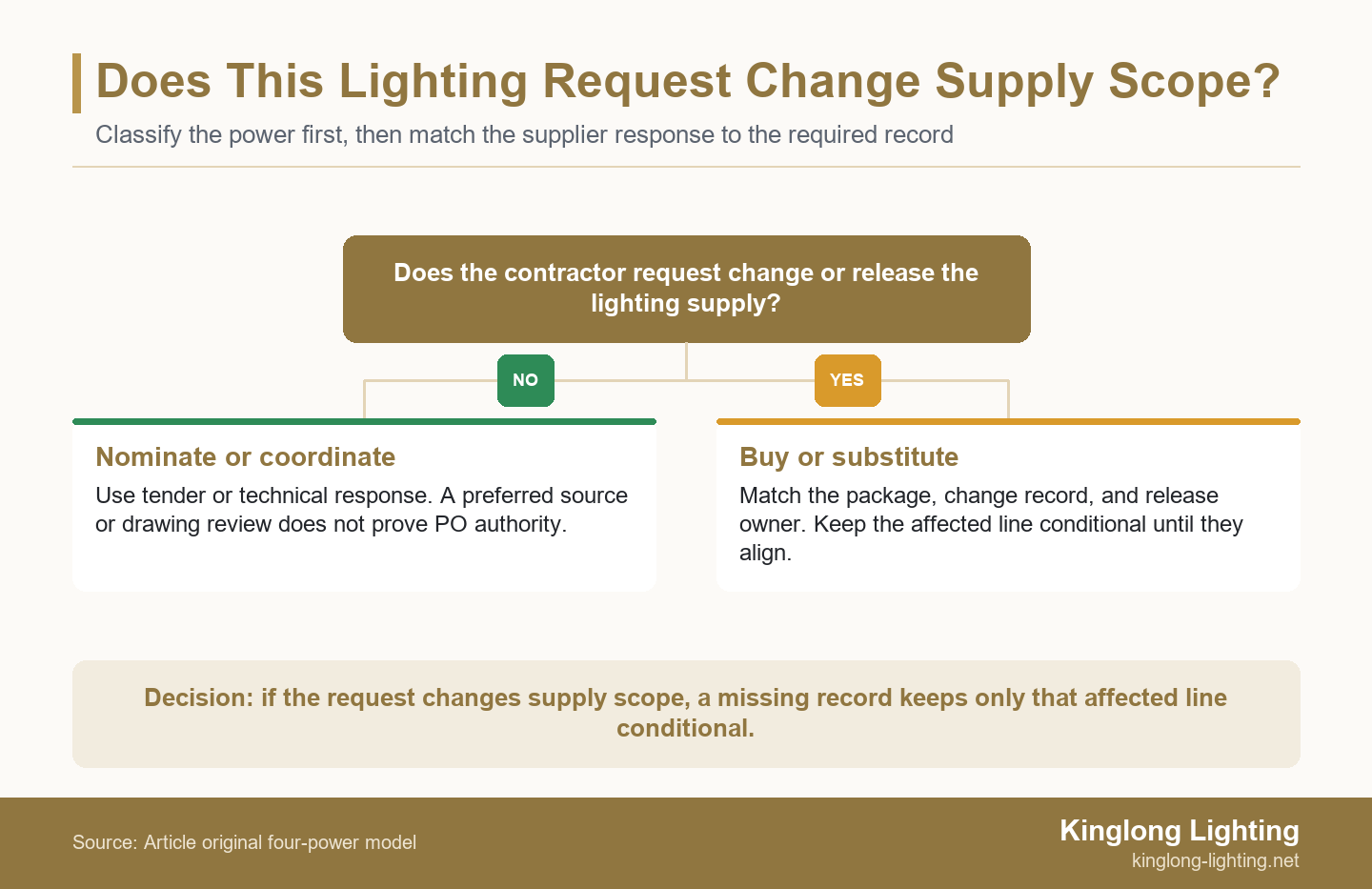
Match the supplier response to the proven scope
An unresolved scope should change a supplier response from awardable to conditional, not prevent a useful exploratory or tender response. An RFQ, or request for quotation, is a request sent to obtain a supplier’s commercial response; it can be valuable before every authority record is complete if the response is labelled honestly. Use a budgetary response when the project is exploring price or finish options, a tender response when the package is being compared, and a conditional changed-line response when a substitution is still awaiting approval. Reserve a purchase-ready quotation for the revision that has both a confirmed supply scope and a named release route.
For decorative lighting, that distinction also keeps custom development in sequence. A supplier can collect dimensions, fixture intent, finish references, and sample expectations without pretending that an open line has been awarded. When the project is ready to turn verified records into controlled development inputs, it can organize a controlled custom-lighting brief.
A controlled brief should identify the fixture family, drawing revision, finish reference, dimensions, quantities, intended installation location, sample expectation, and the technical contact who will consolidate comments. It should also identify which information is provisional. A supplier can then return a budget option, tender response, or conditional change line that matches the actual state of the record. That reduces rework caused by mixing an exploratory finish discussion with a confirmed package schedule. It also makes later comparisons cleaner, because the buyer can see whether a different price reflects a changed material, quantity, drawing detail, freight assumption, or simply a different release condition.
Keep commercial wording as controlled as technical wording. State the document revision, currency and delivery assumptions, whether a sample is priced separately, and what approval or release record is still missing. If a contractor is only coordinating, address the response to the appropriate project contact without excluding the coordinator from technical communication. If the contractor owns the purchase package, the same record set can move the line forward. This distinction protects both sides: the supplier does not invent authority, and the project team does not lose a useful technical and commercial option while its records are being aligned. It also gives the owner-side buyer a clear list of decisions that remain open before any deposit, sample release, or production discussion begins.
For context after the authority check, teams can review lighting project examples by application context.
Illustrative scenario: price the changed pendants without awarding the supply package
A dual-track quotation can price a changed lighting line while preserving the separate question of who may release it. The following composite illustration shows how a supplier can keep a live fit-out conversation moving without deciding the buyer-side scope question.
Rejoin the four records only when the affected line is ready
A design-and-build fit-out contractor is coordinating a hotel reception and lounge refurbishment for an owner-appointed project team. The request covers 26 decorative lighting items across three fixture families, and 7 revised lobby pendants are affected by a proposed finish substitution. The contractor asks the supplier to reprice those pendants. Its inclusions schedule names installation coordination, while a separate owner procurement sheet lists lighting supply.
The contractor can coordinate the drawings and sample comments, but cannot show a current award record for the supply package. The owner-side procurement sheet also does not state whether the proposed finish is inside the approved allowance or authorized as a substitution. The request is detailed enough for price discovery, yet it lacks the authority needed for a binding substituted supply line.
The supplier issues a budgetary option for the 7 changed pendants and keeps the original specified line separate. It asks for the current inclusions schedule, approved revision, substitution record, and purchase-release contact. That response gives the project team a usable number for its decision while making clear that the new finish has not silently replaced the specified version.
A changed line becomes awardable only when its price, finish reference, scope holder, and release instruction align on one revision. Until then, the supplier can reissue only the affected line as conditional and leave the original line visible for comparison. This is a composite illustration, not a Kinglong Lighting project or a rule for every fit-out contract.
Use a four-document pre-quote scope pack
A four-document pre-quote scope pack converts an ambiguous contractor enquiry into a controlled supplier conversation. Ask the contractor or project team for four items: the current inclusions or supply-package schedule; the current fixture or finish revision; the written delegation or change record when an alternative is proposed; and the named purchase-release contact. Each item answers a different question. The first identifies whether lighting supply sits in the contractor’s package, the second controls what is being priced, the third prevents a preference from being mistaken for approval, and the fourth identifies who can release the commercial line.
Do not turn a missing document into a blanket refusal. Mark only the affected item as exploratory, tender-stage, or conditional; state what record would change that status; and keep the unchanged specified items on their confirmed revision. If the records conflict, ask the project team to resolve the conflict in one current instruction rather than asking the supplier to infer the winner. Where a project team has assembled that pack and needs a manufacturer-side discussion of the decorative package, it can request a scoped lighting brief review.
Frequently Asked Questions
Can a fit-out contractor request a lighting quotation without buying authority?
Yes, a contractor can request an exploratory quotation when the request clearly states that buying authority remains unverified. The supplier should label the response budgetary or tender-stage, identify the revision being priced, and avoid presenting it as a purchase-ready offer. The project can still compare price, finish, and technical options while it confirms who owns the supply package and release route.
Which document best proves a contractor can buy decorative lighting?
The strongest evidence is the current contract scope or package schedule paired with the named release route for that same revision. A current schedule shows that the lighting supply is in the contractor’s package; a named release path identifies who can convert the commercial response into a binding instruction. A historic tender list or a drawing-only comment is usually weaker because it may not settle either point.
Does coordination responsibility permit a contractor to approve substitutions?
No, coordination responsibility alone does not prove substitution authority unless the contract documents or a written delegation say it does. Coordination can make the contractor the right person to collect samples, identify clashes, and consolidate feedback. The supplier should still seek the applicable change record and scope owner before treating an alternative finish or fixture as an approved supply instruction.
What should a lighting supplier do when scope documents conflict?
The supplier should keep the affected line conditional and ask the project team to issue one current scope and authority instruction. Keep the original and proposed lines separate, state which document versions are being compared, and identify the missing release contact or approval record. This preserves a useful commercial conversation without allowing an unresolved buyer-side conflict to become a supplier promise.