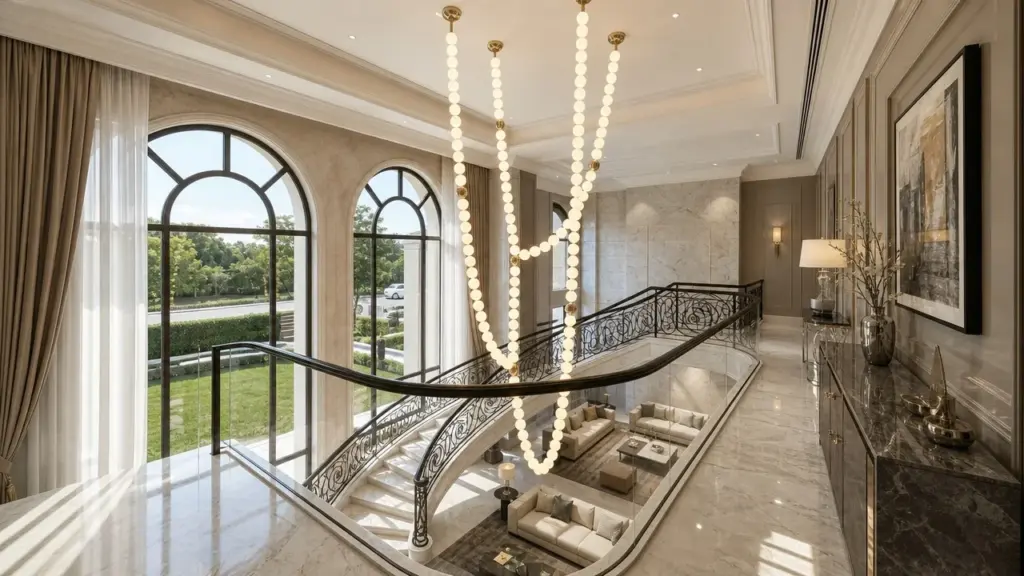
Train the hotel engineering team against the decorative lighting actually installed: its location records, approved care instructions, controls references and replaceable parts. Then ask staff to demonstrate the tasks assigned to them, including knowing when to stop and request help. A presentation about the product range cannot show whether someone can look after a particular fitting.
For an owner representative or chief engineer, the handover question is practical: can the incoming team find the right information and act within its responsibilities after the project team leaves? Build the training around that question before arranging a demonstration.
Teach Tasks the Team Can Demonstrate
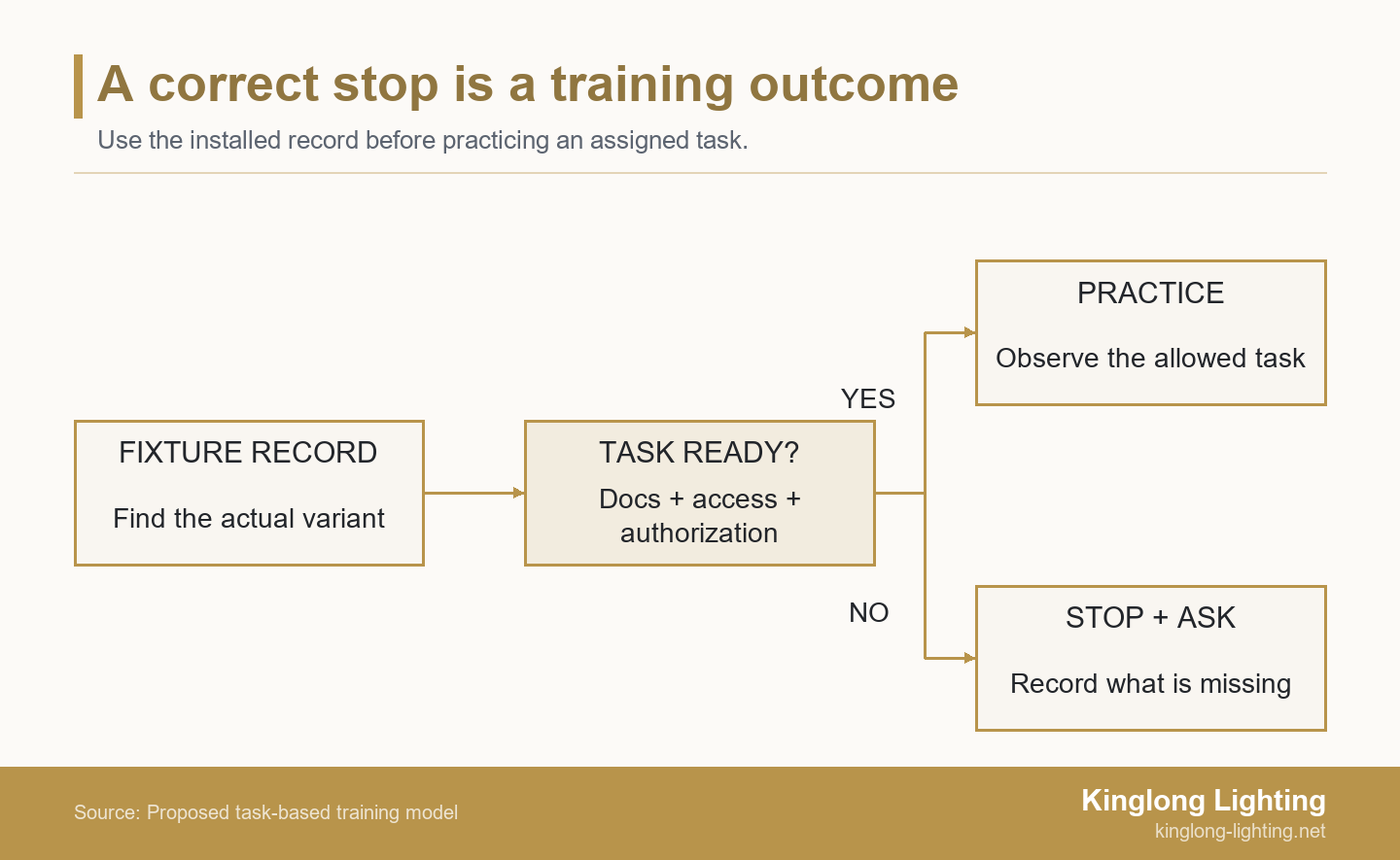
A useful bespoke-lighting handover teaches staff to identify a fixture, retrieve its instructions, stay within their assigned task and escalate missing information. In the proposed approach below, demonstrated performance matters more than attendance: the participant explains or shows the allowed action using the applicable fixture record. When a prerequisite is missing, identifying that gap and stopping is a valid result.
- Find the installed variant. Start with a location and fixture identifier, rather than a photograph of a similar product.
- Separate task responsibilities. Distinguish routine observation, permitted care and work reserved for an appropriately qualified specialist.
- Use the actual instructions. Match cleaning, component handling and controls information to the installed assembly.
- Check the response. Observe a practical task or a correct escalation, and record what remains unresolved.
These are training outcomes to agree with the hotel, not a substitute for trade qualifications or the site’s authorization process. Decide which participants need each task; the same agenda need not give everyone the same permissions.
Prepare the Actual Fixture and Training Records
Begin with the installed fixture list and the documents the team will use during a shift. An asset register is a list connecting each fitting to its location and product records. For training, those connections should lead to the relevant drawing, approved finish or material reference, care instructions, component list and controls information. Confirm that staff can open the files with the hotel’s own access rights.
A useful planning reference is UFGS 01 78 23, which lists equipment, audience, objectives, methods, instructors and supporting materials among its training-plan elements. It is a US federal guide specification; its approval process and timetable do not automatically govern a private hotel contract. Agree the actual deliverables and schedule for this project.
Select representative installed variants for the walk-through, including any unusual suspension, delicate trim or remote control gear. A demonstration on an accessible spare assembly may teach handling, but it does not confirm that access to the ceiling installation has been resolved. Put that difference on the agenda.
Assign subjects to people who can answer them: the supplier for supplied-product information, the responsible installer for the completed arrangement, the controls specialist for scenes and operation, and the hotel’s appointed safety personnel for task authorization. Name the training coordinator who will gather unanswered questions across those boundaries.
The lighting specification and procurement resources provide background for preparing questions. They supplement the project package; they do not replace the approved instructions for the fittings in the room.
Use a Fixture-Specific Training Plan
The proposed plan below pairs each topic with a real input, a supervised exercise and an observable result. Copy it into the hotel’s training agenda. Add the fixture IDs, participant names, instructor, current document revisions, session arrangements and follow-up owner. Decide whether each exercise will be a document walk-through, a bench demonstration or an authorized site task before it starts.
| Training module | Bring to the session | Exercise to supervise | Result to observe |
|---|---|---|---|
| Fixture identification | Location list, fixture tag and current drawing | Find a selected fitting’s record from its room or asset ID | Participant retrieves the installed variant and explains any unresolved mismatch |
| Task limits and access | Approved task scope, site access arrangements and specialist contacts | Explain who can carry out the proposed task and which prerequisites apply | Participant identifies the responsible person and stops if authorization or access is missing |
| Cleaning and finish care | Applicable care sheet and confirmed material/finish reference | Select the instructed method; demonstrate only under the agreed safe conditions | Participant distinguishes permitted materials and methods from unconfirmed ones |
| Decorative-part handling | Trim or assembly drawing, part reference and suitable training sample | Match the sample to its position and explain the instructed handling sequence | Participant preserves part identity and does not improvise a removal method |
| Controls and driver records | Operating guide, scene reference and installed driver record | Find the normal user controls and the product information needed for a service report | Participant distinguishes allowed operation from programming, testing or replacement |
| Fault reporting | Hotel reporting route and a sample symptom description | Prepare a report without opening equipment or creating a fault | Report separates the observation from a suspected cause and reaches the right specialist |
| Spares and follow-up | Component list, spare locations and unresolved-question log | Locate a matching reference and route a missing or uncertain item | Participant identifies the candidate part without treating a stock match as installation approval |
An unavailable input changes the exercise. Record the gap and practice retrieval or escalation instead of substituting an unverified instruction. A finished agenda should show which fixture variants and tasks were actually covered, rather than use one tick to represent the entire hotel.
For supplier-side preparation, Kinglong’s published hospitality process describes construction drawings, physical material and sample confirmation, and final sign-off documentation. Ask which of those records are available for the fixtures supplied by Kinglong Lighting. That published process does not establish a complete staff-training programme or qualify participants to undertake specialist work; agree any training contribution separately.
Set the Limits Before Anyone Opens or Reaches a Fitting
Assign work by the task and the person’s demonstrated competence, not by the word “engineering” on a badge. A staff member may be able to identify a fitting and report an abnormal condition while electrical testing, driver replacement or changes to the controls configuration remain outside that person’s authorized work. Make the boundary visible in the task record.
The UK’s Health and Safety Executive explains in its electrical-work competence guidance that competence depends on task complexity, supported by suitable training, relevant experience and reassessment. This HSE material is UK guidance, not proof that a hotel induction confers legal authorization elsewhere. Have the appointed electrical specialist define the site’s safe working and isolation arrangements; a lighting scene set to “off” should not be treated as permission to open equipment.
Access deserves its own preparation. HSE’s UK guidance on work at height describes avoiding height work where practicable, preventing falls where it is unavoidable, and minimizing remaining fall distance and consequences. The hotel’s competent access planner should select the actual arrangements, including equipment, supervision and emergency provisions, under local requirements. A convenient ladder is not an access plan.
For a lobby session, coordinate guest circulation and the area below the fitting as well as the people attending. If the arrangements are not ready, keep the session at document or sample level. Do not turn a handover meeting into an improvised ceiling-access exercise.
Practice Care Without Guessing at Materials
Teach cleaning from the care instructions for the actual finish, decorative material and assembly. The trainer should show how to locate the approved method and identify anything it does not cover. A familiar appearance does not establish that a cleaner, polish or handling method is compatible. Where the material or instruction is uncertain, obtain clarification before the physical demonstration.
A manufacturer example shows why the assembly reference matters. Schonbek’s care guidance directs users to the trim diagram when replacing crystal trim on its own luminaires and warns against rotating or spinning the fitting. Its product-specific methods are not a general cleaning recipe for another supplier’s finishes or construction. Obtain the applicable instructions rather than transferring a chemical mixture or removal sequence between products.
Where removal is part of an approved task, rehearse identification before handling: which piece belongs where, how the reference is retained, and what happens if a connector or component appears damaged. Use a suitable sample and the instructed method under agreed safe conditions. Similar-looking glass or crystal pieces should not be mixed into an unlabelled tray and reconstructed from memory.
For visual preparation, the decorative-lighting project portfolio can help the team discuss different assemblies and settings. The images do not establish concealed fixing details, cleaning compatibility or a service-access method. Those answers belong in the supplied-product and site records used for training.
Teach Observation and Escalation Before Replacement
First-line diagnosis should begin with a clear report, not a speculative part swap. A driver is the control gear that supplies suitable power to an LED light source. Staff can learn to find its recorded product identity and location without being authorized to open it, test it or change its settings. Include who should receive that information when specialist investigation is needed.
HSE’s UK guidance on equipment maintenance connects competent maintenance personnel and manufacturer instructions with a procedure for reporting damaged or faulty equipment. For the hotel, use that as a planning principle: teach staff the reporting route and their task limits. The guidance does not identify the cause of a particular lighting fault or set a universal service interval.
Give trainees an existing service record or a written symptom card. Ask them to record the fixture ID, location, time, observed behavior, relevant scene or user command, affected scope and any safely available image. “This fitting flickered during the evening scene” is an observation. “The driver has failed” is a diagnosis that the report has not established. Do not manufacture a fault or open an energized fitting for the exercise.
Teach the hotel’s established urgent reporting and protection arrangements for signs such as damaged suspension, loose decorative parts, burning odor or exposed wiring. Staff should not continue normal use or cleaning while treating those observations as cosmetic defects. The appointed personnel decide the immediate site response and subsequent investigation.
A proposed substitute may change more than a spare reference. Where a service proposal affects product selection, design intent or scope, the decorative-lighting value engineering guide helps frame the project-review questions. A similar appearance or an available stock item does not turn that proposal into an approved replacement.
Check the Training With an Unfamiliar Fixture
Consider an illustrative training exercise, not a Kinglong field case. A hotel engineer is asked to prepare for cleaning a suspended decorative fitting. The asset register identifies the location and finish, but the linked folder has a general product brochure and no applicable trim drawing. A spare decorative piece is available, although its part reference is not confirmed.
Using the agenda, the participant first retrieves the fixture record and compares it with the proposed task. The brochure does not answer how the trim is attached or whether removal is part of the approved cleaning method. The participant records the missing care and trim references, leaves the installed assembly untouched and sends a specific question to the training coordinator for the supplier. That is an observable, correct outcome; guessing a removal sequence would conceal the information gap.
Suppose the clarification supplies the applicable care instruction, trim drawing and matching part reference. The coordinator checks that they cover this installed variant and arranges a follow-up demonstration with the appropriate instructor. If access or task authorization is still unresolved, the practical work remains deferred even though the product documents have arrived. Otherwise, the participant can demonstrate the permitted steps under the agreed safe conditions.
The assessor then checks whether the participant can retrieve the right records again, identify the permitted method and state the relevant stop condition. Record the observed result and any remaining follow-up. Do not mark unrelated fixture types or electrical work as completed on that basis. The exercise tests whether the training plan leads to an appropriate action when information is missing and when it becomes available; it does not establish competence for every maintenance task.
Record Demonstrated Tasks and Keep the Training Current
Use a proposed demonstrated-task record alongside attendance. It should identify the participant, fixture version, assigned task, observed result and unresolved follow-up. The instructor records what was actually demonstrated; the hotel’s responsible manager retains the decision on task authorization. A signature against “lighting training” is too broad to show which practical work was covered.
| Record field | Entry to complete during training |
|---|---|
| Participant and task | Name, role, assigned task and limits |
| Fixture and references | Fixture/location ID; document and revision used |
| Observed outcome | Action demonstrated, correct stop, or further instruction needed; assessor and date |
| Open follow-up | Missing information or arrangement; responsible person; agreed next action and review date |
Keep attendance, demonstrated outcomes and open issues distinguishable. Arrange coverage for absent staff and later shifts rather than assuming the first session transfers knowledge automatically. Store recordings and handouts where the team can retrieve them, with the relevant fixture references. If a component, finish, controls arrangement or maintenance procedure changes, review which training record and participants need updating.
Where supplier information is missing, bring the fixture IDs, available drawings and specific unanswered care or component questions to ask Kinglong about the supplied-product information. Request the available references and clarification of any unresolved scope. Incorporate the response into the hotel’s training materials; specialist assessment and authorization remain with the parties appointed for those tasks.
Frequently Asked Questions
Can a recorded supplier video replace an on-site training session?
A video can support learning, but it cannot by itself establish that staff can use the actual installation safely. Check that it shows the relevant fixture version and that participants can connect it to their own records and assigned tasks. A remote document exercise may resolve some questions, while site access, controls operation or physical handling still needs an appropriately arranged demonstration.
Should housekeeping join the engineering training?
Housekeeping should join the parts covering reporting, permitted cleaning and the boundaries between departmental tasks. Agree who notices and reports damage, who requests access and who carries out each care activity. Include outsourced cleaning personnel where their work touches the fittings. Participation does not authorize electrical work or expand the cleaning methods permitted by the actual product instructions.
How long should the training take?
Set the duration from the equipment, tasks and participant needs rather than a universal number of hours. A familiar accessible fitting may need a different session from a suspended assembly with unusual trim and remote control gear. Allow time for retrieval exercises, questions and follow-up demonstrations. Confirm any contractual duration separately; completing the allotted time does not prove the agreed outcomes were achieved.
Does a signed training sheet protect the lighting warranty?
A training sheet records what was covered; warranty conditions still come from the applicable supplier terms. Keep the instructions, service records and approvals relevant to any maintenance or replacement. Where an intended method or substitute may affect coverage, seek clarification before proceeding rather than assuming a signature settles it. Training completion is neither a warranty extension nor confirmation that every later intervention is permitted.