
A large hotel lobby chandelier is not installed at the end of a project; it is installed through months of decisions about structure, modules, access, protection, power, dimming, and handover. The Sheraton Grand Changsha public project reference is useful because it shows the scale of the problem: a feature chandelier must look effortless to guests while many teams coordinate above the ceiling and below the scaffold.
Public Kinglong materials identify Sheraton Grand Changsha as a major lobby chandelier reference, while current project pages should be treated as public context rather than an official Sheraton specification. Actual dimensions, loads, and installation steps always belong to the approved project drawings and site method statement.
For Kinglong Lighting, the practical lesson is that large hotel chandelier installation succeeds when the factory thinks like an installation partner before the fixture leaves the workshop.
Key Takeaways
- Installation logic: Large lobby chandeliers need structure, module sequence, access, power, dimming, and protection planned together.
- Public context: Sheraton Grand Changsha is a public Kinglong project reference, not a private brand standard disclosure.
- Hidden risk: The most expensive installation errors often come from handoff gaps, not crystal or metal defects.
- Supplier role: A hotel chandelier manufacturer should prepare drawings, module labels, packing, and site support assumptions.
- Buyer action: Installation review should start before deposit, not after the chandelier arrives on site.
A large lobby chandelier is installed as a system
The installation risk of a grand lobby chandelier is created before delivery, when structure, packaging, access, and site ownership are still being defined.
The official Sheraton brand page gives public hospitality context, while the Sheraton Changsha hotel photo page gives public visual context for the property. Kinglong’s project page and hospitality lighting page provide the client-side project reference. None of these public pages should be read as the full installation method; they are a starting point for understanding why scale changes procurement behavior.
Small decorative fixtures can often be installed from a product box and a standard drawing. A large lobby chandelier cannot. It may need engineered suspension, staged delivery, modular labeling, temporary protection, scaffold timing, ceiling access coordination, driver placement, scene testing, and a handover file for the hotel engineering team. The object is decorative, but the installation behaves like a construction package.
Structural review starts before the chandelier is beautiful
The first installation handoff is not crystal selection. It is load path. The project team needs ceiling structure information, fixing points, suspension logic, fixture weight, module weight, lifting method, and tolerance assumptions. If these details are left until the fixture is complete, the site may discover that the chandelier is beautiful but the ceiling route is not ready.
The mechanism is responsibility drift. The designer assumes the contractor will solve suspension. The contractor assumes the supplier has a standard bracket. The supplier assumes the ceiling information is confirmed. The owner assumes the final drawing covers everything. A large chandelier punishes that drift because one unresolved load or access issue can delay many other trades.
Module strategy protects both schedule and finish
Large chandeliers are often divided into modules because the finished fixture may be too large, fragile, or heavy to move as one piece. Module strategy should answer four questions: how each part is labeled, how parts are protected during transport, how the installer identifies the sequence, and how final alignment is checked from guest viewpoints. A beautiful module that arrives unlabeled can still create site confusion.
Packaging belongs in the installation plan. Custom chandeliers may include crystal strands, metal frames, diffusers, drivers, fasteners, suspension parts, and spares. If the packing list does not mirror the installation sequence, the site team wastes time opening cartons, protecting parts again, or searching for missing hardware. A supplier can reduce that risk with numbered modules, carton maps, and clear photo references.
Controls testing should happen before guests see the lobby
The visible effect of a large chandelier depends on dimming behavior, color consistency, driver silence, and coordination with surrounding lighting. The IES Lighting Library supports a professional approach to controls and application context. The DOE TM-30 FAQ is useful for color rendition discussion, and WELL Light keeps visual comfort in focus.
Controls testing is not a luxury add-on. A chandelier can be perfectly assembled and still fail the lobby if it flickers at low scenes, creates harsh sparkle at the reception desk, or makes adjacent materials look wrong. Scene checks should include arrival, daytime, evening, event, cleaning, and emergency assumptions where relevant. The control file should state driver locations and access rules so the operator can service the system later.
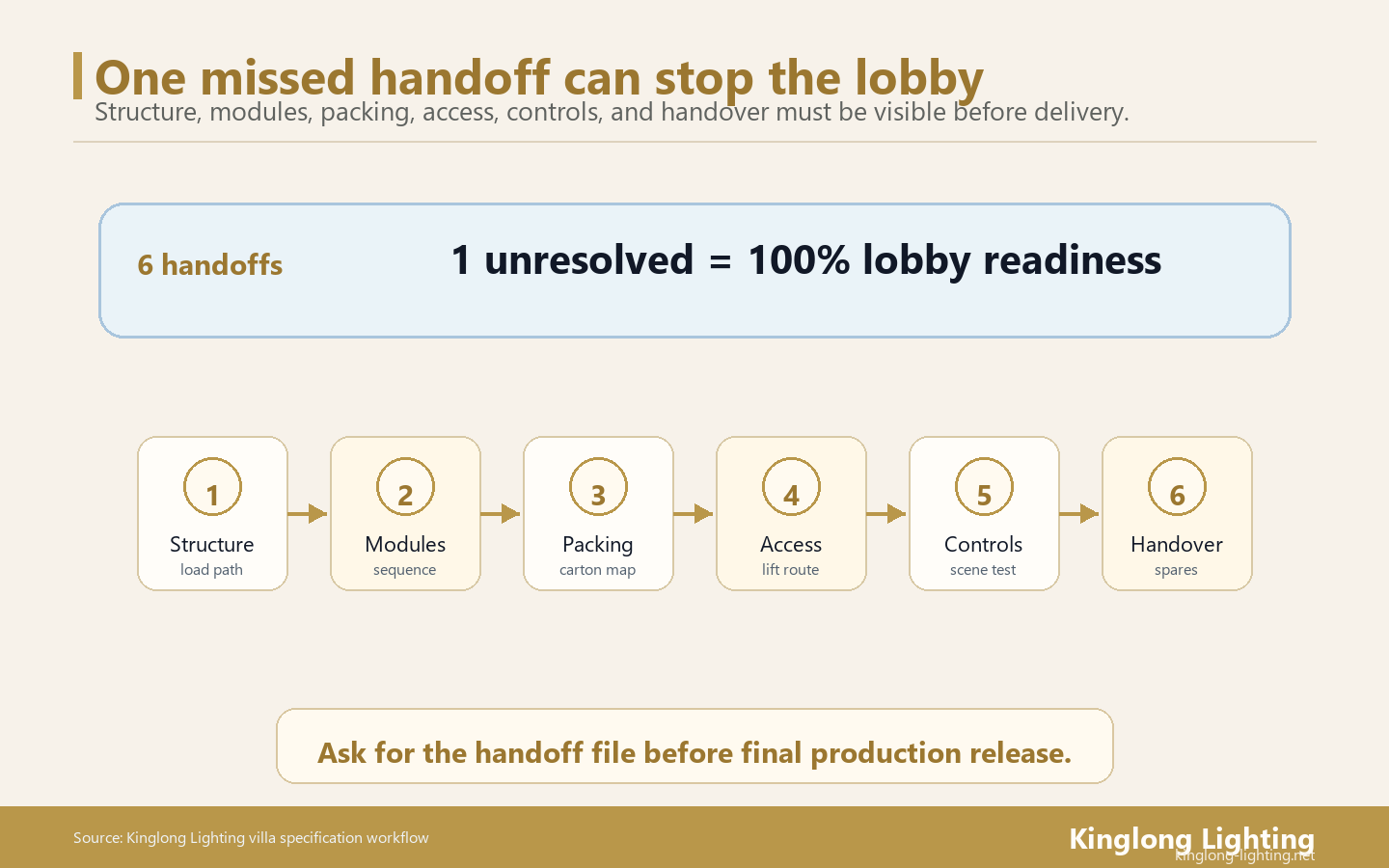
The installation file has six critical handoffs
| Handoff | Owner of evidence | What must be confirmed | Failure if skipped |
|---|---|---|---|
| Structure | Designer, contractor, supplier | Load path, fixing points, tolerances | Late ceiling redesign or unsafe improvisation |
| Modules | Supplier | Numbering, sequence, alignment logic | Slow assembly and finish damage |
| Packing | Supplier and logistics team | Carton map, protection, spare parts | Missing parts or site handling damage |
| Access | Contractor and operator | Scaffold, lift, cleaning, service route | Disruption after opening |
| Power and controls | MEP team and supplier | Driver location, dimming, scene behavior | Flicker, noise, or unresolved scenes |
| Handover | Supplier and hotel engineering | Manual, spares, replacement codes | Future maintenance becomes guesswork |
The table shows why installation is not a single trade task. Each handoff protects a different kind of risk, and the risks compound when ownership is unclear.
A missed handoff can dominate the project schedule
Calculated from a 6-handoff installation file: 1 unresolved handoff / 6 required handoffs = 16.7 percent of the file open, but one unresolved access or control handoff can delay 100 percent of lobby readiness. The math is deliberately simple because installation risk is not averaged. A single missing lifting route, driver access rule, or carton map can hold the entire visible centerpiece.
Based on this installation scenario, the buyer should request the handoff file before final production release. The file should include shop drawings, suspension assumptions, module map, packing map, installation sequence, power and driver notes, scene test expectations, spare list, and maintenance route. It should also name which decisions belong to site contractor, supplier, operator, and designer.
How Kinglong Lighting can reduce site improvisation
Kinglong Lighting’s value in a large hotel installation is the ability to connect custom manufacturing with site-ready documentation. The customization page supports the bespoke design and production handoff, while the projects page gives public context for large hospitality references. The important buyer question is not only whether the factory can make the chandelier. It is whether the factory can make the installation predictable.
A factory-led installation file should label modules, explain assembly order, note special tools, identify fragile parts, separate contractor-owned tasks, and prepare the operator for maintenance. The supplier should also flag assumptions that must be confirmed on site. That honesty protects the project because hidden assumptions become visible before the lobby is blocked by scaffolding.
Installation review before deposit
Before deposit, ask for an installation review that covers ceiling information, fixture weight, module strategy, carton map, lifting method, scaffold assumptions, power and driver plan, control test expectations, cleaning route, and spare parts. The review should state what is confirmed, what is assumed, and what must be checked by the local contractor. A large chandelier should never arrive with its installation logic hidden in scattered emails.
If your project is approaching mock-up or final specification, send Kinglong Lighting the drawings, ceiling section, room height, delivery route, target finish, control system, and installation deadline through the large chandelier installation review. Ask the team to separate factory tasks from site tasks before production release.
Related Guides
- Sheraton Grand Hotel Lobby Lighting: Scale and Material Choices
- Hotel Chandelier Mock-Up Process
- Hotel Lighting Glossary for Specifiers
Build the Sheraton Grand Changsha lobby installation breakdown before final approval
The useful starting point for large hotel chandelier installation case is application context rather than decorative preference. The practical question is whether hotel developer, designer, procurement lead, installer, and custom manufacturer can agree on what must be proven before the chandelier is released. The answer is a short packet that turns design intent, operating risk, evidence, and responsibility into one approval conversation.
The main risk is a case-study chandelier being admired visually without extracting lessons about scale, installation sequence, material proof, and site coordination. That risk is strongest when a beautiful fixture is separated from the evidence that makes it buildable, maintainable, and safe to release. Calculated from a 5-gate review, 2 unresolved gates out of 5 leave about 40 percent of the approval logic open, which is too much uncertainty for a custom decorative lighting order.
Read the case as a coordination lesson
The first approval question should define the practical buying decision behind large hotel chandelier installation case. The decision is not whether a chandelier looks premium in isolation; it is whether the selected approach protects the room role, guest or owner experience, operating reality, and production handoff at the same time. The release note should name the decision owner, the proof expected, and the change that would force a redesign. That boundary lets the buyer reject a tempting option for a specific reason instead of relying on taste language.
Separate visible scale from hidden installation sequence
The first failure point usually appears where the visual promise meets daily use. Calculated from the 5-gate Sheraton Grand Changsha lobby installation breakdown, 1 weak gate times 3 downstream teams equals 3 review paths that can be delayed by one missed proof item. The review should include the view or operating condition that would be most expensive to fix later. Scene behavior and context should be tested before the fixture is treated as release-ready.
Use material rhythm to explain the lobby volume
Supplier evidence is useful only when it matches the risk being controlled. The request should convert that risk into proof such as case observation, room-volume interpretation, module and access logic, finish note, and supplier handoff lesson. If the risk is scale, request a marked elevation and sightline view. If the risk is color, request a material sample under the target scene. If the risk is maintenance, request the cleaning route and spare-part logic. Evidence should change the release decision, not decorate the file.
Translate case evidence into future RFQ questions
Kinglong Lighting’s project workflow moves custom hospitality and villa chandeliers through drawings, samples, manufacturing, packing, shipping, and site installation. The final handoff should state what is approved, what remains flexible, and who can reject a change. In practice, the release packet should include at least 5 named gates and one owner for each gate. That keeps a later suggestion from turning into a redesign after the fixture has already entered production.
Set the final approval boundary for the Sheraton Grand Changsha lobby installation breakdown
The final approval boundary is the point where large hotel chandelier installation case stops being an open design conversation and becomes a controlled production decision. That boundary should be written before the purchase order is released, because it protects the buyer from late changes that look small in a meeting but affect drawings, samples, packing, controls, site access, or maintenance.
Name the decisions that can still move
Some decisions can remain flexible without creating serious risk. Calculated from the 5-gate approval file, 5 total gates minus 2 high-risk gates equals 3 lower-risk gates that can usually absorb controlled refinement. For the Sheraton Grand Changsha lobby installation breakdown, that flexibility should stay away from weight, module size, safety evidence, site access, and the approved sample range. When flexibility is explicit, Kinglong Lighting and the project team can respond to design feedback without reopening the full release packet.
Name the decisions that must be frozen
Frozen decisions should be the items that connect the visual promise to manufacturing and site work. In the Sheraton Grand Changsha lobby installation breakdown, freeze the evidence most tied to a case-study chandelier being admired visually without extracting lessons about scale, installation sequence, material proof, and site coordination: case observation, room-volume interpretation, module and access logic, finish note, and supplier handoff lesson. If one of those proof items changes, the change should trigger a formal review rather than a quick email approval. The goal is not to block design refinement; it is to keep the specific release risk from bypassing the evidence that makes the project buildable.
Frequently Asked Questions
Is Sheraton Grand Changsha an official endorsement of Kinglong Lighting?
No, public project references should not be treated as an official Sheraton or Marriott endorsement. They can provide public context for project scale and application type, while actual claims should stay limited to Kinglong’s published materials and approved project documentation. Brand names should be used carefully and factually.
What makes a large hotel chandelier installation difficult?
The difficulty comes from coordination across structure, module sequence, logistics, power, dimming, access, and hotel operations. The fixture is visible, but many risks are hidden above the ceiling or inside the delivery plan. Missing ownership over one handoff can delay the entire lobby centerpiece.
When should installation planning begin?
Installation planning should begin before deposit or final production release. The project team should confirm ceiling support, site access, module size, lifting method, driver location, control assumptions, cleaning route, and spare parts early enough to change the design if needed. Waiting until delivery makes every correction slower.
What should a supplier include in the handover file?
The handover file should include drawings, module map, packing list, installation sequence, driver and control notes, spare parts, cleaning method, replacement part codes, and maintenance access rules. The file should be clear enough for a hotel engineering team to understand the chandelier after the installation crew has left.