Sample Approval for Hotel Lighting: Closing the Production-vs-Mock-Up Gap is a project-control topic before it is a decorative lighting topic. The buyer is not only choosing a chandelier, sconce, or decorative lighting package. The buyer is deciding how design intent, supplier proof, site constraints, production sequence, and final acceptance will stay aligned.
The common failure is to treat hotel lighting sample approval as a document or meeting that can be cleaned up late. By then, the ceiling interface, samples, control scenes, packaging, shipping terms, and installation responsibilities may already point in different directions.
Kinglong Lighting approaches this kind of article from the manufacturer’s side of the table. A useful lighting supplier should help the project team turn preferences into evidence, evidence into release gates, and release gates into a handover file the hotel can actually operate.
Key Takeaways
- Proof beats preference: every key decision should name the evidence needed before release.
- The supplier file must be useful on site: drawings, samples, labels, and access notes should reduce installation questions.
- Local review still matters: factory information supports local professionals but does not replace them.
- Acceptance should be defined early: final quality cannot be judged only by whether the fixture turns on.
- Soft CTA belongs before FAQ: buyers should know what to send when they ask Kinglong Lighting for help.
The approved sample must become production language
A hotel lighting mock-up is useful only when the factory can repeat what the designer approved.
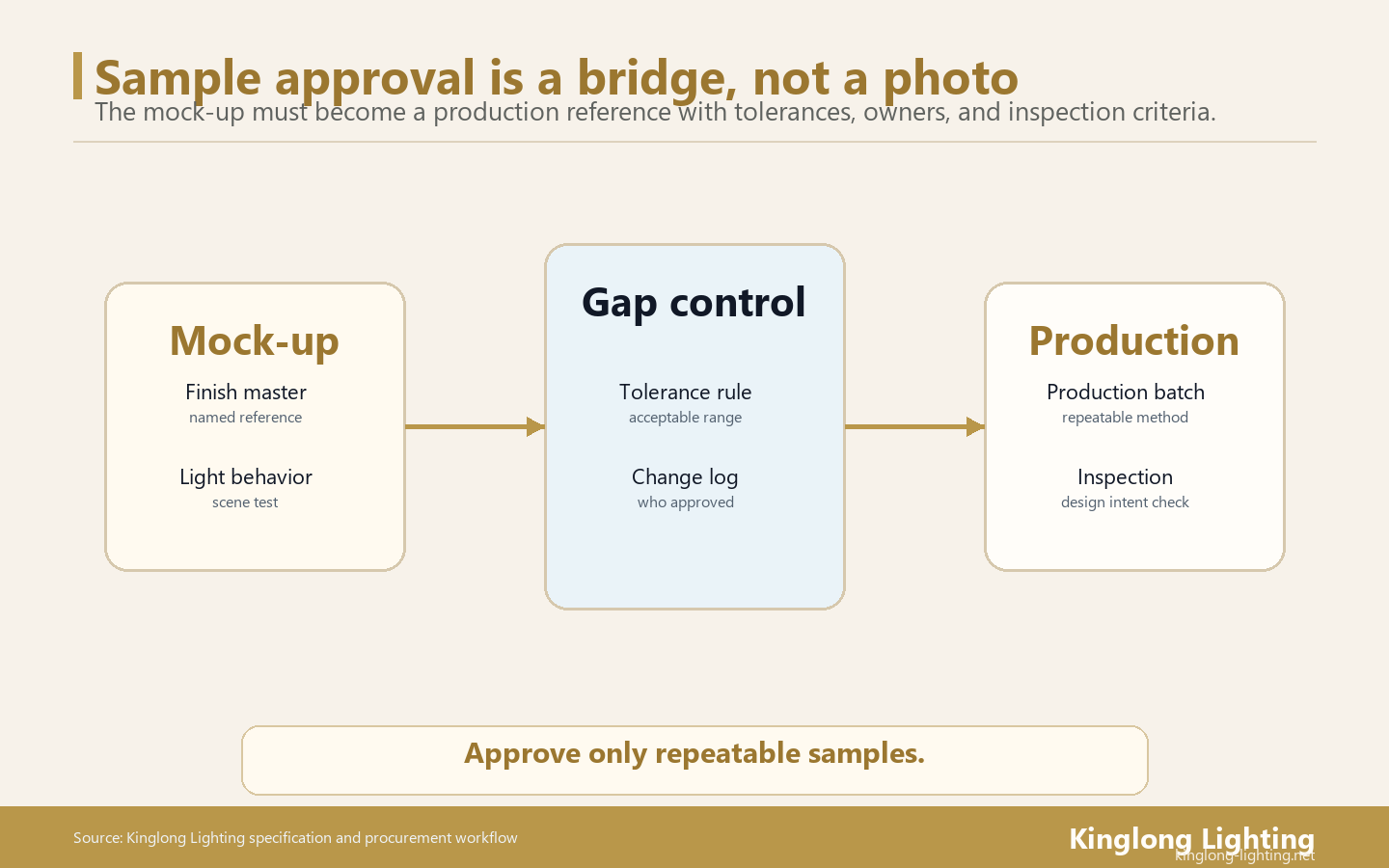
Sample approval often feels like the aesthetic moment in hotel lighting procurement. It is actually a translation moment. The team must convert a finish, glass tone, crystal density, light behavior, module seam, or assembly detail into a reference that production can repeat and inspectors can judge.
The DOE TM-30 FAQ is useful because color quality needs a richer vocabulary than warm/cool or CRI alone when materials matter. For hotel designers, procurement directors, and suppliers closing sample approval before production, that turns the discussion into a master sample file with tolerances and production inspection criteria instead of a preference argument.
Start by naming the sample purpose
A sample should answer a risk, not simply create excitement.
The UL 1598 standard page is useful because decorative chandeliers remain luminaires that need product and installation evidence. For hotel designers, procurement directors, and suppliers closing sample approval before production, that turns the discussion into a sample purpose tied to finish, color, light behavior, or module detail instead of a preference argument.
Color quality needs a precise question
Sample purpose becomes important when the team approves warm light without checking how materials shift under it. The project team should not treat this as a late coordination detail, because the choice changes cost, sequence, drawing responsibility, and the evidence a buyer can reasonably approve. If the issue is left open, the supplier may quote an attractive fixture while the building team silently carries an unresolved constraint.
The practical answer is to name CCT, color quality, dimming level, and material viewing condition before release. That proof gives the owner a decision rule: approve the sample only under the light condition the hotel will use. It also keeps Kinglong Lighting’s role honest. The factory can provide drawings, samples, product information, packing logic, and manufacturing options, while local professionals still confirm the building, code, and site-specific safety requirements.
A sample without a decision is theatre
Sample discipline becomes important when teams request beautiful mock-ups but never name the approval risk. The project team should not treat this as a late coordination detail, because the choice changes cost, sequence, drawing responsibility, and the evidence a buyer can reasonably approve. If the issue is left open, the supplier may quote an attractive fixture while the building team silently carries an unresolved constraint.
The practical answer is to name a sample question and accept/revise/hold rule before release. That proof gives the owner a decision rule: use each sample to close a specific gap before production. It also keeps Kinglong Lighting’s role honest. The factory can provide drawings, samples, product information, packing logic, and manufacturing options, while local professionals still confirm the building, code, and site-specific safety requirements.
Turn the approved piece into a master reference
The mock-up must become the reference production can follow.
The WBDG building commissioning page is useful because commissioning turns design intent into verified operation and handover evidence. For hotel designers, procurement directors, and suppliers closing sample approval before production, that turns the discussion into master sample ID, photos, material notes, and fixture evidence instead of a preference argument.
One master should outrank all old photos
Master sample becomes important when the designer, owner, and factory remember different versions of the approved sample. The project team should not treat this as a late coordination detail, because the choice changes cost, sequence, drawing responsibility, and the evidence a buyer can reasonably approve. If the issue is left open, the supplier may quote an attractive fixture while the building team silently carries an unresolved constraint.
The practical answer is to name one named master with date, owner, photos, and storage location before release. That proof gives the owner a decision rule: reject production if it follows an obsolete sample. It also keeps Kinglong Lighting’s role honest. The factory can provide drawings, samples, product information, packing logic, and manufacturing options, while local professionals still confirm the building, code, and site-specific safety requirements.
Tolerance protects craft without hiding drift
Tolerance rule becomes important when handmade glass or finish variation becomes an excuse for inconsistency. The project team should not treat this as a late coordination detail, because the choice changes cost, sequence, drawing responsibility, and the evidence a buyer can reasonably approve. If the issue is left open, the supplier may quote an attractive fixture while the building team silently carries an unresolved constraint.
The practical answer is to name acceptable range for color, texture, alignment, and finish before release. That proof gives the owner a decision rule: allow natural variation while rejecting drift that changes the design intent. It also keeps Kinglong Lighting’s role honest. The factory can provide drawings, samples, product information, packing logic, and manufacturing options, while local professionals still confirm the building, code, and site-specific safety requirements.
Link sample approval to commissioning
The approved sample should still matter after installation.
The ICC Incoterms 2020 page is useful because international delivery responsibility should be named before production and shipment. For hotel designers, procurement directors, and suppliers closing sample approval before production, that turns the discussion into commissioning checks tied to approved sample criteria instead of a preference argument.
Inspection should judge design intent
Inspection criteria becomes important when factory inspection only checks quantity and damage. The project team should not treat this as a late coordination detail, because the choice changes cost, sequence, drawing responsibility, and the evidence a buyer can reasonably approve. If the issue is left open, the supplier may quote an attractive fixture while the building team silently carries an unresolved constraint.
The practical answer is to name finish continuity, glass variation, alignment, light behavior, and sample match before release. That proof gives the owner a decision rule: inspect the object the designer approved, not only the carton count. It also keeps Kinglong Lighting’s role honest. The factory can provide drawings, samples, product information, packing logic, and manufacturing options, while local professionals still confirm the building, code, and site-specific safety requirements.
Handover should keep the sample record
Handover record becomes important when the sample file disappears after production release. The project team should not treat this as a late coordination detail, because the choice changes cost, sequence, drawing responsibility, and the evidence a buyer can reasonably approve. If the issue is left open, the supplier may quote an attractive fixture while the building team silently carries an unresolved constraint.
The practical answer is to name sample photos, acceptance notes, and maintenance implications before release. That proof gives the owner a decision rule: let the hotel compare future replacements to the approved reference. It also keeps Kinglong Lighting’s role honest. The factory can provide drawings, samples, product information, packing logic, and manufacturing options, while local professionals still confirm the building, code, and site-specific safety requirements.
Do not ignore logistics after approval
A sample can be correct and still fail if production packing and shipping damage the repeated result.
The DOE lighting design page is useful because lighting should be planned around whole-space quality, efficiency, and use rather than fixture appearance alone. For hotel designers, procurement directors, and suppliers closing sample approval before production, that turns the discussion into delivery terms and protective packing linked to sample fragility instead of a preference argument.
Fragile finishes need packing logic
Packing review becomes important when approved surfaces are vulnerable to rubbing, moisture, pressure, or mixed parts. The project team should not treat this as a late coordination detail, because the choice changes cost, sequence, drawing responsibility, and the evidence a buyer can reasonably approve. If the issue is left open, the supplier may quote an attractive fixture while the building team silently carries an unresolved constraint.
The practical answer is to name packing method, crate sequence, labels, and inspection photos before release. That proof gives the owner a decision rule: ship the approved finish in a way that protects what was approved. It also keeps Kinglong Lighting’s role honest. The factory can provide drawings, samples, product information, packing logic, and manufacturing options, while local professionals still confirm the building, code, and site-specific safety requirements.
Change logs prevent silent substitution
Change control becomes important when production changes a material or process after sample approval to solve cost or lead time. The project team should not treat this as a late coordination detail, because the choice changes cost, sequence, drawing responsibility, and the evidence a buyer can reasonably approve. If the issue is left open, the supplier may quote an attractive fixture while the building team silently carries an unresolved constraint.
The practical answer is to name a change log with approve, revise, or hold decisions before release. That proof gives the owner a decision rule: do not let production efficiency rewrite the approved sample without consent. It also keeps Kinglong Lighting’s role honest. The factory can provide drawings, samples, product information, packing logic, and manufacturing options, while local professionals still confirm the building, code, and site-specific safety requirements.
Use LED and material data together
The sample is where lighting performance and decorative material finally meet.
The DOE LED lighting page is useful because LED performance, efficiency, heat, and service expectations belong in the luminaire decision. For hotel designers, procurement directors, and suppliers closing sample approval before production, that turns the discussion into LED data, dimming level, and material sample under target scene instead of a preference argument.
A finish can pass under the wrong light
Lighting sample becomes important when material approval happens under office light instead of hotel scene light. The project team should not treat this as a late coordination detail, because the choice changes cost, sequence, drawing responsibility, and the evidence a buyer can reasonably approve. If the issue is left open, the supplier may quote an attractive fixture while the building team silently carries an unresolved constraint.
The practical answer is to name target source, dimming level, and viewing distance before release. That proof gives the owner a decision rule: repeat the approval under the scene the guest will experience. It also keeps Kinglong Lighting’s role honest. The factory can provide drawings, samples, product information, packing logic, and manufacturing options, while local professionals still confirm the building, code, and site-specific safety requirements.
Sample approval control table
Use this table as a compact release gate. It is not a legal contract, but it shows which proof should be visible before the next project stage.
| Decision | Risk if vague | Proof to request | Release rule |
|---|---|---|---|
| Purpose | sample does not answer a risk | sample question | accept/revise/hold |
| Master | teams remember different versions | master sample ID | one current reference |
| Tolerance | variation hides drift | acceptable range | define before batch |
| Inspection | quantity replaces design review | sample-match criteria | inspect visible intent |
| Change log | silent substitution | approved revision record | hold unapproved changes |
How Kinglong Lighting supports hotel lighting sample approval
Kinglong Lighting can support hotel lighting sample approval by connecting design intent to factory evidence: drawings, finish samples, driver notes, packing logic, installation assumptions, and handover records. The useful output is a project file that reduces avoidable questions for designers, procurement teams, contractors, and owners.
Kinglong Lighting can connect this work to the hotel lighting solution and the custom chandelier manufacturing workflow. The point is not to turn a technical article into a catalogue page. The point is to give hotel designers, procurement directors, and suppliers closing sample approval before production a practical next step when the project file already shows real risk.
When the issue reaches budget, sample, delivery, or site timing, the safer action is to send the hotel lighting sample approval brief with drawings, destination, room schedule, target finish, control expectation, and the proof items already requested in this article.
Soft next step for sample approval
The next step should be a focused file, not a vague request for price. Buyers get better answers when they send the supplier the same evidence they expect the supplier to return.
- Name the risk each sample must answer.
- Assign one master sample and retire older references.
- Define tolerance for finish, glass, color, and alignment.
- Tie inspection criteria to the approved sample.
- Keep the sample record in the final handover file.
FAQ
What is a hotel lighting master sample?
A master sample is the approved reference that production and inspection must follow. It may be a finish chip, glass piece, crystal module, partial fixture, or complete mock-up, but it should be named, dated, photographed, and controlled.
Can handmade variation be accepted?
Yes, but the acceptable range should be defined. Handmade glass or finish can have natural variation, but the project still needs boundaries so production variation does not become design drift.
Who should approve hotel lighting samples?
The design team, owner representative, procurement team, and supplier should approve the sample together. Each party reviews a different risk: aesthetic intent, room fit, commercial scope, and production repeatability.
What happens after sample approval?
After approval, the supplier should freeze the master reference, update drawings or notes if needed, define inspection criteria, and record any production changes. The sample should remain active through final acceptance.