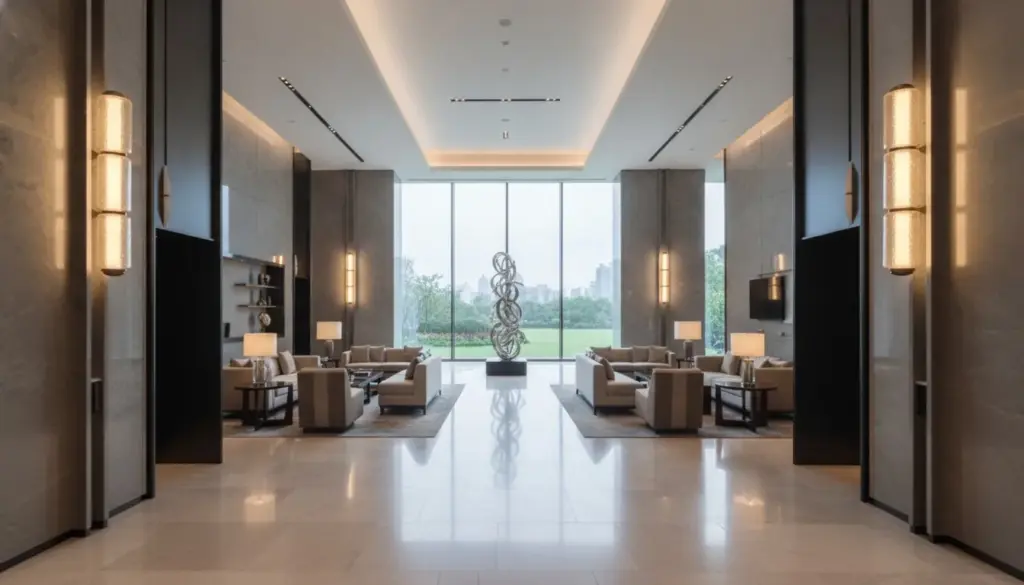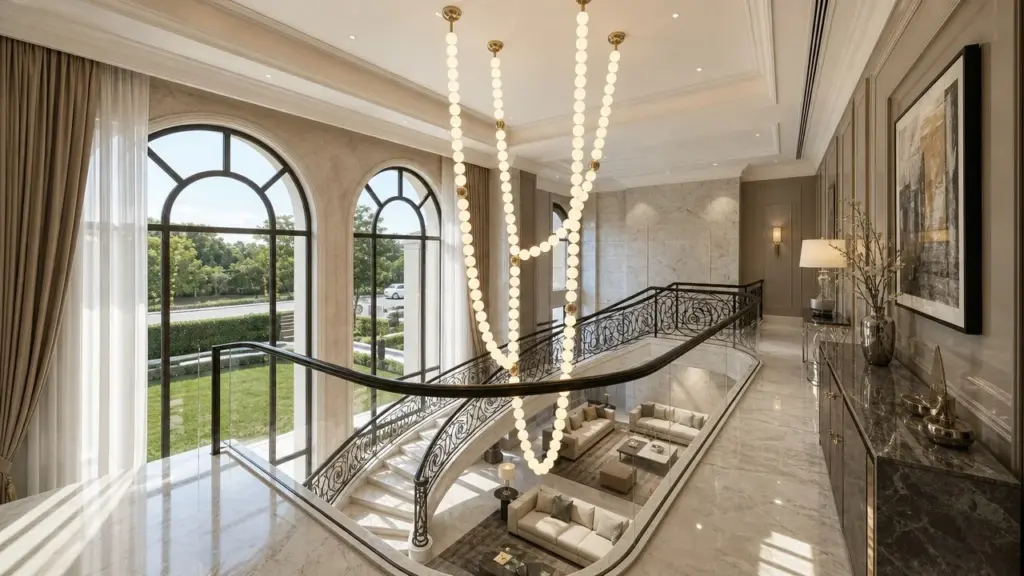
Marriott luxury lighting should not treat The Ritz-Carlton and St. Regis as interchangeable because both are luxury brands but they create different emotional contracts. Ritz-Carlton lighting often needs disciplined warmth, service-led calm, and quietly memorable detail. St. Regis lighting can carry more ritual, glamour, celebration, and classic sparkle. The chandelier file should show which kind of luxury the property is buying.
Public Marriott, Ritz-Carlton, and St. Regis information can support lighting decisions, but it is not an official Marriott lighting standard and does not imply that Marriott, The Ritz-Carlton, or St. Regis endorses Kinglong Lighting. The goal is to help specifiers convert public brand cues into a practical lighting brief for custom chandeliers, public spaces, lounges, ballrooms, and resort features.
Key Takeaways
- Luxury is not one mood: Ritz-Carlton and St. Regis need different lighting emphasis even inside the same parent portfolio.
- Ritz-Carlton cue: Prioritize service culture, refined ease, and details that support calm guest confidence.
- St. Regis cue: Allow more ceremony, sparkle, and ritual when the property story supports it.
- Evidence gate: Both brands still require scale studies, finish masters, color proof, controls, and service access.
- Supplier language: Kinglong Lighting should frame work as public-info-based interpretation and custom manufacturing evidence.
Read public luxury cues before choosing a chandelier language
The Ritz-Carlton and St. Regis can both justify a crystal chandelier, but not for the same reason.
Marriott’s public brand portfolio page places both The Ritz-Carlton and St. Regis in its luxury category. The Ritz-Carlton about page emphasizes service philosophy, legacy, and meaningful journeys. The St. Regis brand site points to exquisite experiences, rituals, butler service, fashion, glamour, and iconic gatherings. Those public cues suggest two different lighting briefs: one centered on controlled excellence, the other on crafted ceremony.
Ritz-Carlton lighting should make excellence feel effortless
For a Ritz-Carlton-style lobby or club lounge, lighting should not shout unless the architecture asks for drama. The stronger move is often proportion, material quality, and calm control. Decorative fixtures can be luxurious, but they should support service flow, seated comfort, privacy, and transition from day to evening. A chandelier that creates visual noise above a concierge moment may be expensive without being helpful.
The mock-up should therefore be judged from service positions as well as guest positions. Concierge eye level, host stand, lounge seating, corridor approach, and elevator arrival can reveal whether the chandelier improves the atmosphere or competes with staff attention. A Ritz-Carlton-style fixture may use crystal or polished metal, but the guest should experience confidence and ease before noticing the fixture mechanics. That is a harder standard than simply approving premium materials.
St. Regis lighting can carry ritual and sparkle
St. Regis public cues give designers more permission for ceremony. Crystal, polished metal, layered reflection, and dramatic arrival moments can fit when they support ritual and refined celebration. The risk is theatrical excess. A St. Regis-style chandelier should still be judged by eye-level comfort, dimming control, maintenance access, and material durability. Glamour needs a production file.
A strong St. Regis-style brief should name the ritual moment the lighting supports. It may be a grand stair arrival, a sabrage moment, an evening lounge transition, or a ballroom pre-function photo point. Once that moment is named, sparkle density, drop length, metal tone, and scene level can be controlled around it. Without that anchor, the chandelier can become a general symbol of luxury rather than a precise hospitality instrument.
Compare the lighting decisions brand by brand
| Decision area | Ritz-Carlton direction | St. Regis direction | Evidence to request |
|---|---|---|---|
| Lobby emotion | Quiet confidence and refined arrival | Ceremonial arrival and classic glamour | Scale render and guest-view sequence |
| Material tone | Elegant restraint, warm metal, fine texture | Crystal tradition, polished detail, richer sparkle | Finish master and material board |
| Club or lounge | Privacy, comfort, and service rhythm | Ritual, evening glow, and social memory | Scene schedule and glare review |
| Ballroom | Timeless formal flexibility | Celebratory identity and photo memory | Dimming channels and maintenance route |
| Supplier proof | Consistency and operational reliability | Craft detail and repeatable glamour | Mock-up, BOM, packing, and QC notes |
The conclusion is that both brands may use similar materials, but the approval criteria change. Ritz-Carlton should ask whether the fixture improves the service experience. St. Regis should ask whether the fixture supports ritual without becoming fragile or over-bright.
Luxury brand lighting still needs technical humility
The IES Lighting Library reminds specifiers that lighting decisions touch application, controls, maintenance, and design guidance. The DOE TM-30 FAQ shows why color quality deserves more precision than a single casual label. The WELL v2 Light concept reinforces the role of visual comfort and human experience. These sources matter because luxury guests may not name glare, poor dimming, or weak color rendition, but they feel the result.
Calculated from a 6-part luxury lighting file: 2 brand-emotion choices plus 4 evidence checks equals 6 decisions before production release. If a proposal only defines the brand emotion and skips the 4 checks, 66.7 percent of the file remains unresolved. That is not a design critique. It is a procurement warning.
Supplier conduct and release control are part of luxury
Marriott’s Global Procurement Supplier Conduct Guidelines provide public context for supplier expectations. For chandelier procurement, supplier conduct should translate into traceable documents: factory capability, material route, product testing path, sample approval, change control, packing plan, and site support assumptions. A luxury chandelier that lacks evidence can create luxury risk.
The hidden cost is late interpretation. If the designer says “Ritz-Carlton quiet luxury” and the supplier builds “St. Regis sparkle,” the project may not discover the mismatch until mock-up. If the brief states eye-level comfort, finish tone, sparkle density, dimming scene, and service access, the supplier can shape the design before expensive rework begins.
For procurement, the safest comparison format is a two-column release sheet. The left column captures the intended brand behavior: service-led calm, ritual-led glamour, private lounge comfort, or ballroom ceremony. The right column captures proof: sample, drawing, test route, control scene, finish master, weight note, cleaning access, and packing plan. If a supplier submits strong visuals but weak proof, the buyer can ask for named documents instead of reopening the whole design debate.
How Kinglong Lighting can present Marriott luxury options
Kinglong Lighting should not claim official Marriott brand authority unless authorized. The stronger path is to present public-info-based design routes with manufacturing evidence. For a Ritz-Carlton-style route, Kinglong Lighting can show restrained material studies, warm scenes, and maintenance-friendly custom details. For a St. Regis-style route, it can show crystal tradition, richer reflectance, ceremonial scale, and controlled dimming.
The customization workflow, hospitality lighting page, and project references can support this discussion. The soft next step is to send Kinglong Lighting a brief with the brand context, guest journey, public-area function, finish palette, control narrative, ceiling constraints, and opening schedule through the contact page. Ask for two side-by-side concepts: service-led refinement and ritual-led glamour, each with the same evidence checklist.
This side-by-side format is especially useful when owners, designers, and operators disagree on how formal the space should feel. The team can compare not only appearance but also cleaning burden, scene flexibility, replacement complexity, and installation risk. A concept that looks more dramatic may still be the right choice if it brings strong brand memory and manageable evidence. A quieter concept may win when the service flow and long-term operations matter more than the first photograph.
Kinglong Lighting can also prepare a value-engineering note for each route. On a Ritz-Carlton-style concept, value engineering may protect proportions and finish while simplifying hidden structure. On a St. Regis-style concept, it may protect sparkle and ritual while reducing fragile density. That makes cost discussion more precise than simply asking for a lower price.
The note should state what the guest will still perceive after the change. If the change saves cost but removes the service-led calm or ritual cue, it is not value engineering. It is brand dilution that will surface during mock-up approval.
Related Guides
Marriott Luxury Lighting Action Card
- State whether the design direction is closer to Ritz-Carlton restraint or St. Regis ceremony.
- Translate brand emotion into sparkle density, finish tone, CCT, scenes, and guest-view comfort.
- Request mock-ups and material samples before approving production drawings.
- Keep supplier conduct, testing, and change-control evidence inside the chandelier file.
- Send the side-by-side brand route request to Kinglong Lighting.
A Marriott luxury distinction file should protect emotion and evidence together
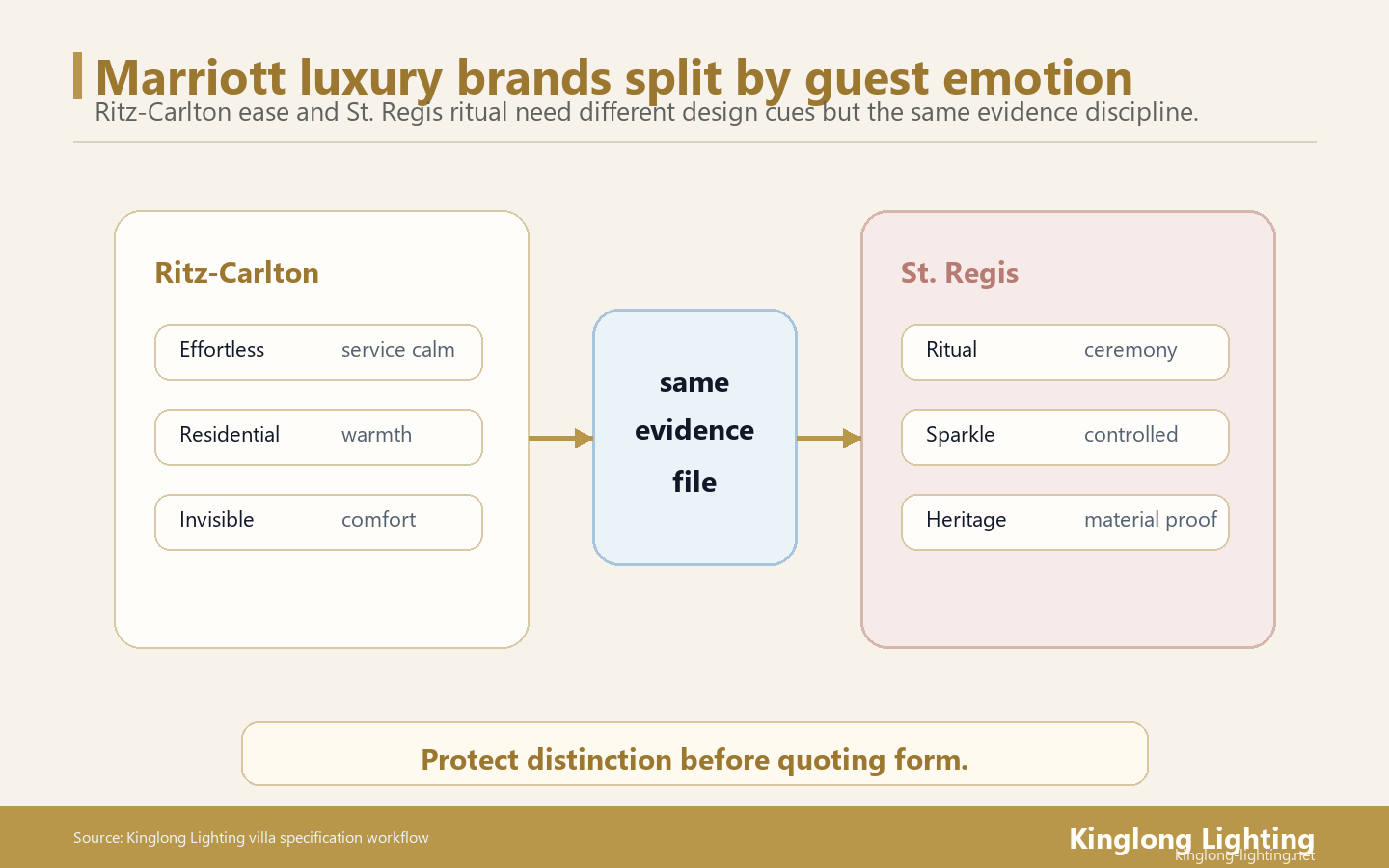
Ritz-Carlton and St. Regis can both sit inside luxury hospitality, but they do not need the same chandelier language. Ritz-Carlton cues may lean toward effortless excellence, residential warmth, quiet service, and invisible comfort. St. Regis cues may allow more ritual, ceremony, heritage, sparkle, and arrival memory. The useful comparison is not which one is more luxurious. It is which guest emotion the project needs and what evidence proves that emotion can be built, installed, and maintained.
Protect distinction before quoting form
A supplier should not be asked to quote a generic luxury chandelier and then make it feel like a brand later. The distinction should appear in the brief before form, finish, and size are priced. If the route is Ritz-Carlton-like, the file may prioritize quiet warmth, refined proportion, low visual friction, and service confidence. If the route is St. Regis-like, the file may prioritize ceremonial sparkle, heritage material, stronger rhythm, and scene choreography. Both routes need evidence, but the evidence supports different emotional outcomes.
Translate ritual and ease into material checks
Material decisions carry much of the distinction. A metal tone, glass clarity, crystal density, shade texture, or warm scene can move a design toward relaxed excellence or ceremonial drama. The packet should show material samples under the proposed source, not just in daylight or studio light. It should also show which details are allowed to be expressive and which must remain controlled for comfort, cleaning, and repeatability.
Avoid unsupported claims about proprietary standards
Public brand context can guide an article and an early design conversation, but project standards belong to the owner and brand process. The release file should avoid claiming access to proprietary standards unless the project team supplies them. A more useful approach is to state the public interpretation, list the open questions, and request the official project criteria before locking production. That keeps the supplier response honest and protects the buyer from overconfident assumptions.
Use finish proof to keep luxury from becoming generic
Luxury can become generic when the evidence file only says premium material, warm light, or elegant chandelier. The finish proof should name the exact sample, acceptable range, scene condition, cleaning expectation, and owner who can approve variation. Kinglong Lighting can then connect design intent to drawings, samples, production notes, packing logic, and service support. That makes the distinction between Ritz-Carlton ease and St. Regis ritual visible in the file, not just in the mood board.
The final approval should freeze the evidence that protects the selected brand emotion while leaving controlled room for refinement. That is how a luxury chandelier stays specific after pricing, sampling, and production pressure begin.
Give procurement a reason to protect the distinction
Procurement pressure can push both directions toward the safest-looking middle. The distinction file gives procurement a reason to resist that drift. If Ritz-Carlton ease is the chosen route, the file explains why visual calm, finish control, and quiet service matter. If St. Regis ritual is the chosen route, the file explains why ceremony, sparkle control, and heritage material deserve different proof. The buyer can then defend value with evidence instead of brand adjectives.
Connect the final sample to the operating promise
The final sample should answer how the fixture will behave after opening: how it dims, how it cleans, how visible parts age, how spares are labeled, and how a replacement part will match the approved finish. Those operating details are where luxury either remains specific or becomes generic. Kinglong Lighting can make the sample review stronger by pairing beauty with the maintenance and production facts that keep beauty stable.
Frequently Asked Questions
Are Ritz-Carlton and St. Regis lighting standards publicly available?
Public brand pages provide useful positioning, but project-specific standards should come from the owner, designer, or authorized brand team.
How should a Ritz-Carlton chandelier differ from a St. Regis chandelier?
A Ritz-Carlton-style chandelier often leans toward restrained service-led refinement. A St. Regis-style chandelier can lean toward ceremony, sparkle, ritual, and classic glamour.
Can Kinglong Lighting use Marriott brand names in proposals?
Brand names can be referenced carefully as public project context, but suppliers should avoid implying endorsement or official approval unless authorized.