A Made in Italy chandelier premium is not automatically waste, and it is not automatically proof. It is a price signal that mixes origin story, design authorship, brand confidence, showroom channel cost, finishing culture, and sometimes genuine project risk reduction.
The useful buyer question is therefore not whether Italian luxury is “worth it” in the abstract. The useful question is which part of the premium buys value your project actually needs, and which part can be replaced by comparable design discipline, manufacturing proof, testing, service planning, and transparent scope.
Kinglong Lighting approaches this comparison from the factory side: keep the design boundary clean, avoid copying named luxury work, then translate the desired guest or homeowner impression into drawings, samples, finish masters, test evidence, packing logic, and installation support.
Key Takeaways
- The premium is mixed: country origin, design authorship, brand trust, sales channel, and project proof can all sit inside the price gap.
- 60-70% is a diagnostic range: use it to audit the visible premium after material, finish, testing, packing, and logistics are normalized.
- Origin is not performance: a country label does not replace luminaire evidence, sample proof, or site coordination.
- Do not copy: value engineering should translate intent and constraints, not reproduce a protected Italian design.
- Spend savings on proof: mock-ups, finish control, spare parts, access planning, and aftercare often protect more value than another label.
Start by separating origin, authorship, and fabrication
A country-of-origin premium should be decoded before it is rejected or accepted.
The European Commission page on non-preferential rules of origin is a useful starting point because it shows that origin is a customs and trade concept. It does not tell a villa owner whether a chandelier’s finish will age well, whether its suspension points fit the ceiling, or whether the installation package is ready.
The OECD trade policy brief on global value chains adds the second layer: many products now involve cross-border services, components, raw materials, and expertise. A chandelier may carry an origin story while still depending on global glass, electronics, logistics, testing, or installation partners.
For buyers, the practical lesson is not cynicism. It is discipline. Treat origin as one value layer, then ask what else is included. Is the premium paying for an original design studio? A limited production channel? A showroom relationship? A brand promise? A local installer network? A documented manufacturing process? These are different kinds of value, and they should not be judged with the same question.
Origin can support trust, but it does not close the technical file
A Made in Italy label may tell a buyer something about the product’s identity, legal origin, or market positioning. It does not automatically prove electrical construction, driver compatibility, finish tolerance, ceiling load path, spare part availability, or cleaning method. Those details still need documents, samples, and project-specific review.
That boundary matters when a homeowner compares an imported luxury chandelier with a value-engineered custom alternative. The origin story can be meaningful, but the ceiling still needs a canopy detail, the installer still needs a lifting route, and the owner still needs a future service plan. If the technical file is thin, a strong origin story can hide unresolved risk.
Design authorship can be real value when it reduces indecision
The WIPO explanation of intangible assets is helpful because it recognizes that ideas, reputation, designs, and brands can carry value even when they are not physical materials. In luxury lighting, design authorship may shorten a buyer’s emotional decision, protect the identity of an interior, and give the project a recognized point of view.
That value is real when the project needs it. A flagship villa, boutique hospitality property, or branded residence may benefit from an object whose design story is part of the owner’s social and aesthetic intent. The mistake is to treat design authorship as proof of every operational detail. A signature can answer “why this object,” but it still cannot answer “how will this object survive this room.”
Fabrication quality should be verified without romance
The DOE lighting design page helps frame lighting as a quality and efficiency discipline rather than a label contest. A chandelier in a double-height foyer, dining room, staircase, coastal villa, or penthouse renovation has different glare, scale, control, and maintenance requirements. Comparable quality must therefore be checked against the room, not against a country stereotype.
For manufacturing comparison, ask for the same evidence on both sides: material grade, glass or crystal clarity, metal finish standard, driver and lamp specification, dimming expectation, suspension method, packing plan, installation manual, spare part policy, and service boundary. Once the buyer normalizes those items, the remaining premium becomes easier to interpret.
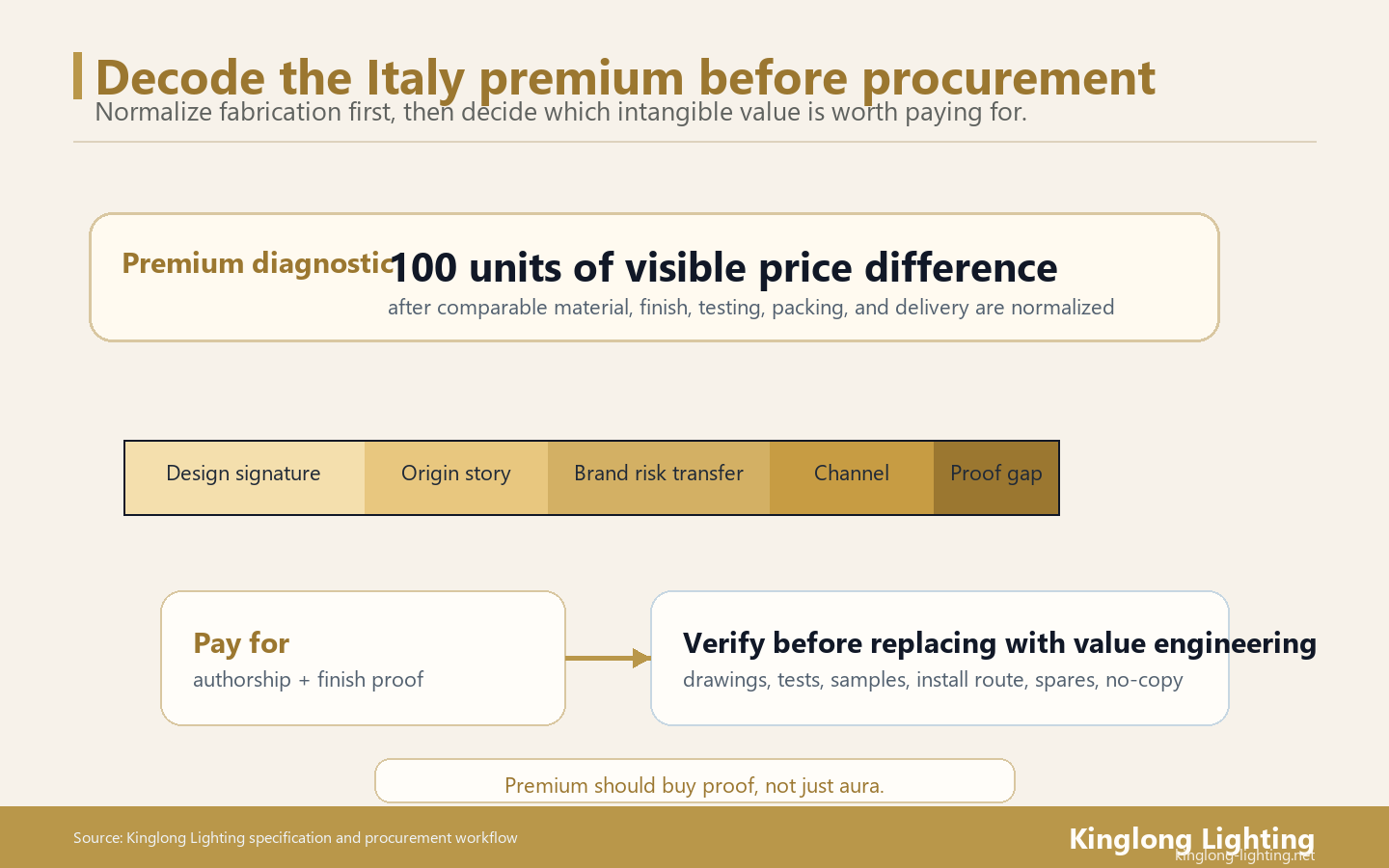
Use the 60-70% number as a diagnostic range rather than a universal statistic. In a project comparison, if two quotes become similar after comparable fabrication inputs are normalized, much of the remaining visible gap may sit in design authorship, brand reputation, origin confidence, showroom margin, and perceived risk transfer. That may be worth paying for, but it should be chosen consciously.
What the 60-70% premium can contain
A clean premium audit starts after the obvious cost drivers are aligned. Compare similar scale, similar material complexity, similar light source quality, similar finish proof, similar packing requirement, similar freight route, and similar installation support. If one quote includes engineering drawings, finish samples, and spares while another includes only a product photo, the comparison is not normalized.
| Premium layer | Legitimate value | Buyer proof to request | When to pay for it |
|---|---|---|---|
| Original authorship | a protected design point of view | design ownership and authorized channel | when identity is central to the room |
| Origin story | market trust and luxury association | clear origin documentation | when resale, branding, or owner preference matters |
| Brand risk transfer | confidence that issues will be handled | warranty, service, spare part policy | when the buyer values recognized accountability |
| Showroom channel | curation, display, local support | scope of advice and after-sales role | when local consultation is part of the purchase |
| Manufacturing proof | documented performance and consistency | drawings, samples, testing, packing file | always, regardless of origin |
The premium is weakest when it only sells atmosphere
A mood image can justify desire, but it cannot justify a large custom order by itself. If the premium depends only on words such as iconic, artisanal, European, or museum-like, the buyer should slow down. The project still needs a measured chandelier diameter, drop, weight, electrical scope, finish tolerance, site route, cleaning method, and damage responsibility.
This is where many villa and boutique hotel buyers overpay without noticing. They do not overpay because the object is beautiful. They overpay because beauty is used as a substitute for documents that should have been in the release package. A premium that includes proof is different from a premium that hides the lack of proof.
The premium is strongest when it protects identity and accountability
Some luxury interiors genuinely need a named design source, a recognized design culture, or a carefully controlled distribution channel. A private villa owner may want the social meaning of a specific Italian object. A developer may need a brand story for a show residence. A designer may want a known form language because it supports the whole interior concept.
When that is the case, the buyer should not pretend the decision is only about kilograms of glass and metal. The better approach is to separate the intangible purchase from the project proof. Pay for authorship if the project needs authorship. Still demand drawings, testing boundaries, packing, installation coordination, and aftercare.
How value engineering should work without copying Italian design
Value engineering in decorative lighting should never mean asking a factory to reproduce a protected luxury design. That creates legal, ethical, and brand risk, and it usually produces a weaker object because the team is chasing a surface resemblance rather than solving the room.
The right brief names the emotional and spatial intent instead: calm arrival, floating sparkle, warm stone reflection, sculptural dining focus, low-glare stair volume, or restrained coastal luxury. From there, Kinglong Lighting can use its OEM/ODM customization workflow to develop a distinct fixture around scale, material, finish, assembly, and service requirements.
Translate intent, not the outline of a named product
A good value-engineered brief might say: “The room needs a suspended warm-glass centerpiece with soft vertical movement and easy cleaning access.” It should not say: “Make this famous Italian chandelier cheaper.” The first instruction gives the manufacturer room to solve the project. The second instruction traps everyone in imitation and weakens the buyer’s design position.
The Mofun Design Platform can help test scale, drop, cluster density, and visual mass before physical sampling. That is where many premium decisions should move: not into copying a reference, but into proving whether the room can carry the intended chandelier language.
Use savings to buy mock-up discipline
If a buyer decides not to pay the full Italian premium, the saved budget should not vanish into a thinner specification. Put part of it into finish samples, control testing, mock-up review, spare crystal or glass, packing protection, and installation planning. Those are the items that prevent a cost-efficient fixture from feeling like a compromise after installation.
The UL 1598 standard page is a reminder that luminaires still belong to a technical product category. The buyer does not need to become a lab engineer, but the buyer should ask what product evidence exists for the destination market and how the electrical and mechanical scope will be handled.
Compare the total room outcome, not only the object price
A low object price can become expensive if it creates rework, site delay, fragile cleaning, mismatched finish, or owner dissatisfaction. A high object price can be reasonable if it includes design certainty, service, and genuine accountability. The comparison should include total room outcome: procurement time, design confidence, ceiling changes, installation support, future maintenance, and the cost of being wrong.
Kinglong Lighting’s hospitality and luxury project references are useful in this context because they show how decorative lighting has to move from concept to site reality. The premium question is not only “who made it.” It is also “who can carry the project from idea to functioning fixture.”
Practical premium audit for owners and designers
Before accepting or rejecting a Made in Italy premium, create a one-page audit. Put the premium into five buckets: authorship, origin, brand confidence, channel/service, and proof. Then attach evidence to each bucket. If a bucket has no evidence, it may still be desire, but it should not be treated as risk reduction.
Step 1: Normalize the specification
Align size, material, finish, light source, driver, control intent, suspension, packaging, delivery term, and installation support. If one quote includes drawings and one quote excludes them, adjust the comparison. If one quote includes spares and one does not, adjust again. A premium cannot be decoded until the base specification is comparable.
Step 2: Name the non-material value
Write down what the premium is supposed to buy beyond the physical object. It might be originality, design reputation, local showroom support, lower owner anxiety, brand prestige, or a documented service promise. Naming that value makes the decision more honest. Some buyers will still choose it. Others will decide that a custom alternative with strong proof is more useful.
Step 3: Decide what cannot be compromised
Every project has a few non-negotiables. For a villa foyer, it may be scale, glare control, finish warmth, and cleaning access. For a branded residence, it may be identity, documentation, and speed. For a coastal home, it may be corrosion notes and spare parts. The premium should be judged against those non-negotiables, not against a generic luxury hierarchy.
Soft next step before procurement
If your project is comparing an Italian luxury quote with a custom value-engineered alternative, the next step is to send Kinglong Lighting the room dimensions, ceiling condition, reference mood, required design boundary, finish expectations, target market, and any existing quote scope. The team can then identify which parts of the premium are project-critical and which parts can be replaced by samples, drawings, manufacturing evidence, and a distinct custom design. You can send a value-engineering brief for review before the owner commits to a premium that may or may not buy usable proof.
FAQ
Is a Made in Italy chandelier always better?
No, a Made in Italy chandelier is not always better for every project. It may carry valuable design authorship, origin trust, and brand confidence, but the buyer still needs evidence for scale, finish, electrical construction, installation, and maintenance. Judge it by the room outcome and documentation, not by origin alone.
What does the 60-70% premium mean here?
The 60-70% figure is a procurement diagnostic, not a universal market statistic. It describes the portion of a visible price gap that may remain after comparable physical scope, testing, packing, delivery, and support are normalized. That remaining gap often reflects intangible value such as authorship, brand, channel, and perceived risk transfer.
Can a Chinese factory create an Italian-style chandelier?
A responsible factory should not copy a protected Italian design or trade on another brand’s identity. It can create a distinct custom chandelier that answers the same room intent, such as warm sculptural presence, glass movement, or restrained luxury. The brief should describe atmosphere, constraints, and proof requirements rather than asking for a replica.
When should a buyer pay the Italian premium?
Pay the premium when authorship, brand story, resale identity, local showroom support, or owner preference is central to the project. Do not pay it as a substitute for technical proof. Even a premium object needs drawings, samples, market evidence, packing logic, installation planning, and service assumptions.