A luxury hotel chandelier renovation should begin with a hard question: is the existing fixture still a trustworthy host for the next guest experience, or is it only an expensive object the project team is afraid to replace? Retrofit is attractive when it preserves heritage, shortens closure time, and keeps a proven structure. Full replacement is better when the old chandelier blocks the new lighting strategy, safety path, maintenance plan, or brand direction.
The risk is that “renovation” sounds gentler than replacement. In reality, a weak retrofit can create the most disruptive outcome: the hotel keeps the old fixture, pays for new parts, and still inherits dimming problems, color inconsistency, poor service access, or unresolved compliance evidence.
Kinglong Lighting can support renovation decisions by separating what can be reused, what must be re-engineered, and what should be replaced before the hotel commits to a construction schedule.
Key Takeaways
- Retrofit fit: Retrofit works when structure, design language, safety route, and service access remain sound.
- Replacement fit: Full replacement wins when the old chandelier forces the new hotel to compromise.
- Guest impact: Color, glare, dimming, and maintenance matter more than whether the frame is old or new.
- Cost logic: A retrofit that leaves 2 major unknowns unresolved can be more expensive than a planned replacement.
- Kinglong relevance: A custom lighting supplier should help build a decision file before any decorative work begins.
The decision starts with what must remain open
Retrofit is a strong renovation choice only when it reduces project risk; it is a weak choice when it merely postpones replacement.
Hotel teams often prefer retrofit because it feels less disruptive. A heritage chandelier may carry emotional value, the ceiling structure may already be proven, and operators may want to avoid a long closure. Those are valid reasons. The problem appears when retrofit is chosen before the team has checked electrical safety, listing implications, driver space, color target, cleaning method, and scene control.
The UL LED luminaire retrofit resource is a useful reminder that changing light sources or electrical parts is not just a cosmetic decision. The UL luminaire testing and certification page also reinforces the need for evidence around luminaires. For a hotel, the practical lesson is clear: a renovation file should define what is reused, what is modified, and what evidence confirms the modified fixture is acceptable for its destination market.
Retrofit works when the old chandelier is still a good platform
A luxury hotel should consider retrofit when the frame is structurally sound, the aesthetic still fits the property, and the failure points are limited to replaceable parts. Examples include lamp upgrades, crystal replacement, re-polishing, driver relocation, improved dimming, or wiring renewal under a controlled safety path. Retrofit is also sensible when the chandelier has heritage value or when the public space cannot support a long replacement window.
The mechanism is leverage. If 80 percent of the fixture still supports the new guest experience, the project can focus money and time on the 20 percent that needs improvement. If the reverse is true, retrofit becomes a way to spend money defending a design that no longer serves the room.
Full replacement wins when the room strategy has changed
Full replacement becomes the cleaner choice when the hotel is changing its brand tier, public-area concept, ceiling geometry, control system, energy strategy, or maintenance philosophy. A chandelier designed for one era may not support a lobby that now needs flexible scenes, lower glare, quieter drivers, or easier access for a lean operations team. Keeping the old structure can force every new decision around yesterday’s constraints.
The decision should be especially strict when a fixture has recurring failures, undocumented wiring, inconsistent color, inaccessible components, excessive weight for the revised ceiling plan, or no clear replacement parts. In that situation, the purchase price of a new chandelier is not the only comparison. The team must compare future downtime, repeated troubleshooting, guest disruption, and the risk of opening with a compromised centerpiece.
Compare retrofit and replacement by evidence, not habit
| Decision factor | Retrofit favors | Full replacement favors | Evidence to request |
|---|---|---|---|
| Structure | Existing support is verified | Load path is uncertain or room layout changes | Ceiling review and fixture weight file |
| Design intent | Heritage value remains strong | Brand or concept direction changes | Material board and visual mock-up |
| Electrical path | Safe retrofit route is documented | Wiring or driver space is weak | Certification and control notes |
| Guest comfort | Glare and color issues are fixable | Optics cannot meet new scenes | CCT, color proof, dimming test |
| Operations | Cleaning and access remain practical | Service requires disruption or special risk | Maintenance route and spare list |
The strongest choice is the one that removes the hotel team’s largest unknowns before construction. Retrofit and replacement are both valid when the evidence file proves why one path reduces risk.
Color and controls decide whether the guest feels the renovation
A renovated chandelier should not simply become brighter. The DOE TM-30 FAQ explains why color rendition deserves more precision than a single vague promise. The WELL Light concept connects lighting with visual comfort. The IES Lighting Library provides broader professional lighting context. For hotels, these references point to the same procurement rule: the guest should feel the room improved, not merely notice that the chandelier has new lamps.
Color mismatch is a common retrofit trap. New sources can make stone look flat, crystal look cold, fabric look tired, or skin tones look harsh. Control mismatch is another trap. A chandelier may technically dim but still step, flicker, buzz, or fall out of scene balance with adjacent coves and downlights. The renovation file should therefore include target CCT, color evidence, dimming range, driver location, and scene tests before final release.
A 6-gate renovation file exposes the hidden cost
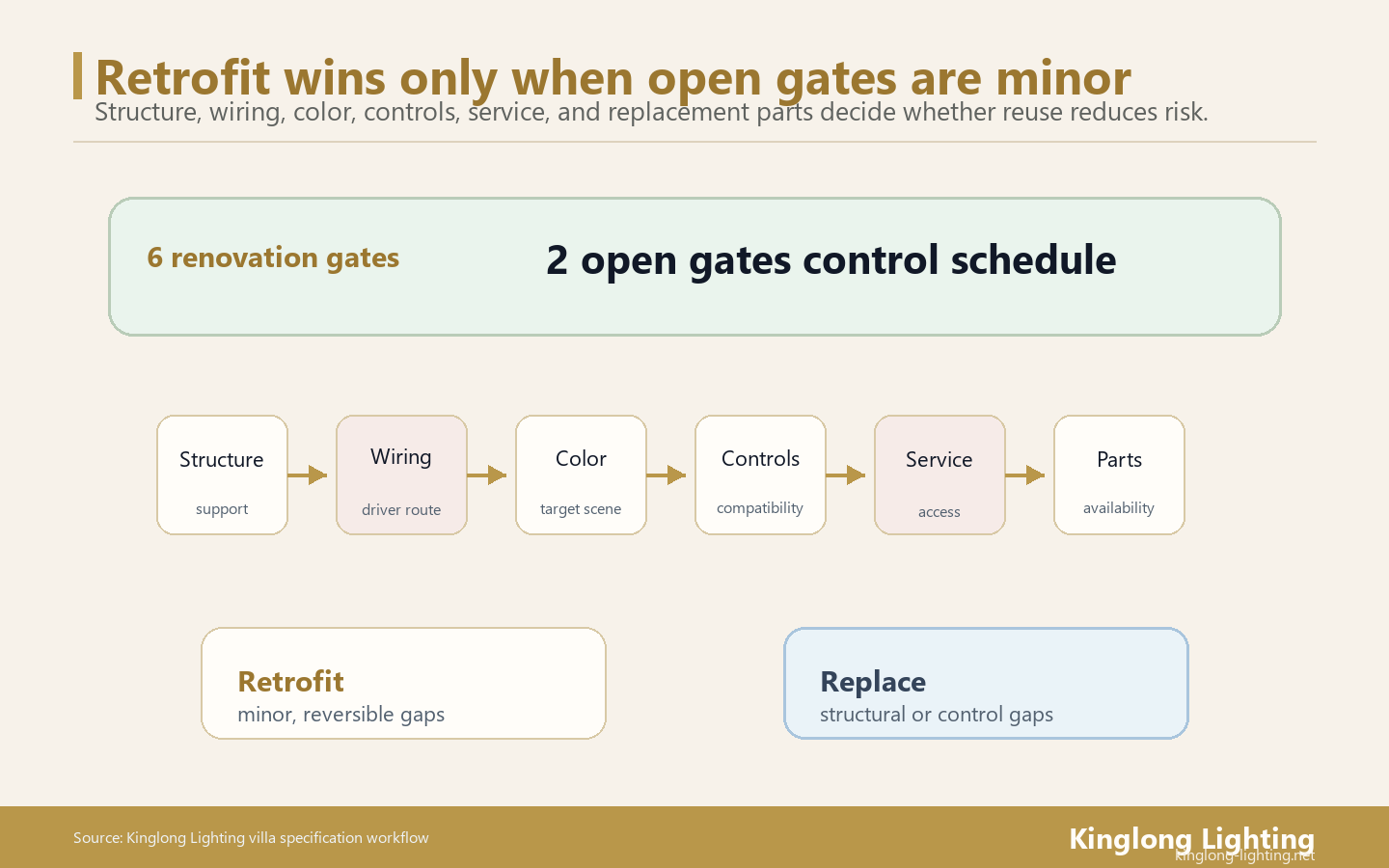
Calculated from a 6-gate renovation file: 2 unresolved gates / 6 required gates = 33.3 percent of the decision file still open, and those 2 unresolved gates often control the schedule. The 6 gates are structure, electrical route, color target, control compatibility, service access, and replacement part plan. If the two missing gates are electrical route and access, the hotel may not discover the real cost until scaffolding, closure, and contractor coordination are already committed.
Based on this scenario calculation, a retrofit should be approved only when the unresolved gates are minor and reversible. If the missing items are structural, certification, control, or service access issues, replacement deserves a serious comparison even if the initial fixture price is higher. The decision boundary is not sentiment. It is the point where reuse stops reducing risk.
How Kinglong Lighting can support a renovation decision
Kinglong Lighting can help renovation teams turn a vague retrofit idea into an evidence file. The customization workflow supports bespoke drawings and material decisions, while the hospitality lighting page connects the work to hotel public-area requirements. When the original chandelier cannot meet the new brief, custom replacement can preserve the room’s intent while resetting structure, controls, material quality, and maintenance planning.
A useful request is to ask for two files, not one quotation. The first file should state what can be kept and what evidence is needed. The second should outline a replacement concept with drawings, materials, lighting assumptions, packing, and installation sequence. The comparison then becomes operational: which path gives the hotel the cleaner opening, steadier guest experience, and easier maintenance life?
Renovation handoff before FAQ
Before a hotel chooses retrofit or full replacement, prepare a one-page decision file. Include fixture age, room role, opening deadline, ceiling access, current problems, desired scenes, destination market, maintenance restrictions, and whether the existing fixture has heritage value. Add photos of the frame, wiring access, driver location, ceiling connection, and damaged or aging parts.
If the file already shows high structural, electrical, or service uncertainty, send the evidence to Kinglong Lighting through the renovation specification review. Ask for a side-by-side retrofit and replacement risk view before choosing the route.
Related Guides
- Hotel Chandelier Mock-Up Process
- CNAS-Accredited Testing for Hotel Chandeliers
- Hotel Corridor Lighting Continuity
A renovation decision file should prove when reuse stops reducing risk
Hotel chandelier renovation decisions often start with a natural preference to reuse what already exists. Reuse can protect budget, reduce waste, and preserve familiar character. It can also hide structural, electrical, control, finish, and service problems that only appear after closure and scaffolding are committed. A good retrofit-versus-replace file makes that risk visible before the team compares fixture price.
Audit the existing chandelier as a platform
A retrofit works when the existing chandelier is still a sound platform. The file should check weight, suspension points, wiring route, driver condition, finish condition, crystal or shade availability, cleaning access, and compatibility with the renovated room. If those items are strong, refurbishment, partial replacement, or control upgrades may be sensible. If several are weak, the old fixture may be preserving sentiment while pushing cost into installation and operations.
Separate cosmetic refresh from functional renewal
Cosmetic retrofit changes what the guest sees. Functional renewal changes how the fixture works, how it is serviced, and how it coordinates with the new room strategy. The decision file should separate these two questions. A fixture may accept new crystal, finish work, or small component replacement while still failing the control, color, access, or safety needs of the renovated space. That is where full replacement deserves a serious comparison, not as an upsell but as a risk decision.
Compare downtime, not only purchase price
Renovation cost is shaped by room closure, lift access, ceiling work, contractor coordination, shipping, testing, and return visits. A lower fixture price can become expensive if the team discovers wiring or access problems late. Kinglong Lighting can help by building a decision packet that compares retrofit scope, replacement scope, site assumptions, module plan, spare availability, and expected downtime. The buyer then sees the total decision instead of a narrow fixture quote.
Freeze the route before the hotel commits to closure
The final approval should name the route: retrofit, partial rebuild, full replacement, or phased replacement. It should also name what would force the route to change. If structural evidence, driver compatibility, color target, replacement part availability, or service access fails, the project should know whether that means redesign, replacement, or a revised schedule. That boundary protects the hotel from discovering the real decision only after work has already begun.
Use replacement as a disciplined option, not a default
Full replacement should not be treated as the automatic answer to every renovation problem. It becomes the stronger path when the existing chandelier cannot support the new room strategy without repeated exceptions. The decision file should still respect useful existing assets, including decorative intent, ceiling conditions, guest familiarity, and salvageable components. By separating what can be reused from what must be rebuilt, Kinglong Lighting and the hotel team can defend the selected route with evidence rather than preference.
The final file should be usable by both purchasing and the site team. Purchasing needs scope, cost drivers, and route logic. The site team needs access, closure timing, ceiling impact, module handling, and commissioning notes. When both views sit in the same packet, the renovation decision is less likely to change after contractors are already scheduled.
Frequently Asked Questions
Is chandelier retrofit cheaper than full replacement?
Retrofit is cheaper only when the structure, safety route, controls, and maintenance plan remain usable. If the renovation needs major rewiring, custom access work, repeated testing, or extensive finish correction, the lower fixture cost can disappear. Compare total disruption, evidence gaps, and future service risk before choosing retrofit.
When should a hotel keep an original chandelier?
A hotel should keep an original chandelier when it has heritage value, the frame is sound, the room strategy still fits, and the improvement scope is limited. The project should still document electrical route, dimming behavior, color target, cleaning access, and replacement parts. Sentimental value needs a practical maintenance plan.
What evidence should a retrofit supplier provide?
A retrofit supplier should provide a reuse assessment, modified drawing, material and finish notes, electrical change description, control compatibility plan, safety or certification path, installation sequence, and spare part list. The file should make clear which parts are original, which are modified, and which are newly manufactured.
Can a new chandelier preserve the old design language?
Yes, a new chandelier can preserve the old design language if the project treats heritage as a design requirement rather than a constraint. The new fixture can carry similar proportions, materials, or rhythm while improving weight, wiring, dimming, service access, and color quality. That path is often cleaner than forcing modern performance into a weak old structure.