
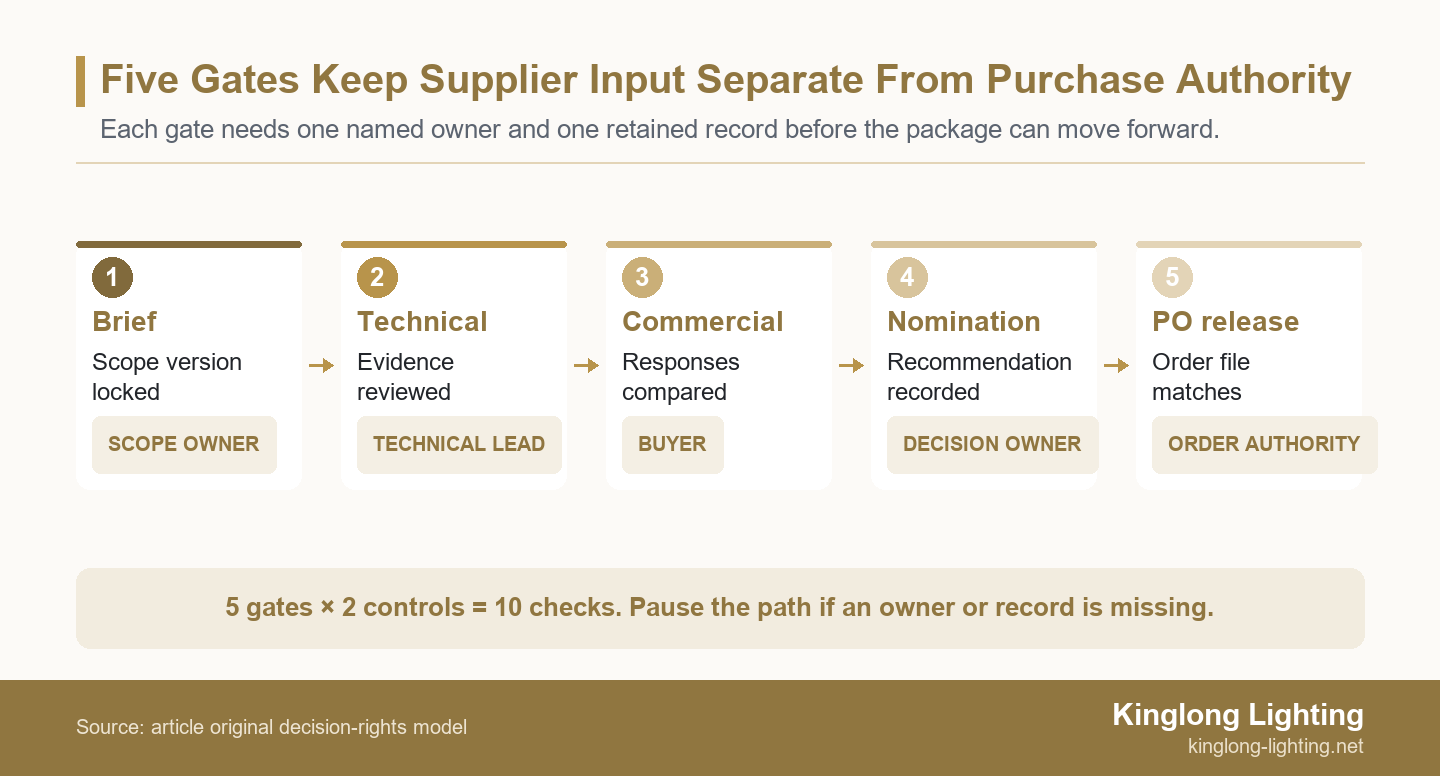
Hotel lighting supplier decision rights are rarely settled by the most senior person in the room. They are settled when the project can show, at each gate, who may shape the brief, who may recommend a supplier, who may nominate one, and who may release the commercial commitment. When those rights are blurred, a technically preferred fixture can turn into a late dispute over cost, maintenance, programme, or contractual authority. The practical remedy is a five-gate decision map with a named approver and a retained record at every handoff.
The decision-rights map at a glance
A hotel lighting supplier is not truly chosen until the relevant gate has one accountable approver and one retained decision record. This is an original project-control rule, not a statement of legal delegation. Its purpose is to make roles, delegated limits, and escalation routes visible before a selection needs to be defended.
Use this map before a finalist meeting, not after a disagreement. It does not replace the project contract, delegated-authority schedule, or approval policy. It makes the questions those documents answer visible early enough to control the selection process.
- Brief control: one owner accepts the version of the fixture schedule, interfaces, and operating requirements being evaluated.
- Technical review: specialists test evidence and recommend; their view is recorded as input, not assumed to be the final choice.
- Commercial comparison: procurement compares like-for-like responses against the same controlled basis.
- Preferred-supplier handoff and commercial release: the project records the decision owner separately from the person authorized to issue the order.
The simple test is useful in a hotel, resort, branded residence, or mixed-use scheme: if the team cannot point to the approver and the matching record, it has not closed that gate. It has only expressed a preference.
Four rights that are often confused
A RACI can clarify responsibility and accountability, but it does not by itself prove who may bind the project commercially. A RACI—responsible, accountable, consulted, and informed—is a role map for work and decisions. APM’s governance guidance describes responsibility assignment alongside delegation limits and escalation routes. A person can therefore coordinate a technical gate while lacking authority to authorize expenditure or commit the owner.
Start by naming four different rights. Influence means a stakeholder can set requirements or raise a risk. Recommendation means a reviewer can assess responses and advise a preferred option. Supplier nomination is the documented recommendation to move a preferred supplier forward for the next approval. Purchase authority means the designated commercial authority can issue or approve the binding order. One person may hold more than one right, but the team should not infer that combination from a job title.
Ask each stakeholder one precise question: “Which decision can you make, and which decision can you only inform?” The owner representative may own the project outcome; the design studio may protect intent; the operator may protect maintainability; the contractor may confirm buildability; and procurement may control comparison and ordering. Their legitimate inputs are not competing vetoes unless the governing documents make them so.
Map authority across five approval gates
A controlled selection process can separate the people who evaluate and recommend from the person who makes the final selection. In a formal source-selection example, the designated authority establishes an evaluation team, considers recommendations, and selects the source; see FAR 15.303. Related public examples distinguish an evaluation board’s recommendation from the authority’s final selection. Private hospitality projects follow their own contracts, but the control principle is useful: do not let a review meeting silently turn into a selection meeting.
Build the map around actual deliverables, rather than departmental labels. The sample below is a discussion tool. Confirm every “A” against the owner’s delegations and the project’s approval path before treating it as authority.
| Gate and output | Owner representative | Design / lighting team | Operator | Procurement lead | Fit-out contractor |
|---|---|---|---|---|---|
| 1. Controlled brief | A | R | C | I | C |
| 2. Technical evidence review | A | R | C | C | C |
| 3. Comparable commercial review | A | C | I | R | C |
| 4. Supplier nomination | A | R | C | R | C |
| 5. Commercial release | C | I | I | A/R | C |
Legend: R = responsible for the work; A = accountable for the gate; C = consulted before the gate closes; I = informed after the decision. The same table may need a different “A” where the developer, operator, or contractor has retained a contractual approval. What matters is that each output has one visible owner and one version-controlled record.
For a custom package, the most useful starting document is the one that links design intent to specifications, interfaces, and response evidence. Teams can use Kinglong Lighting’s resources to map the custom-lighting development brief before approaching suppliers, then keep the buyer-side approval path separate from the supplier’s response process.
1. Freeze the brief before anyone scores suppliers
Compare suppliers only after the project has defined the scope, criteria, and assessment method that the comparison will use. UK guidance on assessing tenders requires criteria to relate to the subject being bought and to be clear and specific, with a stated assessment method. That is a public-procurement rule, not a hotel-project mandate; its useful private-project lesson is to reset a comparison when its basis changes.
A controlled brief does not need to be perfect; it needs to be identifiable. Give it a version, issue date, owner, package boundary, drawings or schedules referenced, and a short list of evaluation criteria. Include what the reviewer needs to evaluate: visual intent, fixture construction, finish samples, installation interfaces, maintenance access, mock-up requirements, delivery split, and commercial assumptions. If an item is unresolved, mark it as an assumption that cannot be scored.
A new maintenance condition or ceiling interface changes the comparison basis. Reset the affected gate instead of hiding the change inside a revised score. The objective is not extra paperwork; it is a comparable answer from every finalist to the same current requirement.
2. Separate technical recommendation from supplier nomination
A meaningful supplier review asks for project-relevant capability and quality evidence, not only the lowest quote. NIST’s supplier-selection guidance likewise points buyers toward capability and quality-system evidence beyond price. Apply that as an evidence discipline, not as a claim about any particular lighting supplier: a technical reviewer can explain what is supported, conditional, or missing without acquiring the right to choose the supplier.
The technical review should answer, “Can this response meet the controlled brief, and what remains conditional?” It should not answer, “May we now award the supplier?” Ask both finalists for the same evidence set: drawings or details relevant to the defined fixture type, finish and material information, interface clarifications, sample or mock-up route, quality documentation where required, packing approach, delivery assumptions, and a list of exceptions. Record unknowns as unknowns. A polished presentation is not evidence that a requirement is accepted.
The design team can recommend the technically stronger response while the accountable owner decides whether the remaining commercial and programme conditions are acceptable.
3. Record who can nominate and who can overrule
A documented evaluation can recommend a supplier without itself becoming the final selection decision. A GSA evaluation-board example separates a board that evaluates and recommends from a selection authority that receives the recommendation. It is a public-sector analogue, not a rule for a resort purchase, but it makes the handoff testable: technical preference becomes a traceable recommendation; the authorized person accepts it, rejects it, or returns it with a stated question.
The nomination record is the bridge between a comparison and a commercial decision. It should identify the controlled brief version, finalists compared, criteria used, evidence reviewed, exceptions still open, recommended supplier, accountable approver, and any conditions to be met before release. If the operator, quantity surveyor, design lead, or contractor may stop a nomination for a defined reason, write that reason and the escalation path into the record. Do not rely on an informal “everyone was aligned” statement.
4. Treat commercial release as a separate authority check
A purchase order (PO) is the commercial document that authorizes purchase of the defined scope under agreed terms. It is not merely an administrative echo of a design decision. Before it is issued, procurement should verify that the nominated supplier, scope, pricing basis, document version, approvals, payment and delivery assumptions, and contract route match the approved record. A mismatch should return the package to the relevant gate, rather than being corrected silently in the order.
Give the accountable owner an evidence pack, not a pile of opinions
The accountable owner needs one comparable evidence pack that shows criteria, project-fit evidence, and the reason for the recommendation. Guidance on clear criteria and assessment methods, evaluation-record guidance, and supplier-evidence guidance support that discipline. The sources are governance analogues; they do not decide a hotel project’s contractual authority.
Make the pack easy to review in one meeting. In the first review block, a buyer can use Kinglong Lighting’s hospitality information to review the hospitality lighting project inputs around the spaces and requirements being considered. Then put the controlled brief and change log first, followed by the comparison sheet, each response to the same questions, technical comments, commercial exceptions, programme assumptions, open-risk owner, recommendation, and decision requested. A reviewer should see which point is verified, assumed, or conditional before a supplier is nominated.
Keep informal email opinions as supporting material, not as the decision record. A mixed review team may include financial, technical, purchasing, operations, and delivery input, but each comment must return to a stated criterion. Record which party owns an unresolved interface, who may accept a deviation, whether a sample is required, and whether the current schedule changes the commercial comparison. This format makes it easier to distinguish a factual response from a preference and to give the accountable owner a bounded choice rather than an open-ended debate.
Before treating a reference as relevant, compare the application, scope boundary, and evidence available with the current package. Ask whether an example covers the same decision gate, delivery boundary, approval route, and evidence type—not whether it merely looks similar. Identify what the example cannot establish for the present brief, such as current specification acceptance, payment terms, contractual responsibility, or the authority of the reviewer. The comparison should create questions for the current supplier response, rather than importing an untested conclusion.
For that screening step, reviewers can use examples only as a prompt for questions about comparable scope, without treating them as proof that a particular requirement, approval, or outcome will transfer to the current project. They can review project examples by application context.
Illustrative scenario: a resort project pauses nomination before it becomes a purchase dispute
The illustrative scenario below tests how a changed brief can cross design, operations, procurement, and commercial authority before a supplier is nominated. It is a fictional composite, not a Kinglong Lighting customer case. Actual authority always remains a matter for the project’s own contracts, delegations, and approval policy.
Why the nomination must reset
When the approved brief changes, pause supplier nomination until the revised basis and decision owner are reconfirmed. This is an illustrative control response, not contract interpretation: the team should restore a shared scope, a named gate owner, and an auditable handoff before it resumes comparison.
An owner representative is coordinating a 180-room resort with a design studio, operator, furniture, fixtures, and equipment (FFE) procurement lead, fit-out contractor, and two decorative-lighting finalists. The preliminary fixture schedule covers 250 fixture positions: 34 public-area decorative fixtures and 216 repeated guestroom fixtures across two delivery packages. Quotes have been compared, but the owner has not recorded who may convert the preferred technical recommendation into a supplier nomination.
The design team approves the visual direction for a lobby feature fixture, while the operator asks for revised maintenance access. Procurement is still comparing the earlier fixture schedule, and the contractor has not confirmed the revised ceiling interface. Each view is valid, but each concerns a different decision right and a different version of the scope.
The recommendation cannot safely become a nomination because the product brief and evaluation basis no longer match. The problem is not a judgment about supplier quality; it is a document-version conflict crossing technical, operational, and commercial gates. The owner representative pauses nomination, names the project delivery director as accountable for the revised technical gate, and keeps procurement responsible for reissuing the commercial comparison when the revision is confirmed.
The team issues one revision-controlled brief, asks both finalists for the same response set, and records the operator’s consulted sign-off in a signed gate register before a new nomination meeting. It may nominate a supplier only when the revised brief, evaluation record, accountable approver, and procurement recommendation carry the same document version. The quantities, roles, and sequence are illustrative. Actual authority must be confirmed against the project’s contracts, delegations, and approval policy.
The 10-point decision pack to complete before supplier nomination
Use the score as a meeting prompt, not as a substitute for judgment. A team should be able to produce these ten items: the controlled brief; scope boundary; evaluation criteria; assessment method; response set; technical review; commercial comparison; open-exception list; named approver; and signed or retained decision record. If a point is missing, say who will close it and by when.
When the owner-side team has the brief, roles, and evidence pack ready, a supplier discussion becomes more efficient. Kinglong Lighting can discuss the information a custom decorative-lighting response may need, while the buyer retains ownership of approval, supplier nomination, and purchase authority. For a scoped discussion, send a decision-rights brief for a scoped review.
Frequently Asked Questions
Can a hotel operator reject a lighting supplier after the owner has nominated one?
A hotel operator can reject a supplier only when the project documents give it a defined approval, compliance, or operating-requirement gate. That gate should be recorded before supplier nomination. The practical question is not whether the operator is influential; it is whether the changed requirement affects the controlled brief and who has authority to accept the resulting commercial or programme impact. If it does, pause the affected gate and document the route back to nomination.
Is the procurement manager always accountable for choosing the supplier?
No. Procurement may be responsible for the comparison, commercial clarification, and PO workflow while an owner-side executive or delegated project authority remains accountable for selection. The record should show both roles. Treating the person who runs the spreadsheet as the final decision maker can conceal a missing approval and leave the PO issuer exposed when scope, budget, or contractual assumptions later differ.
What should change when the lighting brief changes after quotes arrive?
Pause nomination, identify which approved criterion changed, and reissue the affected brief or scoring basis before comparing supplier responses again. Do not ask one finalist to address a new condition privately while retaining the earlier comparison as if it were still equivalent. The accountable owner should decide whether the change is technical only or also alters cost, programme, maintenance, interface, or contractual risk.
When should the supplier join the decision-rights conversation?
Bring the supplier in after the buyer has named its accountable owner and controlled the brief, then ask the supplier to respond to the evidence required at the relevant gate. A supplier can clarify assumptions, identify exceptions, and support technical review. It should not be asked to resolve unresolved buyer-side authority or to infer which stakeholder may make a binding decision for the project.