
Hotel chain chandelier procurement is not won by the prettiest fixture alone because global brands buy design intent, supplier governance, technical evidence, project reliability, and property-level fit at the same time. The chandelier is visible, but the purchasing decision is cross-functional. Brand, design, procurement, engineering, sustainability, finance, and the property owner all see a different risk.
This cross-brand analysis uses public supplier and brand materials as decision context, not as a claim that any hotel group has endorsed a supplier. Marriott, Hilton, IHG, Accor, Sheraton, Shangri-La, and similar groups operate with different brand systems, ownership structures, and procurement routes. Still, their public policies point in the same direction: suppliers need more than a good catalogue. They need credible conduct, transparent evidence, durable production control, and the ability to adapt a chandelier to a specific property without weakening the brand experience.
Key Takeaways
- Multi-gate buying: Chain-level chandelier procurement combines design, compliance, supplier governance, cost, schedule, and property fit.
- Brand difference: Luxury, premium, resort, and urban business properties evaluate the same chandelier risk through different guest expectations.
- Supplier evidence: Public sourcing policies make conduct, transparency, audit readiness, and legal compliance part of the purchasing context.
- Custom advantage: A strong manufacturer can translate brand intent into drawings, samples, testing, packing, and installation support.
- Kinglong position: Kinglong Lighting should be framed as a custom hospitality lighting manufacturer, not as an official spokesperson for hotel brands.
Chain procurement is a risk allocation exercise
The design team buys atmosphere; procurement buys controlled uncertainty.
Public hotel group materials rarely discuss chandelier purchasing in isolation, but they reveal the expectations around suppliers. Marriott’s Global Procurement Supplier Conduct Guidelines, Hilton’s Responsible Sourcing Policy, IHG’s policy documents, and Accor’s Responsible Procurement Charter context all show that large hospitality groups care about supplier conduct, transparency, responsible sourcing, and the ability to verify standards. A chandelier supplier entering that world must speak design and governance at the same time.
The practical effect is that the RFQ should be written like a risk allocation document. It should ask who owns the finish master, who approves the mock-up, who confirms destination-market evidence, who checks ceiling load, who accepts control compatibility, and who signs the packing and installation assumption. A supplier that answers those questions early reduces meeting time for the buyer. A supplier that waits for the buyer to discover the gaps can still win on design, but the buyer has to carry more uncertainty through the approval cycle.
Design approval is only one buying gate
A design director may select the sculptural direction, but procurement still asks whether the supplier can document materials, meet shipment windows, support certifications, and handle property-specific changes. Engineering checks weight, heat, controls, access, and ceiling interface. The owner checks budget and maintenance exposure. The brand team checks whether the fixture supports the property’s story without looking generic or off-brand. Because each function owns a different failure mode, a supplier that sends only beauty images creates friction.
Supplier governance changes the RFQ language
Public responsible sourcing documents reviewed for this analysis often show supplier expectations such as legal compliance, ethical conduct, workplace standards, transparency, and possible audits or assessments. Based on our analysis, that pushes chandelier RFQs toward 6 evidence groups: company profile, project references, material traceability, testing route, production quality control, and installation logistics. The fixture still needs to be beautiful, but beauty is not the whole file.
What changes across luxury, premium, resort, and urban brands
The same decorative lighting proposal should not be presented identically to every chain segment. A luxury resort lobby may prize local craft, a grand arrival gesture, and long-dwell atmosphere. An urban premium hotel may need a public space that supports work, coffee, meetings, and evening social use. A ballroom-focused convention property may put more weight on dimming scenes, rigging coordination, and maintenance after high-use events. The procurement question changes with the guest journey.
| Property context | Chandelier value | Evidence that helps buying | Common risk |
|---|---|---|---|
| Luxury urban flagship | Signature arrival and brand memory | Render, mock-up, finish master, maintenance plan | Beautiful but difficult to service |
| Premium public-space hotel | Warm community and work-social atmosphere | Scene schedule, glare check, durable materials | Fixture conflicts with flexible use |
| Resort lobby | Local story and relaxed guest immersion | Material narrative, corrosion note, cleaning plan | Craft detail lacks climate durability |
| Ballroom property | Event transformation and scale | Dimming channels, rigging coordination, access plan | Late conflicts with AV, sprinkler, or ceiling load |
| Renovation property | Refresh without disrupting operations | Phasing plan, module size, site survey | Delivery or install sequence causes closure risk |
The conclusion is that chain procurement is not one universal checklist. It is a hierarchy. The non-negotiables are supplier conduct, compliance path, quality control, and delivery reliability. The differentiators are design translation, property storytelling, value engineering, and installation intelligence.
Use public brand signals without pretending they are specifications
Sheraton’s official brand page describes public space as a place for guests and locals to connect, while Marriott Bonvoy Traveler’s Sheraton design coverage discusses community-oriented public space strategy. Shangri-La’s official brand page emphasizes five-star hotels, tranquil surroundings, architecture, design, and hospitality from the heart. These are useful public signals, but they are not project specifications. A supplier should convert them into questions, not claims: should the chandelier support gathering, calm, local heritage, work-social flexibility, event drama, or a ceremonial arrival?
This boundary is important for Kinglong Lighting. Public project references can show experience, but they should not imply official representation by any hotel chain. The safer and stronger position is manufacturer competence: Kinglong Lighting can help translate a brand narrative into scale studies, material options, mock-ups, technical drawings, and production evidence for the specific property team reviewing the project.
The procurement scorecard behind a chandelier RFQ
Calculated from a 6-gate procurement file: 3 missing gates / 6 required gates = 50 percent of the decision evidence unresolved when a supplier scores strongly on design and price but lacks testing route, change control, and logistics. That gap does not mean the supplier is unqualified. It means the buyer has to spend more time closing uncertainty before approval. In a renovation or fast-track opening, that uncertainty can be more expensive than a higher unit price.
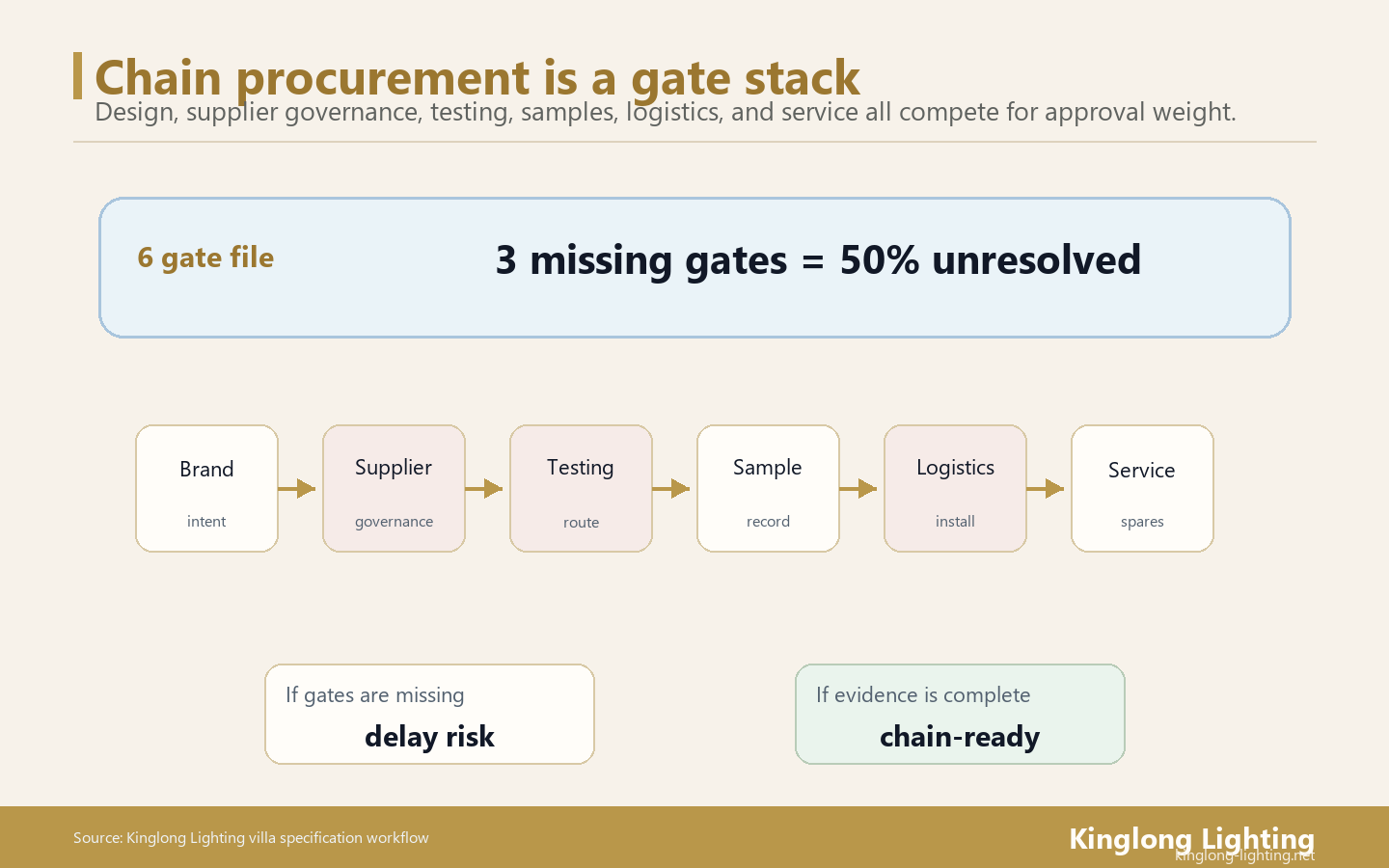
The strongest vendor comparison therefore separates “concept value” from “execution confidence.” Concept value covers visual fit, material story, property differentiation, and owner preference. Execution confidence covers documentation, production capacity, sample discipline, testing route, packing, and site support. When the two are mixed into one price column, the lowest quote can look cleaner than it really is. When they are separated, the hotel team can decide whether a custom design premium is buying guest memory, risk reduction, or merely additional complexity.
This also makes value engineering cleaner. The buyer can reduce crystal density, simplify modules, or adjust finish process while seeing which risk gate is affected.
The trade-off is clear: a heavily standardized chandelier reduces decision time but can weaken property identity; a fully bespoke chandelier can express the hotel story but needs stronger proof around weight, finish, dimming, safety evidence, packing, and installation. The best RFQ asks vendors to price the base concept and the controlled customization options separately, so the owner can see what each design move costs and protects.
How Kinglong Lighting can frame chain-ready evidence
Kinglong Lighting’s public brand materials describe hospitality lighting, custom manufacturing, project experience, and a large integrated manufacturing base. In chain procurement language, those assets should be organized into a buyer-facing evidence pack: company overview, 33-year heritage, 300+ hotel client experience, project gallery, customization workflow, sample process, testing route, quality control checkpoints, packing plan, and installation support scope. The hospitality lighting and projects pages can support the front of that file, while the customization page supports the production discussion.
The soft next step is to send Kinglong Lighting the brand context, property type, public-area function, ceiling information, destination market, control requirement, and expected opening date through the project inquiry route. Ask for a proposal that separates design concept, technical evidence, value-engineering options, and installation assumptions. That structure fits how chain buyers actually compare risk.
Related Guides
- Hotel Lighting Procurement Framework
- Hotel Chandelier Total Cost Surprises
- CNAS-Accredited Testing for Hotel Chandeliers
Chain Procurement Action Card
- Separate design intent from supplier governance and technical evidence.
- Ask for project references without implying hotel-brand endorsement.
- Price controlled customization options separately from the base concept.
- Require a testing route, change-control process, packing plan, and installation assumptions.
- Send the evidence pack request to Kinglong Lighting before final vendor comparison.
A cross-brand chain procurement file should show who owns each risk
Hotel chains do not buy a chandelier only as a decorative object. They buy an approval path that has to satisfy brand reviewers, ownership, procurement, operators, site teams, and sometimes responsible sourcing expectations. A chain-ready file should therefore show which party owns each risk. Brand fit, supplier qualification, testing route, sample record, logistics, installation support, and after-service planning should not be scattered across emails. They should sit in one decision file that the buyer can compare across properties and brands.
Separate brand expression from chain governance
Luxury, premium, resort, and urban brands may ask for different atmospheres, but governance questions often repeat. Who approves a finish change? Who accepts a substitute component? Who signs off on testing evidence? Who confirms access and installation timing? These questions are not creative friction. They are the reason a beautiful proposal can still feel risky to procurement. Kinglong Lighting can support chain buyers by making the governance layer visible without flattening the design intent.
Make the supplier response easy to compare
A chain procurement team needs more than a strong visual concept and a competitive price. The response should include company capability, relevant hotel references, material and finish evidence, testing route, quality control method, packing plan, installation handoff, and service support. When every supplier answers in a different order, the buyer spends time translating instead of deciding. A structured Kinglong file helps the buyer see which risks are closed, which are open, and which need owner input before quotation can be final.
Use exceptions as a test of readiness
Chain projects often allow exceptions, but exceptions need a trail. A custom chandelier may need a non-standard finish, special crystal density, unusual suspension detail, or faster delivery route. The question is not whether the exception is allowed in theory. The question is what evidence supports it and who can approve it. If the exception changes weight, maintenance, compliance, finish repeatability, or guest comfort, it should reopen the relevant gate rather than pass as a small design note.
Give each property a reusable release packet
The final procurement file should be reusable enough for a chain buyer but specific enough for the property. It should name the property context, brand intention, design option, technical gates, responsible owners, open risks, and next evidence request. That allows the buyer to compare a resort lobby, urban lounge, and renovation project with the same evidence logic. It also gives Kinglong Lighting a clearer basis for pricing, sampling, engineering, and production timing.
The strongest version is not a thick manual. It is a short file that makes the hidden decision path visible. Once the chain team can see the path, the conversation moves from preference to readiness.
Let the scorecard change the next request
The procurement scorecard should not sit beside the supplier response as a formality. It should change the next request. If testing route is weak, the next action is not another render; it is a test path or compliance note. If logistics is weak, the next action is a module and packing plan. If service is weak, the next action is a spare and access strategy. That turns the scorecard into a working tool rather than a decorative checklist.
Frequently Asked Questions
Do hotel chains buy chandeliers centrally or by property?
It varies by group, brand, ownership model, and project. Many decisions involve a mix of brand standards, owner approval, designer recommendation, procurement review, and property-level constraints.
What evidence helps a chandelier supplier look chain-ready?
Useful evidence includes project references, supplier conduct information, drawings, samples, testing route, quality control checkpoints, packing plan, installation support, and change-control records.
Can a supplier claim partnership with a hotel chain after completing a project?
No, not unless the hotel chain has authorized that language. It is safer to describe the project accurately and avoid implying endorsement, representation, or preferred-supplier status.