A live factory video call can reduce supplier uncertainty, but it cannot erase every decision-critical question before a project award. For a custom lighting package, the practical question is not which format looks more thorough. It is whether the team can connect a named factory, current drawing, finish reference, sample or work-in-progress, and accountable person into an evidence chain that supports the next decision.
A factory video audit versus on-site audit lighting decision is therefore a proof decision. A controlled video call can make useful claims testable quickly. An on-site audit can add physical context and independent observation when a camera route or shared document still leaves an award-changing unknown. Neither method accepts a supplier by itself; both should close defined evidence gates before the buyer releases the next commitment.
What the method choice changes before award
For an FFE (furniture, fixtures, and equipment) procurement team, the method changes how uncertainty is recorded and resolved. A video call is strongest when the buyer can ask a supplier to show a specific process, person, record, drawing reference, or current item in a live sequence. It is weaker when the buyer needs to know what sits outside the route, how a physical condition appears in context, or whether an observation is independent of the supplier’s presentation.
- Start with the claim that matters to award, such as a finish-to-drawing match, current work-in-progress location, or responsibility for a technical record.
- Ask what evidence can be obtained remotely, then name the uncertainty that still remains.
- Use an on-site audit only for an unresolved condition that could change the supplier award, release, or risk treatment.
- Keep the decision traceable: claim, evidence seen, residual risk, owner, and next verification step.
Compare the claim, not the tour format
IAF requires documentation of how ICT will be used while maintaining audit integrity and says virtual sites cannot represent physical manufacturing processes. Its guidance also lists video meetings, data sharing, remote records review, recorded evidence, and visual access as possible activities. The guidance applies to conformity-assessment activity, not lighting-supplier approval; it is still a useful boundary for a buyer deciding what a remote session can and cannot establish. Read IAF MD 4.
In its ISO 19011:2018 overview, the ISO 9001 Auditing Practices Group describes the guidance as covering audit-program management, auditing methods, and auditor competence. It also notes that the guidance can be useful for supplier assessments, but it does not set a lighting supplier-approval standard. For supplier awards, use that context as an editorial prompt to plan video and on-site work as connected evidence steps, not as generic substitutes. Read the ISO/IAF audit-practice overview.
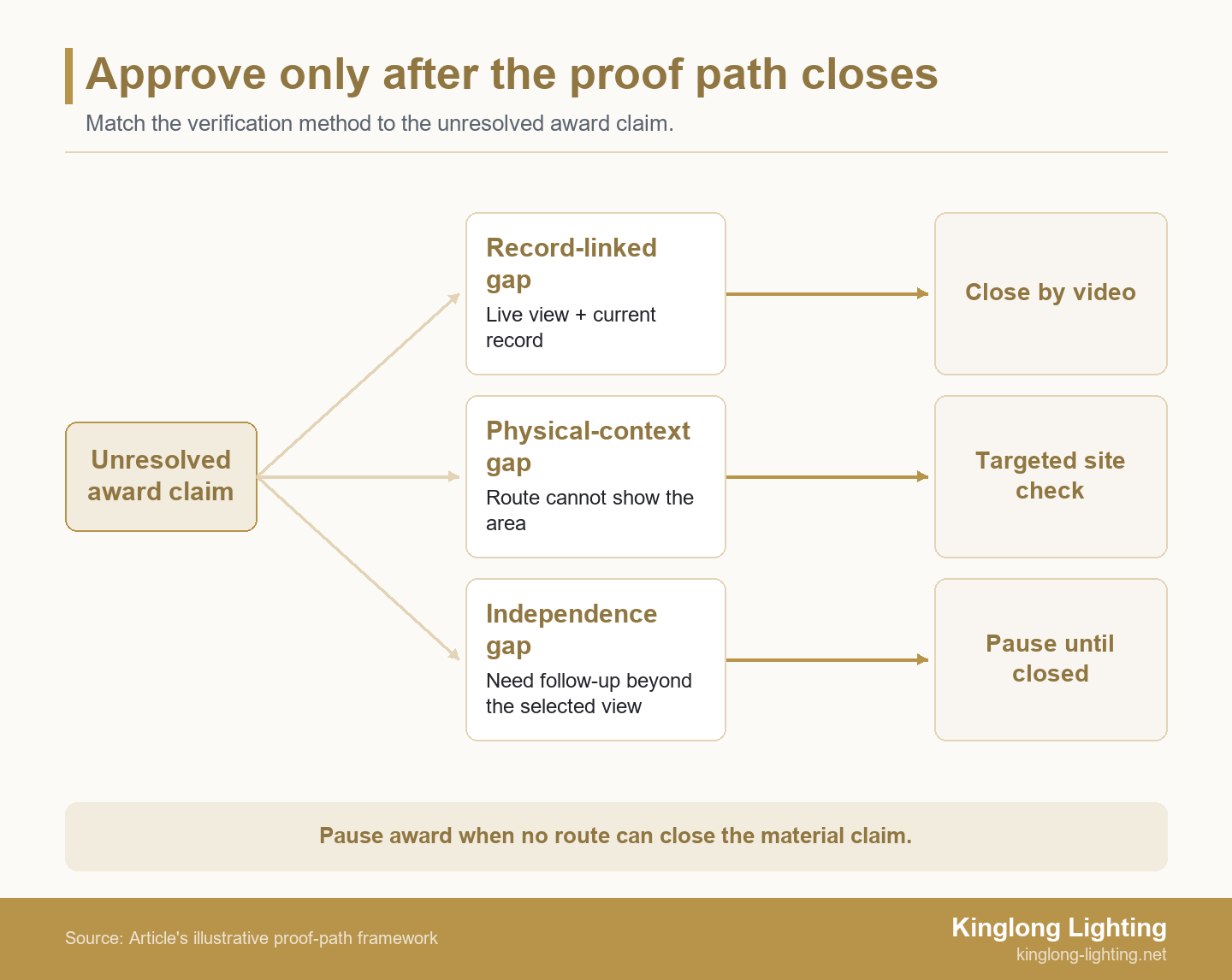
Compare the claim, the evidence obtained, and the residual uncertainty before asking whether travel is justified. An evidence gate is simply a condition that must be supported before a supplier can move to the next decision. It prevents an attractive walkthrough from becoming an unexamined approval signal.
Kinglong Lighting’s public business information can be a useful starting point for a buyer’s own provider-context review, but it is not proof of a project-specific capability. Review the public manufacturing background.
| Claim to test | What a directed live video call can support | What an on-site audit can add | Decision before award |
|---|---|---|---|
| Named site and accountable team | Live introductions, location cues, and direct questions against the buyer’s agenda. | Broader context for who is present and how responsibilities are followed on the floor. | Hold if the responsible role or location cannot be tied to the quoted scope. |
| Current drawing, finish, and record references | Screen-shared records and a live view of the related label, sample, or process point. | Physical cross-checks across records, materials, work areas, and handling conditions. | Request reconciliation when references do not connect. |
| Stated process or work-in-progress | A time-bounded view of the process route selected by the supplier and buyer. | Follow-up beyond the camera route, including surrounding work and the practical sequence. | Travel only if the unseen context can alter the award decision. |
| Independence of the observation | Questions, requests for unscripted views, and a contemporaneous observation log. | More opportunity to follow an observation in person and test it against the environment. | Do not convert a curated view into an acceptance conclusion. |
The matrix does not rank one method above the other. It assigns each method to the gap it can reduce. When the remaining uncertainty is site-dependent or depends on an observation beyond the supplier’s selected route, the supplier should stay paused until the team names a different proof path.
Use a video call to test a connected evidence chain
A useful video session is not a remote brochure tour. It starts with a short evidence register: the fixture family, drawing revision, finish reference, current document owner, and the exact question each view must answer. IAF describes video, data sharing, remote records review, and visual access as possible ICT uses in audit activity. ISO’s Auditing Practices Group also notes that remote methods can be combined with on-site activity after feasibility and resources are considered. These are audit-method references rather than supplier certificates; they support a deliberate, combined approach. Read the IAF ICT guidance and the ISO Auditing Practices Group guidance.
Ask the supplier to move from one connected item to the next: name the person responsible, show the relevant record, identify its revision, and show the associated item or process point. The buyer’s observer should log what was seen, what was merely stated, and the time or file reference where practical. That distinction matters later when a consultant compares two shortlists or asks why a question remained open.
For custom work, the agenda should begin with the buyer’s own technical inputs rather than with a broad factory introduction. A team preparing a discussion can organize the custom-lighting development inputs around fixture families, finish references, drawings, samples, and questions that need a supplier response. The result is not a pass/fail audit score; it is a clearer record of which claims the call actually supported.
Use an on-site audit for site-dependent questions
On-site work is most valuable when the missing proof depends on physical context, a route the camera did not reach, or a follow-up that needs independent observation. The OECD report describes advance documents, livestream visits, extra preparation, and possible concealment or misrepresentation in remote auditing. The sector is different, so it does not establish a rule for lighting factories; it usefully explains why remote evidence needs an explicit boundary. Read the OECD remote-audit findings and the IAF boundary guidance.
That does not mean an on-site audit should become a generic factory tour. The audit brief should identify the physical question in advance: for example, whether the stated work-in-progress can be located against the current finish reference; whether a record can be reconciled with an item in the relevant area; or whether an observed handoff has the context the project team needs. The observer can then record what was checked, what remained inaccessible, and what the finding means for the award gate.
An on-site visit also has limits. It is a point-in-time observation, not a promise that every future order will conform. Drawings, sample approvals, inspection criteria, commercial scope, and later production controls still need their own project evidence. Treat the visit as a targeted way to reduce one residual risk, not as a substitute for those controls.
Authorize travel only when the residual risk can change award
Travel is justified only when the unanswered claim can still change the award decision. That is a decision rule, not a regulatory threshold or a rule set by Kinglong Lighting. It stops the team from travelling because a supplier feels unfamiliar, while also stopping the team from approving a supplier merely because a call looked professional.
Use a simple residual-risk test. First, state the claim: “this finish record matches the current package,” “this work area contains the relevant item,” or “this person owns the referenced process.” Second, state what the video call established. Third, ask whether the remaining uncertainty could change supplier selection, scope release, schedule treatment, or the controls needed before a purchase order. If the answer is no, document the remote evidence and defer travel. If the answer is yes, define the smallest on-site question that can resolve it.
FDA’s risk-based remote regulatory assessment considers location, inspection history, process complexity, and travel restrictions, and may precede, prompt, or follow an inspection. Those FDA factors are not a lighting-project scorecard, but they reinforce the discipline of recording why a particular uncertainty deserves escalation rather than applying the same visit to every supplier. Review the FDA’s risk-ranking framework.
FDA describes remote oversight tools that may include livestreaming, teleconferences, screen sharing, and record review, and these activities can identify issues that lead to an inspection. That regulatory context does not prescribe buyer diligence for decorative lighting; it illustrates why a remote finding can lead to a narrow in-person confirmation rather than an automatic approval. See FDA remote oversight tools.
Go/no-go travel trigger: authorize a targeted on-site audit when all three conditions are true: the unresolved claim is material to award or release; a controlled remote session cannot close it; and an in-person observation has a defined way to change the decision. Otherwise, request a narrower record or a second directed video view.
Illustrative scenario: two clean video calls, two different holds
This composite scenario shows how two apparently successful video sessions can create different next steps. It is deliberately limited to a buyer’s evidence decision; it does not assess any real lighting factory. Buyers can review hospitality lighting requirements as project context before defining their supplier-specific proof questions.
Keep the hold tied to the missing proof
Consider a composite example, not a Kinglong Lighting client case. An FFE procurement manager and consultant are reviewing two factories for a hotel public-area decorative-lighting package. The package has 36 decorative fixtures across 3 fixture families, 2 finish references, and a controlled drawing revision. Travel approval is pending, so each supplier receives the same directed live video agenda and document request.
Supplier A shows an active workshop and shared records, but the process record shown on screen cannot be tied to the finish code on the current schedule. Supplier B provides an auditable document path but its live walkthrough cannot reach the area said to hold the relevant work-in-progress. Neither observation is a reason to reject a supplier; each is a different kind of incomplete proof.
The calls have still done useful work. They have narrowed the uncertainty from a vague question about factory capability to two specific award-critical questions: A has a document-to-product link gap; B has a site-observation gap. The team advances neither supplier solely on the video result. It records both as paused pending claim-specific proof, rather than treating either polished call as a positive or negative verdict.
A different proof gap requires a different resolution path. For Supplier A, the buyer requests a dated reconciliation that links the fixture family, current drawing revision, finish reference, record owner, and relevant item. For Supplier B, it authorizes a targeted on-site check only if the inaccessible work area remains material to the award timetable; the observer’s brief names the area, item, context needed, and the condition that would clear the hold. Each supplier can move forward only when its own gap is closed by a traceable record or an independent physical observation. This illustrative example is a teaching method, not an assessment of any real factory and not a prediction of project performance.
Turn the audit result into a controlled supplier request
Write the claim, evidence, owner, next action, and resolution condition beside each open item. A buyer can keep this in the same register used for the RFQ, meaning the request for quotation, drawing review, or technical clarification. The wording should be specific enough that a consultant, purchasing owner, and supplier contact can all see what remains open without interpreting a vague note such as “please confirm capacity.”
- Name the claim: identify the fixture family, current revision, finish reference, physical area, or responsibility in question.
- Separate evidence from assertion: record the document, live view, sample label, or observation actually obtained.
- Assign the next path: request a dated reconciliation, a controlled follow-up call, or a targeted on-site observation.
- Set the resolution condition: define what will close the hold and who may move the supplier to the next decision.
This approach keeps diligence proportional. It gives a supplier a scoped way to respond and gives the buyer a defensible record of why the award advanced, deferred, or paused. Kinglong Lighting can use a defined fixture-and-evidence brief as the basis for a scoped technical discussion. Request a scoped custom-lighting brief review.
Frequently Asked Questions
Can a video factory audit replace an on-site audit?
No, a video audit can support a defined audit objective, but it should not be treated as a universal replacement for on-site observation. It can help a buyer connect people, records, current references, and selected live views. If the unresolved question depends on physical context, an inaccessible area, or independent follow-up, the team should specify a separate on-site verification path rather than treating the video call as conclusive.
What should a lighting factory show on a live video call?
Ask for a live, directed view that links the named site, relevant process area, current records, and the people accountable for the quoted fixture family. Start with the buyer’s current drawing revision and finish reference. Then ask the supplier to show the related record, label, item, or process point. Record what was observed, what was stated, and what remains unverified so the next step is clear.
When does a project justify travel for a factory audit?
Travel is justified when an unresolved site, process, independence, or physical-condition question could still change the supplier award or release decision. The visit should have a stated purpose and a defined resolution condition. If the team cannot say what the on-site observation would change, a narrower document request or directed video follow-up is usually the better next step.
Does an on-site audit prove that the final lighting order will pass?
No, an on-site audit evaluates the observed facility and process at a point in time, so it cannot prove final-order conformity on its own. Order acceptance still needs project-specific drawings, finish and sample references, commercial scope, and inspection evidence. A targeted visit can reduce a defined residual risk; it does not replace the later controls that connect the approved package to production and delivery.