
A China-based procurement contact can be essential to an overseas lighting project without being the person who may change a finish, accept a final price, or release a purchase order. The useful distinction is not where the contact works. It is whether four records agree: who appointed the contact, which live project they represent, what decision they may make, and how that decision becomes a PO. Treating those records as one check keeps a supplier responsive without turning a promising enquiry into an assumed commitment.
Four checks turn a China-based enquiry into a project-ready brief
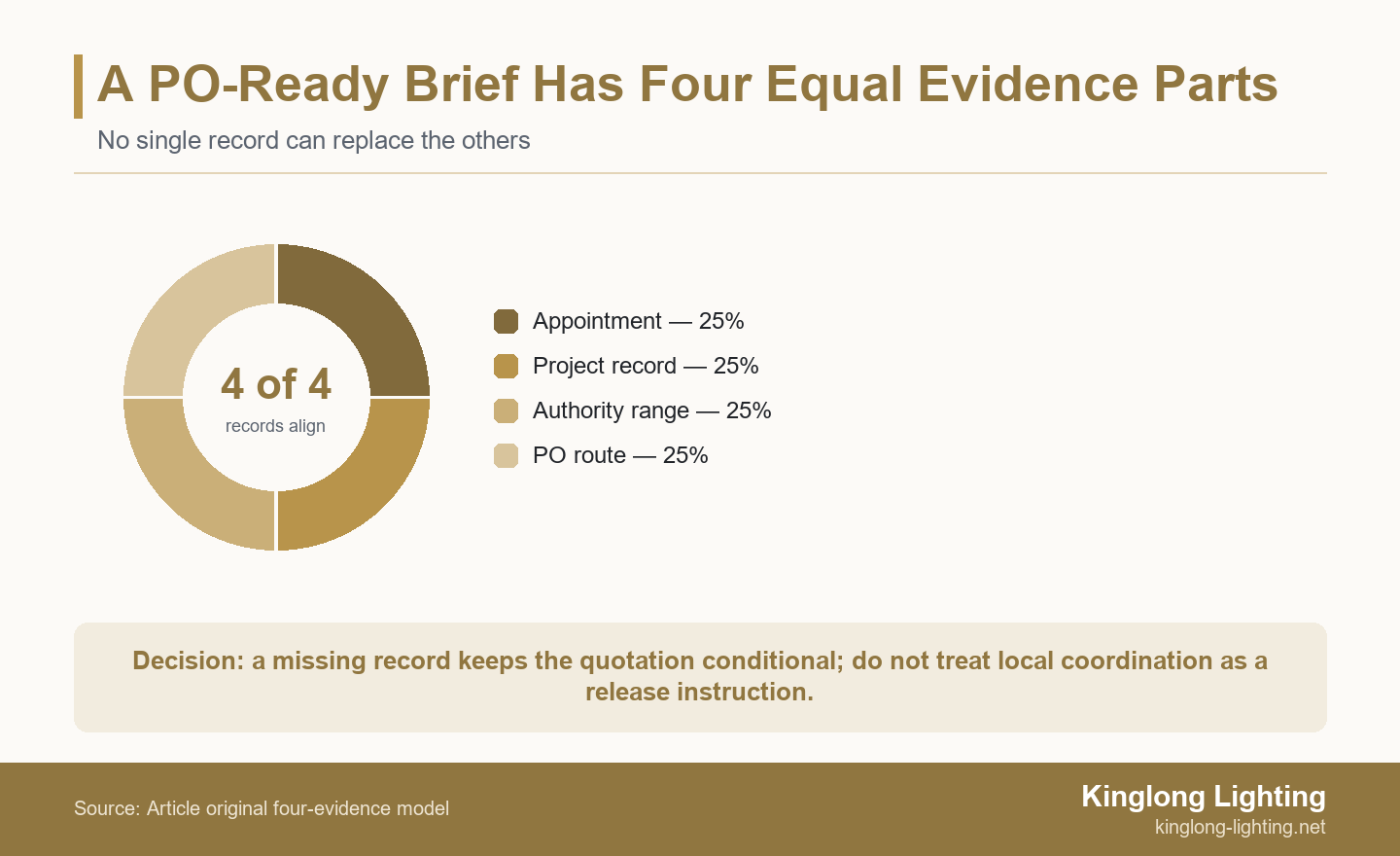
A China-based overseas-project enquiry becomes purchase-ready only when appointment, project record, authority range, and PO route align. Use the four checks together: an appointment names the organization behind the contact; a project record connects the request to current scope; an authority range states what the contact may approve; and a PO route identifies who can turn the accepted package into an order.
- Do not score location as authority. Local supplier access, bilingual communication, or a familiar title can speed coordination, but none proves a binding decision.
- Price to the evidence present. An incomplete file can still justify an exploratory or conditional commercial response.
- Control the revision before the price. A quote has little value when the drawing, finish schedule, or language version is unresolved.
- Keep the PO route separate from logistics. A party arranging samples, freight, or supplier calls may not be the party that issues commercial release.
Local supplier access is not the same as project authority
| Record to request | What it can establish | What it does not establish alone |
|---|---|---|
| Appointment or email from the owner-side organization | Who asked the contact to work on the project | Authority to approve every change or sign a PO |
| Current project schedule, room list, or lighting package | That the request belongs to an identifiable scope | Which version controls a finish or quantity change |
| Authority note with a value, decision, and validity limit | What the contact may decide for that project | Authority outside that stated range |
| Named PO issuer or approval route | How an accepted package becomes an order | That a coordination message is a commercial release |
First prove the request belongs to a current project
The cited World Bank procurement framework uses clear role definition and assigns the Borrower responsibility for procurement activities, records, and contract management. That is a public-procurement example rather than a rule for every private project, but it makes a practical supplier question clear: which organization owns this particular lighting decision?
Ask for a project name or code plus one current record that makes the request concrete: a lighting package, room schedule, bill of quantities, procurement schedule, or approved concept package. The record need not disclose a full project file. It simply needs enough context to tie the request for pricing to a live scope, location, and revision date. For a hotel package, the team can also review hospitality lighting project requirements before translating a decorative concept into fixture, finish, and room-by-room inputs.
Then prove what the contact may decide
GOV.UK guidance says authority evidence should identify the subject, representative, permissions, when they were granted, involved third parties, and any relevant conditions. In this checklist, delegated authority means documented permission to make a defined decision for a named organization. The useful request is therefore specific: may this contact approve a finish change, accept a unit price, authorize a sample, or only collect supplier information?
U.S. trade guidance advises that a foreign-representative agreement should specify whether the representative has power of attorney and may enter agreements binding the firm. It is a U.S. export resource, not legal advice for another jurisdiction. Its operational lesson still travels well: a title such as sourcing agent, procurement manager, or project coordinator does not answer the binding-authority question. Match each request to its limit, especially where value, timing, design change, or third-party approval is involved.
Use one controlling revision before discussing custom lighting
The cited UNCITRAL model requires a documentary procurement record that includes the subject matter, participating suppliers or contractors, the contract party, and contract price. A controlling revision is the approved version a project uses when files or languages conflict. This public model does not dictate a private overseas project’s file format, but it shows why a commercial request should identify the current subject and the trail of the decision rather than rely on an isolated spreadsheet attachment.
Before a supplier re-prices a decorative pendant, request a cover note that identifies the project code, drawing or schedule number, revision date, changed item, and person who resolves a discrepancy. If an English finish description and a local-language schedule differ, quote the change as an option against the named reference line. Do not make the supplier choose the more likely version.
That discipline is particularly useful where a project is refining dimensions, finish samples, mounting details, or room allocation. Kinglong Lighting can receive a defined decorative-lighting brief, but it cannot determine the buyer-side approval. Teams preparing those inputs can organize a controlled custom-lighting brief around the drawing, finish, and scope that are actually ready for review.
Do not confuse supplier coordination with a purchase-order path
A purchase-order path is the approved route through which a project turns an accepted package into an order. A purchase-ready overseas-project request needs a named commercial release route in addition to the project contact’s supplier coordination. It may involve an owner, project-management company, purchasing entity, or authorized contractor; the checklist does not assume that the China-based contact must occupy any one of those roles.
U.S. trade guidance says Incoterms® clarify buyer and seller tasks, costs, and risks for shipment, insurance, documentation, and customs-related activities. Those responsibilities matter once a sale moves toward delivery, but they do not assign authority inside the buyer’s project team. A freight instruction, sample collection request, or shipping contact is therefore not evidence that someone can release the revised commercial line.
Ask one direct question before calling a quotation final: who issues the PO, or who authorizes the named party to issue it? The answer should point back to the same project and current revision. If the route is still being selected, record that fact and keep the offer conditional rather than forcing the contact to produce a document they do not control.
Match the quotation to the evidence that exists
An RFQ is a request for quotation used to obtain a supplier’s commercial response. A supplier can use exploratory, conditional, and purchase-ready response states instead of treating every enquiry as either a rejection or an order. The count is an illustrative decision aid, not a legal score: zero or one matched record calls for clarification; two or three support a conditional option; all four support a purchase-ready commercial handoff, subject to normal contract and compliance review.
| Matched evidence | Supplier response | Commercial boundary |
|---|---|---|
| 0–1: contact detail or a broad project description | Exploratory reply: clarify project, scope, and decision owner | No final price, change release, or production commitment |
| 2–3: identifiable project plus partial authority or PO information | Conditional quotation, sample discussion, or budget range | State the missing record and retain the current reference line |
| 4: appointment, project record, authority range, and PO route agree | Purchase-ready commercial handoff | Proceed only under the supplier’s normal contract, technical, and compliance checks |
An RFQ is not automatically an approval. This three-state approach lets a local coordinator keep moving a project forward while protecting the owner-side team from an accidental scope release. The condition should be plain enough to reuse in an email: price valid for the identified revision, subject to written confirmation of the change approver and PO route.
Illustrative scenario: price a finish change without turning it into a release
A conditional option can price a finish revision while preserving the separate question of authority and PO release. The following composite example is not a Kinglong Lighting project or a universal contractual rule; it shows how the evidence threshold can guide a supplier response.
Align the four records before releasing the revised line
The revised line remains conditional until the project reference, controlling revision, authority limit, and PO route align in one handoff. In this illustration, a China-based procurement coordinator is collecting quotations for an owner-appointed overseas boutique-hotel renovation. The lighting request covers 48 decorative pendant and wall-light pieces across two guest-floor zones, including 12 pendants whose finish changes after a local designer updates the palette.
The coordinator provides a bilingual finish schedule and asks for a revised price. The project and contact are identifiable, yet neither attachment names the approved current revision or shows whether the coordinator may approve a finish change or commercial release. The English and local-language schedules carry different revision dates, and no PO issuer or discrepancy owner appears. That is enough evidence for a genuine, conditional price exercise, not enough for a purchase-ready revision.
The supplier keeps the prior finish as the reference line and quotes the 12 revised pendants as a clearly conditional option. The reply asks for one revision cover note: project code, current schedule, changed finish, named decision owner, and the party authorized to issue or authorize the PO. This preserves the designer’s ability to compare a finish option without telling the project team that a changed commercial line has already been released.
The verification gate is simple: the same project reference, approved revision, documented authority limit, and PO route must appear in the handoff before the revised line becomes purchase-ready. The count is not a universal contract test; it is a supplier-side boundary that prevents a missing record from being mistaken for approval. This composite example may have additional project controls, but it should not need to guess which file or person governs the changed item.
Send a five-part packet before asking for a binding quote
The World Bank describes the Project Procurement Strategy for Development as the Borrower’s primary procurement planning instrument for an investment project. That framework applies to World Bank-financed projects, not every private project. Its planning logic is useful here: a supplier can ask for a project-linked reference before treating a commercial request as a final release.
A five-part packet of project, revision, scope, authority, and PO information enables a supplier to give a controlled response. Keep it short enough for the project team to assemble and precise enough for the supplier to price the same object the approver intends to release.
- Project: name, code, location, and the appointing organization.
- Revision: the drawing or schedule that controls, with date and discrepancy owner.
- Scope: item codes, quantities, finishes, room allocation, and any open technical question.
- Authority: the named approver, permitted decision, and any value, timing, or change limit.
- PO route: the organization or party that will issue or authorize the PO for that scope.
The useful handoff is a defined set of drawings, finishes, quantities, and decision contacts—not a claim that the whole project is ready for production. Once those five items are available, a project team may ask Kinglong Lighting to request a scoped project-brief review.
Frequently Asked Questions
What proves a China-based procurement team represents an overseas project?
The strongest starting proof combines a named project reference, the appointing organization, and a current document that connects the team to that project. A lighting schedule, room list, or package reference establishes the scope; an appointment or owner-side confirmation establishes the relationship. Ask separately what decision the team may make, because representing the project does not automatically include authority to approve a price, change, or PO.
Can a procurement coordinator ask suppliers for project pricing?
Yes, a coordinator can request exploratory pricing if the supplier records that the project authority and PO route remain unconfirmed. An identifiable scope may justify a budget range, a sample discussion, or a conditional quotation. The supplier should state the reference revision and the missing approval information so a helpful price exercise is not mistaken for a released commercial commitment.
Should bilingual specifications be treated as the same revision?
Only if the project identifies both files as the same approved revision and names the document that controls when a discrepancy appears. Matching titles or similar filenames are not enough where a finish, dimension, quantity, or installation detail could change the quoted line. If the files diverge, retain the existing reference and price the alternative as conditional until the project resolves the difference in writing.
When can a supplier treat an overseas project quote as purchase-ready?
A quote becomes purchase-ready when the relevant scope, current revision, authorized approver, and intended purchase-order route point to the same project decision. That alignment does not replace the supplier’s normal contract, technical, compliance, credit, or production checks. It does give both sides a clean commercial handoff and a record of who may release the specific package being quoted.