
The most expensive lighting approval mistake is not choosing the wrong fixture. It is treating one party’s comment as authority for every downstream decision. In a hotel project, five gates can sit with different people: concept direction, brand fit, technical and operational review, budget, and purchase-order release. The useful question is not “Who is most senior?” It is “Who owns this decision, on which current record, and who resolves a conflict?”
Start with five gates, not one senior approver
Hotel lighting approval authority should be mapped across five separate gates: concept, brand, technical and operational review, budget, and purchase-order release. An approval gate is a specific decision with a named owner and supporting record; it is not a job title or a meeting invitation. FF&E, or furniture, fixtures, and equipment, is the category that often places decorative lighting inside this multi-party route.
- Concept: does the proposed decorative direction match the approved design brief?
- Brand: does it meet the relevant brand requirement or approved exception path?
- Technical and operational: can the item be documented, installed, maintained, and used as intended?
- Budget: does the active allowance or approved change cover the decision?
- PO release: does the authorized purchase route point to the same specification revision?
A developer may own the investment decision, an operator may shape operability, and a hotel brand may govern design consistency. Those roles can overlap, but none should be assumed to own every gate. The governing project documents decide the route.
Name the approval object before naming the approver
A hotel lighting approval route needs a distinct current record for the concept, brand, technical, budget, and PO gates that apply to the project. This prevents a supplier from treating a mood-board comment, a sample observation, or a price request as an instruction to manufacture or change a line item.
Start with the object being decided. A concept gate may concern the visual hierarchy of a lobby pendant. A brand-fit gate may concern whether the finish, scale, or location fits a stated standard. Technical review may concern drawings, fixing points, electrical data, sample finish, access, or maintenance. Budget approval concerns the commercial effect. PO release concerns the authorized document used to place the order. These decisions are connected, but they are not interchangeable.
On a branded project, the relevant contract may include a technical services agreement, an agreement describing technical or design review services for a hotel project. It can assign review rights without automatically assigning the owner-side budget or purchase commitment. Ask for the current appointment, approval matrix, or submittal register rather than asking a supplier to infer the answer.
For a decorative-lighting manufacturer such as Kinglong Lighting, an early response should distinguish an option study from a supplier-ready instruction. That protects the buyer’s decision rights and lets the supplier state exactly which record is still needed.
Concept and brand-fit gates protect the intended guest experience
Hilton’s public fitness-center workflow sends a final selected layout to a Hilton Designer and Project Manager for review and approval. Hilton’s published workflow is a specific fitness-center example, not a universal hotel-lighting rule, but it makes the useful point that a brand-facing project review can have named reviewers and a defined submission route.
A Marriott disclosure example requires information and samples when an unapproved FF&E source is proposed for a standards-controlled item. The cited disclosure is limited to its own system and specifications, yet it explains why a brand-fit conversation may require evidence about both the decorative-lighting item and the proposed source.
The output of this gate is not “the brand likes it.” It is a current instruction: an approved concept package, logged comment, approved sample reference, or documented exception. If the design direction is still open, a supplier can offer options, but should label the response as exploratory rather than final.
Technical and operational review tests whether the chosen direction can be delivered and used
Hilton describes owners, project managers, and hotel personnel using its supplier resource to select products and services for new builds and renovations. That Hilton resource shows several hotel-side roles participating in selection; participation alone does not reveal who may release the supplier.
A Marriott disclosure example requires franchisor approval for future material changes to the Design and Independent Brand. The disclosure example supports a narrower lesson: a material design change can need a new approval even when a commercial comparison already exists.
For decorative lighting, define what technical acceptance means. It might be a reviewed drawing, a finish sample, a mock-up comment, a mounting detail, or a maintenance-access response. The operator’s team may contribute critical operating input. The designer or brand reviewer may test the guest-facing result. Neither input should be silently converted into a purchase instruction unless the project record says it also carries that right.
Budget and PO release are commitment gates, not design comments
A filed hotel agreement example separates an owner-approved capital budget from specific authorization for certain capital expenditures. The filed agreement is one contract example, not a universal threshold, but it illustrates why a budget record should be kept distinct from design and technical comments.
Before a quote becomes a commitment, confirm the allowance or approved change, the commercial decision owner, and the authorized PO route. A developer’s representative may approve the commercial impact. Procurement may run comparison and documentation. A separate signer may release the PO. Treat “please proceed” as conditional until its sender, scope, and revision match the authorized route.
Turn roles into a gate-and-record map
A filed Marriott project exhibit reviews a mock-up against design standards, fit, finish, quality, and installed FF&E. That filed exhibit is a stated project-agreement example, not a generic mock-up mandate. Its value here is that technical acceptance names evidence objects rather than a vague “approval.”
A lighting request is supplier-ready only when each required gate has a named decision owner, a current record, and an escalation path. This is an original route-completeness test: roles follow records, not titles. If one gate is missing, the supplier’s response remains conditional; if a revision changes a record, the affected gate must be checked again before release.
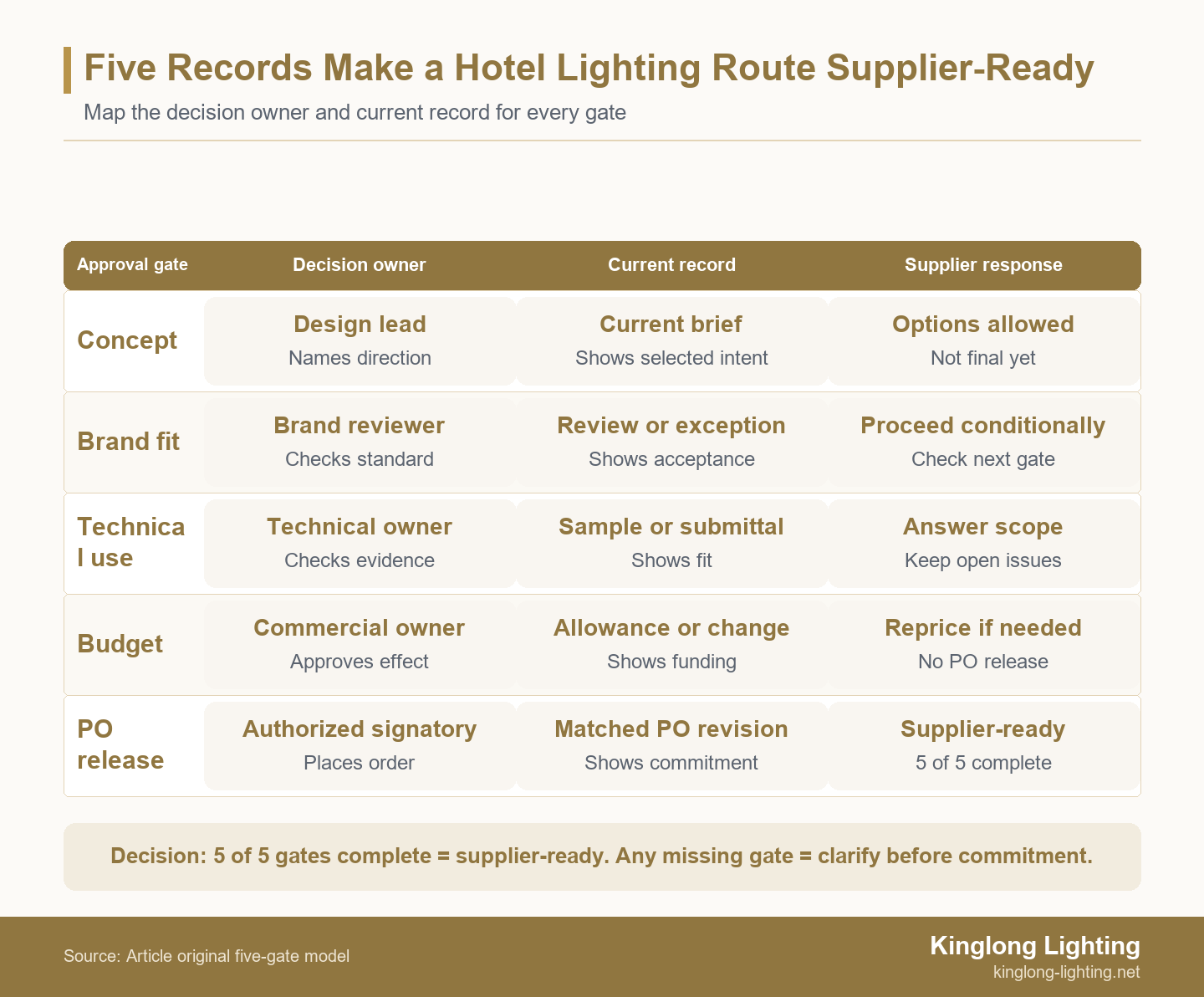
| Gate | Question to settle | Record to request | Typical owner to verify |
|---|---|---|---|
| Concept | What visual direction is being selected? | Approved lighting brief or issue log | Developer design lead or appointed designer |
| Brand fit | Does the direction meet the applicable standard? | Brand review, comment log, or exception | Named brand reviewer |
| Technical and operations | What evidence proves the item can be delivered and used? | Drawing, sample, mock-up, or submittal response | Technical reviewer and relevant operator input |
| Budget | Is the commercial effect authorized? | Allowance, change approval, or approved comparison | Owner-side commercial decision owner |
| PO release | Who can place the order on the current revision? | Authorized PO route and final issue reference | Procurement or named authorized signatory |
Use the table as an approval matrix, not as a hierarchy chart. One organization may own two or more rows. Another project may split one row between a reviewer and a signatory. Once the first two rows are clear, teams can review hospitality lighting project inputs against the active brief rather than send a supplier a stack of unranked comments.
Give the supplier a controlled brief, not a collection of stakeholder comments
A controlled lighting brief should identify the active specification, gate owners, revision status, and unresolved decisions without assigning buyer-side authority to the supplier. This gives the supplier enough information to answer the right question while keeping approval and award responsibility where the project documents place it.
For a custom pendant, chandelier, or feature-lighting line, include the fixture schedule and locations, the latest drawings or dimensional limits, the material and finish reference, the sample or mock-up decision needed, the commercial status, and the date by which each open gate must be resolved. If the design is still being developed, state that plainly. A request for a final quote with an unclosed finish or unconfirmed quantity should produce a conditional quote, not a promise of release.
Kinglong Lighting can receive this type of project input for a custom decorative-lighting response. After the owner-side route is mapped, teams can organize a custom-lighting development brief around the decision records rather than around titles. That distinction is useful when a change affects appearance, fabrication detail, or the quote basis at the same time.
The provider check comes after, not before, the authority check. Published work can help a team understand application context, but it cannot prove the present project’s approval route. For that limited purpose, a buyer may review lighting project examples by application context, then return to the current brief, approval log, and commercial record.
Illustrative scenario: isolate a revised pendant line instead of reopening the whole package
Rebuild the four records that changed with the line item
A revised decorative-lighting line can be held and reissued without reopening unaffected approved lines. The following is a composite scenario, not a Kinglong Lighting project or a statement of any hotel brand’s standard process.
A resort developer has appointed an operator and is preparing a branded-lobby package with 18 decorative pendants. 4 pendant variants are affected when a supplier has already priced the issue and a sample comment asks for a revised finish presentation. The brand reviewer accepts the intended guest-experience direction, but the developer’s cost controller has not confirmed whether the revision changes the approved allowance.
The first observation resolves part of the brand-fit gate. The second leaves the budget gate open. The team also needs to know whether the revised finish requires a new technical sample response and whether procurement’s comparison sheet still represents the same line item. A comment from either the operator or brand reviewer may be valuable evidence, but it does not automatically settle all four questions.
The proportionate decision is to hold the revised pendant line, not to reopen every unaffected fixture. The team issues one controlled revision showing the revised sample reference and names the brand reviewer, technical reviewer, budget owner, and PO release owner. The supplier re-prices only the changed line against that revision, while unchanged lines remain on their existing approved references.
A revised pendant line returns to the PO route only when its sample, technical response, budget effect, and release record point to the same revision. This protects both sides: the buyer does not compare unlike scopes, and the supplier does not manufacture against a superseded instruction.
Before release, compare the finish reference, current drawing or sample decision, changed price effect, and authorized PO instruction line by line. If one record still names the old variant, the route is incomplete. This illustrative example does not replace contract interpretation, but it makes the missing decision visible quickly enough to escalate it to the right project owner.
Use a five-item pre-PO approval pack
A five-item pre-PO pack turns an ambiguous lighting request into a controlled supplier route. Prepare it before asking any supplier to treat a quotation, sample, or revised schedule as final.
- Name the concept and brand decision owners for the active lighting revision.
- Attach the current schedule, drawings, finishes, quantities, and location references.
- State the technical or operational evidence still needed to accept the line.
- Identify the budget record and commercial owner for any change effect.
- Confirm the authorized PO release route and required decision date.
If your team has these records but needs a supplier-ready response, request a scoped approval-and-brief review with the matrix, current decorative-lighting schedule, sample or drawing revision, and named commercial-release owner. Kinglong Lighting can use those inputs to clarify the response package without assuming buyer-side approval rights.
Frequently Asked Questions
Can a hotel brand approve a lighting fixture without the owner’s budget approval?
Usually no: brand acceptance and budget authorization are separate project decisions unless the governing agreement combines them. A brand reviewer may confirm that a decorative-lighting direction fits the relevant standard or approved exception. That does not, by itself, confirm the allowance, approved change, or commercial release. Ask the project team to identify the budget record and owner-side decision owner before treating a brand comment as a purchase instruction.
Who should approve a decorative-lighting sample for a branded hotel?
The named technical or brand reviewer should approve the sample against the current brief, while the commercial owner confirms any cost or scope effect. The sample decision should name the exact finish, material, dimensions, and fixture line it resolves. If the sample changes the quoted item, its approval should trigger a check of the budget and PO gates rather than become a standalone production release.
What should a supplier do when developer and operator comments conflict?
The supplier should log both comments, identify the affected gate, and request one consolidated direction from the recorded decision owner. It is reasonable to continue exploratory technical work if the scope is clear, but the resulting response should be labelled conditional. The supplier should not choose between developer and operator comments or treat either as final if the current record does not assign that decision right.
When is a lighting quotation ready for a purchase order?
A quotation is PO-ready when the active specification, quantities, commercial terms, and authorized release route all point to the same revision. The project should be able to trace any sample or design change into the price record and final instruction. If one document still refers to an earlier finish, quantity, or fixture detail, keep the affected line conditional until the records are aligned.