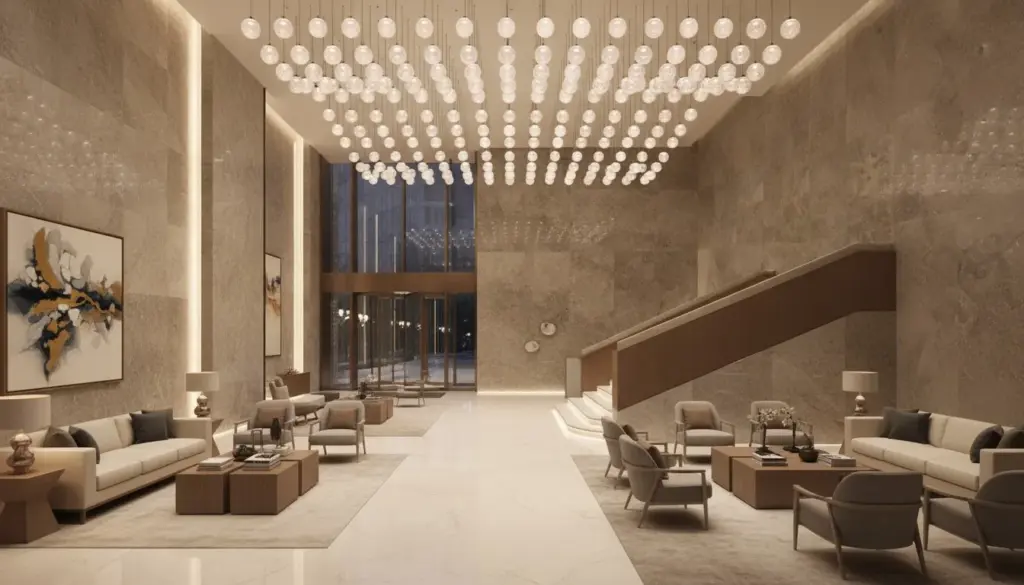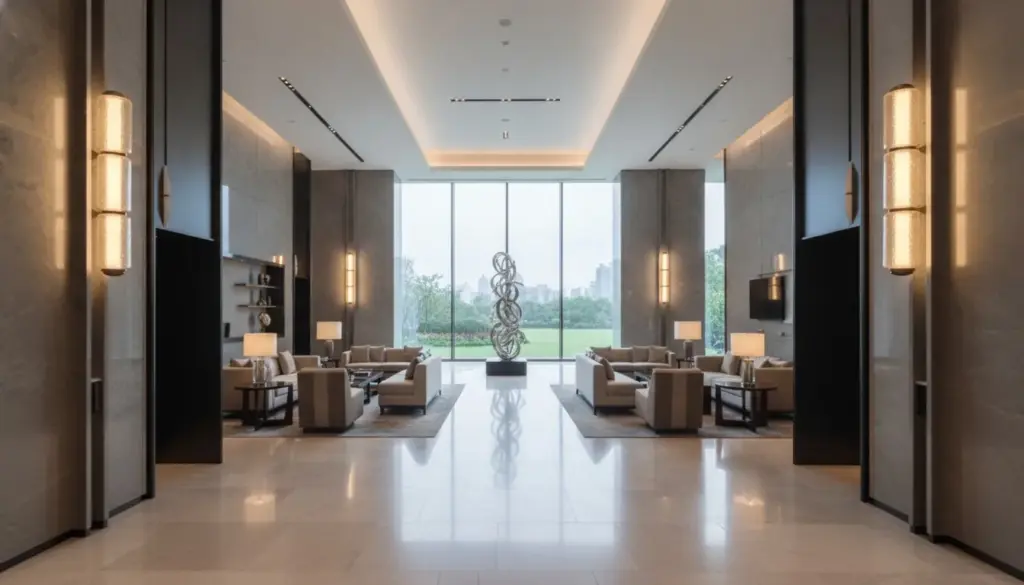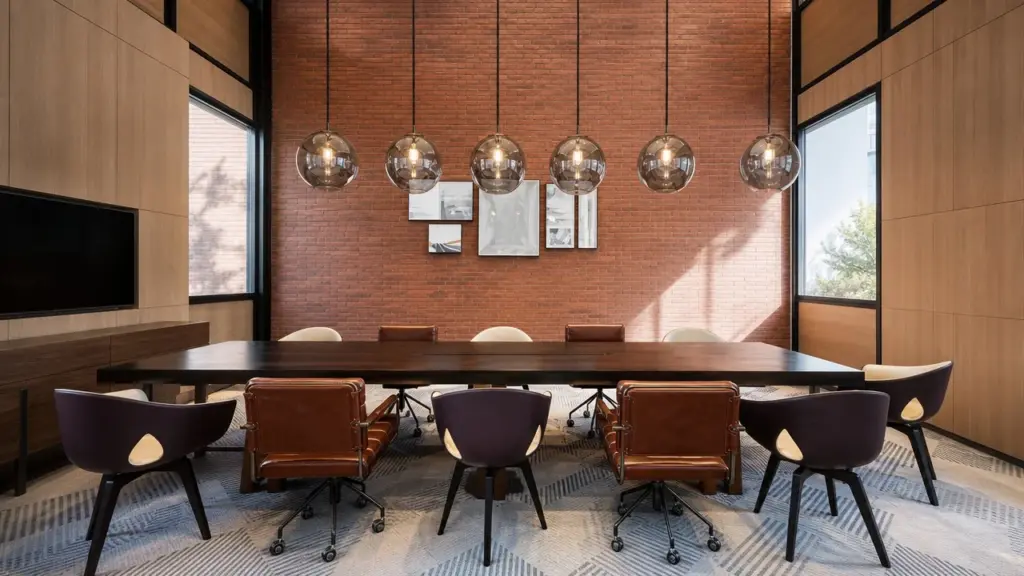
Boutique hotel chandelier procurement is usually a design-authority problem, while branded hotel chandelier procurement is a proof-authority problem. The fixture may look similar in renderings, but the approval path is different: a boutique owner can choose a dramatic story quickly, while a branded property must show that the story fits a system of guest experience, maintenance, compliance, and repeatability.
That difference matters because chandelier decisions are expensive to reverse. A lobby piece can touch structure, dimming, public-area identity, cleaning access, replacement parts, delivery routes, and operator reputation. The smartest procurement teams therefore ask a simple question before comparing quotations: who has the authority to change the design, and who must prove that the final fixture will work after opening?
For Kinglong Lighting, the useful role is not to push one hotel type over another. It is to help owners, designers, and purchasing teams translate the chosen operating model into drawings, samples, color proof, packing, and release evidence before production.
Key Takeaways
- Authority first: Boutique projects move faster when one owner can approve changes, but the same freedom can create late rework.
- Brand proof: Branded hotels usually need a stronger evidence file because consistency matters across many properties.
- Supplier risk: The best chandelier supplier is the one that can document decisions, not only manufacture beauty.
- Design trade-off: Boutique memorability and branded repeatability can both work when the proof file matches the decision path.
- Kinglong relevance: Custom hospitality lighting needs supplier-side drawing, sample, testing, and installation coordination.
The real difference is who owns change control
A boutique chandelier brief is usually won by a stronger story; a branded hotel chandelier brief is usually won by a cleaner approval file.
Public hotel brand policy pages show why procurement has become broader than appearance. Marriott keeps supplier and responsible business materials in its Serve 360 policy hub. Hilton publishes a Responsible Sourcing Policy. IHG publishes a responsible procurement policy. These documents are not chandelier specifications, but they show the direction of chain procurement: suppliers are evaluated as risk owners, not just product vendors.
A boutique hotel can still be highly disciplined, and a branded hotel can still be highly creative. The separation is not taste. It is governance. When a boutique owner asks for a sculptural lobby chandelier, one owner, one design team, and one operator may settle the final compromise. When a branded property requests a lobby chandelier, the same fixture may need alignment with brand review, fire and electrical review, hotel operations, purchasing, owner budget, maintenance, and sometimes regional design approval.
Boutique flexibility can hide missing evidence
Boutique projects often move through personality and narrative. The owner wants a memorable arrival moment, the designer wants a fixture that photographs well, and the supplier may be asked to prototype fast. That can be efficient. It can also skip quiet decisions that become painful later: driver access, crystal cleaning, replacement module numbering, dimming compatibility, ceiling load path, and the exact finish master to repeat if a second fixture is ordered.
The mechanism is an information gap. Because the approval circle is smaller, the team may assume that everyone shares the same image of the final chandelier. The buyer approves a rendering, the designer approves the mood, the factory builds from a drawing, and the installer discovers that the room needs a different service route. Freedom is valuable only when the supplier converts it into a documented release file.
Branded hotels reduce ambiguity by adding gates
Branded projects tend to create more gates before production. The project team may ask for drawings, samples, color notes, certification evidence, mock-up photos, installation method, spare parts, and maintenance instructions. Those gates can feel slow, but they protect the property from a common failure: a beautiful chandelier that does not fit operational expectations once the hotel opens.
For a supplier, the hidden requirement is version discipline. If a sample is approved with one metal tone and the drawing uses another, a branded hotel team will treat that as a release risk. If a public-area chandelier requires special cleaning equipment but the maintenance team was not told, the issue is not only aesthetic. It becomes an operator burden. Branded procurement pushes these decisions into the file before a deposit becomes a production commitment.
What brand standards change in the chandelier file
Brand standards reshape procurement by moving attention from isolated beauty to repeatable evidence. A chandelier package for a branded hotel should make it easy to answer five questions: does the fixture fit the brand experience, can the operator maintain it, can the supplier reproduce approved finishes, can safety and testing evidence be checked, and can the installation team assemble it without improvising in the lobby?
| Decision area | Boutique hotel tendency | Branded hotel tendency | Supplier evidence to request |
|---|---|---|---|
| Concept approval | Owner and designer judge story strength | Brand review checks identity fit | Scaled rendering, material board, finish master |
| Specification control | Changes can be informal | Changes need traceable approval | Revision log and signed sample record |
| Operation | Maintenance may be solved late | Maintenance is part of risk review | Cleaning route, spare list, driver access |
| Compliance | Evidence may follow the order | Evidence is reviewed before release | Testing path, label plan, destination market notes |
| Rollout risk | Single-property uniqueness dominates | Repeatability matters across properties | Lot traceability and replacement part coding |
The conclusion is that boutique procurement needs disciplined freedom, while branded procurement needs documented creativity. The fixture can be expressive in both cases, but the supplier file must answer different approval anxieties.
Lighting quality still needs technical discipline
The IES Lighting Library gives professional context for application, controls, maintenance, and lighting practice. The DOE TM-30 FAQ helps teams discuss color rendition beyond vague claims about warmth or richness. UL luminaire testing and certification reinforces that a luminaire file needs evidence beyond a beautiful product photo. These sources do not decide hotel style, but they support a procurement habit: translate atmosphere into measurable checks.
Calculated from a 5-gate chandelier file: 2 missing gates / 5 required gates = 40 percent of the approval file unresolved, and the unresolved part usually lands in the most expensive phase. If the missing gates are maintenance and compliance, a low purchase price can become a high-risk decision. In practice, the buyer should treat a weak evidence file as a delayed cost, not as a faster route.
Where Kinglong Lighting naturally fits the decision
Kinglong Lighting is relevant because hotel chandelier procurement often needs a bridge between design ambition and factory proof. The hospitality lighting page frames the hotel application, while the customization workflow supports bespoke drawings, materials, and production handoff. For branded hotels, that bridge should make the evidence file easier to approve. For boutique hotels, it should keep creative freedom from turning into late ambiguity.
The useful procurement request is not simply “send options.” Ask for a file that separates design intent, material sample, electrical route, maintenance route, packing plan, and installation assumptions. If the supplier cannot separate those topics, the project team will be forced to solve them later, when design changes are slower and more expensive.
Procurement handoff before quotation
Before requesting prices, align the approval path. A boutique buyer should name the final creative decision maker and the issues that cannot change after mock-up. A branded hotel buyer should list the required review gates and the evidence format expected by the brand, operator, owner, and contractor. Both should define destination market, ceiling condition, dimming system, service access, delivery route, and sample approval authority.
If the project is already close to specification, send Kinglong Lighting the room role, concept images, drawings, ceiling information, target materials, destination market, and required approval gates through the custom chandelier procurement review. Ask the team to identify which parts of the file are design decisions, which are manufacturing decisions, and which are installation risks.
Related Guides
- Hotel Chain Chandelier Procurement: Cross-Brand Analysis
- Hilton Branded Properties Lighting Standards: Conrad vs Curio
- Four Seasons Lighting Benchmark
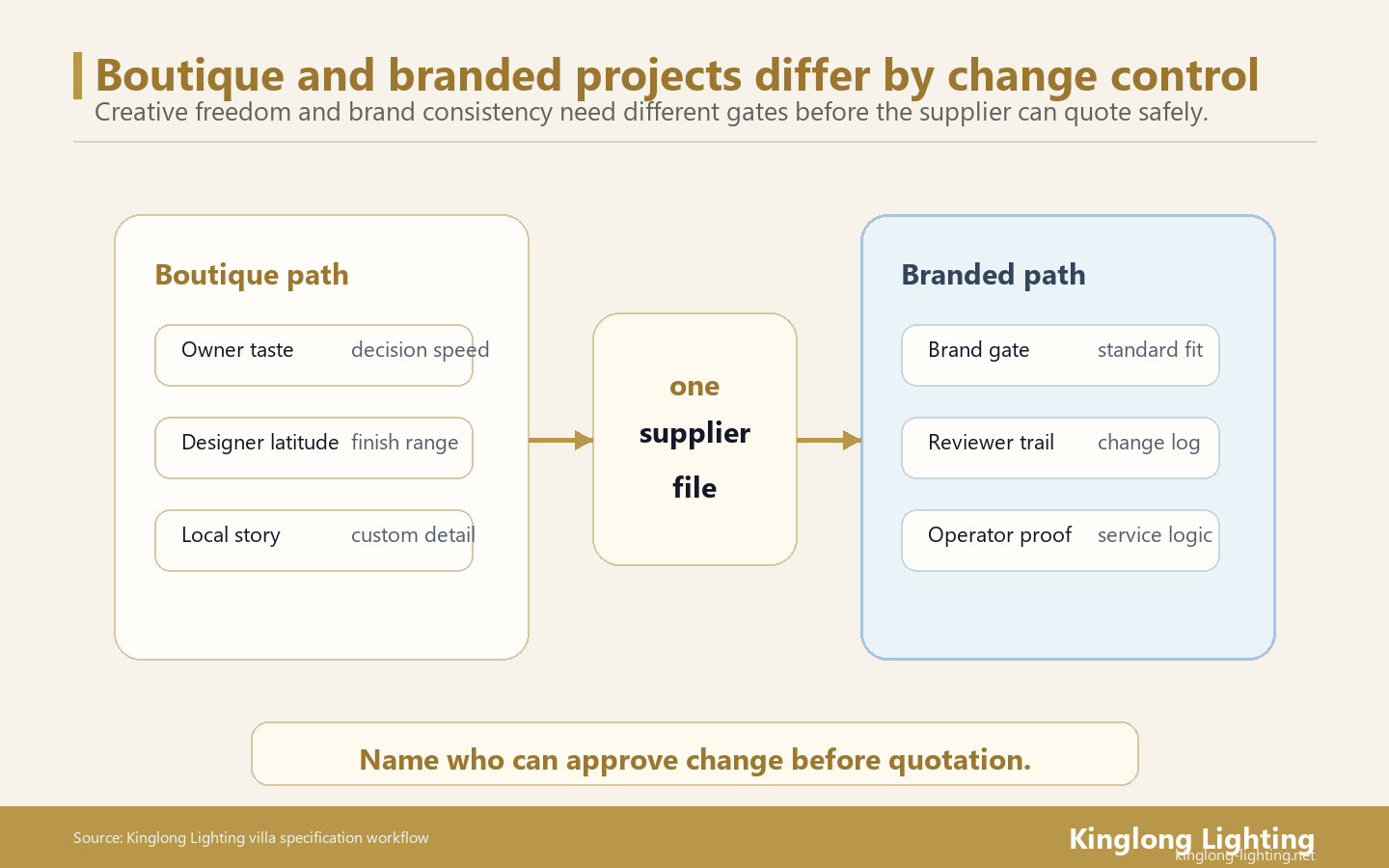
A boutique-versus-branded chandelier file should expose change control
The useful comparison between boutique and branded hotel chandeliers is not only visual freedom versus brand consistency. It is who can approve change, what evidence must follow that approval, and when the supplier can treat the design as ready to quote. Boutique projects can move quickly because fewer stakeholders may be involved. Branded projects can move safely because standards and review gates reduce ambiguity. Both paths need a clear handoff before custom production.
Make boutique freedom visible
Boutique freedom is valuable when the owner, designer, and supplier agree on the limits of that freedom. The file should name the design intent, material range, budget sensitivity, installation assumptions, and the person who can approve a late revision. Without that boundary, creative flexibility can become a source of repeated redraws, finish changes, or scope growth. A custom chandelier supplier can support boutique work best when freedom is translated into a controlled set of options.
Give branded standards a creative outlet
Branded hotels need consistency, but that does not mean every chandelier should feel generic. The branded file should identify where creativity is allowed: local material cue, proportion, shade detail, scene behavior, decorative rhythm, or lobby focal point. It should also identify what cannot move: safety evidence, maintenance route, finish master, guest comfort, brand reviewer requirement, and installation access. That separation lets the project feel specific without forcing the brand team to reject the whole concept.
Use one supplier file with different gates
Kinglong Lighting can present boutique and branded options through one supplier file structure while changing the gate emphasis. Boutique work may need stronger revision tracking and owner sign-off. Branded work may need clearer compliance notes, reviewer history, and documentation continuity. In both cases, the file should include drawings, samples, material proof, control notes, packing logic, spare strategy, and a final approval boundary. That gives procurement a way to compare risk instead of comparing only visual mood.
Decide before quotation what a change costs
The most expensive changes are often the ones that look small: a finish adjustment after sample approval, a size change after engineering, a driver move after ceiling coordination, or a crystal density change after packing logic is set. The procurement file should state which changes are free design refinement, which changes reopen engineering, and which changes require a new quotation. That is the real boundary between creative flexibility and uncontrolled cost.
Keep the final brief short enough to use
The change-control file does not need to become a long manual. It should be short enough for the owner, brand reviewer, designer, procurement lead, and supplier to use in one meeting. A strong version names the project path, the approval owners, the evidence required, the flexible items, the frozen items, and the trigger for repricing. That gives Kinglong Lighting a practical basis for quotation while leaving enough room for design development where the project genuinely needs it.
Once that brief is agreed, every revision can be logged against the same structure. The team can see whether a change is a design improvement, a brand requirement, a procurement clarification, or a manufacturing risk. That visibility is what keeps a custom chandelier project from drifting while still allowing creative decisions to mature.
Frequently Asked Questions
Do boutique hotels need brand-style chandelier documentation?
Yes, boutique hotels need documentation when the chandelier affects structure, safety, dimming, maintenance, or replacement parts. The documentation can be lighter than a chain hotel file, but it should still capture approved finish, dimensions, electrical assumptions, cleaning access, spare parts, and installation sequence. The smaller approval circle should speed decisions, not remove evidence.
Why do branded hotels ask for more supplier evidence?
Branded hotels ask for more evidence because the chandelier must protect guest experience, operator consistency, and reputation across a larger system. A fixture that looks right in one rendering can still fail if it is hard to clean, incompatible with controls, undocumented for replacement, or weak on compliance proof. Evidence reduces those repeatable risks before production.
Can the same chandelier design work for both hotel types?
The same design language can work for both hotel types if the approval file changes. A boutique version may prioritize story, material expression, and owner approval. A branded version should add stronger revision control, maintenance notes, test evidence, and installation documentation. The product may look similar, but the procurement package should not be identical.
What should buyers send before asking for a quotation?
Buyers should send drawings, ceiling conditions, room role, concept images, target dimensions, material preferences, destination market, control assumptions, maintenance restrictions, and approval gates. If any of these are unknown, the supplier should identify the risk before pricing. A quotation without those inputs is more likely to hide later decisions.
Planning guides for your project
Use these guides to compare materials, prepare specifications and coordinate the next approval.