A dining room chandelier is specified correctly when it protects conversation, table composition, food color, guest comfort, and dimming control at the same time. A beautiful fixture can still fail if it hangs too high, drops into the sightline, or makes the table feel colder than the rest of the villa.
The dining room is a close-range hospitality space. Unlike a foyer chandelier, people sit under it for a long time. That makes scale, drop, color temperature, color rendering, glare, and control behavior more important than a dramatic first impression.
Kinglong Lighting can help villa owners and interior designers turn dining chandelier preference into a release-ready specification with table dimensions, finish samples, CCT targets, dimming behavior, and service notes.
Key Takeaways
- Table first: Dining chandelier scale should follow the table and seating pattern before room center.
- Drop is experiential: The fixture should create intimacy without blocking faces or serving movement.
- Warmth needs proof: 2700K-3000K may be useful, but material testing matters.
- Color quality matters: Food, flowers, timber, stone, and skin tone need better evidence than a CRI label alone.
- Dimming is part of specification: Scene behavior and driver compatibility should be approved before production.
Specify from the table outward
A dining chandelier belongs to the table experience before it belongs to the ceiling plan.
The DOE high performance residential lighting guide notes that dining rooms often combine table-specific lighting with ambient lighting and that dimming is often desirable. That matches how luxury villas use dining rooms: family dinner, formal hosting, late drinks, seasonal flowers, and sometimes work.
The first specification layer is table geometry. Record table length, width, height, number of seats, chair pull-out zone, buffet or sideboard location, and whether the table is fixed. A chandelier centered on the ceiling but not on the table will look wrong once furniture arrives.
Scale should respect edge distance
A practical dining rule is to keep the chandelier visually inside the table field unless the design is intentionally architectural and there is enough head clearance around the edges. The exact number depends on table width, chair style, ceiling height, and fixture geometry.
Drop height should protect faces and atmosphere
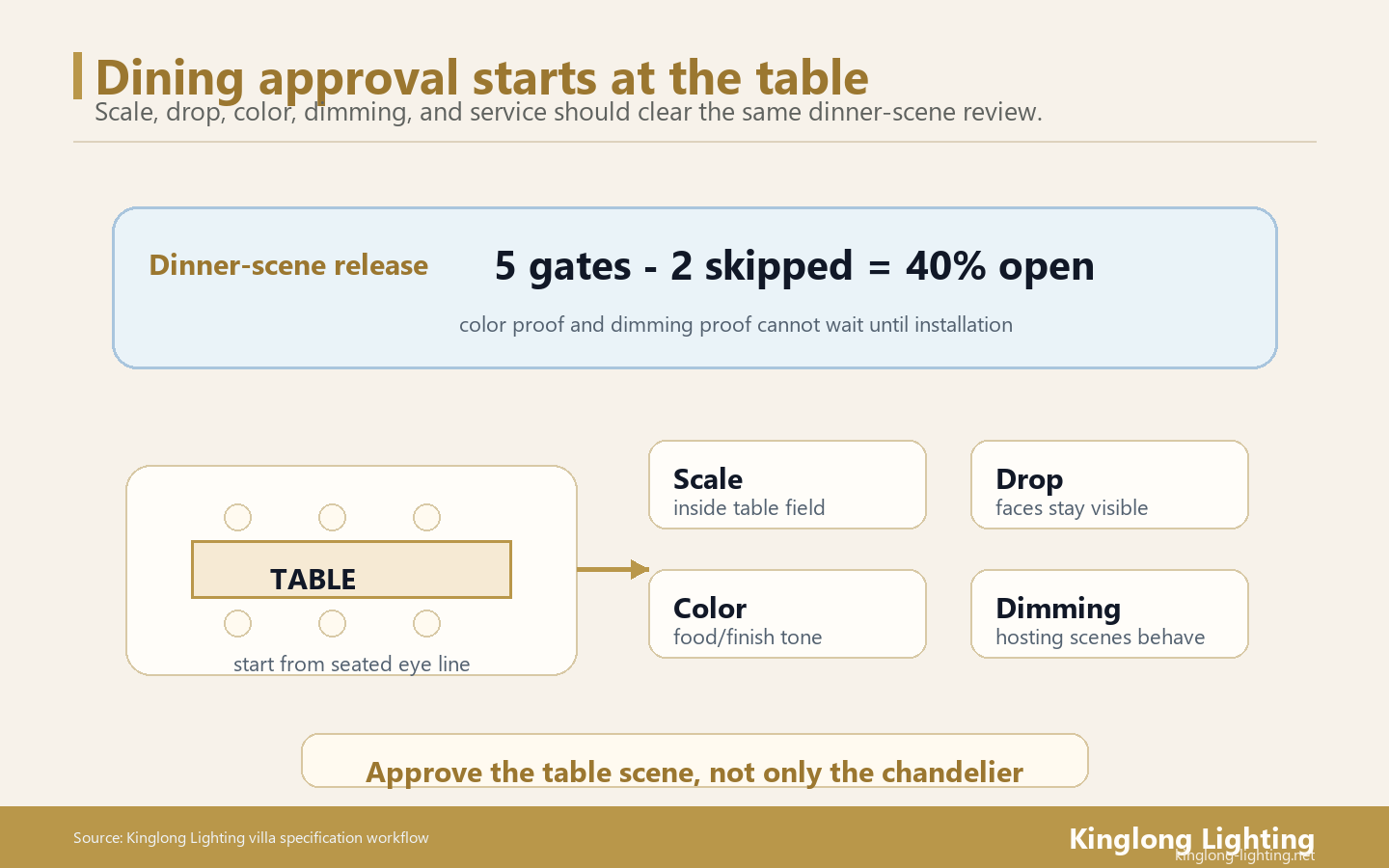
The drop should create intimacy without cutting across eye contact. In luxury villas, drop height should be reviewed with actual table height and seating plan. Test a seated eye line, a standing service route, and a sideboard view before approving the final suspension.
Color temperature is a material decision
Dining rooms often benefit from warm light, but warm white is too vague for specification. The DOE TM-30 FAQ explains that TM-30 provides a more complete way to evaluate color rendition than older shorthand. PNNL TM-30 guidance also explains why color quality criteria help users balance rendering, preference, and efficiency.
For a dining chandelier, color quality affects food, tableware, floral arrangements, timber, leather, stone, metal finish, and skin tone. A 2700K source and a 3000K source can both be appropriate, but the choice should be tested against the actual room palette.
2700K-3000K is a range, not a guarantee
Many dining rooms sit comfortably in the 2700K-3000K range, but the exact choice depends on interior palette and use. The safer specification is target CCT plus color evidence plus dimming range. If one of those three is missing, the dining room can look correct in a sample photo and wrong during dinner.
Dimming should be designed before ordering
The Lutron controls guide notes that scene-based controls can coordinate multiple zones at different intensities. A dining room benefits from that logic because chandelier, wall lights, art lighting, cove lighting, and sideboard lighting should not all move together at one level.
Material and glare checks belong in the release file
A complete dining chandelier release file names fixture diameter, drop height, finish, material samples, color target, color evidence, dimming behavior, driver location, cleaning method, spare parts, and installation assumptions.
| Spec area | Dining question | Risk if skipped | Evidence to request |
|---|---|---|---|
| Fixture diameter | Does it fit table and seating? | Guests feel crowded or room feels weak | Plan overlay with table |
| Drop height | Can guests see each other? | Blocked conversation or cold atmosphere | Seated eye-line check |
| CCT | Does the palette stay warm and accurate? | Food or finishes shift color | Sample under target source |
| Dimming | Can scenes support hosting? | One brightness level fits no occasion | Driver and control note |
| Service | Can parts be cleaned above a table? | Dust and fingerprints become visible | Cleaning method and spare list |
Calculated from a five-part dining release file, skipping color proof and dimming proof leaves two of five core decisions unresolved, or 40 percent of the dining experience uncontrolled before installation.
How Kinglong Lighting can support dining room specifications
Kinglong Lighting’s villa lighting service is relevant because dining chandeliers sit between interior design and manufacturing. The customization workflow can convert the selected form into drawings, finish masters, material decisions, CCT notes, and production release details.
The useful next step is to send Kinglong Lighting the dining room plan, table size, ceiling height, furniture layout, finish palette, preferred fixture style, and control system. Through the dining chandelier specification review, ask for a scale, drop, CCT, material, and dimming package rather than a fixture-only quote.
Run a sample dinner review, not only a showroom review
Dining chandeliers are often approved in a showroom, factory photo, or empty room rendering. That is useful for material selection, but it does not test the real use case. The better review simulates a dinner: chairs pulled out, table set, glasses and reflective surfaces in place, sideboard visible, and the chandelier dimmed to the level the family will actually use. A fixture that looks strong at 100 percent may feel harsh or weak at the 35 to 55 percent range where dining often happens.
The sample dinner review should include at least two CCT options and one dimming curve check. The owner should see how brass, stone, timber, tableware, flowers, and skin tone behave under each option. If the chandelier uses crystal or clear glass, review sparkle from seated eye level, not only from standing height. If the fixture is linear, check the ends of the table so outer seats are not visually forgotten.
Kinglong Lighting can turn the result into a release note: approved CCT, preferred dimming range, material sample, finish master, bottom-of-fixture height, and driver or control requirement. This note protects the dining atmosphere after installation because the electrician, installer, and owner are not forced to reinterpret the design intent on site.
The final dining release should also name what happens when the table changes. If the owner later switches from a round table to a long rectangular table, the chandelier may need a different visual center, linear length, or endpoint balance. Recording the approved table condition keeps future furniture changes from being mistaken for lighting defects.
The review should also protect the table as a social object. A chandelier can be mathematically centered and still fail if it blocks eye contact across the table, creates reflections in wine glasses, or makes food look flat. Seated photographs from both long sides and both ends are often more revealing than a single room render. They show whether the fixture frames conversation or competes with it.
For villas with open dining and living areas, the dining chandelier must also negotiate with nearby decorative fixtures. The goal is not to match every finish exactly. The goal is hierarchy: the dining piece should feel intentional from the living room, but it should not shout over a foyer chandelier, kitchen island light, or feature wall. A simple adjacency board can compare finishes, color temperature, height, and visual density before ordering.
The final sample review should include what happens when the room is cleaned, reset, and used by different people. Tall centerpieces, seasonal table decor, children standing from chairs, or service staff carrying dishes can change the safe visual envelope. Recording these use cases keeps the chandelier from being treated as a showroom object and turns it into a fixture that supports real hospitality at home.
| Dinner test | Why it matters | Release note |
|---|---|---|
| Seated eye line | protects conversation | bottom height and glare note |
| Material palette | keeps food and finishes accurate | CCT and sample approval |
| Dimming curve | supports hosting scenes | driver and control compatibility |
| Table endpoints | protects all seats | linear length or cluster spacing |
Dining chandelier action card
- Lock table size before approving fixture diameter.
- Review drop height from seated eye level.
- Test 2700K-3000K against real materials.
- Require color evidence, not only a warm-white label.
- Confirm driver, dimmer, and scene behavior before production.
Related Guides
Build the dining room chandelier scale-drop-color file before final approval
For a dining room chandelier, the useful starting point is application context rather than decorative preference. The practical question is whether villa owner, interior designer, dining-room planner, lighting supplier, and installer can agree on what must be proven before the chandelier is released. The answer is a short packet that turns design intent, operating risk, evidence, and responsibility into one approval conversation.
The main risk is a dining chandelier being centered and sized without protecting seated eye line, food color, dimming, and table service. That risk is strongest when a beautiful fixture is separated from the evidence that makes it buildable, maintainable, and safe to release. Calculated from a 5-gate review, 2 unresolved gates out of 5 leave about 40 percent of the approval logic open, which is too much uncertainty for a custom decorative lighting order.
Start from the table field, not the ceiling center
The first approval question should define the practical dining decision. The decision is not whether a chandelier looks premium in isolation; it is whether the selected approach protects the room role, guest or owner experience, operating reality, and production handoff at the same time. The release note should name the decision owner, the proof expected, and the change that would force a redesign. That boundary lets the buyer reject a tempting option for a specific reason instead of relying on taste language.
Protect seated faces with drop-height evidence
The first failure point usually appears where the visual promise meets daily use. Calculated from the 5-gate dining room chandelier scale-drop-color file, 1 weak gate times 3 downstream teams equals 3 review paths that can be delayed by one missed proof item. The review should include the view or operating condition that would be most expensive to fix later. Scene behavior and context should be tested before the fixture is treated as release-ready.
Test food and finish color under the dinner scene
Supplier evidence is useful only when it matches the risk being controlled. The request should convert that risk into proof such as table plan, drop height, seated view, CCT sample, dimming scene, and material proof. If the risk is scale, request a marked elevation and sightline view. If the risk is color, request a material sample under the target scene. If the risk is maintenance, request the cleaning route and spare-part logic. Evidence should change the release decision, not decorate the file.
Use dimming proof before freezing lamp choices
Kinglong Lighting’s project workflow moves custom hospitality and villa chandeliers through drawings, samples, manufacturing, packing, shipping, and site installation. The final handoff should state what is approved, what remains flexible, and who can reject a change. In practice, the release packet should include at least 5 named gates and one owner for each gate. That keeps a later suggestion from turning into a redesign after the fixture has already entered production.
Frequently Asked Questions
How high should a dining room chandelier hang?
A dining chandelier should hang low enough to create intimacy but high enough to keep faces, serving movement, and sightlines clear. The final drop depends on table height, ceiling height, fixture body, and whether people pass around the table during service.
What color temperature is best for dining chandeliers?
Many luxury dining rooms work well around 2700K-3000K, but the best target depends on timber, stone, metal, tableware, and desired mood. Test the chandelier sample under the intended CCT and dimming level before approving production.
Should a dining chandelier be centered in the room or over the table?
It should normally be centered over the table because the dining experience is organized around seating and conversation. If the table is intentionally off-center, the chandelier should follow the table unless the room has a strong architectural reason to do otherwise.
What should be in a dining chandelier specification?
The specification should include table dimensions, fixture diameter, drop height, finish, material samples, CCT, color evidence, dimming compatibility, driver location, cleaning method, spare parts, and installation assumptions.