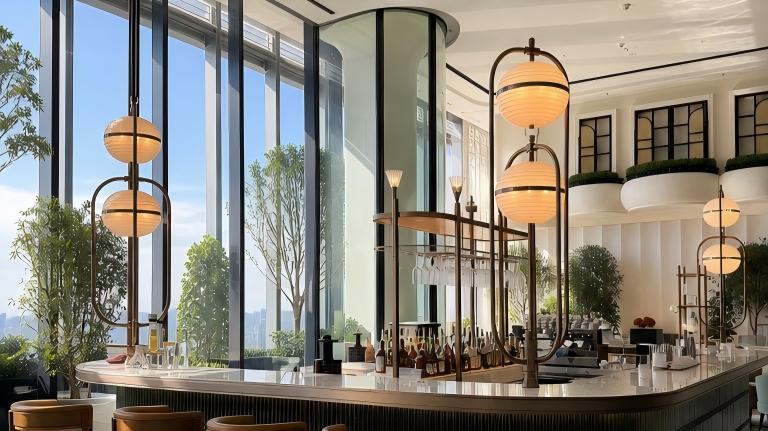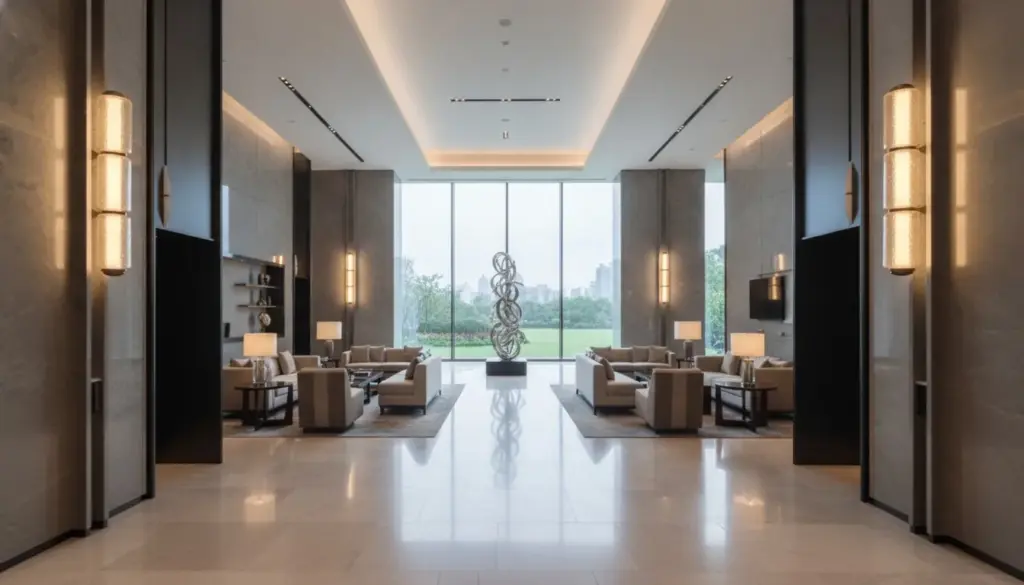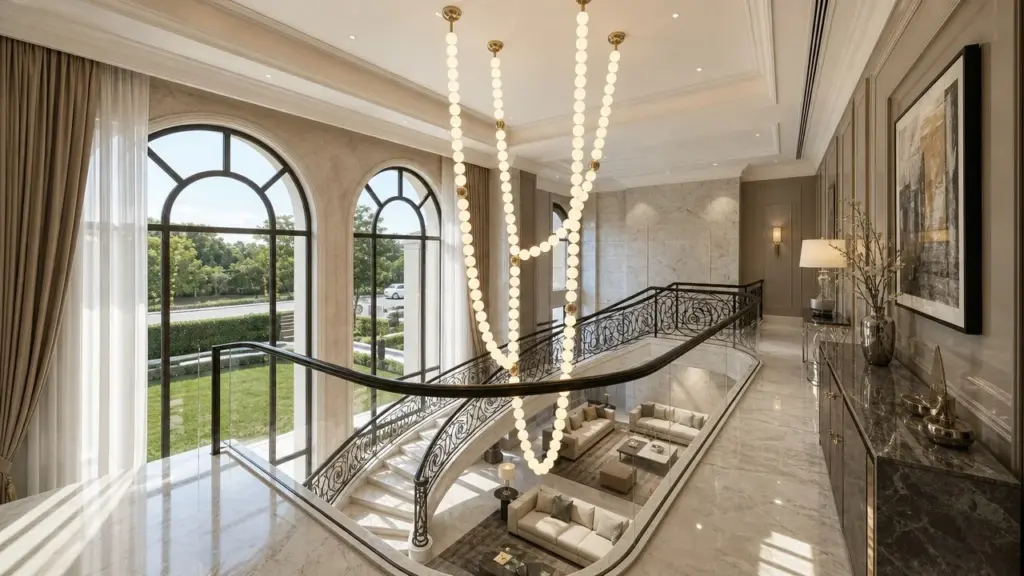
Hyatt hotel chandelier decisions should not copy the same luxury formula across Park Hyatt and Andaz because the two brands reward different lighting behavior. Park Hyatt lighting should feel personal, residential, refined, and deeply tied to culture and context. Andaz lighting can be more fluid, social, expressive, and neighborhood-facing. Both can use custom decorative fixtures, but they need different evidence priorities.
Public Hyatt brand information is useful as context, not as an official Hyatt specification. It does not imply Hyatt endorsement of Kinglong Lighting. The goal is to help designers and procurement teams translate public brand cues into lighting identity, mock-up requirements, material choices, control scenes, and manufacturing proof for hotel chandeliers and public spaces.
Key Takeaways
- Brand distinction: Park Hyatt and Andaz require different lighting language even when both are design-led hospitality brands.
- Park Hyatt cue: Use residential calm, cultural context, art, and restrained luxury as decision anchors.
- Andaz cue: Use local expression, fluid public space, sociability, and creative contrast more confidently.
- Shared proof: Both routes still need color evidence, control scenes, glare review, service access, and production drawings.
- Kinglong role: Kinglong Lighting should present brand-sensitive options without implying official Hyatt approval.
Park Hyatt and Andaz start with different guest behavior
Park Hyatt lighting should often make a guest settle; Andaz lighting can invite a guest to explore.
The official Park Hyatt brand page emphasizes personal luxury, culture, context, visionary architects, designers, art, and refined comfort. The Park Hyatt story page describes a hotel that can feel like a beautifully curated private residence. By contrast, the Andaz story page describes personal style, fluid spaces, local materials, and environments connected to the neighborhood. Hyatt’s Andaz brand information reinforces local perspective and self-expression.
Park Hyatt lighting is quiet but not generic
Quiet luxury can become bland if it is reduced to beige materials and low contrast. Park Hyatt-style lighting should still carry authorship: curated art, local stone, warm timber, tailored metal, soft reflectance, and carefully controlled decorative focus. A chandelier should support the feeling of a private residence while still meeting hotel durability, service, and safety needs. The approval question is whether the fixture feels collected, considered, and of place.
A Park Hyatt-style review should include close-range material judgment because guests often experience the luxury in slower, more residential moments. A pendant above a lounge table, a sculptural fixture in a library-like lobby, or a chandelier near an art wall must reward proximity. The supplier should show how the material surface, edge detail, joinery, and light source behave at guest distance, not only in a wide architectural render.
Andaz lighting is expressive but not chaotic
Andaz-style spaces can tolerate more color, rhythm, contrast, and local references. The public-space lighting may invite movement between bar, lounge, art, check-in, and neighborhood-facing social zones. The risk is too many ideas competing. A custom chandelier should have one clear story function: orientation, social energy, local craft, dramatic transition, or neighborhood identity. The evidence file should control the personality so it remains intentional.
For Andaz, the best question is whether the fixture helps the guest participate in the place. A local material rhythm may connect the lobby to the neighborhood. A more open chandelier form may support fluid circulation. A bolder color or glass treatment may make the bar more social at night. But each expressive move needs a boundary: how bright, how durable, how replaceable, how cleanable, and how compatible with the control system.
Map brand identity to lighting decisions
| Decision area | Park Hyatt direction | Andaz direction | Approval evidence |
|---|---|---|---|
| Arrival | Residential calm and curated welcome | Social discovery and local energy | Guest journey views |
| Material | Subtle craft, art, natural texture | Bold local palette and expressive surface | Finish master and mock-up board |
| Decorative fixture | Refined focal point with restraint | Statement piece with neighborhood story | Scale render and sightline review |
| Controls | Smooth day-to-evening residential transition | Flexible social scenes and events | Dimming curve and scene schedule |
| Maintenance | Quiet access and premium consistency | Durable feature details despite bolder design | Cleaning route and spare parts |
The conclusion is that Park Hyatt and Andaz can both be deeply local, but they express locality differently. Park Hyatt tends to absorb local context into refined calm. Andaz tends to reveal local context through social energy and visible design personality.
Use lighting standards to keep personality useful
Official lighting references help prevent brand interpretation from becoming subjective. The IES Lighting Library gives professional context for application, controls, and maintenance. The WELL v2 Light concept centers visual comfort and human experience. The DOE TM-30 FAQ helps specifiers discuss color rendition more precisely. For hotel lighting identity, these sources turn mood words into checkable requirements.
Calculated from a 4-zone public-space review: arrival, lounge, dining edge, and circulation equal 4 guest behavior zones. If a chandelier supports only 1 zone, it covers 25 percent of the guest journey and may become a photo object rather than a hospitality tool. The decision rule is to judge brand fit by movement through space, not only by a hero render.
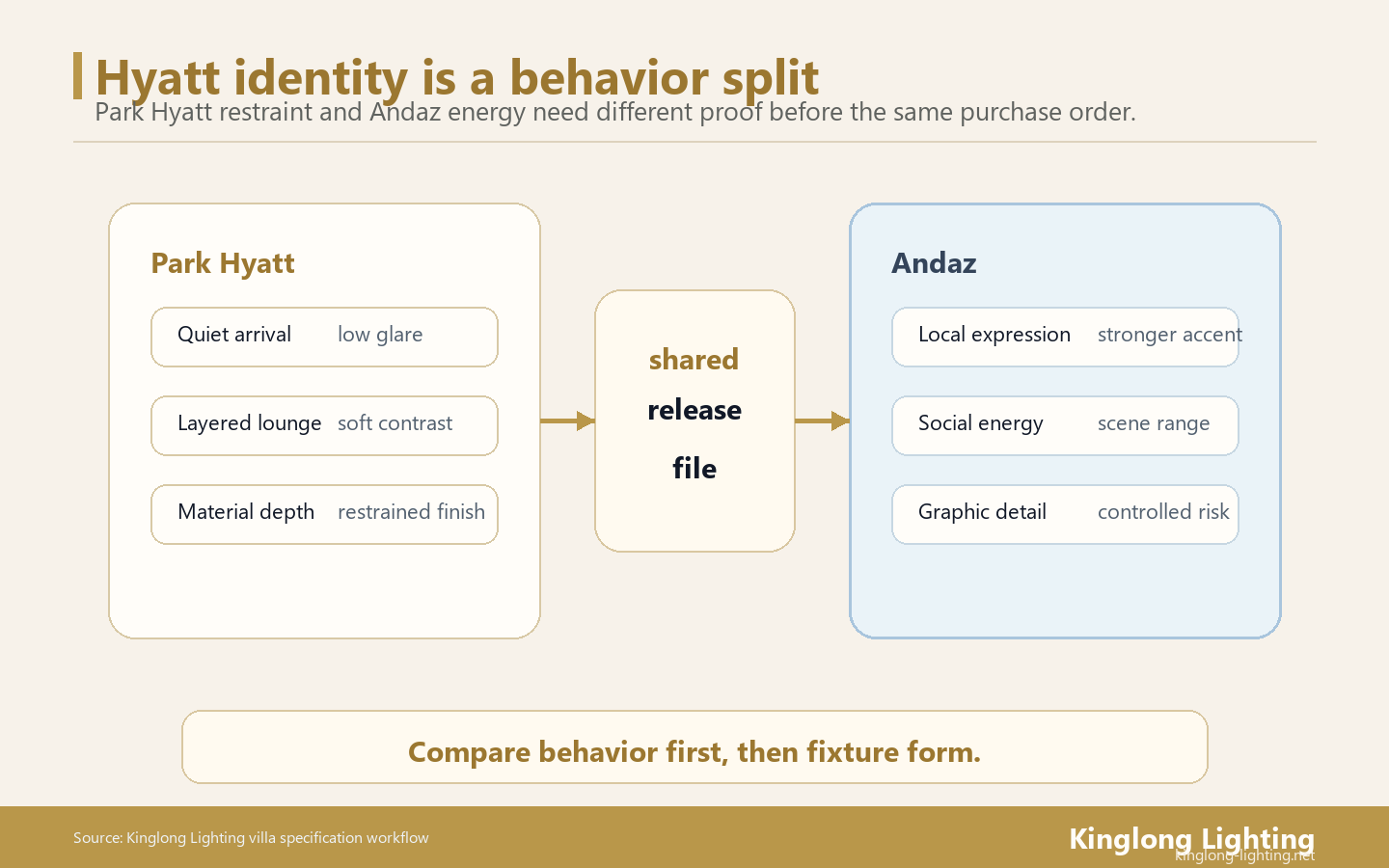
This is where Park Hyatt and Andaz briefs should diverge. In a Park Hyatt project, the 4-zone review may ask whether each transition feels calmer, more personal, and more settled. In an Andaz project, the same 4 zones may ask whether each transition feels more social, curious, and connected to local energy. The measurement method is shared, but the interpretation changes. That lets procurement compare suppliers with discipline while still respecting brand personality.
Hyatt-style procurement should separate identity from buildability
A Park Hyatt-style proposal may fail if it is too plain; an Andaz-style proposal may fail if it is too loud. Both can fail if the fixture cannot be built, tested, packed, cleaned, or dimmed properly. For destination markets, supplier evidence may include product testing route, electrical safety documentation, and local authority requirements. Sources such as UL luminaire testing and certification and the IEC 60598 luminaire standard family show why luminaire evidence must remain connected to the final product configuration.
The practical RFQ should ask suppliers for two lanes. The identity lane includes brand cue, local reference, material story, guest behavior, and visual hierarchy. The buildability lane includes drawing, dimensions, weight, driver, control protocol, finish master, test route, packing, installation sequence, and maintenance access. If the lanes disagree, the design needs another round before production.
How Kinglong Lighting can present Park Hyatt and Andaz options
Kinglong Lighting can support this comparison by creating two clearly separated concept routes. A Park Hyatt route could emphasize warm restraint, tactile materials, low-glare sparkle, and residential scale discipline. An Andaz route could emphasize local material rhythm, bolder feature geometry, social scenes, and more expressive color or texture. Both routes should include the same production evidence so the owner can compare design value without losing risk control.
The Mofun Design Platform can help visualize these routes before sample cost is committed, and the customization process can turn the selected route into drawings, samples, and release documents. The soft next step is to send Kinglong Lighting the brand context, local story, public-space map, control needs, finish palette, and budget boundary through the contact page.
Kinglong Lighting can make the comparison more decision-ready by keeping the base performance package identical across both routes. The same driver quality, dimming test, safety route, packing discipline, and finish approval method should support the quiet Park Hyatt route and the expressive Andaz route. That way, the buyer is choosing identity and guest behavior, not accepting hidden differences in technical risk.
The proposal should also identify which design elements are brand-critical. For Park Hyatt, that may be proportion, natural material tone, and low-glare intimacy. For Andaz, it may be local color, social visibility, and a more open fixture rhythm. If those elements are named, the team can simplify secondary parts without weakening the identity that guests actually perceive.
That makes later revisions easier because every change can be tested against the identity list before the supplier updates drawings or samples.
Related Guides
Hyatt Lighting Action Card
- Decide whether the route should settle guests like Park Hyatt or energize discovery like Andaz.
- Map the chandelier to at least four guest behavior zones.
- Separate identity evidence from buildability evidence in the RFQ.
- Test color quality, glare, dimming, finish, and maintenance access before release.
- Send both concept routes to Kinglong Lighting for custom review.
A practical Hyatt comparison file for custom chandelier approval
A Park Hyatt and Andaz comparison should not force both brands into the same lighting personality. The useful file separates guest pace, room role, material tone, control behavior, and maintenance expectation before the buyer compares fixture forms. That is especially important for custom chandeliers, because a small change in scale, sparkle, or finish can make a restrained concept feel underdesigned or make an expressive concept feel uncontrolled.
Start with guest pace instead of style adjectives
Park Hyatt public spaces usually reward slower reading: arrival, conversation, dining edge, and quiet transition should feel composed. Andaz spaces can carry more local energy, but that energy still needs a defined guest path. The comparison file should describe how the chandelier behaves when a guest enters, sits, photographs the space, moves past the bar or lounge, and sees the fixture again from circulation. That approach turns brand identity into a sequence of checks rather than a debate over whether the fixture looks premium enough.
Translate brand tone into material and scene decisions
For Park Hyatt, the material question is often whether metal, glass, stone, crystal, or fabric can stay calm under different scenes. For Andaz, the question may be whether stronger geometry or a local motif remains serviceable and not visually noisy. A useful supplier packet should show finish samples, warm-scene behavior, dimming assumptions, and any custom detail that may be difficult to repeat. The goal is not to make Andaz conservative or Park Hyatt plain. The goal is to make each direction buildable without losing its intended guest signal.
Give procurement one shared evidence structure
Procurement teams need a file that can compare two brand readings without restarting the technical review. Kinglong Lighting can present the options through the same evidence structure: concept summary, marked elevation, material proof, control scene, module logic, packing route, maintenance access, and final release boundary. When both options use the same evidence order, the buyer can see where the real difference sits. One option may require more custom metalwork; another may require tighter scene control or more careful spare planning.
Freeze the decisions that protect the brand
The final comparison should name which items can still move and which must be frozen before production. Finish shade, crystal density, module size, driver location, access route, and cleaning assumptions should not drift after approval. If a late comment changes one of those items, it should reopen the right part of the file, not the whole concept. That keeps Park Hyatt restraint and Andaz energy from becoming vague taste labels after the purchase order is released.
Use mock-up feedback without losing the distinction
Mock-up review should sharpen the difference between the two directions instead of pulling both toward a compromise. If Park Hyatt feedback asks for more warmth, the response may be a softer scene or subtler finish change, not a more decorative form. If Andaz feedback asks for more energy, the response may be a stronger local detail or accent rhythm, not uncontrolled sparkle. Recording those likely responses helps Kinglong Lighting protect the design logic when samples, visualizations, and pricing are being revised at the same time.
The comparison file should end with a plain decision note: which option fits the room role, which evidence supports that fit, and which next sample or drawing would change the decision. That note gives the hotel team a practical way to move forward without flattening the two Hyatt expressions into one generic luxury answer.
Frequently Asked Questions
How does Park Hyatt lighting differ from Andaz lighting?
Park Hyatt lighting usually leans toward refined, residential, culturally grounded calm. Andaz lighting can be more expressive, social, local, and fluid.
Can both Park Hyatt and Andaz use statement chandeliers?
Yes, but the statement should serve different roles. Park Hyatt statements should feel curated and restrained, while Andaz statements can carry more visible local personality.
What should suppliers avoid in Hyatt-style proposals?
Avoid generic luxury language, unsupported brand claims, and designs that look expressive but lack control scenes, safety route, cleaning access, and production evidence.