CNAS-accredited testing helps hotel chandelier specifiers only when the certificate, scope, test method, sample identity, and report traceability match the exact luminaire being approved. A CNAS logo is not the same as project evidence. For a 5-star hotel chandelier, the specifier needs to know which laboratory is accredited, what the laboratory is accredited to test, which standard or method was used, which sample was tested, and how the report connects to the production lot.
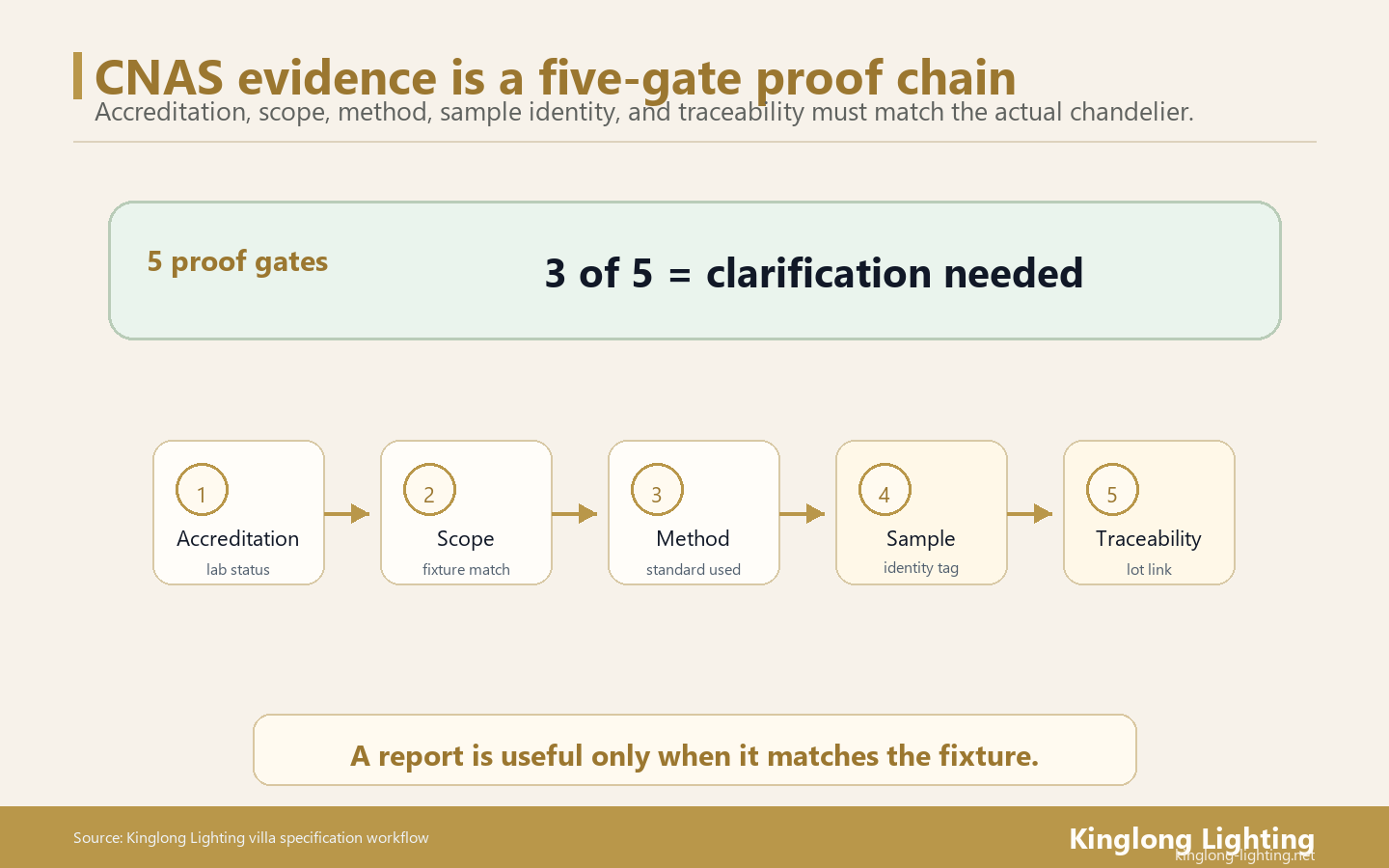
Based on our analysis, a five-gate evidence model is the cleanest way to read a test file: accreditation body, scope match, test method, sample identity, and production traceability. If a supplier provides only three of five gates, the evidence file is 60% complete and should trigger clarification before approval. The goal is not to reject the supplier. The goal is to prevent a decorative lighting decision from being supported by a report that does not match the fixture, market, or project risk.
Key Takeaways
- CNAS is not a shortcut: Accreditation supports laboratory competence within scope; it does not automatically approve every chandelier.
- Scope matters: The report should show that the lab scope covers the relevant test, method, and product category.
- Sample identity matters: The tested sample must connect to the actual hotel chandelier design and production lot.
- Destination market still matters: UL, IEC, CE, or local requirements may still be needed depending on the project.
- Procurement proof: Ask for certificate, scope page, test report, sample ID, standard, date, and lot traceability before release.
Read CNAS as laboratory evidence, not product approval language
The right question is not “does the supplier have CNAS?” It is “does this CNAS-accredited report cover this chandelier decision?”
CNAS stands for China National Accreditation Service for Conformity Assessment. The official CNAS introduction identifies CNAS as an accreditation body and references its international accreditation connections. That matters because accreditation is about the competence of conformity assessment bodies, not a decorative marketing label for every product a supplier makes.
The distinction is critical in hotel chandeliers. A laboratory can be accredited for certain tests and not others. A report can apply to one sample and not to a modified fixture. A chandelier can use different drivers, finishes, suspension parts, or modules after a design revision. If the evidence file does not connect the tested sample to the final production configuration, the specifier should ask for clarification before approval.
Accreditation scope is the first real check
The CNAS laboratory criteria page lists CNAS-CL01:2018 as accreditation criteria for testing and calibration laboratories, aligned with ISO/IEC 17025:2017. The so what for hotel specifiers is that the scope page is not optional paperwork. It tells the buyer what the laboratory is recognized to do. A certificate without scope can leave procurement with an impressive logo and no proof that the relevant chandelier test is inside the accredited boundary.
ISO/IEC 17025 defines laboratory competence, not hotel design adequacy
ISO describes ISO/IEC 17025:2017 as the international standard for testing and calibration laboratories, including competence, impartiality, and consistent operation. That is valuable evidence, but it still does not decide whether the chandelier is visually right for a ballroom, structurally coordinated with the ceiling, or acceptable for the destination authority. ISO/IEC 17025 supports trust in the testing process. The specifier must still check product identity, test method, report date, standard edition, and production change control.
Use the five-gate evidence model
A complete hotel chandelier test file has five gates: accreditation, scope, method, sample, and traceability.
Gate 1 is accreditation body and laboratory identity. Gate 2 is the scope that covers the relevant test. Gate 3 is the standard or method used. Gate 4 is sample identity, including model, drawing, material, driver, and configuration. Gate 5 is production traceability, showing how the approved sample connects to the manufactured lot. If a report has accreditation and a test result but no sample identity or lot link, the specifier still has an evidence gap.
In a simple scenario, a file has accreditation identity, test method, and test result, but lacks scope page and sample-to-lot traceability. That is three gates out of five, or 60% completeness. The report may be legitimate, but it is not yet decision-ready for a 5-star project. The next step is to ask for the missing scope and traceability documents before purchase release or shipment approval.
Based on our analysis a 5-unit proof chain is the minimum practical review for a custom hotel chandelier: certificate, accredited scope, test method, sample identity, and production traceability. If two units are missing, procurement should not treat the file as a yes or no decision. It should treat the file as a clarification request with named gaps. That wording matters because many delays are created by vague objections such as “testing is not enough.” A better note says exactly which document is missing, why it affects the project, and whether the supplier can close the gap with a scope page, revised report, sample tag, drawing revision log, or lot record.
ISO/IEC 17025:2017 ties laboratory confidence to competence, impartiality, and consistent operation in testing and calibration work. For a hotel specifier, that supports trust in the report process, but it does not remove the need to match the report to the actual chandelier. A large lobby chandelier may change driver brand, cable length, canopy construction, crystal density, or control gear after mockup. Each change should be checked against the evidence file so the final installed product is not quietly different from the tested sample.
That last comparison is where many luxury projects gain speed: the buyer is no longer debating a logo, but checking a document chain.
Check international recognition without overclaiming
The ILAC MRA explains that signatories assess and accredit conformity assessment bodies to relevant international standards, including ISO/IEC 17025 for testing and calibration laboratories, and that results can be recognized internationally under the arrangement. ILAC also maintains a CNAS signatory detail page. The procurement meaning is useful but bounded: international recognition supports acceptance of accredited results, but it does not replace destination-market certification, local authority review, or project-specific product approval.
This boundary matters for hotel chandeliers because destination markets may ask for different evidence. UL’s luminaire testing and certification, OSHA’s NRTL program, and IEC’s IEC 60598 luminaire standard family can all become relevant depending on where the project is built and which approval path the owner requires. CNAS-accredited testing is part of the evidence strategy, not a universal substitute for every market requirement.
What 5-star specifiers should demand in the file
| Evidence item | What to check | Why it matters | Red flag |
|---|---|---|---|
| Certificate | Lab name, validity, accreditation body | Confirms the lab identity | Logo only, no certificate page |
| Scope | Product category and test method | Shows whether the test is accredited | Scope does not include the claimed test |
| Report | Standard, edition, date, sample ID | Connects result to method and sample | Report describes a different configuration |
| Traceability | Drawing, BOM, driver, finish, lot | Connects sample to production | Design changed after test with no update |
For high-end hotels, the file should also note what the report does not prove. A safety or electrical test report does not prove chandelier diameter, acoustic coordination, color temperature choice, guest comfort, or maintenance access. Those items need drawings, mockups, project review, and site coordination. The specifier’s job is to keep each evidence type in its lane.
Connect CNAS evidence to Kinglong’s production release
Kinglong Lighting’s brand materials note a CNAS-accredited laboratory as part of its evidence assets, and the custom lighting workflow is the practical place to connect testing with drawings, samples, and production release. A hotel buyer should ask Kinglong Lighting to align the test file with the actual chandelier configuration: model, dimensions, driver, finish, suspension, control gear, and any project-specific customization.
The soft next step is specific. Send the project standard, destination market, hotel brand requirement, drawing package, sample ID, and approval deadline through the hotel chandelier testing inquiry. Ask for certificate, scope, test report, sample identity, and lot traceability before deposit, shipment, or final installation handover. That request is more useful than asking whether the factory “has CNAS.”
Related Guides
- Hotel Lighting Procurement Framework
- Large Hotel Chandelier Installation Rework
- Hotel Chandelier Total Cost Surprises
CNAS Testing Action Card
- Ask for certificate and accredited scope together.
- Match the test method to the destination requirement.
- Check sample ID against drawing, driver, and finish.
- Require lot traceability after design changes.
- Send market and project requirements through the CNAS testing evidence inquiry.
A CNAS evidence packet should match the report to the purchased chandelier
CNAS-related language can help a hotel specifier ask better questions, but it should not be used as a shortcut for product approval. Laboratory accreditation, test scope, method, sample identity, destination requirement, and production traceability all have to match the actual chandelier being purchased. The release file should therefore turn testing evidence into a chain of checks rather than a single logo or certificate reference.
Ask what the report actually covers
The first question is scope. Does the report apply to a complete chandelier, a component, a driver, a material, or a similar product family? Does it cover the standard relevant to the destination market? Does the tested sample match the fixture configuration after mock-up changes? If a large hotel chandelier changes driver, canopy, cable length, finish process, crystal density, or control gear, the report should be reviewed against the new version before production release.
Separate lab competence from project compliance
Laboratory competence improves trust in the report process, but it does not prove that the project has the right report. A hotel buyer still needs to ask whether the standard, test method, sample label, destination requirement, and production lot are aligned. The evidence packet should make this distinction visible so that procurement does not overclaim and the supplier knows exactly which gaps need clarification.
Match sample identity to the purchase order
The sample identity is often where evidence becomes practical. The report, drawing, mock-up record, bill of materials, and purchase order should point to the same fixture version. If the report identifies one driver and the purchase order uses another, the project needs a clarification note. If the tested sample uses a simplified construction that differs from the final chandelier, the difference should be named and reviewed. This protects the buyer from discovering late that the evidence file belongs to a different configuration.
Use testing evidence as a release gate
Testing evidence should influence timing. If scope, sample identity, or destination requirement is open, the production order may proceed only if the team has clearly defined what is held before shipment or installation. Kinglong Lighting can support this by connecting test records to drawings, material lists, production lots, packing labels, and final inspection notes. That makes the evidence useful beyond procurement review.
The best CNAS evidence packet does not promise more than it proves. It tells the buyer which evidence is valid, which evidence needs clarification, and which fixture changes would trigger another review.
The packet should also record who is allowed to accept a clarification. A procurement buyer may collect the file, but a local compliance reviewer, project engineer, or brand-side quality manager may need to confirm whether the evidence is sufficient. Naming that owner prevents testing questions from appearing only after shipping or installation.
For custom chandeliers, the evidence packet should travel with the approved version record. If the mock-up changes construction, drivers, crystal density, cable, or canopy detail, the testing note should say whether the existing evidence still applies. That simple version-control habit prevents a valid report from being attached to the wrong product configuration.
Frequently Asked Questions
Does CNAS accreditation mean a chandelier is automatically approved?
No. CNAS accreditation supports laboratory competence within an accredited scope. The specifier still needs to verify the test method, sample identity, production traceability, and destination-market requirements.
What is the most important CNAS document to request?
Request the certificate and the scope together. The certificate identifies the lab, while the scope shows whether the relevant test is inside the accredited boundary.
Can CNAS testing replace UL or other market evidence?
Not automatically. It depends on the project, jurisdiction, and owner requirement. CNAS-accredited reports can support the evidence file, but destination-market certification and authority review may still be required.