Les tests accrédités CNAS aident les prescripteurs de lustres hôteliers seulement lorsque le certificat, le périmètre, la méthode d’essai, l’identité de l’échantillon et la traçabilité du rapport correspondent au luminaire exact à approuver. Un logo CNAS n’est pas une preuve projet complète.
Pour un lustre d’hôtel 5 étoiles, le prescripteur doit savoir quel laboratoire est accrédité, pour quels essais, selon quelle méthode, sur quel échantillon et avec quel lien vers le lot produit.
Cette distinction protège les acheteurs autant que les designers. Un rapport sérieux peut être mal utilisé s’il concerne un composant différent, une version antérieure, une méthode hors périmètre ou un échantillon non relié à la commande. À l’inverse, un fournisseur capable de relier clairement rapport, échantillon, plan, nomenclature et production donne au projet une base de décision plus solide.
Points clés à retenir
- CNAS n’est pas un raccourci : l’accréditation soutient la compétence du laboratoire dans son périmètre.
- Le périmètre compte : le rapport doit couvrir l’essai, la méthode et la catégorie produit pertinents.
- L’échantillon compte : le luminaire testé doit correspondre à la conception approuvée.
- Le marché compte : UL, IEC, CE ou exigences locales peuvent encore être nécessaires selon destination.
- Preuve d’achat : demander un dossier, pas un simple logo.
Lire un dossier en cinq portes
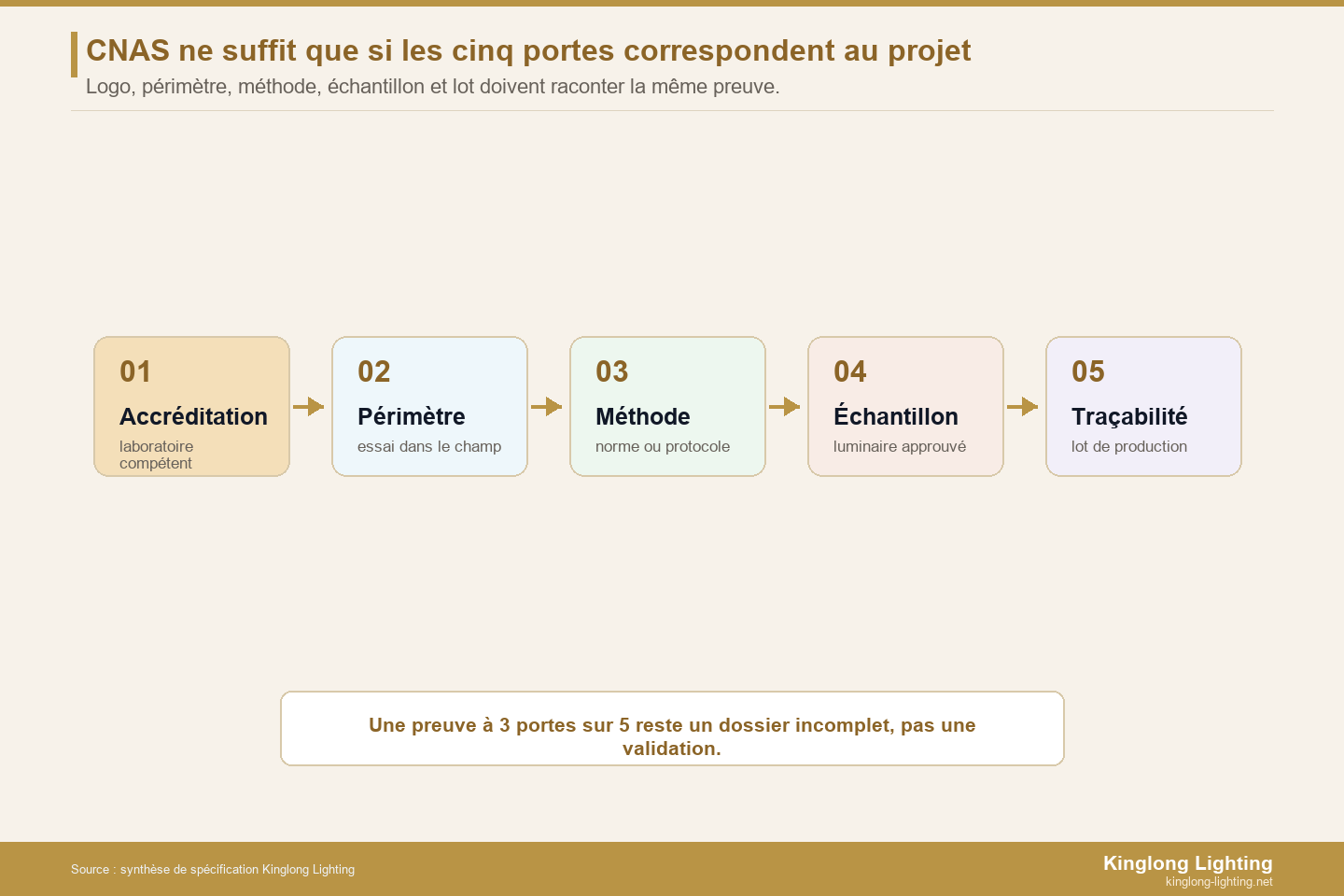
Une preuve CNAS utile relie laboratoire, périmètre, méthode, échantillon et lot de production.
Le site du CNAS présente le rôle d’accréditation, tandis que l’écosystème international d’accréditation rappelle l’importance du périmètre et de la compétence. Pour un acheteur hôtelier, la question pratique est simple : le rapport présenté prouve-t-il ce luminaire, pour ce projet, dans ce marché ?
Calcul illustratif : si un dossier fournit seulement 3 portes sur 5, il reste 40 % de la logique de preuve à clarifier. L’objectif n’est pas de rejeter le fournisseur, mais d’éviter qu’une décision décorative soit soutenue par un rapport mal relié au produit réel.
Le périmètre d’accréditation est le premier vrai contrôle
Le premier contrôle n’est pas le logo. C’est le champ d’accréditation. Un laboratoire peut être accrédité pour certaines méthodes et pas pour d’autres. Un rapport peut être utile pour une mesure électrique, mais ne rien dire sur la charge de suspension, la résistance d’une finition, la sécurité d’un assemblage spécifique ou la conformité finale d’un marché. Le prescripteur doit donc demander le certificat et le périmètre, puis vérifier que l’essai cité appartient bien à ce périmètre.
Pour les lustres hôteliers, ce point est crucial parce que le produit peut combiner structure métallique, cristal ou verre, LED, drivers, câbles, suspentes, pavillon, modules démontables et exigences de chantier. Un seul rapport ne couvre pas automatiquement tout cet ensemble. Le dossier doit dire quelle partie est testée et quelle partie reste couverte par dessin, calcul, inspection, certification de composant ou validation locale.
ISO/IEC 17025 définit la compétence du laboratoire, pas l’adéquation au design hôtelier
L’accréditation selon ISO/IEC 17025 soutient la compétence du laboratoire pour effectuer des essais ou étalonnages dans son périmètre. Elle ne signifie pas que le lustre est automatiquement adapté à un hall, une salle de bal ou une villa. Le confort visuel, la proportion, la maintenance, la route d’installation et la conformité du bâtiment restent des décisions de projet.
Cette nuance évite deux erreurs. La première consiste à rejeter une preuve utile parce qu’elle n’est pas une approbation complète. La seconde consiste à accepter trop vite un produit parce qu’un rapport existe. Le bon réflexe est de placer le rapport dans une chaîne : laboratoire compétent, méthode pertinente, échantillon identifié, version de produit claire et lien avec la commande.
Ce qu’un prescripteur doit demander
| Porte | Question | Preuve |
|---|---|---|
| Accréditation | Le laboratoire est-il compétent ? | certificat et numéro |
| Périmètre | L’essai est-il couvert ? | champ d’accréditation |
| Méthode | Quelle norme ou procédure ? | référence d’essai |
| Échantillon | Quel luminaire a été testé ? | photos, référence, version |
| Traçabilité | Comment le rapport rejoint-il le lot ? | nomenclature et production |
Utiliser le modèle de preuve en cinq portes
La première porte est l’accréditation. Elle répond à la question : le laboratoire est-il reconnu pour faire ce type d’essai ? Le dossier doit inclure le nom du laboratoire, le numéro de certificat, la validité et le champ applicable. Une capture de logo sans référence ne suffit pas.
La deuxième porte est le périmètre. Elle répond à la question : l’essai demandé est-il réellement couvert ? Pour un luminaire d’hôtel, le périmètre doit être lu avec attention, car un laboratoire peut couvrir certaines normes ou méthodes mais pas toutes les exigences du projet. Le prescripteur doit éviter les phrases générales comme « testé CNAS » sans détail.
La troisième porte est la méthode. Elle précise selon quelle norme, procédure ou condition le test a été réalisé. Une mesure de performance lumineuse, un essai électrique, une vérification de composant ou une inspection mécanique ne prouvent pas la même chose. La méthode doit être liée à la décision : sécurité électrique, performance LED, traçabilité de matériau, ou preuve de lot.
La quatrième porte est l’identité de l’échantillon. C’est souvent la partie la plus faible des dossiers. Le rapport doit dire quel échantillon a été testé, avec photos, modèle, version, composants, date et référence. Si le projet modifie driver, taille, matériau, câblage ou configuration après le test, le lien doit être réévalué.
La cinquième porte est la traçabilité de production. Le rapport doit rejoindre la commande : nomenclature, version de dessin, lot de production, inspection, photos de fabrication ou contrôle de sortie. Sans ce lien, le rapport prouve une pièce de laboratoire, mais pas forcément le lustre qui arrive sur site.
Vérifier la reconnaissance internationale sans surpromettre
CNAS participe à un système d’accréditation plus large, mais cela ne transforme pas automatiquement chaque rapport en passeport universel. Les marchés peuvent demander UL, CE, IEC, CB, normes locales, inspection tierce, preuves de composants ou validations chantier. Les exigences dépendent du pays, du type de bâtiment, du cahier des charges et de l’autorité compétente.
Pour l’acheteur, la question à poser est donc : « cette preuve suffit-elle pour notre destination, ou soutient-elle seulement une partie du dossier ? » Un fournisseur prudent ne doit pas promettre qu’un rapport CNAS remplace toutes les autres exigences. Il doit expliquer ce que le rapport couvre, ce qu’il ne couvre pas, et quels documents complémentaires peuvent être nécessaires.
Cette prudence n’affaiblit pas la preuve. Au contraire, elle la rend plus crédible. Les hôtels cinq étoiles préfèrent généralement un dossier qui nomme ses limites à une promesse trop large. Un rapport bien relié peut accélérer l’achat ; une affirmation exagérée peut créer un blocage au moment de l’inspection, de l’importation ou de l’installation.
Ce que les prescripteurs 5 étoiles doivent exiger dans le fichier
Un fichier complet doit commencer par une page de synthèse. Cette page indique projet, luminaire, version, destination, exigences connues, rapports disponibles, parties couvertes, parties non couvertes et responsabilités restantes. Elle permet au designer, à l’acheteur, à l’ingénieur et au fournisseur de lire le même statut.
Ensuite, le dossier doit inclure le certificat du laboratoire, le champ d’accréditation, le rapport complet, les photos d’échantillon, les références de composants critiques, le dessin ou la nomenclature correspondant au rapport, la version de maquette approuvée, et le lien vers la production. Si le lustre est sur mesure, le fichier doit préciser quelle modification exigerait un nouveau test, une nouvelle inspection ou une note technique.
Le fichier doit aussi séparer preuve de laboratoire et preuve de projet. La preuve de laboratoire soutient une méthode d’essai. La preuve de projet inclut dimensions, poids, suspension, maintenance, installation, scènes, accès et exigences locales. Les deux sont utiles, mais elles ne remplacent pas l’une l’autre.
Comment Kinglong Lighting prépare le dossier
Pour les projets d’éclairage hôtelier, Kinglong Lighting peut associer plans, échantillons, essais et traçabilité. Les demandes doivent indiquer marché cible, type de luminaire, quantité, exigence de certification et calendrier via la page contact.
Dans un projet sur mesure, Kinglong Lighting peut relier les preuves au jalon de libération : plans approuvés, maquette, composants LED, câblage, finition, emballage, inspection et production. L’objectif est d’éviter que le rapport soit séparé du lustre acheté. Lorsque le marché cible exige d’autres documents, le dossier doit les nommer tôt afin que l’équipe puisse organiser essais, composants, délais et responsabilités.
Avant de demander un devis final, transmettez les exigences connues du projet : destination, tension, normes demandées, type d’espace, hauteur, taille, matériau, quantité, planning, intégrateur et documents déjà exigés par l’hôtel ou le consultant. Plus le brief est clair, plus la réponse peut distinguer les preuves existantes, les preuves à produire et les validations qui appartiennent aux professionnels locaux.
Un dossier CNAS doit faire correspondre le rapport au lustre acheté
Le résultat attendu est une chaîne de preuve lisible. Elle doit permettre à l’acheteur de suivre le chemin depuis le laboratoire jusqu’au produit livré. Si un maillon manque, le dossier n’est pas forcément mauvais, mais il est incomplet. Le rôle du prescripteur est alors de demander la clarification avant dépôt ou libération de production.
Demander ce que le rapport couvre réellement
Chaque rapport doit être lu comme une réponse limitée. Couvre-t-il un composant, un module, une source, un driver, un échantillon complet ou une méthode précise ? Un rapport sur un élément ne prouve pas automatiquement le système entier.
Séparer compétence de laboratoire et conformité de projet
La compétence du laboratoire est une preuve importante, mais la conformité finale dépend aussi du bâtiment, du marché, de l’installation et des exigences locales. Cette séparation évite les promesses trop larges et les refus tardifs.
Faire correspondre l’identité de l’échantillon au bon de commande
Le rapport doit être relié au modèle, à la version, aux composants et au lot. Si le bon de commande modifie les dimensions, drivers, matériaux ou câbles, l’équipe doit vérifier si la preuve reste valable.
Utiliser les preuves d’essai comme porte de libération
Le dossier CNAS doit devenir une condition de libération, pas une annexe oubliée. Avant production, l’équipe doit savoir quelles preuves sont fermées, lesquelles restent à obtenir et lesquelles ne relèvent pas du fabricant.
Conserver une matrice de correspondance entre rapport, produit et marché
La meilleure protection consiste à créer une matrice simple qui relie chaque rapport à un produit, une version, un composant, un marché de destination et une décision de libération. Cette matrice évite de présenter un document valide dans l’absolu mais insuffisant pour le lustre réellement acheté. Elle aide aussi l’acheteur à voir quelles preuves viennent du laboratoire, quelles preuves viennent du fabricant et quelles preuves doivent être confirmées localement.
Pour un hôtel international, cette séparation est essentielle. Un rapport CNAS peut soutenir la confiance dans un essai, mais il ne remplace pas automatiquement les règles du pays, les exigences du propriétaire, les demandes de l’opérateur ou les contrôles de chantier. Le dossier final doit donc raconter la chaîne complète : échantillon testé, produit commandé, marché visé et preuve encore ouverte.
Guides associés
- Processus de maquette pour lustres hôteliers
- Glossaire de l’éclairage hôtelier
- Achats de lustres par chaînes hôtelières
Questions fréquentes
L’accréditation CNAS signifie-t-elle qu’un lustre est automatiquement approuvé ?
Non. Elle soutient la compétence du laboratoire dans un périmètre donné. Le rapport doit encore correspondre à la méthode, à l’échantillon, à la version du produit, au lot de production et aux exigences du marché de destination.
Quel est le document CNAS le plus important à demander ?
Le rapport complet et le champ d’accréditation doivent être lus ensemble. Le certificat seul indique le laboratoire ; le champ montre ce qu’il peut couvrir ; le rapport montre l’essai réel. Les trois doivent être reliés à l’échantillon du projet.
Les tests CNAS peuvent-ils remplacer UL ou d’autres preuves de marché ?
Pas automatiquement. Selon destination, l’hôtel peut encore demander UL, CE, IEC, CB, inspection locale ou documents de composants. Les exigences finales doivent être confirmées avec les professionnels et autorités compétentes du marché concerné.