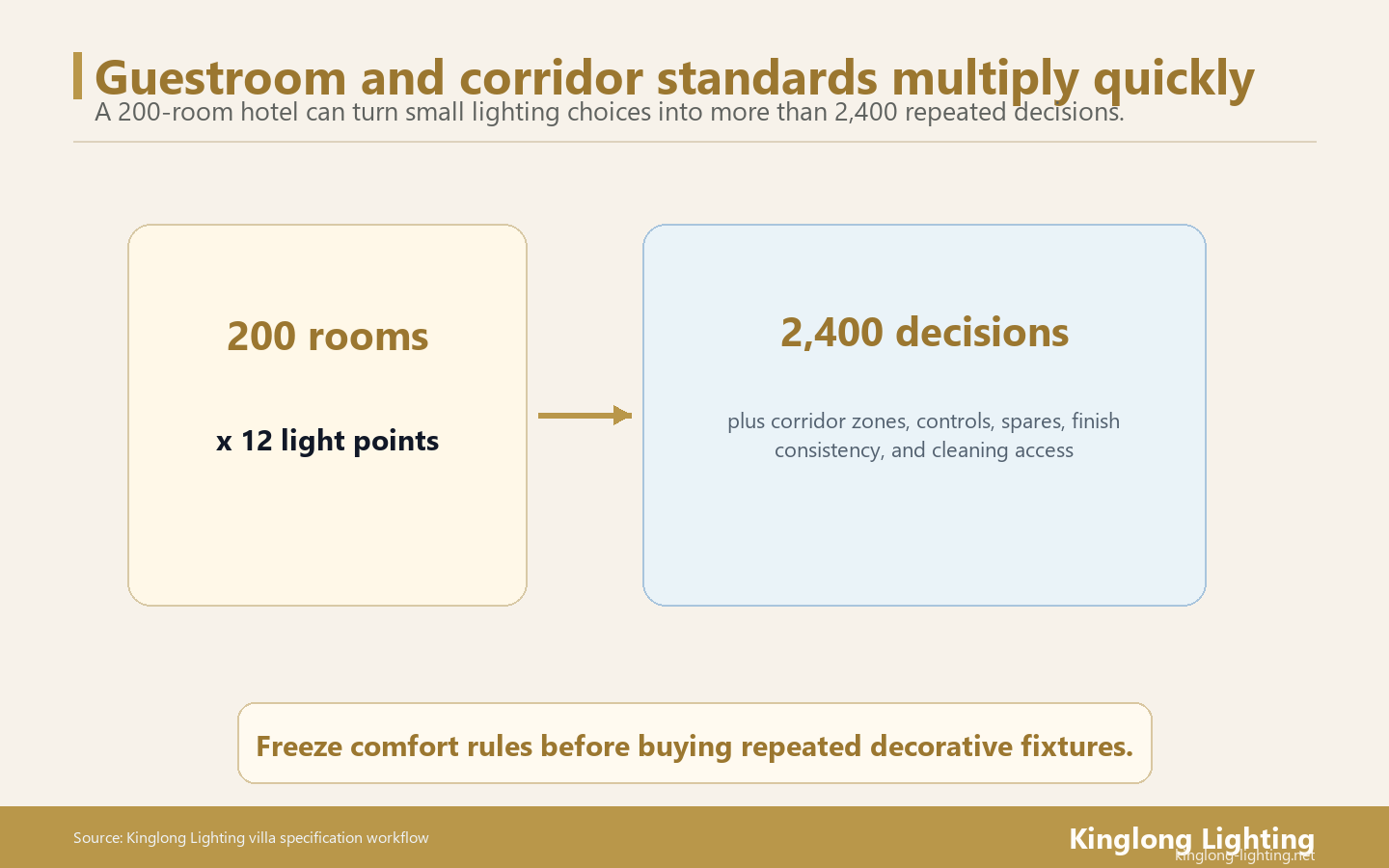
A luxury hotel guestroom and corridor lighting standard should behave like a continuity system, not a room-by-room fixture list. The guest moves from elevator lobby to corridor threshold to sleep zone, and every lighting jump changes perceived safety, calm, and brand quality. An illustrative 200-room hotel with 12 light points per room and 4 corridor zones per floor can create more than 2,400 repeatable lighting decisions before public areas are counted. The practical standard is to freeze comfort rules for glare, color, controls, maintenance, and replacement consistency before the project buys decorative fixtures.
Guestrooms and corridors are quieter than lobbies, but they punish weak standards more often. The same lamp family, finish, driver, shade, dimming behavior, and replacement part may be repeated hundreds or thousands of times. A small inconsistency becomes a brand-wide irritation: a harsh corridor outside the suite, a bedside light too weak for reading, a glowing switch that wakes the guest, or a decorative pendant that cannot be cleaned without removing ceiling parts.
Key Takeaways
- Continuity first: Treat elevator lobby, corridor, entry door, room vestibule, bed, desk, bath, and suite lounge as one guest path.
- Comfort beats brightness: Luxury lighting standards should control glare, contrast, color, and scene behavior, not only lux.
- Repeatability matters: Hundreds of rooms require finish, driver, color temperature, and spare-part discipline.
- Corridors are brand spaces: They should guide movement, reveal room numbers, reduce tunnel effect, and avoid cold commercial light.
- Release evidence: Ask for samples, mock-up photos, driver data, maintenance access, and replacement maps before procurement approval.
Treat guestroom and corridor lighting as one guest continuity system
The standard should describe how the guest feels while moving, resting, reading, grooming, and finding the room at night.
Many hotel lighting schedules separate guestrooms and corridors because the purchasing categories are different. The guest does not experience them that way. The corridor sets a safety and calmness expectation before the door opens. The room entry either confirms or breaks that expectation. The bedside, desk, lounge, bath, mirror, and night path then decide whether the lighting feels luxurious or merely decorative.
Write standards as experience rules, then translate them into fixtures
The first layer should be experience language: warm arrival, clear room number, low-glare walking path, intuitive entry scene, readable bedside task light, flattering mirror light, safe night movement, and easy housekeeping service. Only after those rules are clear should the team choose pendants, sconces, downlights, table lamps, linear lights, and decorative details. The IES Lighting Library helps anchor this mindset because it treats lighting by application and quality criteria, while the WELL v2 Light concept keeps visual comfort and human experience in the decision.
Kinglong Lighting’s hospitality lighting scope naturally touches this continuity problem: the company supports hotel spaces from lobby centerpieces to corridor pendants and in-room lighting families. For a luxury hotel, the specification should not let corridor fixtures, guestroom decorative lights, and suite upgrades drift into unrelated product decisions.
Set corridor standards for calm orientation
A luxury corridor should be easy to navigate without feeling like a retail aisle, office hallway, or emergency-only path.
Corridors need enough visibility for safety, housekeeping, luggage movement, and room-number recognition. They also need warmth and rhythm so the guest does not feel pushed through a tunnel. Decorative sconces, small pendants, wall washing, ceiling coves, or concealed linear light can all work, but the standard must define what each layer is allowed to do. If downlights create the base path, decorative fixtures can create rhythm and brand character. If sconces provide orientation, the standard must control mounting height, glare angle, finish durability, and cleaning access.
Control the transition from public brightness to private calm
The guest often arrives at the corridor from a brighter lobby, elevator, or pre-function space. A sudden drop can feel unsafe; an overly bright corridor can feel clinical at night. Many luxury projects settle near warm white decorative light, but the correct target depends on material palette and local design intent. Rather than prescribing one universal number, the standard should require mock-up review under real corridor finishes, door hardware, carpet, artwork, signage, and CCTV conditions.
Set guestroom standards by task and body position
Guestroom lighting fails when it is specified from ceiling plans only; it succeeds when it is checked from the bed, desk, mirror, luggage bench, and nighttime path.
A room can look elegant in a rendering while still failing daily use. The guest needs a welcoming entry scene, a way to unpack without shadows, a bedside reading option that does not disturb a sleeping partner, a desk light that supports work, a bath or vanity condition that renders skin tone honestly, and a night path that prevents stumbling without flooding the room. Decorative lighting can support all of this, but it must be coordinated with functional layers.
Color quality is especially important in guestrooms because finishes, textiles, skin tone, food, and makeup are judged close-up. If the project uses high-CRI language, ask for source data rather than a loose claim. The ANSI/IES TM-30 method gives design teams a stronger vocabulary for color rendition discussions than a single broad marketing label.
| Area | Standard to define | Evidence to request | Common failure |
|---|---|---|---|
| Corridor | Warm orientation, room-number visibility, low glare, rhythm | Mock-up photos, spacing plan, glare review, fixture finish sample | Tunnel effect or cold commercial mood |
| Entry vestibule | Welcome scene, luggage visibility, switch clarity | Scene note, switching diagram, housekeeping review | Guest cannot find controls quickly |
| Bedside | Reading without partner disturbance | Shade sample, aiming test, dimming data | Decorative lamp too weak or too glaring |
| Desk or lounge | Task light plus relaxed ambience | Prototype room review and control sequence | Flat room with no comfortable work point |
| Bath and mirror | Flattering face light and clean color rendering | Source data, mirror mock-up, local wet-zone review | Shadows on face or mismatched color |
Make standards procurement-ready, not just design-friendly
Repeatable luxury depends on how consistently the fixture family can be made, tested, packed, replaced, and maintained.
For 200 rooms, a difference that looks small in one mock-up can become a large operational problem. A 12-light-point room count creates 2,400 fixture, driver, shade, lamp, control, and spare-part decisions before corridors are included. That simple estimate explains why a standard should define acceptable finish tolerance, replacement components, driver location, shade cleaning method, spare quantities, and packaging labels. Kinglong Lighting’s customization and OEM/ODM manufacturing page is relevant because hotel standards require production repeatability, not only a nice prototype.
Electrical evidence still belongs in the file. Ask the project engineer which local safety and energy paths apply. For cross-border projects, UL luminaire testing, IEC 60598, and ANSI/ASHRAE/IES Standard 90.1 may shape the vocabulary used for certification, driver data, and lighting power coordination. US energy-code documentation may also involve DOE COMcheck.
Based on our analysis of a 200-room scenario, the repeatability risk is larger than the design team usually feels during one mock-up: 200 rooms x 12 light points creates 2,400 repeated decisions, and a 10-floor corridor stack with 4 lighting zones per floor adds 40 more recurring conditions. The simple room-count calculation, 200 rooms x 12 light points = 2,400 repeated decisions, shows why even a small finish, driver, shade, or color-temperature mismatch can become a property-wide maintenance issue instead of a single-room defect. The decision rule is to approve the guestroom and corridor standard only after 5 evidence groups are aligned: mock-up photos, source data, dimming behavior, replacement parts, and cleaning access. In practice, luxury comes from quiet consistency as much as from one impressive fixture. This is why the standard should be owned by design, procurement, engineering, housekeeping, and operations together, not left as a purchasing note after the prototype room looks acceptable.
Related Guides
Guestroom and Corridor Standard Action Card
- Map the guest path before selecting fixtures.
- Mock up corridor, entry, bedside, desk, and mirror scenes.
- Freeze finish, CCT, dimming, driver, and spare-part rules.
- Ask Kinglong Lighting to review the room schedule and corridor family before procurement release.
- Send drawings, room count, fixture schedule, destination, and sample requirements through the custom hotel lighting inquiry.
A guestroom and corridor standard should protect repeated comfort
Guestroom and corridor lighting standards are high-risk because small decisions repeat many times. A slightly harsh corridor sconce becomes a floor-wide experience. A weak bedside light becomes a complaint across hundreds of rooms. A driver or shade substitution becomes a maintenance issue for years. The standard should therefore define comfort, glare, CCT, dimming, finish, replacement, and service rules before decorative fixtures are purchased.
Link corridor calm to room arrival
The guest does not experience the corridor as a separate purchasing category. The corridor sets a mood before the door opens, and the room entry either continues that calm or breaks it. The standard should align corridor rhythm, room-number visibility, threshold light, entry scene, and bedside control behavior. This is where a lighting family can protect brand continuity without making every space look identical.
Use the room count to discipline substitutions
The 2,400-decision estimate should make substitutions more serious. A small change in CCT, shade opacity, driver, finish, or mounting height can repeat across the whole property. The standard should name who can approve substitutions and what evidence is required. Kinglong Lighting can support this by connecting the approved sample, BOM, spare plan, and replacement logic to the final production file.
Make maintenance part of the comfort standard
Comfort fails when maintenance cannot preserve the approved condition. The standard should state which parts are replaceable, how future sources are matched, what spare quantities are expected, and how housekeeping or engineering staff should access fixtures. A corridor or guestroom fixture that is difficult to service will drift away from the mock-up standard faster than a public-area feature that receives closer attention.
Define the guest control behavior before procurement
Guestroom comfort depends as much on control behavior as fixture beauty. A bedside pendant, reading light, entry light, cove, and night path can all be correct individually and still feel confusing if switching logic is poor. The standard should state what happens at arrival, sleep, reading, bathroom use, and night movement. Corridor lighting should support the same calm transition by avoiding sudden brightness jumps at the threshold.
Before final approval, send Kinglong Lighting the room count, corridor zone plan, sample room notes, fixture schedule, CCT target, dimming behavior, finish sample, driver expectation, and spare-part strategy. The supplier response should confirm repeatability, replacement control, and any risk that becomes larger because the decision repeats so many times.
The standard should also distinguish brand consistency from sameness. Suites, accessible rooms, lift lobbies, and corner corridors may need special handling, but those exceptions should still use the same comfort rules and evidence structure. Naming exceptions keeps the standard flexible without letting each floor become a separate procurement interpretation.
Mock-up review should include housekeeping and engineering voices, not only design approval. These teams know whether a shade is hard to clean, whether a bedside control will confuse guests, whether corridor fixtures are reachable, and whether replacement parts can be stored sensibly. Their comments should be recorded before the standard is copied across rooms and floors.
The final standard should name what is allowed to vary by room type and what must stay fixed across the property. For example, suite decorative scale may vary, but CCT family, driver behavior, replacement logic, and corridor calm should remain controlled. This balance lets the hotel feel tailored without creating a maintenance system made of exceptions.
Frequently Asked Questions
What color temperature is best for luxury hotel guestrooms?
Warm white is often preferred for luxury guestrooms, commonly around the 2700K to 3000K design range, but the final value should be checked against finishes, mirrors, fabrics, and brand mood. Mock-up review is safer than choosing by number alone.
Why are hotel corridors difficult to light well?
Corridors must support orientation, safety perception, room-number visibility, housekeeping, luggage movement, and nighttime comfort while avoiding a tunnel effect. The best standard combines functional base light with controlled decorative rhythm.
Should guestroom and corridor fixtures come from the same design family?
Not always, but they should share a coherent material language, finish discipline, color behavior, and maintenance logic. A deliberate contrast can work; accidental mismatch usually feels like procurement drift.
What evidence should a hotel request before approving repeated room lighting?
Request a mock-up room, source data, finish samples, dimming and driver information, shade-cleaning notes, spare-part list, packaging labels, and a replacement map. Repetition makes small lighting errors expensive.