A ballroom chandelier specification is a scene-control document before it is a decorative lighting document. The fixture has to protect four event modes at once: conference clarity, banquet warmth, gala drama, and cleaning access. Under a simple coordination model, one late ceiling-load or control-zone mismatch can consume 6 to 9 crew-days because the designer, engineer, factory, and site electrician all have to reopen the same decision. The release rule is simple: approve the chandelier only when each scene has a matching drawing, control note, load path, material sample, and maintenance plan.
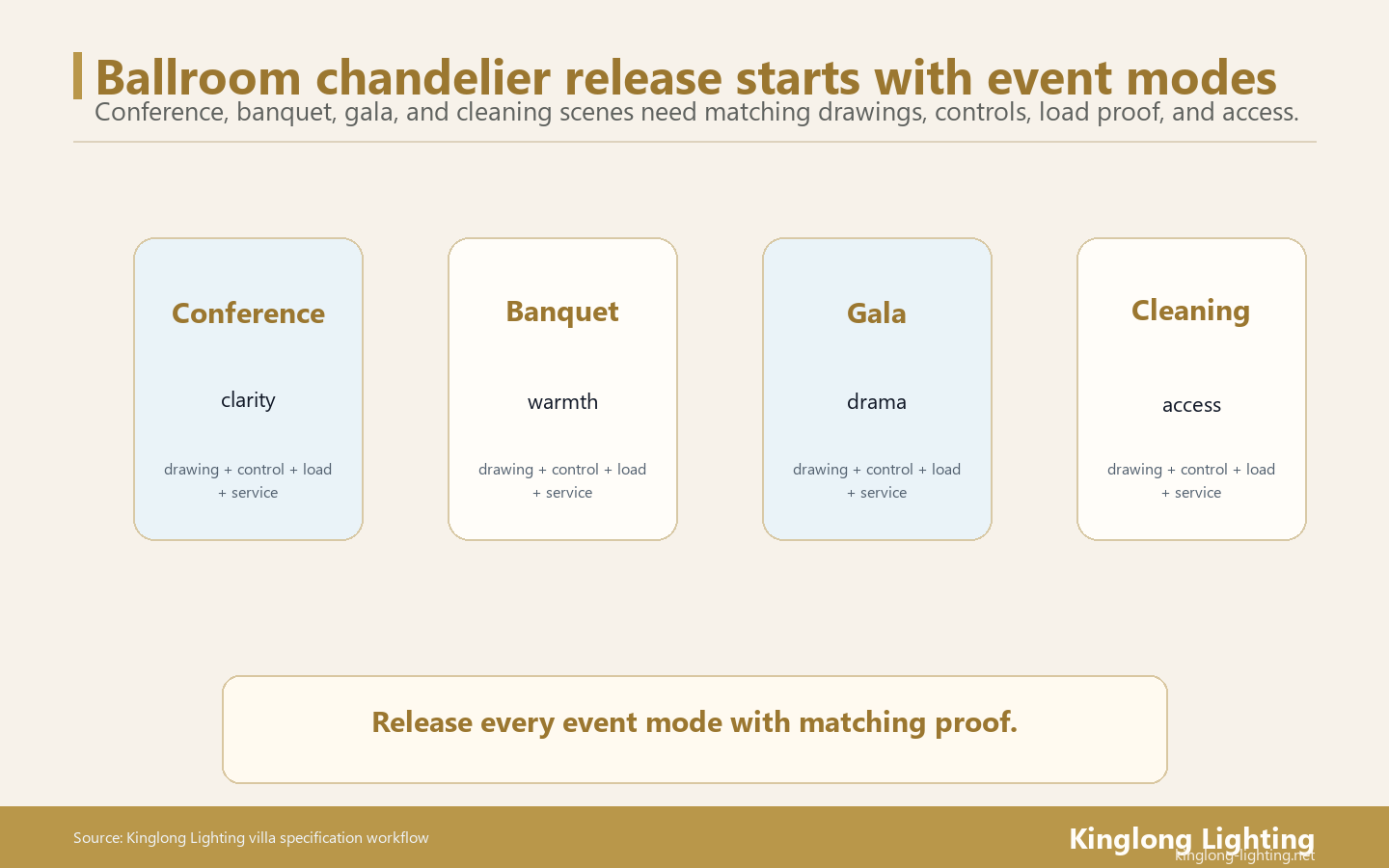
Hospitality designers usually inherit a hard problem: the ballroom must look generous in a wedding photograph, disciplined during a conference, warm during a banquet, and practical for hotel staff at midnight. A chandelier that succeeds in only one of those conditions is not fully specified. It is a beautiful object waiting for a coordination argument.
Key Takeaways
- Scene first: Start the ballroom specification with event modes, not a fixture shape.
- Evidence before approval: Pair every aesthetic decision with a drawing, sample, control note, or safety document.
- Scale is operational: Diameter, drop, weight, module size, and lift access affect both design and hotel maintenance.
- Controls matter: The chandelier should support conference, banquet, gala, pre-function, and cleaning scenes without fighting the ambient layer.
- Supplier fit: Rank manufacturers after the proof package shows what can be built, tested, packed, installed, and serviced.
Build the ballroom spec around event scenes, not fixture beauty alone
A ballroom chandelier earns approval when it can change mood without changing the room’s basic safety, comfort, and service logic.
The most useful first page of a ballroom lighting specification is a scene schedule. It should name the event mode, target atmosphere, chandelier role, dimming expectation, supporting layers, and owner of final approval. The IES Lighting Library is a better reference than a fixture catalog for this stage because it frames lighting as a designed application with quality criteria, not as a decorative object alone.
Conference and banquet use need different proof
Conference mode needs facial clarity, readable screens, disciplined glare, and enough ambient support that the chandelier does not become a distraction. Banquet mode needs warmer material rendering, table sparkle, and comfortable vertical brightness. Gala mode can carry stronger contrast and drama, but it still needs camera-friendly faces and safe circulation. Cleaning mode should be brighter, simpler, and serviceable. A specification that only says “dimmable chandelier” does not define any of these outcomes.
Kinglong Lighting’s hospitality lighting solutions are relevant here because ballroom work is rarely one isolated pendant. The chandelier has to coordinate with wall sconces, cove lighting, downlights, pre-function zones, and sometimes a full decorative family across the property. The business decision is not “which chandelier looks most luxurious”; it is “which supplier can preserve the ballroom’s event range through drawings, samples, controls, and installation evidence.”
Translate ceiling conditions into chandelier geometry
Diameter is only one dimension; a ballroom chandelier also has vertical density, suspension logic, module weight, crate path, and maintenance reach.
Large ballrooms expose proportion errors quickly. A fixture that fills the rendering may block AV sightlines. A fixture that looks elegant in elevation may become weak from the back of the room. A chandelier centered in plan may fight air diffusers, ceiling coves, sprinklers, rigging points, speakers, projectors, or movable partitions. The spec should therefore ask for plan, elevation, reflected ceiling plan coordination, suspension detail, canopy size, module breakdown, and the lowest finished point.
Use a crew-day risk model to make coordination visible
Assume a late mismatch forces three teams to reopen the same decision: the designer updates visible geometry, the engineer checks the load path, and the site electrician or ceiling contractor revises access and control routing. If each team loses two to three working days, the issue consumes 6 to 9 crew-days before freight, replacement parts, or event-calendar pressure are counted. This is not a universal cost figure; it is an illustrative coordination estimate that helps specifiers decide why early evidence is cheaper than late improvisation.
| Specification field | Why it matters in a ballroom | Evidence to request before release |
|---|---|---|
| Event scenes | One room may host a meeting, wedding, gala, and cleaning cycle in the same day. | Scene schedule with dimming, circuit, and control-owner notes. |
| Scale and drop | The chandelier must hold the room without blocking AV, cameras, or sightlines. | Plan, elevation, section, and human-view renderings. |
| Load path | Large decorative fixtures need ceiling coordination before production. | Weight estimate, suspension detail, fixing-point assumptions, and engineer review path. |
| Controls | The chandelier must dim with ambient, accent, and wall layers. | Driver data, control protocol, circuit grouping, and mock scene notes. |
| Maintenance | Luxury fails when cleaning requires room closure or unsafe access. | Lift or winch access plan, module map, spare part list, and cleaning method. |
Specify light quality as a ballroom experience, not a single number
The chandelier should support the emotional hierarchy of the event while the full lighting system carries visual comfort and code coordination.
A chandelier can supply sparkle, vertical emphasis, and brand memory, but it should not be forced to do every lighting job. Ambient downlights, cove lighting, wall grazing, pin spots, and table lighting may carry different responsibilities. The WELL v2 Light concept is useful as a comfort reminder: people experience light through visibility, glare, perception, and rhythm, not through fixture count alone. For color quality, the ANSI/IES TM-30 method can help teams talk about color rendition with more precision than a single generic “high CRI” request.
For many luxury ballrooms, warm white decorative light in the 2700K to 3000K range feels appropriate, but the exact target should be tested against finishes, food presentation, floral color, wall fabric, and camera expectations. If tunable white or multiple drivers are used, the specification must define the allowed scene range and who owns commissioning. Otherwise the final setting may be decided under opening-week pressure rather than by design intent.
Protect safety and certification evidence before price comparison
A ballroom chandelier price is not comparable until the safety path, test evidence, driver access, and installation responsibilities are comparable.
Large custom luminaires should be reviewed through the project’s local code and electrical authority. The UL luminaire testing and certification page and OSHA’s NRTL program help explain why third-party testing evidence matters in North American contexts, while IEC 60598 gives international vocabulary for luminaire safety discussion. The point is not to paste standards into a decorative brief; it is to ask the supplier for the correct proof path before the fixture is released.
Energy coordination also belongs in the handoff. Commercial projects may need lighting power and control documentation aligned with ANSI/ASHRAE/IES Standard 90.1 or a local equivalent, and US project teams may use DOE COMcheck as part of compliance documentation. The chandelier manufacturer cannot replace the project engineer, but it can provide driver data, wattage, dimming notes, and cut sheets early enough for the engineer to work.
Write the RFQ as a release package
The strongest RFQ asks the supplier to prove readiness, not merely to quote a beautiful fixture.
For a ballroom chandelier, the RFQ should request project drawings, ceiling height, ballroom dimensions, event modes, desired material language, control intent, preferred color temperature, local certification requirement, delivery destination, installation responsibility, and maintenance access constraint. Kinglong Lighting’s custom lighting manufacturing workflow fits this release-package approach because custom hospitality fixtures need design, engineering, sampling, production, testing, packing, and installation handoff to move together.
Based on our analysis, a ballroom release file should name at least 4 scene modes, 5 evidence gates, and 3 decision owners before the supplier comparison is useful. Calculated from the 3-team mismatch model above, a 2-day review delay equals 6 crew-days, while a 3-day delay equals 9 crew-days before freight or opening-date pressure enters the discussion. The decision rule is to treat a missing drawing, missing control note, or missing access plan as a release hold, not as a detail to solve after production starts. In practice, that rule keeps the chandelier from becoming the point where design, engineering, procurement, and site work discover that they approved different versions of the ballroom. It also gives the owner a clean reason to pause without making the discussion personal: the evidence package is incomplete.
Related Guides
Ballroom Chandelier RFQ Action Card
- Freeze event scenes before fixture comparison.
- Attach RCP, section, ceiling height, and AV sightlines.
- Request load, control, material, safety, and packing evidence.
- Ask Kinglong Lighting to review proof gaps before release.
- Send spec, drawings, quantity, destination, and control intent through the hotel lighting project inquiry.
A ballroom chandelier spec should release scenes before releasing the fixture
A ballroom chandelier can look correct in a rendering and still fail the hotel if it supports only one event mode. Conference clarity, banquet warmth, gala drama, and cleaning access create different lighting requirements. The release file should show how the chandelier behaves in each mode and which supporting layers carry the rest of the room. Without that scene logic, the fixture becomes a beautiful object that forces the controls team, AV team, and hotel staff to improvise.
Keep AV and ceiling systems in the same decision
Ballroom ceilings carry speakers, rigging, sprinklers, air distribution, acoustic surfaces, projectors, cameras, and maintenance access. A chandelier that ignores those systems can create glare, block sightlines, complicate rigging, or make cleaning impractical. The specification should therefore include ceiling sections, reflected ceiling plans, AV locations, rigging zones, and access method before geometry is frozen.
Make the RFQ answer event-mode proof
The RFQ should ask the supplier to respond by scene, not only by product. For each event mode, the response should state chandelier role, dimming expectation, control assumption, driver access, material behavior, and maintenance implication. Kinglong Lighting can then connect custom manufacturing details to the actual hospitality use case rather than quoting a decorative form in isolation.
Protect the cleaning and reset mode
Cleaning and reset modes are easy to omit because guests do not see them, but hotel staff depend on them. The spec should state whether the chandelier can be inspected, cleaned, and serviced without damaging finishes or disrupting ceiling systems. If the cleaning mode requires a different light level, driver behavior, access route, or removable part strategy, it belongs in the same release file as the gala and banquet scenes.
Use a coordination hold point before the ceiling closes
The most practical ballroom hold point is before the ceiling becomes difficult to reopen. At that moment, the team should confirm suspension points, driver locations, access panels, control zones, speaker and rigging conflicts, crate route, and service method. If the chandelier is approved visually but those items remain open, the project is not ready for production release. The hold point protects the designer’s scene intent and the contractor’s installation sequence at the same time.
Before production release, send Kinglong Lighting the ballroom event schedule, ceiling package, control intent, AV constraints, material targets, certification context, packing route, and maintenance access requirement. The useful response is a scene-ready release package, not only a visual price.
The release package should also name which future changes reopen review. A larger diameter, deeper drop, new speaker position, revised air diffuser, different driver, or changed access panel can all affect the same chandelier decision. Writing those triggers into the file helps the hotel move through design changes without losing control of the fixture.
The ballroom operator should receive a short version of the same release logic. Banquet teams do not need every engineering detail, but they do need to know which scenes exist, how cleaning mode is used, what access is allowed, and which changes require design or engineering review. That handoff keeps the chandelier useful after the opening photography is over.
Frequently Asked Questions
What should be included in a ballroom chandelier specification?
Include event scenes, diameter, drop height, weight estimate, suspension details, material samples, color temperature, dimming and control notes, driver access, safety evidence, packaging method, installation responsibility, and maintenance plan. A specification is ready when each field has an owner and evidence.
Should a ballroom chandelier be the main light source?
Usually no. It can be the main visual anchor and part of the ambient layer, but ballrooms need separate ambient, accent, task, wall, and cleaning layers. The chandelier should support the hierarchy instead of carrying every lighting job.
How early should the chandelier supplier join a hotel ballroom project?
Bring the supplier in before ceiling coordination is frozen. Early review protects suspension points, module size, crate routes, dimming expectations, and maintenance access. Late supplier involvement often turns design decisions into field compromises.
What is the biggest hidden risk in ballroom chandelier procurement?
The hidden risk is not only fixture cost. It is the coordination loss created when design intent, load path, controls, packing, and installation are approved separately. That is why a release package is stronger than a price-only RFQ.