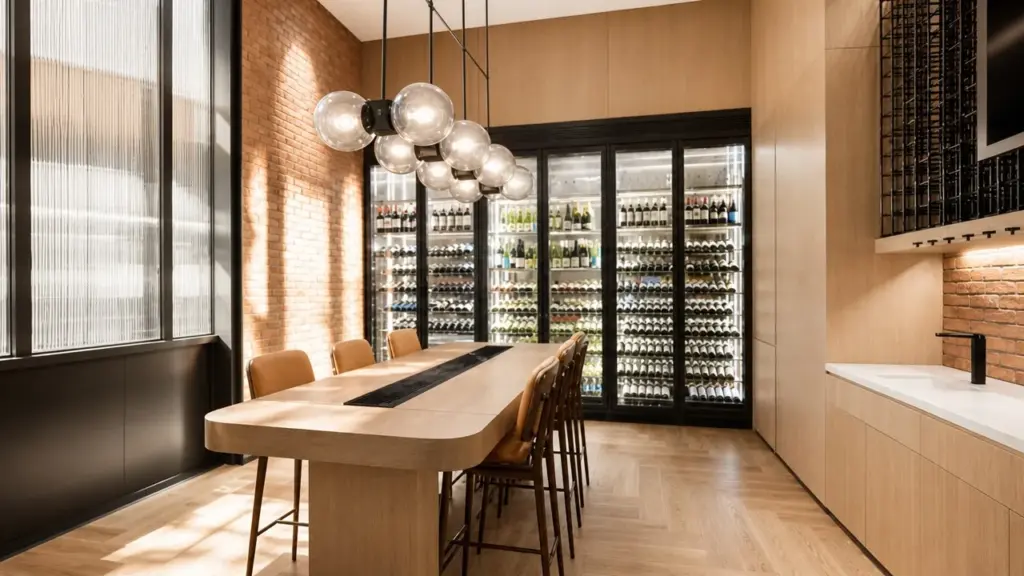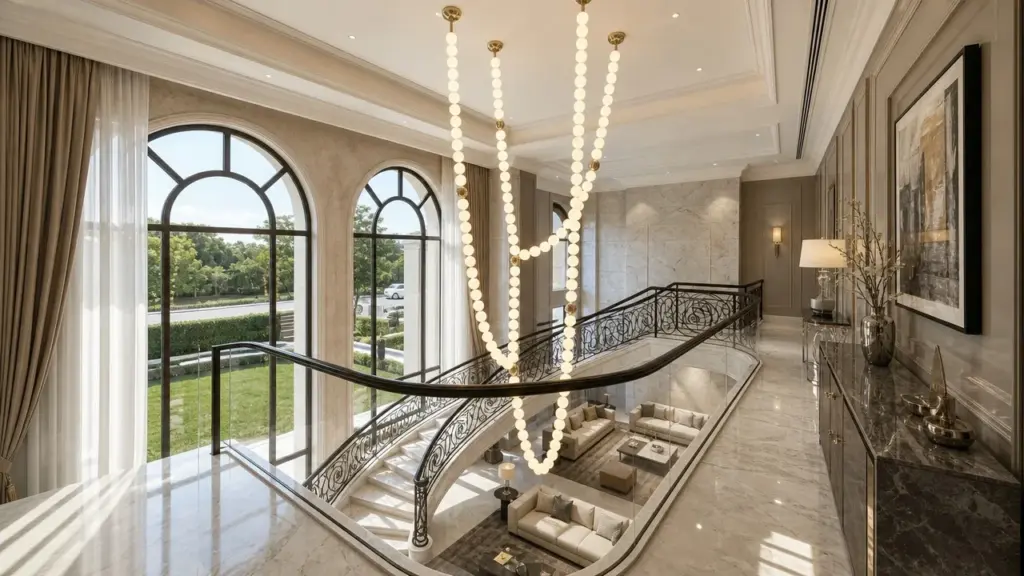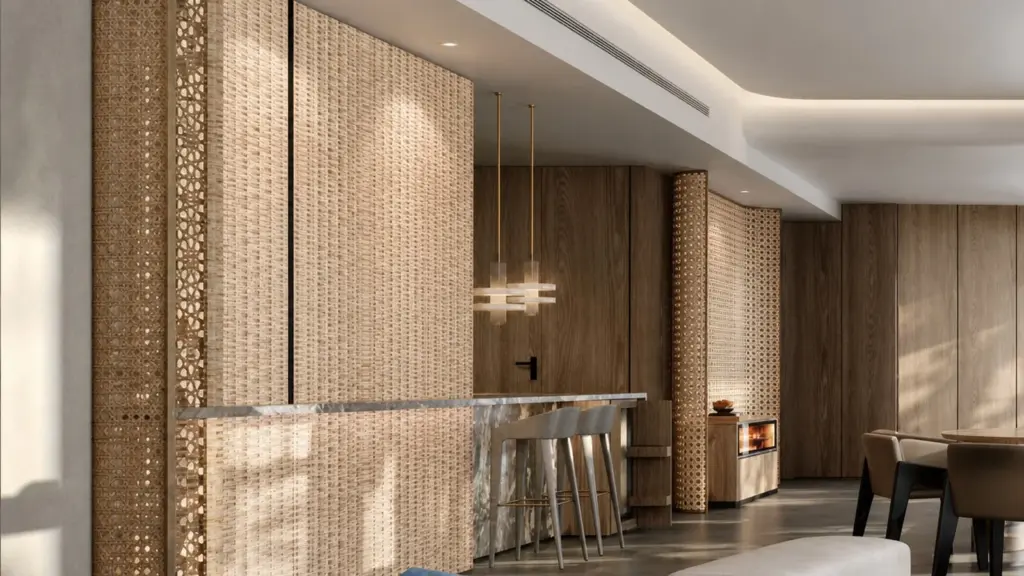
A hotel lobby chandelier should earn its scale by shaping arrival behavior, face quality, wayfinding, material perception, and operational confidence – not by becoming the largest object the owner can afford.
The lobby is where a guest decides, often within seconds, whether the property feels generous, orderly, memorable, and professionally operated. The chandelier has a privileged role in that judgment because it sits at the intersection of architecture, brand identity, lighting design, structural coordination, and daily maintenance. A beautiful fixture can still be the wrong fixture if it blocks views, creates glare at reception, photographs poorly, fights the ceiling, or cannot be cleaned without disturbing hotel operations.
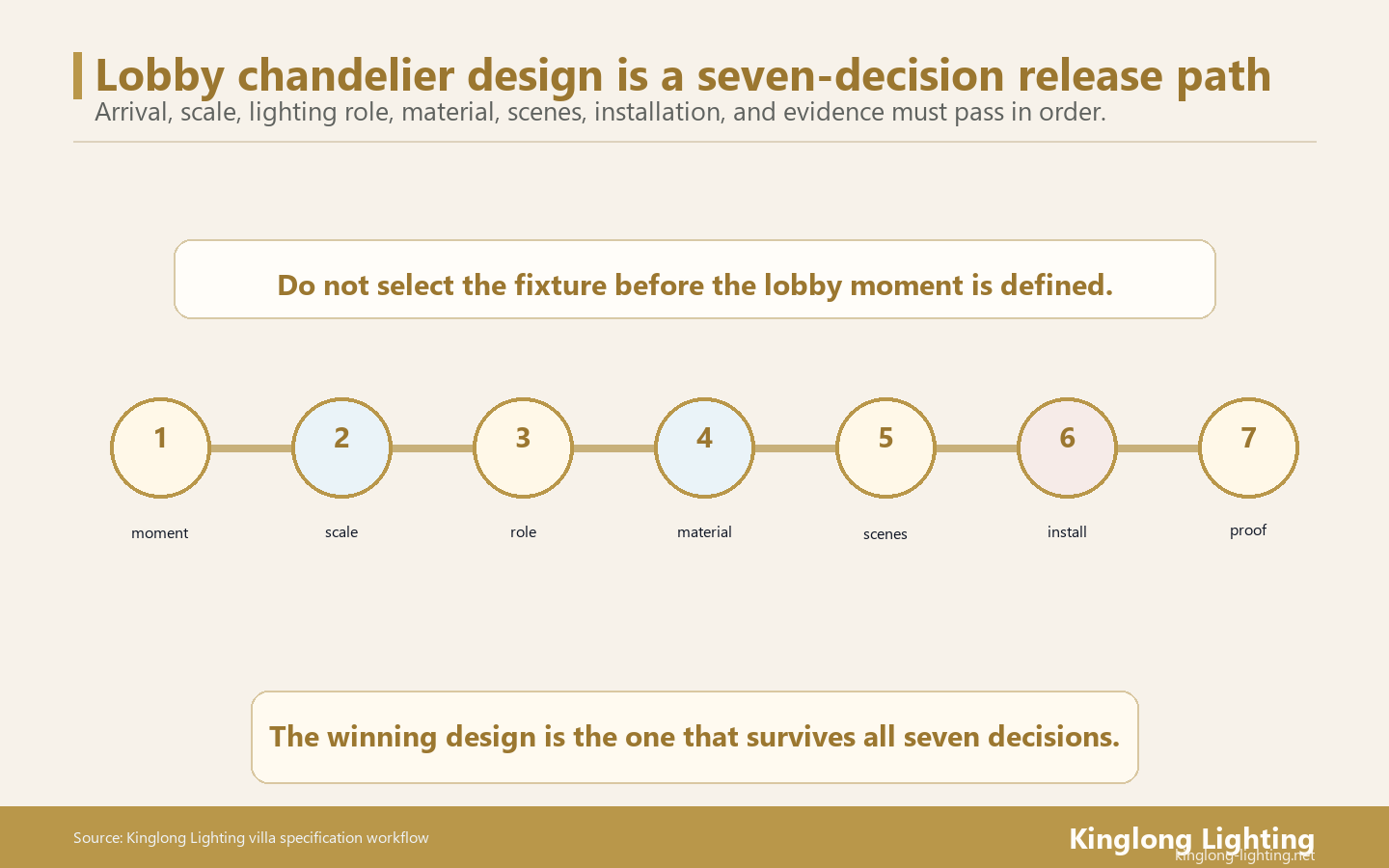
Key Takeaways
- Arrival first: The chandelier should define the first emotional moment without overwhelming reception, circulation, or seating zones.
- Scale is conditional: Diameter, drop height, and visual density should be judged against ceiling height, viewing distance, camera angles, and furniture plan.
- Light quality beats sparkle alone: The best lobby fixture coordinates with ambient, accent, and task lighting instead of trying to do every job.
- Materials must age well: Crystal, glass, brass, leather, acrylic, and resin each communicate luxury differently and create different cleaning risks.
- Proof protects design: A luxury lobby chandelier needs drawings, load assumptions, certification evidence, dimming compatibility, packaging logic, and site support before order release.
Decision 1: Define the lobby moment before choosing the fixture
The chandelier should answer one strategic question: what does this property want guests to remember about arrival?
A resort lobby, an urban business hotel, a cultural boutique property, and a private luxury residence hotel do not need the same chandelier language. One property may need a vertical cascade that can be seen from the driveway. Another may need a quieter composition that supports art, landscape, or reception service. The design team should write the lobby moment in one sentence before reviewing options: “arrival theater,” “calm residential luxury,” “cultural landmark,” “branded social hub,” or another explicit role.
This role prevents aesthetic drift. If the chandelier is supposed to create arrival theater, it can justify more vertical presence and sparkle. If the lobby must feel residential, a lower-contrast material palette may be stronger. Kinglong Lighting’s hospitality lighting positioning fits this kind of early decision because custom manufacturing should begin from the property story, not from a fixed catalog shape.
Decision 2: Size the chandelier from sightlines, not a formula alone
The right scale is the one that holds attention from the main arrival path while preserving human comfort at reception and lounge seating.
Common diameter formulas are useful only as a first sketch. A luxury lobby chandelier must be judged against ceiling height, atrium depth, approach distance, elevator or stair views, reception desk height, seating clusters, and photography angles. A fixture that looks dramatic in a rendering can feel heavy if guests see it from directly below for too long. A fixture that seems modest on plan can feel powerful if it aligns with a long arrival axis or a double-height void.
Ask for a minimum of three views: entrance approach, reception check-in, and lounge seating. For atrium projects, add balcony or mezzanine views. The specification should state diameter, drop height, lowest visible point, clearance, canopy dimensions, and whether the chandelier is a single sculptural mass or a distributed cluster. This is also the moment to test cleaning access, because scale that cannot be maintained will lose its luxury signal over time.
Decision 3: Decide what the chandelier lights – and what it should not light
A lobby chandelier should create visual hierarchy; it should not be forced to carry the entire lobby lighting load.
Many lobby mistakes come from asking one chandelier to supply sparkle, general brightness, reception task light, art light, evening atmosphere, and wayfinding. That creates glare, flatness, or disappointment when dimmed. The better specification assigns jobs: the chandelier creates identity and vertical sparkle; downlights support circulation; wall washers reveal surfaces; table or floor lamps humanize lounge zones; integrated architectural lighting supports the ceiling and columns.
The IES Lighting Library is a stronger reference point than fixture marketing copy because it treats lighting as a designed environment. WELL’s Light concept also reinforces the need to consider visual comfort and human experience. In practical RFQ language, ask the supplier to provide lumen output, beam behavior if applicable, dimming range, color temperature, driver information, and how the chandelier coordinates with the rest of the lobby lighting package.
Decision 4: Match material language to the hotel positioning
Crystal is not automatically more luxurious than glass, brass, resin, acrylic, or mixed materials; luxury comes from the fit between material, story, detail, and maintenance.
K9 Crystal can support a classic international luxury tone when the lobby needs brilliance and refraction. Hand-blown glass can feel more artisanal and site-specific. Brass and leather can make a boutique or culturally rooted lobby feel warmer. Acrylic may work when the project needs scale with lower weight or a softer budget envelope, but it should be presented honestly as value-engineered rather than as a substitute for crystal prestige.
The material decision should also include cleaning, fingerprinting, yellowing risk, replacement availability, and finish consistency. A lobby chandelier is photographed, touched by maintenance teams, exposed to dust, and judged across years. Request samples under the project’s intended color temperature, not only under showroom lighting. When material accuracy matters, discussing color rendition with a method such as ANSI/IES TM-30 is more useful than accepting a vague “premium LED” claim.
Decision 5: Build lobby scenes before the control system is ordered
The lobby chandelier should have a scene sequence, not a single on/off identity.
A luxury lobby usually needs at least four lighting states: daytime arrival, evening arrival, late-night calm, and cleaning or event reset. Some properties also need photo moments, wedding arrivals, VIP reception, or seasonal decor scenes. If the chandelier contains multiple circuits or driver groups, the control logic should be defined before production so the factory can place drivers, access panels, and wiring groups correctly.
Scene planning protects both design and operations. A chandelier that is spectacular at 100 percent may be uncomfortable at reception. A chandelier that dims poorly may flicker in evening scenes or lose its material depth. Ask the supplier to confirm dimming protocol, driver location, service access, compatibility responsibilities, and whether the final mock-up should include dimming tests. The design team should decide which party owns scene commissioning: lighting designer, electrical contractor, controls vendor, supplier, or hotel engineering.
Decision 6: Treat installation as part of the design
If installation is not specified, the chandelier has not been fully designed.
The most expensive lobby chandelier problem is often not a broken crystal; it is a late discovery that the fixture cannot be lifted, suspended, wired, accessed, or assembled under the actual site condition. The spec should define ceiling opening, suspension points, structural coordination, module size, crate access route, lift access, on-site assembly sequence, and who provides technical supervision. For oversized lobby chandeliers, even one missed access constraint can disturb several workstreams.
An illustrative decision model: if a lobby fixture delay stops the ceiling contractor, electrician, and installation crew for two days each, the project has already spent 6 crew-days before any replacement component or schedule impact is counted. That is why the installation method should be reviewed before order release, not after goods arrive. Kinglong’s project references can help a buyer understand the kind of installed environments to discuss, but the final proof should be specific to the new lobby.
Decision 7: Require supplier evidence before final selection
The supplier should be chosen by its ability to close design, engineering, and delivery risks – not only by the beauty of its first rendering.
A luxury lobby chandelier supplier should provide shop drawings, structural assumptions, material samples, finish control method, light-source data, driver and dimming information, safety documentation, packaging plan, on-site installation guide, spare-parts list, and a named communication workflow. Safety evidence matters because decorative fixtures still need to be acceptable in the destination market. UL luminaire testing, the NRTL framework, and IEC 60598 vocabulary give buyers more precise questions than “is it certified?”
Energy and documentation responsibilities should also be assigned early. ASHRAE 90.1 and COMcheck are U.S.-oriented references, but the broader lesson applies internationally: decorative lighting must fit the project’s compliance workflow. If the chandelier supplier, lighting designer, electrical contractor, and hotel engineering team do not know who owns each document, the lobby design becomes fragile.
| Decision | Best question to ask | Evidence to request | Failure if skipped |
|---|---|---|---|
| Arrival role | What should guests remember? | Lobby story sentence and visual references | Large but forgettable decoration |
| Scale | Where will guests see it from? | Entrance, reception, lounge, and mezzanine views | Fixture blocks views or feels undersized |
| Light layers | Which jobs belong to other lights? | Scene schedule and lumen/dimming data | Glare, flatness, or weak night mood |
| Material story | What luxury language fits the property? | Samples under project color temperature | Mismatch between mock-up and installed atmosphere |
| Controls | Who owns scene commissioning? | Driver, dimmer, circuit, and access plan | Flicker, poor dimming, or service confusion |
| Installation | Can the site install and clean it? | Load path, crate route, module map, access method | Late ceiling changes and opening delay |
| Supplier proof | Can the factory close risk, not just render beauty? | Drawings, reports, packaging, spare parts, guide | Pretty proposal, weak delivery confidence |
Procurement action card for lobby chandelier design
- Write the lobby arrival sentence before fixture review.
- Approve scale from entrance, reception, lounge, and upper-level views.
- Request material samples under the actual lighting temperature.
- Test dimming behavior before freezing driver placement.
- Require installation and maintenance evidence before final supplier ranking.
For a custom lobby project, use Kinglong Lighting’s Mofun Design Platform for early visualization and the contact page for project-specific drawings, quotation, and evidence requests.
A lobby chandelier design file should keep all seven decisions connected
The seven lobby decisions should not be treated as a checklist where the team can pass one item and forget it. The lobby moment affects size. Size affects suspension, packing, and cleaning access. Lighting role affects controls and glare. Material affects brand tone, replacement, and maintenance. Installation affects what can be safely built. Evidence determines whether the preferred design is ready for production.
Start with the guest moment, then test the fixture against it
The first decision should describe what the guest should feel and understand from the driveway, entrance, reception desk, lounge seating, and elevator approach. Once that moment is clear, every later decision can be tested against it. A large chandelier that blocks reception sightlines weakens the moment. A subtle chandelier that disappears from the arrival axis may also fail. The design file should make those trade-offs explicit.
Turn installation into a design decision
Installation is not an afterthought for a luxury lobby chandelier. Ceiling opening, suspension points, lift route, crate size, module labels, driver access, and service clearances can all change the design. Kinglong Lighting should see these constraints before the design is sold to the owner as final. If the installation plan is still unknown, the visual approval should remain conditional.
Require evidence before emotional preference becomes purchase order
A lobby chandelier is allowed to be emotional, but the purchase order should be evidence-led. The final design file should include drawings, material samples, source data, dimming notes, load assumptions, finish control method, packing plan, spare strategy, and installation responsibility. That evidence lets procurement compare suppliers without reducing the project to price and delivery time.
The practical next step is to send Kinglong Lighting the seven-decision file: lobby moment, sightline targets, lighting role, material direction, scene list, installation route, and evidence requirement. The supplier response should make clear where the design is ready, where it needs adjustment, and where owner approval is still required.
Frequently Asked Questions
What size should a hotel lobby chandelier be?
There is no universal diameter. Start with ceiling height, approach distance, reception sightlines, lounge seating views, and maintenance access. Then test the fixture in entrance, check-in, and seated guest views before approving the final scale.
What color temperature works best for a luxury lobby chandelier?
Many luxury lobbies use warm white ranges, but the exact choice depends on stone, brass, wood, leather, fabric, daylight, and adjacent lighting. The specification should state the range, dimming behavior, sample conditions, and who approves the mock-up.
Should the lobby chandelier provide general lighting?
It may contribute to ambient light, but it should rarely carry the whole lobby lighting load. Better results usually come from a layered system where the chandelier creates identity while architectural and task lighting handle circulation, reception, art, and seating comfort.
How do hotels avoid glare from a large chandelier?
They test viewing angles, shielding, lamp visibility, diffuser quality, dimming scenes, and the relationship between the chandelier and surrounding ambient light. Glare should be reviewed from guest arrival, reception, seating, and upper-level views.
What should be included in a lobby chandelier RFQ?
The RFQ should request drawings, dimensions, weight, suspension method, material samples, finish control, light-source data, dimming information, certification path, packaging plan, installation guide, maintenance access, spare parts, and site-support responsibilities.