A villa lighting punch list should help the designer and owner accept the project with clarity. It should not become a messy list of comments where a dimming fault, a scratched finish, a missing spare, and a personal preference all carry the same weight.
Villa lighting acceptance is personal and technical at the same time. The owner cares about beauty, comfort, and finish. The designer cares about intent. The installer cares about closure. The manufacturer cares about evidence and responsibility. A good punch list lets those interests meet without turning every observation into a dispute.
Kinglong Lighting can support villa lighting punch list closure when the list connects visible issues to drawings, samples, component maps, warranty, spares, and the custom chandelier workflow. The goal is not to avoid corrections; it is to make correction decisions clean.
Key Takeaways
- Triage before debating: Separate blocking defects, repair items, documentation gaps, and preference changes.
- Use evidence categories: Photos, scene notes, sample references, drawing references, and part codes make each item actionable.
- Do not hide controls in aesthetics: Dimming, flicker, buzz, and scene behavior should be checked separately from visual beauty.
- Owner preferences need a change path: A preference after installation may be valid, but it should not be mislabeled as a defect.
- FAQ should not close the project: Acceptance requires a signed punch list and handover file before future service begins.
Start by classifying the punch list item
A punch list is not a complaint list; it is the owner's final decision map for what must be fixed, documented, accepted, or changed.
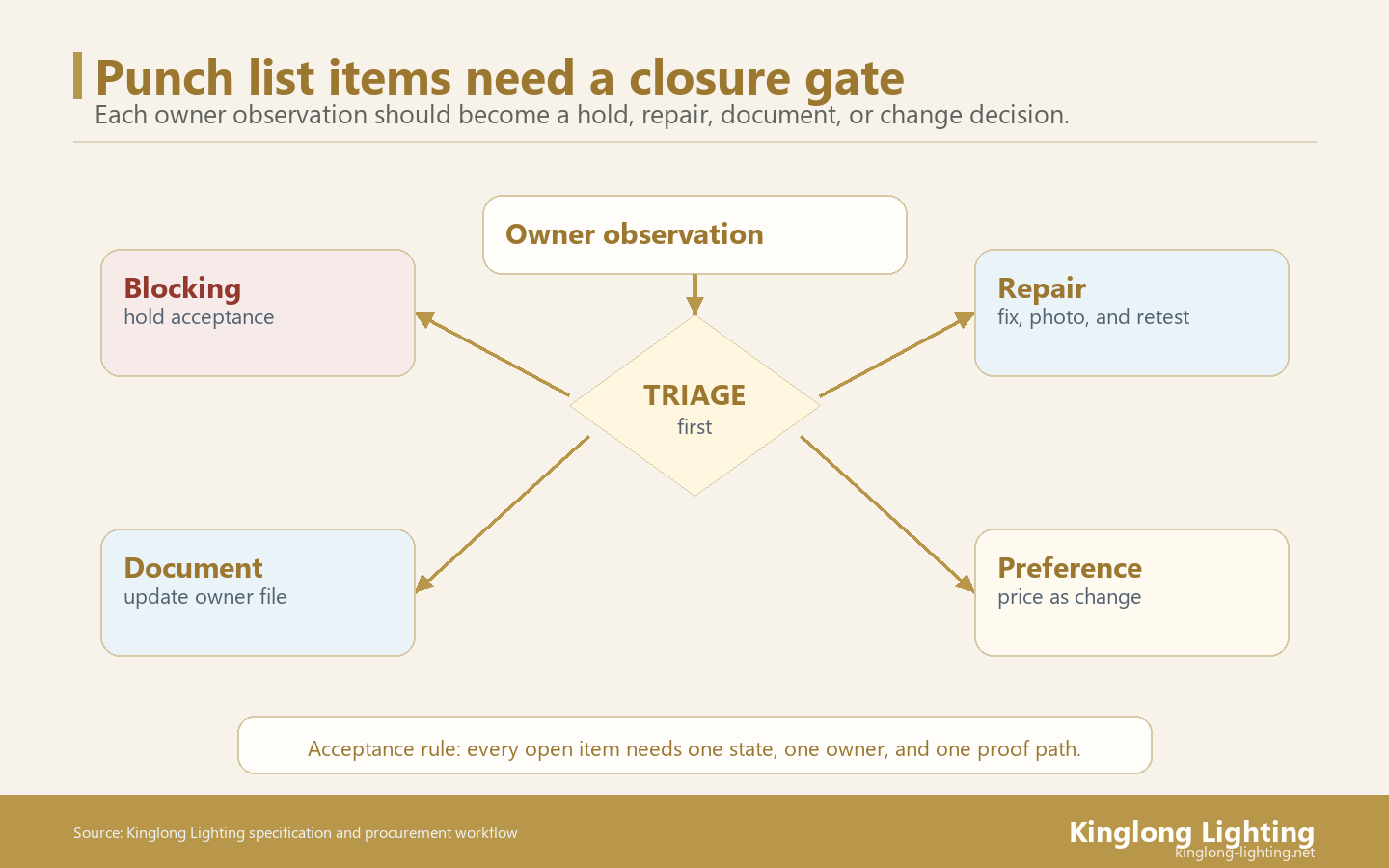
The first mistake is to write every observation as a defect. A villa lighting punch list should classify each item before assigning responsibility. Classification changes the next action and prevents the owner from treating every issue as a crisis.
The WBDG building commissioning page gives a useful boundary because commissioning connects design intent, installation quality, operation, and owner handover. For project buyers, the practical action is to turn final acceptance into a structured close-out process with evidence and owner handover.
Blocking items prevent acceptance
Blocking items affect safety, operation, installation integrity, major visual intent, or the owner’s ability to use the room. Examples include a chandelier that cannot be controlled, a support concern, missing critical parts, visible major damage, or a fixture that does not match the approved drawing.
Blocking items should have an owner, deadline, evidence requirement, and retest method. They should not be mixed with preference comments or minor finish questions because the project needs to know what actually prevents acceptance.
Preferences need a change decision
A preference item may be real: the owner wants a warmer tone, lower drop, denser crystal, or softer diffusion after seeing the room. But if the installed fixture matches the approved drawing and sample, the item may be a change request rather than a defect.
This distinction protects relationships. The owner can still request a change, the designer can defend the original approval, and the supplier can price or schedule the revision without pretending the original work failed.
Check visual quality against approved evidence
Visual quality should be judged against approved evidence, not against memory. The punch list should reference drawings, samples, finish masters, room intent, photos, and accepted variation boundaries.
The DOE TM-30 FAQ gives a useful boundary because color quality needs more precise language than warm, cool, or beautiful when materials are being approved. For project buyers, the practical action is to use precise color and material language for finish or light-quality punch items.
Finish items need sample references
Finish comments such as too yellow, too matte, or not premium are difficult to close unless the project has a sample reference. The punch item should say whether the installed finish differs from the sample master, differs from a rendering, or simply feels different in the finished room.
If the sample master was never frozen, the punch list should say that as well. The problem may be an approval gap rather than a production defect. That changes how the owner and supplier should solve it.
Alignment and proportion need room context
A chandelier may be level but still feel misaligned with a table, stair line, ceiling feature, or furniture layout. The punch list should include photos from agreed viewing positions and note whether the issue is fixture alignment, room layout change, installation tolerance, or owner preference.
This is where designer participation matters. The designer can distinguish between visual intent and personal reaction, then help the owner decide whether to accept, adjust, or revise.
Controls and electrical behavior require separate checks
Lighting acceptance should not stop at appearance. Villa owners should check switching, scenes, dimming, flicker, driver noise, heat, and any control integration that affects daily use.
The DOE LED lighting page gives a useful boundary because LED performance, heat, service life, and operating behavior need to be part of luminaire decisions. For project buyers, the practical action is to include driver behavior, dimming, heat, and service expectations in the punch list rather than treating LED issues as minor afterthoughts.
Scene behavior is a user experience item
A chandelier may look correct during inspection but fail in daily life because the scenes are wrong. Dining, cleaning, evening, reading, party, or night scenes may need different behavior. The punch list should name the scene and the problem, not simply say dimming issue.
If another control vendor owns programming, the punch item should name the responsibility boundary. The supplier may need to confirm driver behavior, while the control team adjusts scenes or compatibility.
Electrical issues need local qualified review
The punch list should not make the lighting manufacturer responsible for local electrical work unless the contract says so. It should identify whether the symptom appears to be fixture-side, driver-side, wiring-side, control-side, or unknown.
The NFPA 70 National Electrical Code page gives a useful boundary because electrical installation and field acceptance decisions need local qualified code review. For project buyers, the practical action is to keep local electrical code and installation responsibility visible during final acceptance.
Inspect access, spares, and service readiness
A villa can pass visual acceptance and still fail future ownership if access, spare parts, cleaning, or warranty records are missing. Punch list review should include maintenance readiness before final close-out.
The OSHA aerial lifts page gives a useful boundary because overhead installation and later service require planned access and trained site practice. For project buyers, the practical action is to include access and future service conditions for overhead lighting in the acceptance checklist.
Access issues should not wait for the first failure
If the chandelier cannot be reached safely after furniture, flooring, or stair finishes are complete, the owner should know before acceptance. Access questions may involve lift reach, canopy opening, driver location, cleaning method, or fragile component handling.
The punch item should name whether the issue blocks acceptance or becomes a handover note. A missing access plan for a large stair chandelier may be blocking. A cleaning note for a small dining pendant may be a documentation gap.
Spares need part codes and storage instructions
Spare parts should be checked during punch list closure. The owner should receive part codes, quantities, fixture locations, storage recommendations, and ordering path. A loose bag of unlabeled glass pieces does not solve future maintenance.
The ICC Incoterms 2020 page gives a useful boundary because international delivery responsibility should be named before goods, crates, and spare parts move. For project buyers, the practical action is to connect replacement movement, delivery responsibility, and destination handoff to future spare part support.
Close the punch list with owner-readable evidence
A punch list is closed when the owner can read what happened and what remains. A verbal agreement is not enough for a custom villa lighting package that may need future maintenance, replacement, or warranty discussion.
The UL 1598 standard page gives a useful boundary because decorative chandeliers are still luminaires that need product evidence and qualified installation review. For project buyers, the practical action is to keep luminaire evidence, product references, and installation boundaries connected to final handover.
Every item needs a closure state
Use simple closure states: accepted, repaired, replaced, retested, documented, priced as change, or deferred with owner approval. Avoid vague states such as done or noted. They do not tell a future maintenance person what actually happened.
The closure record should include photos where helpful, responsible party, date, and evidence reference. This record becomes part of the owner handover file, not a separate message thread that disappears.
Handover should follow punch list closure
The owner handover file should include final drawings, installed photos, sample references, component map, spare list, warranty path, cleaning notes, service access, and open deferred items. If the punch list is not reflected in the handover file, future teams will not know what was accepted.
Kinglong Lighting can help connect the closure record to the villa lighting project support file when component identification, spares, or manufacturer evidence is needed after installation.
Villa lighting punch list acceptance table
Use this checklist to turn owner and designer comments into clear decisions.
| Decision area | Owner risk if vague | Evidence to request | Acceptance action |
|---|---|---|---|
| Blocking defect | Project accepts an unsafe or unusable condition | Photo, symptom, location, responsible party, retest rule | Hold acceptance until corrected |
| Repair item | Small visible or functional defect remains unresolved | Before/after photos, sample or drawing reference | Repair, replace, or accept with record |
| Documentation gap | Future maintenance lacks evidence | Drawing, component map, spare list, warranty path | Close only when owner file is updated |
| Preference change | Approved work is mislabeled as a defect | Original approval, new owner request, cost/schedule impact | Price or schedule as a change |
| Deferred item | Open issue disappears into memory | Owner approval, date, responsible party, future action | Track as deferred, not closed |
How to triage a 25-item villa punch list
A 25-item punch list feels overwhelming when every item is treated equally. A better triage might find five blocking items, eight repair items, seven documentation gaps, and five preferences. The owner then knows which items hold acceptance and which can be closed through records or change decisions.
This estimate is illustrative, but the logic is practical. Blocking items need urgent correction. Repair items need scope and proof. Documentation gaps need the handover file updated. Preference items need owner choice and commercial clarity. The list becomes smaller because each item has a path.
The designer should help the owner make this separation. Otherwise the owner may spend time debating a preference while a true access or control issue remains unresolved.
The triage should happen before the team assigns cost. If a scratch is classified as shipping damage, the next evidence is receiving photos and packing records. If it is classified as site handling, the next evidence is storage and installation sequence. If it is classified as owner preference, the next evidence is the original approval record. The same visible mark can lead to different decisions depending on category.
This is why the punch list should be written in complete issue statements. Instead of finish problem, write dining pendant arm has visible scratch on west-facing side, compare with approved finish sample, receiving damage unknown, close by repair photo or accepted variation. That sentence gives the team a path; a vague label gives the team another meeting.
For owner acceptance, clarity is the kindness. It tells every party what must happen next.
How Kinglong Lighting supports punch list closure
Kinglong Lighting can support punch list closure by linking installed issues to drawings, sample masters, component maps, spare parts, packing evidence, and the custom chandelier workflow. That support is strongest when each item includes photos, location, symptom, and the requested closure state.
If a villa project is near handover, the next action is to send the villa lighting punch list file with item categories, photos, fixture codes, sample references, and owner priorities. Kinglong Lighting can then help identify which items need manufacturer evidence and which belong to local site teams.
Before signing villa lighting acceptance
Use this short action list before the next approval meeting. It is intentionally practical, because vague approval language is the usual source of later rework.
- Classify each item as blocking, repair, documentation, preference, or deferred.
- Attach photos, location, evidence reference, owner, and closure state.
- Separate fixture issues from local electrical, control, structure, and site work.
- Update the handover file with spares, cleaning, warranty, and service records.
- Do not let preference changes hide real defects or missing evidence.
FAQ
What should be on a villa lighting punch list?
It should include visual defects, control issues, electrical symptoms, damage, access problems, missing spares, cleaning notes, warranty gaps, and handover documentation.
Who should prepare the punch list?
The designer, owner representative, installer, electrician, and supplier should contribute where relevant, but each item needs one responsible owner and closure state.
Are owner preferences part of the punch list?
They can be recorded, but approved work that the owner later wants to change should be treated as a preference or change request, not automatically as a defect.
When is a villa lighting punch list closed?
It is closed when blocking items are resolved, accepted items are documented, deferred items have owner approval, and the final handover file reflects the agreed status.