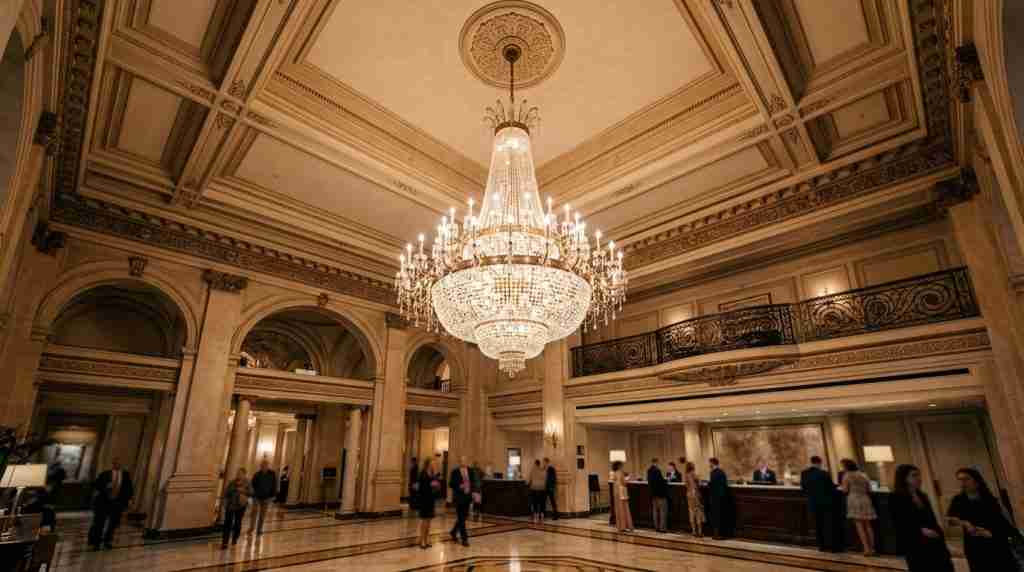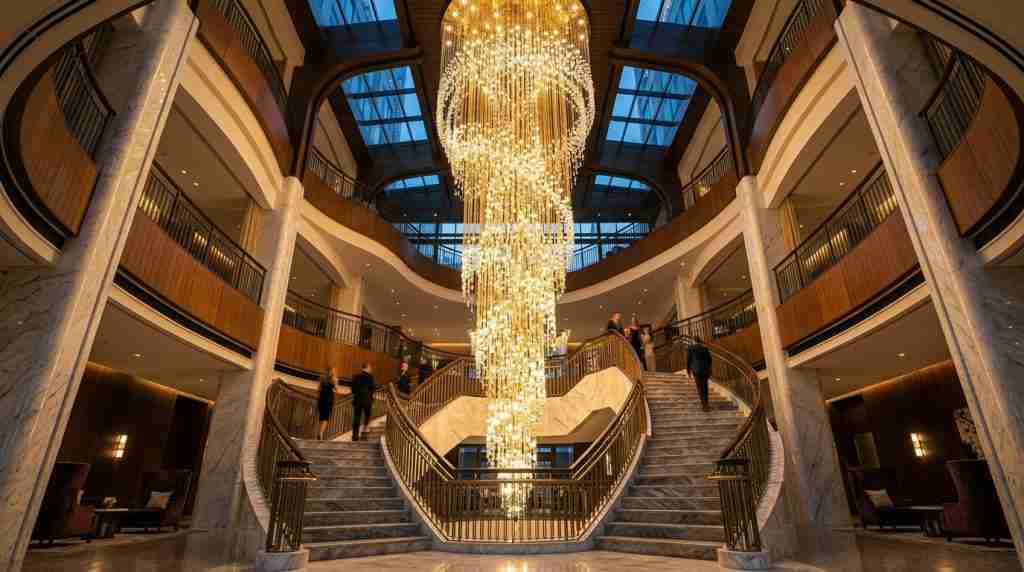
A hotel ballroom is one of the most demanding lighting environments in hospitality — a single space that must transform from a morning conference room to an afternoon awards ceremony to a black-tie gala by evening, sometimes within the same 24 hours. Get the lighting wrong, and even the most meticulously planned event feels flat. Get it right, and the room itself becomes part of the guest experience. According to Action Services Group’s hospitality lighting analysis, lighting directly influences how guests feel throughout an event — it controls emotion, signals formality, and guides attention in ways no other design element can replicate.
Key Takeaways
- Layered lighting — ambient, accent, decorative, and task — is the foundation of every successful ballroom design.
- Color temperature and scene programming are what allow one room to host a corporate breakfast and a black-tie gala on the same day.
- The chandelier is not just a decorative element — it is the ballroom’s primary visual anchor and the starting point for every design decision.
- Smart control systems with DALI protocol deliver 40–80% lighting energy savings and allow staff to switch scenes with a single tap.
- CRI ≥ 90 (ideally 95+ for luxury venues) ensures guests, food, and décor all look their best under your ballroom’s light.
The Four Layers of Professional Ballroom Lighting
Most lighting failures in hotel ballrooms come from treating light as a single, undifferentiated resource. Professional designers think in layers, and every successful ballroom installation relies on at least four distinct layers working in concert.
Ambient: The Foundation
Ambient lighting establishes the room’s base illuminance — the “floor” of brightness from which all other effects are built. For ballrooms, the recommended baseline illuminance is around 300 lux for banquet events, scaling up to 300–600 lux for multi-functional daytime use. This is typically delivered through a combination of recessed downlights, cove lighting, and — critically — the architectural chandelier. The ambient layer must be fully dimmable: too bright and the room feels clinical; too dim and it reads as underpowered and unfinished.
Accent: Drama and Direction
Accent lighting does the narrative work. Pin spots draw the eye to centerpieces, floral arrangements, and cake tables. Uplighting along the perimeter walls adds height and depth — particularly important in ballrooms with low ceilings, where vertical light lines create the illusion of greater volume. Gobo projections can cast branded logos, monograms, or intricate patterns onto walls and floors, personalizing the environment without permanent changes to the space. As Elegant Event Lighting notes, when chandelier fixtures are paired with complementary uplighting, the result further accentuates architectural grandeur in a way neither element achieves alone.
Decorative: The Statement Piece
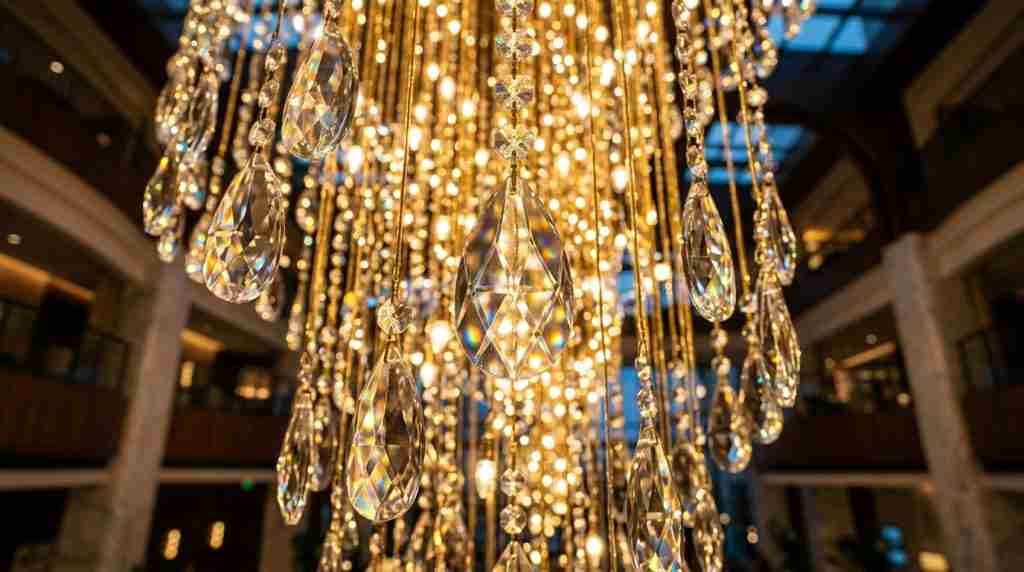
In a hotel ballroom, the decorative layer is almost always led by the chandelier — and this choice carries outsized design weight. The chandelier anchors the entire room’s visual hierarchy, sets the style register (traditional crystal, contemporary sculptural, transitional), and determines how the ambient layer is perceived. A chandelier with high-quality K9 crystal, properly specified for ceiling height and room volume, distributes light in ways that create sparkle, movement, and depth no recessed fixture can replicate. For luxury hospitality projects, the decorative layer must be engineered — not just selected from a catalog — to ensure the fixture’s lumen output, beam distribution, and scale are correctly proportioned to the space. For large ballrooms, this often means custom manufacturing to achieve the right diameter-to-ceiling-height ratio.
Task: The Invisible Layer
Task lighting in a ballroom is deliberately unobtrusive — podium spots for speakers, adjustable lighting at AV tables, focused illumination at registration desks or buffet stations. The goal is to support function without undermining the ambient mood. This layer is most commonly delivered through adjustable track fixtures or independently addressed downlights that can be dimmed independently from the room’s general lighting zones.
Color Temperature: The Most Underestimated Variable
Color temperature may be the single biggest lever in ballroom ambiance design, yet it is frequently specified as an afterthought. The science is straightforward: warm light (2700–3000K) creates intimacy, flatters skin tones, and signals luxury — exactly what a gala or wedding demands. Cooler temperatures (3000–3500K) project professionalism and alertness, appropriate for conferences and presentations. Anything above 4000K tends to feel clinical in an event setting and should be avoided in ballroom ambient fixtures.
A 2025 specification guide from Diane Erich & Associates confirms the hospitality standard: 2700–3000K for guestrooms and lounges, rising to 3000–3500K for more active food and beverage spaces. For ballrooms, the sweet spot is 2700–2900K for evening events, with the ability to shift slightly warmer or cooler depending on the specific event mode. This requires tunable white LED sources — fixtures capable of adjusting color temperature dynamically rather than being locked to a single output.
Beyond color temperature, CRI (Color Rendering Index) is equally critical. Industry guidance calls for a CRI of at least 90, with 95+ for boutique and luxury venues. High CRI ensures that the food on the banquet table looks appetizing, floral arrangements retain their true color, and guests look their best in the room and in photographs.
Scene Programming: One Room, Infinite Events
The operational breakthrough for modern hotel ballrooms is scene programming — the ability to pre-set and recall specific lighting configurations instantly. A well-designed scene library for a ballroom typically includes: a full-brightness setup mode for staff to arrange tables and décor; a corporate day mode at 300–400 lux with neutral color temperature; a dinner mode at 150–200 lux with warm 2700K ambient; a gala mode that dims the room and activates accent layers for drama; and a clear-down mode that returns to full brightness for post-event cleanup.
The technology enabling this is DALI (Digital Addressable Lighting Interface), the digital protocol that allows every fixture in a system to be individually addressed, grouped, and programmed. As Buildings magazine’s analysis of DALI systems explains, in a ballroom serving multiple purposes throughout the day, one button can be pre-programmed to set the lights for a morning meeting while another triggers an evening gala scene — with smooth transitions, precise dimming down to 1%, and no flickering. For hotel operations teams managing back-to-back events, this capability is transformative.
The energy case is equally compelling. Signify’s Interact platform research indicates that LED lighting combined with smart controls can reduce lighting energy costs by up to 80% compared to conventional systems. For properties running ballrooms through multiple daily events, the ROI on a DALI-integrated smart lighting system is typically measured in months, not years.
The Chandelier as Engineering Challenge
What distinguishes great hotel ballroom lighting from merely adequate lighting is almost always the chandelier specification. This is not a decorative decision — it is an engineering one. The key parameters that must be resolved before any fixture is selected or specified:
| Parameter | Typical Range | Design Implication |
|---|---|---|
| Fixture diameter | Room width ÷ 12 (ft) → diameter in inches | Undersized fixtures look lost; oversized ones dominate and block sightlines |
| Bottom clearance | Minimum 7 ft above floor; 8 ft preferred over tables | Safety, sightlines, AV sightlines to screens |
| Lumen output | Varies; must be calculated against room volume | Chandelier as primary ambient source vs. accent role |
| Dimming compatibility | DALI or 0-10V with compatible LED drivers | Essential for scene programming integration |
| Rigging load | Structural ceiling capacity must be confirmed | Custom large-format fixtures require structural engineering review |
| CRI | 90 minimum; 95+ for luxury | Determines how guests, food, and décor read under the light |
For large-format hotel ballrooms, standard catalog fixtures rarely meet all these requirements simultaneously. The Waldorf Astoria New York’s restored Grand Ballroom offers an instructive case: architects SOM incorporated luminescent cove lighting built within three tiered coves to replicate the original intent and illuminate the 1,500-person capacity space — a custom engineering solution that no off-the-shelf fixture could provide. The scale required for landmark hotel ballrooms almost always demands a manufacturing partner capable of bespoke design, structural engineering collaboration, and exacting quality control.
For hotels developing new event spaces or renovating existing ballrooms, bespoke lighting customization offers the path to fixtures that precisely match room dimensions, ceiling architecture, and brand aesthetic — rather than forcing a space to accommodate whatever standard sizes are available in a distributor’s catalog.
Designing the Lighting Journey: Arrival Through Farewell
One of the most sophisticated concepts in ballroom lighting design is the idea of a lighting journey — a deliberate progression of ambiance that moves guests through the emotional arc of an event. Leading event lighting practitioners recommend structuring this in four phases: low, welcoming ambient light during arrival and cocktail hour to encourage mingling; warm, table-focused illumination during dinner to create intimacy; energized, color-rich lighting during dancing and celebrations; and a clean, neutral reset for the event conclusion.
The diagram below maps this four-phase structure as it applies to a luxury hotel gala.
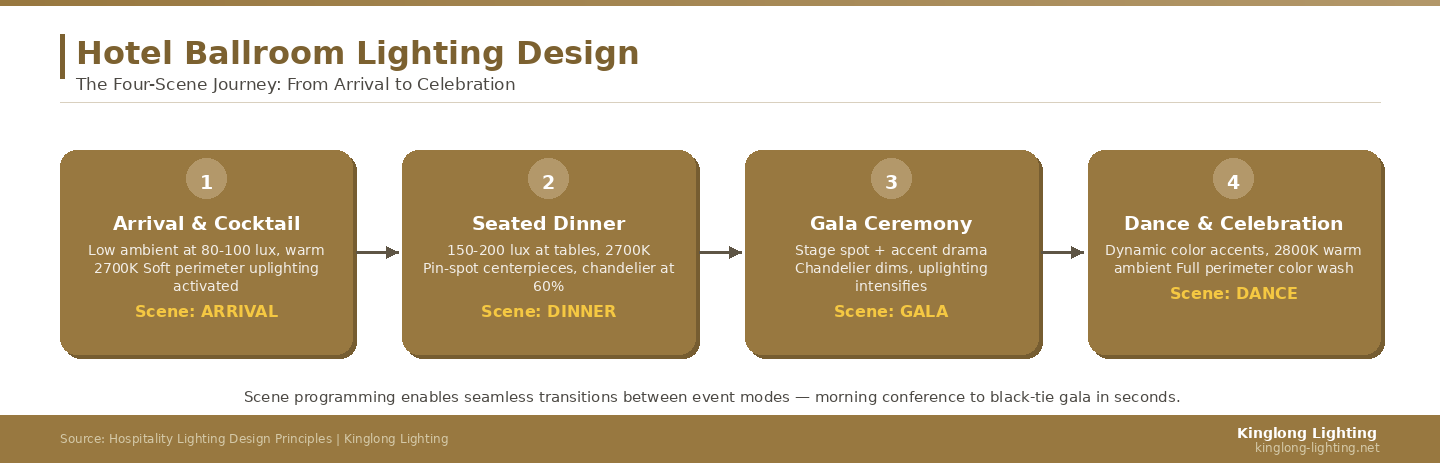
The four-phase ballroom lighting journey: each scene serves a distinct emotional purpose and is recalled with a single scene preset.
Solving Common Ballroom Lighting Challenges
The Low Ceiling Problem
Many hotel ballrooms — particularly in urban properties with constrained floor plates — contend with ceiling heights that feel less grand than the occasion demands. The solution is counterintuitive: rather than downlighting from a low ceiling, use uplighting along the room’s perimeter. Vertical light lines draw the eye upward, creating the perception of greater height. Texture lighting projected onto walls adds visual depth and distracts attention from the ceiling plane entirely. Pin-spotting table centerpieces creates local focal points that further reduce the apparent dominance of the ceiling.
AV and Projection Conflicts
Events with large-format projection screens present a fundamental tension: the ambient light needed for a gala look washes out projected content, while the dimming needed for clear projection leaves the room feeling empty. The solution is zone control — programming the ballroom’s DALI zones to automatically reduce illuminance in the areas adjacent to screens while maintaining warmth elsewhere. Additionally, specifying fixtures with tight beam distribution near screen walls prevents spill onto the projection surface.
The Transition Problem
Back-to-back events with radically different lighting requirements — a corporate breakfast followed by a wedding reception — require fast, reliable transitions. Scene programming handles the atmospheric shift, but the physical reset (replacing rental uplights, repositioning pin spots) still requires time. Hotels that specify a comprehensive built-in lighting system — including a full perimeter uplighting circuit, multiple independently controllable accent zones, and a robust chandelier dimming system — can dramatically reduce their dependence on event-specific rental equipment and the setup time that comes with it. This is where the capital investment in quality permanent fixtures pays dividends across every subsequent event booking.
Ballroom Lighting and Brand Identity
The lighting specification of a hotel ballroom is ultimately a brand statement. Guests who have attended events in Ritz-Carlton, Four Seasons, or Shangri-La ballrooms carry a visceral memory of the quality of light in those spaces — the warmth, the sparkle of crystal, the precision of scene transitions. That memory is inseparable from the brand impression. For hotels competing for premium event bookings, the ballroom lighting specification is a direct competitive differentiator. Properties equipped with high-quality chandelier installations, tunable white LED systems, full DALI scene control, and CRI 95+ sources command higher per-head event pricing and attract clients whose events generate the kind of social documentation — photography, video, social sharing — that functions as ongoing brand marketing.
To explore how Kinglong Lighting’s hospitality-certified chandelier collections are specified for large-scale hotel ballroom installations, explore our lighting collections or request a custom lighting quote for your project.
Common Questions About Hotel Ballroom Lighting
What color temperature is best for a hotel ballroom?
For evening events and galas, 2700–2900K delivers the warmest, most flattering ambiance. For daytime corporate events, 3000–3200K provides brightness without harshness. The ideal ballroom specification uses tunable white LED fixtures capable of adjusting across this range, allowing the hotel to optimize for each event type.
How many lux should a hotel ballroom be lit to?
The standard target for banquet-mode ballroom lighting is approximately 300 lux at table level for dining events. Multi-functional daytime use (conferences, presentations) typically requires 300–600 lux. Scene programming allows the system to move fluidly between these levels based on the event schedule.
What is DALI and why does it matter for hotel ballrooms?
DALI (Digital Addressable Lighting Interface) is the industry-standard digital protocol for professional lighting control. In a ballroom context, it allows every fixture to be individually addressed, grouped into zones, and assigned to scenes. One button press can transition the room from a conference preset to a gala preset — with smooth dimming transitions and precise brightness levels at every fixture. It is the technology that makes multi-event-per-day ballroom operations practically manageable.
Should hotel ballroom chandeliers be LED?
Yes — modern high-quality LED sources now fully match or exceed the color quality of traditional incandescent or halogen lamps, while providing 50,000+ hour lifespans and dimming compatibility with DALI systems. The critical specification is CRI: ballroom chandeliers should use LED sources with CRI ≥ 90, ideally 95+, to ensure flattering light quality for guests and photography.
How do I choose the right chandelier size for a hotel ballroom?
A commonly used rule of thumb: add the room’s length and width in feet, and that sum (expressed in inches) gives the appropriate chandelier diameter for a standard ceiling height. For very large ballrooms, multiple chandelier groupings or a custom large-format piece may be more appropriate than a single oversized fixture. Bottom clearance should be at least 7 feet above the floor, and ideally 8 feet or more above table height. View completed hospitality lighting projects for real-world scale references across different ballroom configurations.
For real-world examples of how these design principles translate into completed installations across five-star hotels worldwide, view our completed hotel projects and see how ballroom lighting specifications perform in practice.
Kinglong Lighting Editorial Team — Drawing on 30+ years of decorative lighting manufacturing expertise and insights from 300+ hospitality projects across 60+ countries.