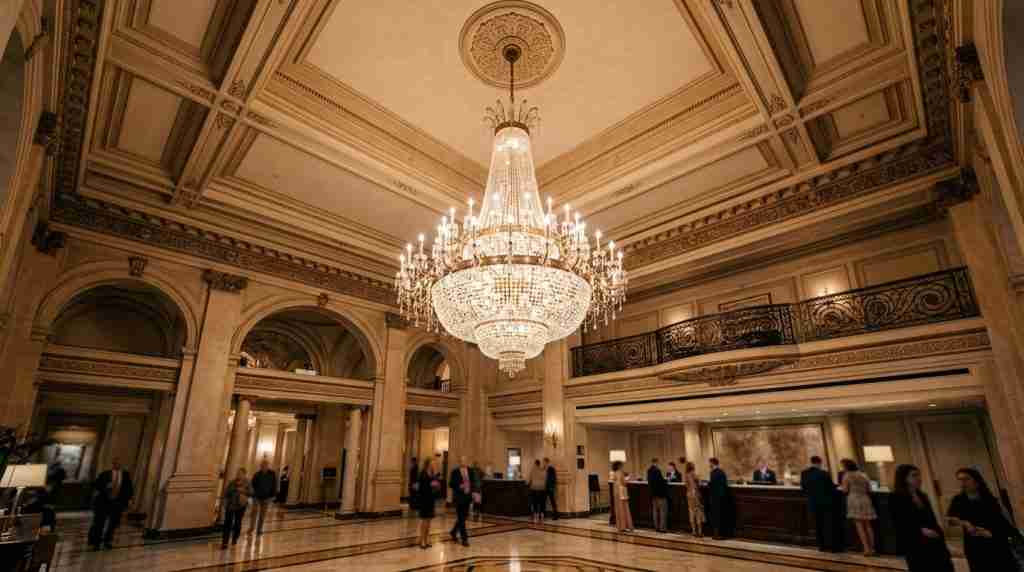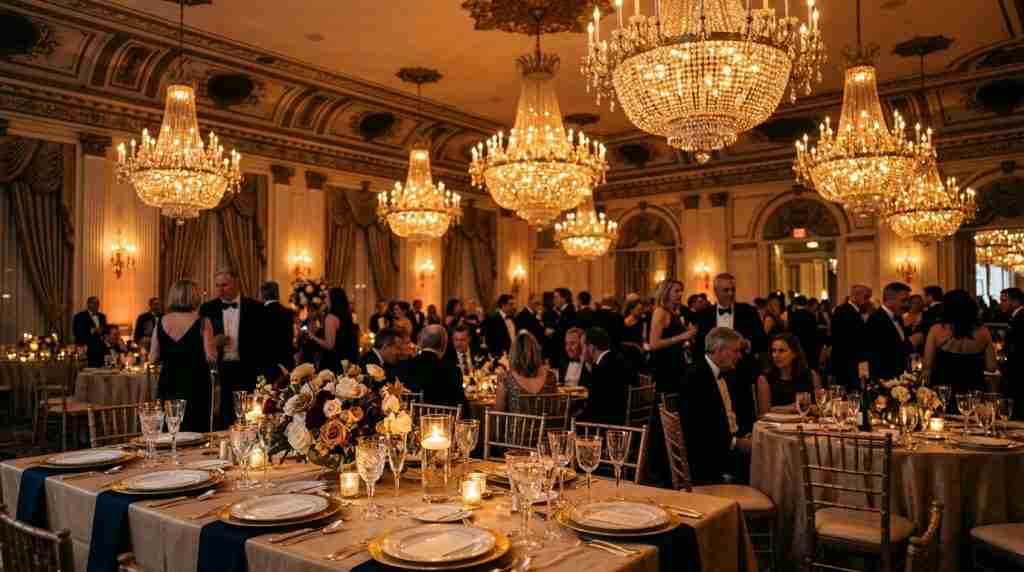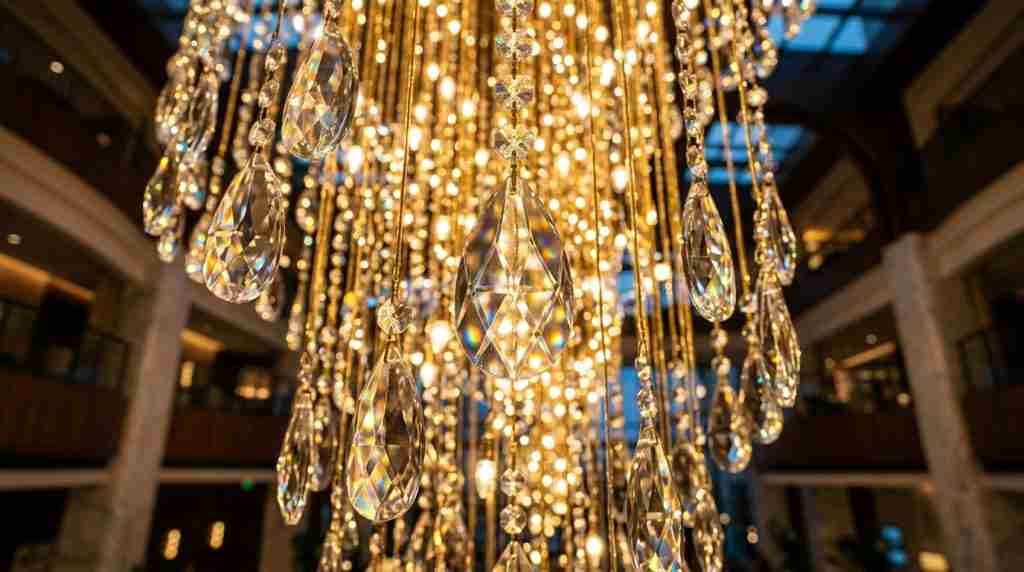
A hotel grand staircase is one of the few architectural moments that guests experience at multiple spatial elevations simultaneously — looking up as they arrive, looking down as they ascend, and looking across from the landing above. The chandelier that occupies the staircase void must perform at every one of these angles, every time of day, and for guests at every point in the vertical sequence. Get it right and the staircase becomes the most photographed element of the property. Get it wrong and the most architecturally impressive space in the hotel reads as underlit or visually disconnected. Research by Hospitality Institute confirms that guests form their impressions within seven seconds of entering a space, and that strong design execution can lift satisfaction scores by up to 25%. The grand staircase chandelier is where that impression is most dramatically created.
Key Takeaways
- The staircase void is a vertical canvas: Unlike lobby chandeliers that address a horizontal floor plan, staircase chandeliers must fill a tall, narrow vertical volume — which demands elongated, multi-tier configurations with meaningful drop length.
- Safety clearance governs everything else: A minimum 7 feet (213cm) above any step or walking surface, and 8+ feet in high-traffic commercial stairwells — these are non-negotiable constraints from which all other sizing decisions flow.
- The chandelier must read from three directions: Ground floor arrival view, midway-stair viewing angle, and upper-landing overhead view. A fixture that looks correct from one angle may read as wrong from another.
- Cascading and tiered configurations are structurally and aesthetically correct for staircase voids: They address the vertical space progressively, create visual rhythm at multiple elevations, and are the industry-standard specification for hotel staircase lighting at the luxury tier.
Why Hotel Staircases Present Unique Lighting Challenges
A hotel lobby chandelier addresses a space that is fundamentally horizontal: wide, even-ceilinged, viewed primarily from a single floor. A staircase chandelier addresses a fundamentally vertical space: tall, angled, viewed from three distinct vertical positions by guests who are moving through the space at different speeds and directions. These are different design problems, and the solutions that work for a lobby chandelier do not transfer directly to a staircase installation.
The specific challenges of hotel staircase lighting, as noted in Hospitality Institute’s design principles guide, include creating emphasis through contrast, size, and placement that works at each viewing angle — and addressing how movement through the space affects the guest’s visual experience over time. A staircase chandelier that appears proportional from the ground floor may appear oversized and heavy when viewed from the upper landing; a fixture sized conservatively from above may appear inadequate and thin from the ground floor. The specification must resolve this three-dimensional viewing problem before it can address aesthetic considerations.
The additional challenge is safety. Hotel staircases receive high guest traffic, often including guests who are tired, jet-lagged, carrying luggage, or operating in low-light conditions. The chandelier specification must ensure that every step remains adequately illuminated from every angle of approach, that the fixture provides no obstruction hazard at any point in the staircase travel path, and that emergency lighting requirements are met independently of the decorative fixture. These safety parameters are not architectural preferences — they are regulatory requirements that constrain the specification envelope before design choices are made.
Sizing a Grand Staircase Chandelier: Formulas and Principles
The standard chandelier sizing formula — add room length and width in feet, convert to inches for approximate diameter — is a useful starting point but requires significant modification for staircase applications. In a staircase void, the relevant spatial dimensions are the stairwell width, the stairwell depth, and — most importantly — the total vertical height of the void from ground floor to ceiling. The chandelier must address this vertical dimension as its primary design challenge.
Diameter calculation for staircase installations
For hotel staircases, the chandelier diameter should be calculated relative to the stairwell dimensions rather than the overall floor plan. A practical formula: chandelier diameter (in inches) = stairwell width (in feet) + stairwell depth (in feet). For a stairwell that is 4 metres wide and 5 metres deep (approximately 13 × 16 feet), this yields a diameter of approximately 29 inches (73cm). This is a minimum starting point; the visual weight of the staircase itself — its architectural grandeur, the width of the balustrade, the height of the ceiling — may justify a fixture 20–30% larger than the formula baseline to ensure the chandelier does not appear lost against the architecture.
Hanging height and safety clearances
The safety clearance standard for hotel staircase chandeliers is a minimum 7 feet (213cm) above the highest point of the staircase where guests walk — typically the uppermost step or the landing. In high-traffic commercial stairwells, lighting specification guidance from Seus Lighting recommends 8 feet (244cm) of clearance as the safer commercial standard, allowing for guests of all heights and the unpredictable movement patterns of a busy hotel.
For the vertical positioning of the chandelier body itself, the conventional guideline is that the fixture should occupy approximately one-third of the decorative vertical space between the ceiling and the highest walking point. In a staircase with a 10-metre (33-foot) void where the uppermost step is at 3 metres (10 feet), the decorative vertical space is 7 metres (23 feet). One-third of this — approximately 2.3 metres (7.5 feet) — is the target fixture body length. This places the chandelier’s center mass at a height that reads as dramatic from the ground floor without appearing to crowd the ceiling when viewed from the upper landing.
When ceilings exceed 15 metres
In hotel atria and grand staircase voids that exceed 15 metres (50 feet) in total height, a single chandelier — however large — may be insufficient to address the full vertical space. The design response is typically a cascading multi-tier system that drops through multiple levels, with the uppermost tier anchoring near the ceiling and the lowest tier engaging the guest at eye level as they arrive at the foot of the stairs. These installations require modular manufacturing — the fixture is built in sections that can be assembled at height — and professional structural engineering coordination to confirm ceiling attachment load capacity. Our bespoke lighting customization service includes complete structural load documentation and modular assembly drawings as standard for staircase installations of this scale.
Tier Configuration: The Engine of Staircase Drama
Single-tier chandeliers are rarely the correct specification for hotel grand staircases above standard ceiling heights. The staircase void is a vertical space, and a single-tier fixture — however wide — addresses only a horizontal plane within that vertical volume. The architectural response to a tall vertical void is a vertically articulated fixture: a two-tier, three-tier, or cascading design that distributes visual and illuminative presence through the height of the space rather than concentrating it at one point.
The tiered configuration creates three specific benefits in staircase applications. First, it provides illumination at multiple elevations, ensuring that the staircase is evenly lit from ground to landing rather than brightly lit only at the ceiling level. Second, it creates visual rhythm — the progression of tiers from large to small, or from full to tapered — that guides the eye through the vertical space in the same direction guests travel on the staircase. Third, it allows the fixture to occupy meaningful visual real estate across the full height of the void, preventing the underfurnished appearance that a single-tier fixture creates in a tall staircase.
For hotel staircases with ceiling heights above 6 metres (20 feet), a three-tier cascading crystal chandelier is the standard specification at the luxury tier. The uppermost tier is typically the largest in diameter, creating a strong ceiling anchor; the middle tier transitions the visual mass downward; the lower tier engages the arriving guest at a humanly readable scale. This configuration is what Lightopia’s staircase lighting guide describes as the chandelier’s ability to fill vertical space while maintaining harmony between the lighting and surrounding architecture.

Multi-Angle Visual Performance: Designing for Three Viewing Positions
A staircase chandelier is unique among hotel lighting installations in being routinely viewed from three distinct spatial positions: the ground-floor arrival view (looking up and forward into the void), the mid-stair view (looking up at an oblique angle as guests ascend or descend), and the upper-landing view (looking down or across at the fixture from above). Each position reveals a different geometry of the chandelier, and each must produce a compelling visual impression.
From the ground floor, guests see the chandelier’s silhouette against the ceiling void — its overall form, the visual rhythm of its tiers, and the sparkling quality of its crystal or glass elements. This is the “wow” moment that defines the guest’s initial impression of the staircase. The fixture must have sufficient visual mass to read as a statement piece from this distance, and its lowest tier must be at an appropriate visual height — not so low that it feels obstructive, not so high that it appears to float disconnectedly near the ceiling.
From midway up the stairs, guests see the chandelier more closely and from a more intimate angle. At this point, the quality of the crystal elements, the precision of the metalwork, and the warmth of the light source become more perceptible. The mid-stair view is where material quality matters most — a K9 crystal fixture that produces complex prismatic light effects at this angle creates the sense of luxury that justifies the architectural investment. A fixture that looks impressive from the ground floor but reveals poor crystal quality or cheap metalwork at mid-stair distances fails at this critical second viewing moment.
From the upper landing, guests look down or across at the fixture, seeing its plan geometry rather than its profile. A symmetrical, well-proportioned tier configuration reads as elegant from above; an irregular or poorly balanced arrangement can appear awkward. This is also the view from which the fixture’s armature and hanging system are most visible — details that are invisible from below become prominent when viewed from above and should be specified with the same attention to quality as the crystal elements.
Complementary Lighting: Staircase Step and Wall Fixtures
The grand chandelier is the dramatic center of the staircase lighting composition, but it cannot function alone in a commercial hotel context. The 2025 hotel lighting specification guide from Diane Erich & Associates emphasizes that signature lobby and staircase spaces require coordinated lighting systems, not isolated statement fixtures. In a hotel staircase, this means three layers of complementary lighting working alongside the chandelier.
Step lighting — low-level recessed or surface-mounted fixtures at the riser of each step — provides the most direct safety function: ensuring that each step edge is visible and clearly differentiated from the step surface. In luxury hotel staircases, step lighting is typically integrated into the balustrade or the wall adjacent to the stair, using warm-spectrum LED strips or small recessed fixtures that produce a subtle glow without disrupting the visual hierarchy that the chandelier establishes. Wall sconces at regular intervals on the staircase wall provide supplementary vertical illumination, ensuring that the walls and balustrade are adequately lit across the full vertical travel path. These fixtures must be specified at the same 2700–3000K color temperature as the chandelier to maintain consistent atmospheric coherence throughout the staircase.
The complementary fixtures also serve a practical maintenance function: they ensure that the staircase remains safely lit even during chandelier maintenance periods, when the primary fixture may need to be powered down for crystal cleaning or LED driver service. Our hospitality lighting installations routinely include full staircase system specifications — chandelier, wall sconces, step lighting, and emergency lighting — as an integrated package, ensuring that the dramatic focal point and the safety infrastructure are designed as a coherent system from the outset.
Installation Logistics for Hotel Staircase Chandeliers
The installation of a grand hotel staircase chandelier is one of the most logistically complex tasks in a hotel construction or renovation project. Unlike lobby chandeliers that can be installed using a mobile elevated work platform positioned on the lobby floor, staircase chandeliers require the installation team to work from within the stairwell itself — a tall, narrow void with limited horizontal maneuvering space at height. Most large-format staircase chandelier installations use temporary scaffolding erected within the stairwell void, which must be carefully coordinated with the construction schedule to minimize the period during which the staircase is non-operational.
Modular fixture design — in which the chandelier is manufactured as a series of pre-assembled sections that can be lifted and connected at height — significantly reduces both the installation duration and the risk of component damage during the assembly process. A chandelier that would require 5–7 days to install as a single assembled unit can often be installed in 2–3 days using modular sections, reducing both scaffold rental costs and the operational downtime of the staircase. This installation efficiency is one of the practical arguments for working with a manufacturer who has specific commercial hospitality experience: the design brief should include installation logistics as a specification parameter from the outset, not as a challenge to be solved after the fixture has been selected.
For structural coordination: any chandelier exceeding approximately 50 kilograms in total assembled weight requires a structural engineer to confirm that the ceiling attachment point can bear the load. In hotel renovation projects where the building’s original structural drawings may be incomplete or unavailable, this assessment may require non-destructive testing of the ceiling structure before the fixture is specified. Review our project portfolio for examples of how this coordination has been managed across staircase installations in luxury hotel properties around the world.
Brand Narrative and the Grand Staircase Moment
Hotel Designs has consistently highlighted the role of the staircase as one of the most powerful brand narrative moments in a luxury hotel — a theatrical transition between the arrival experience and the deeper life of the property. The chandelier that occupies the staircase void is the primary visual element of this transition, and its design should reflect the hotel’s brand narrative as specifically as any bespoke element in the property.
A heritage luxury hotel might specify a grand European-inspired tiered crystal chandelier whose form references the great hotel staircases of Paris and Vienna — communicating continuity, authority, and established prestige. A contemporary resort property might specify a bespoke cascading installation in organic forms — referencing the natural landscape of the resort’s location. A design-forward urban lifestyle hotel might commission a sculptural installation that reads more as contemporary art than traditional chandelier — communicating the property’s alignment with cultural sophistication rather than traditional luxury.
In each case, the staircase chandelier should be one of the first design decisions in the interior architecture brief, not one of the last FF&E selections. The fixture’s dimensions, weight, and structural requirements need to be built into the architectural design; its form and material language need to inform the selection of balustrade detailing, wall finish, and flooring in the staircase zone. When the chandelier is specified last — chosen to fit a space that has already been fully designed around other priorities — the result is rarely the kind of integrated architectural statement that defines memorable hotel staircases. For projects where this early-stage design collaboration is a priority, our hospitality team works alongside interior architects from concept stage, providing fixture form studies and structural data as part of the design development process.
Frequently Asked Questions
What size chandelier is right for a hotel grand staircase?
Calculate the chandelier diameter using the stairwell dimensions: add the stairwell width and depth in feet, and the result in inches is your baseline diameter. For very tall voids above 10 metres (33 feet), a cascading multi-tier configuration is more appropriate than a single large fixture, as it addresses the vertical space progressively rather than attempting to fill it with a single horizontal plane of crystal. The fixture body length should occupy approximately one-third of the decorative vertical space in the void — the space between the ceiling and the uppermost walking surface.
What is the minimum hanging height for a hotel staircase chandelier?
The minimum is 7 feet (213cm) above the highest step or walking surface in the staircase. For commercial hotel staircases with high guest traffic, 8 feet (244cm) is the recommended standard, providing a margin for guests of all heights and the dynamic movement patterns of a busy hospitality environment. This clearance is calculated from the fixture’s lowest point — the bottom of the lowest crystal element or pendant — to the floor of the uppermost step, not from the landing below.
What chandelier configuration works best for a hotel staircase?
For ceiling heights above 6 metres (20 feet), a three-tier cascading crystal configuration is the luxury hotel standard. The largest tier anchors the ceiling, the middle tier creates visual rhythm, and the lower tier engages the arriving guest at a humanly readable scale. For very tall voids above 12 metres (40 feet), a five or six-tier cascading system that distributes illumination and visual mass across the full vertical height is the appropriate specification. Single-tier fixtures are generally appropriate only for staircase voids below 4 metres (13 feet) in ceiling height.
How should a staircase chandelier coordinate with the lobby chandelier?
The staircase chandelier should use the same crystal grade, metal finish, and light source color temperature as the primary lobby chandelier to create a coherent aesthetic language throughout the arrival sequence. The two fixtures do not need to match in form — the staircase installation should be vertically articulated in ways that the lobby chandelier need not be — but they should read as members of the same design family. This coordination is most effectively achieved by specifying both fixtures from a single manufacturer who can ensure material consistency and finish matching across the two installations.