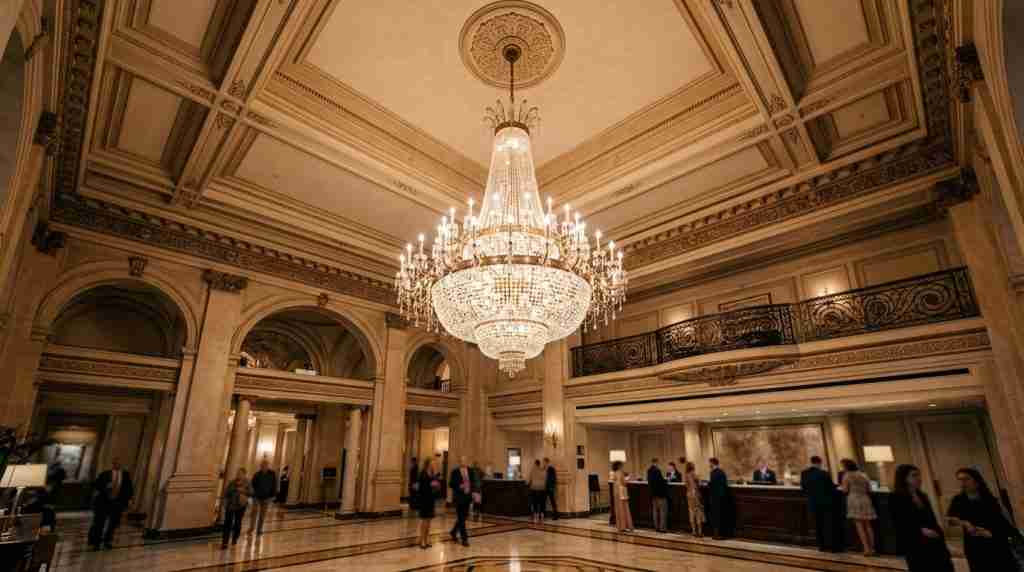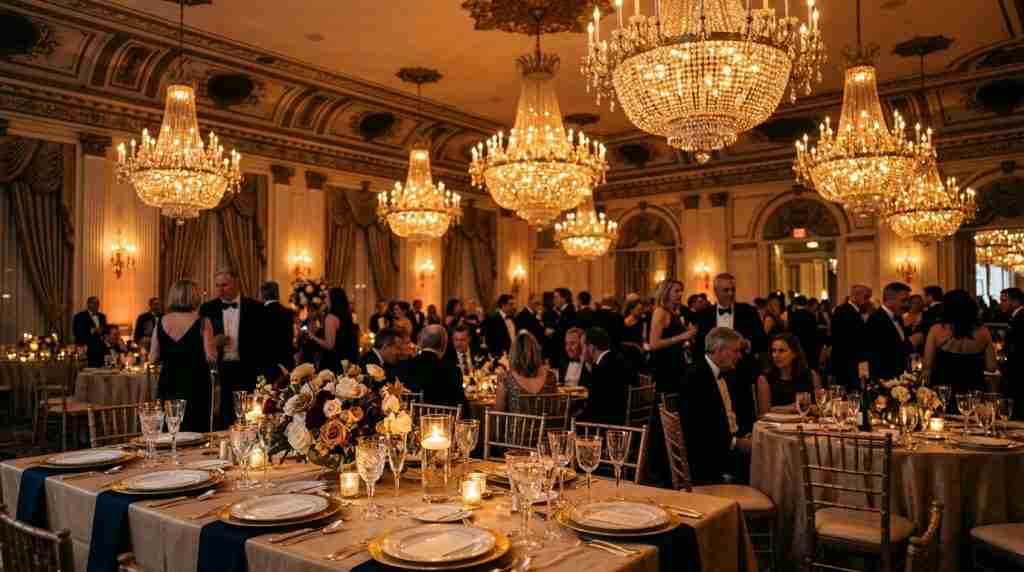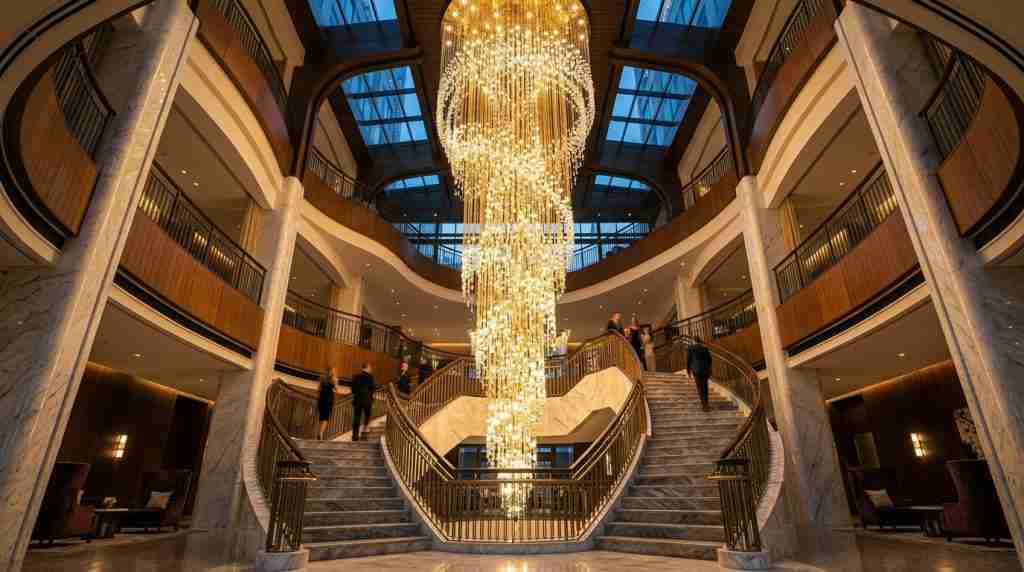
The material your hotel lobby chandelier is made from shapes everything that matters: how light disperses across marble and stone, how the fixture will read in year five compared to opening night, what load it places on the ceiling structure, how often it needs professional cleaning, and — most importantly — what it communicates about your brand the moment a guest enters. Research by Hospitality Institute confirms that guests form their first impression within seven seconds of entering a lobby, and that strong interior design can raise satisfaction scores by up to 25%. Material selection in the chandelier is one of the most visible encoding of that design quality. This comparison breaks down crystal, glass, and acrylic across every dimension that matters for hospitality procurement.
Key Takeaways
- K9 crystal delivers the best light refraction per dollar of the three materials, producing the distributed warm sparkle that defines luxury hotel lobbies — superior to standard glass and dramatically superior to acrylic.
- Glass offers versatility and lower weight with strong design flexibility for contemporary and boutique hotel applications where sculptural form matters more than prismatic sparkle.
- Acrylic reduces structural requirements and installation complexity, making it viable for very large-span modern installations where crystal’s weight would require costly structural remediation.
- Crystal wins on total cost of ownership at the 5-star tier because its durability, optical permanence, and prestige signaling justify the higher initial specification cost over the fixture’s multi-decade lifespan.
Understanding the Three Materials
Before comparing performance dimensions, it is worth establishing what distinguishes these three materials at a chemical and optical level, because the performance differences follow directly from their composition.
Crystal — specifically K9 optical crystal or lead-free crystal barium glass — is manufactured with a higher refractive index than standard glass. The refraction index determines how sharply and at what angles light bends as it passes through the material. Higher refraction index means more dramatic prismatic dispersion: light entering a crystal element exits as a spread of distinct directional rays across a wider arc, creating the distributed sparkle that fills a lobby with light points at multiple distances and angles. K9 crystal, which is the most common specification in hospitality-grade chandeliers, achieves this without the lead content of traditional Bohemian crystal, making it appropriate for commercial projects with strict materials compliance requirements.
Glass, in chandelier applications, refers to standard decorative glass — borosilicate, soda-lime, or hand-blown glass in various forms including clear, frosted, colored, and textured. Glass has a lower refractive index than crystal, producing a softer, more diffuse glow rather than directional sparkle. It reflects light rather than refracting it into separate color-band rays. Glass is lighter than crystal by a meaningful margin — a given volume of standard glass is approximately 10–15% lighter than the same volume of K9 crystal — and it is generally more resistant to surface scratching in high-contact cleaning situations.
Acrylic is a thermoplastic polymer: it has optical transparency comparable to glass at first installation, but its refractive index is lower than both crystal and glass, and its surface is significantly more susceptible to micro-scratching over time. Acrylic’s primary advantages are weight (approximately 40–50% lighter than glass for equivalent volume) and moldability — it can be extruded, cast, or formed into shapes that are difficult or prohibitively expensive to achieve in crystal or glass. It is also shatter-resistant in the conventional sense, which makes it mechanically safer in very-high-traffic installations, though impact resistance should not be confused with long-term optical durability.
Light Performance: Refraction, Sparkle, and Lobby Atmosphere
For a hotel lobby chandelier, light performance is the most consequential material characteristic. The chandelier’s primary functional role — beyond aesthetics — is to contribute meaningful warm-spectrum ambient light across the lobby floor plane, and the material determines how effectively it distributes that light. Industry analysis of 2025 hotel chandelier trends consistently shows that five-star hotels choose crystal, metal, and glass for their opulent designs, precisely because these materials deliver the light performance standards that the luxury tier demands. This aligns with published research in the Journal of Hospitality and Tourism, which confirms that lobby aesthetic quality — including material selection — directly influences guest satisfaction scores.
K9 crystal produces sharp, prismatic light distribution. Each faceted element generates multiple directional light rays, creating the effect of hundreds of distributed light points across the lobby ceiling, walls, and floor at various angles. This prismatic effect fills the space with visual energy without requiring higher wattage from the light source — the crystal itself multiplies and distributes the available light. The warmth of a 2700K LED source operating through K9 crystal produces a distinctly different atmospheric quality than the same source operating through glass or acrylic: more alive, more three-dimensional, more immediately impressive.
Glass produces a softer, more diffuse glow. Light exits glass elements in a wider, less differentiated distribution — less directional sparkle, more general luminance. This produces a calmer, more contemporary atmosphere that works well in boutique hotel lobbies where the design brief calls for refined understatement rather than dramatic opulence. Seus Lighting’s material comparison characterizes the distinction as crystal creating a stronger focal point while glass feels lighter and less formal — a design choice rather than a quality difference.
Acrylic’s light performance degrades over time in ways that crystal and glass do not. Micro-scratches from cleaning accumulate on acrylic surfaces, progressively diffusing the light output and reducing the optical clarity that was present at installation. After three to five years of commercial cleaning cycles, acrylic elements in a hotel lobby chandelier may produce noticeably less crisp light distribution than their initial specification suggested. This is the most operationally significant disadvantage of acrylic for hospitality applications.
Weight and Structural Implications
Material weight affects not just the installation process but the structural engineering requirements of the project and the feasibility of the chandelier’s size and configuration. A chandelier specified for a 20-foot hotel atrium must be large enough to address the vertical space — and at that scale, material weight becomes a specification constraint, not just an operational inconvenience.
K9 crystal is the heaviest of the three materials per unit volume. A large-format hotel lobby chandelier in K9 crystal — spanning, say, 1.5 metres in diameter and 2 metres in height — may weigh 80–120 kilograms in assembled form. This requires a ceiling attachment system engineered for the load, and in some older hotel buildings with decorative ceilings, structural remediation is required before a crystal chandelier can be specified at grand scale. The structural engineering cost is real, but it is a one-time capital investment that protects a fixture expected to perform for 20–30 years.
Glass, at 10–15% lighter than crystal per volume, allows slightly larger configurations within the same structural envelope. The difference is not transformative at conventional hotel lobby scales, but for exceptionally large installations — cluster systems spanning 3 metres or more — the weight advantage of glass over crystal can meaningfully affect feasibility.
Acrylic’s weight advantage is the most significant of the three materials: 40–50% lighter than glass per equivalent volume. This makes very large-span modern acrylic installations feasible without structural remediation in buildings that cannot support a crystal or glass fixture of equivalent visual scale. For a contemporary boutique hotel lobby that wants a dramatic sculptural installation at 3+ metre diameter, acrylic may be the only material that makes the specification structurally feasible within the existing building envelope. Our custom lighting team regularly advises on material selection for exactly this kind of structural constraint scenario.
Durability and Total Cost of Ownership
Hotel lobby chandeliers are long-life assets, not seasonal decorations. The total cost of ownership calculation — initial specification cost plus maintenance cost over the fixture’s operational life — frequently produces a different result than a comparison of unit purchase prices alone. Hospitality Institute’s research on interior design investment confirms that properties approaching design as a strategic long-term investment rather than a cosmetic upgrade achieve better guest satisfaction outcomes and stronger repeat bookings over time.
K9 crystal is the most durable of the three materials in terms of optical permanence. Its hardness resists surface scratching in routine cleaning, and its refraction quality does not degrade over time — a properly maintained crystal chandelier looks essentially identical in year fifteen to how it looked on opening day. The maintenance requirement for crystal is periodic crystal cleaning, typically annually for hotel lobby environments, using appropriate crystal-safe cleaning solutions applied by trained maintenance staff. This is not an insignificant operational cost, but it is predictable and budgetable.
Glass durability is strong and maintenance requirements are lower than crystal. Glass elements are less prone to showing dust and fingerprints than crystal surfaces, and they clean more easily in routine maintenance cycles. The trade-off is that individual glass elements are more susceptible to impact breakage than crystal elements of equivalent thickness, and replacement of hand-blown or custom-formed glass components can require longer lead times than standard crystal replacement.
Acrylic’s long-term durability is the most problematic of the three for hotel applications. The micro-scratch accumulation described in the light performance section is inevitable in commercial environments with routine cleaning, and there is no restoration process that reverses the optical degradation once it has occurred. An acrylic chandelier that was specified with a ten-year lifespan expectation in residential settings may require replacement consideration at five to seven years in a hotel lobby with three or four professional cleanings per year. This operational reality should be factored explicitly into the total cost of ownership calculation. See our hotel project portfolio for examples of crystal chandelier installations that have maintained their specification quality over long operating periods.
Brand Positioning and Material Perception
Beyond optical and mechanical performance, chandelier material carries a brand communication function that hospitality designers must account for explicitly. Hotel Designs notes that material choices in hotel design create immediate associations in guests’ minds about the property’s positioning, investment level, and design intelligence. Crystal communicates prestige, heritage, and investment. Glass communicates design sophistication and contemporary refinement. Acrylic communicates contemporary innovation and, when poorly specified, cost-consciousness.
For a 5-star hotel lobby competing in the top tier of luxury hospitality — the Hilton, Marriott, Four Seasons, Ritz-Carlton segment — crystal is the specification default for good reason. The material’s cultural associations with luxury are deeply embedded in the guest’s perceptual framework, and specifying away from it requires a deliberate and sophisticated design rationale that succeeds when executed by an excellent designer but creates an uncanny impression when it does not. Research published in the Journal of Hospitality and Tourism confirms that guests’ perception of lobby aesthetic quality directly influences overall satisfaction scores — making material selection a business decision, not just an aesthetic one.
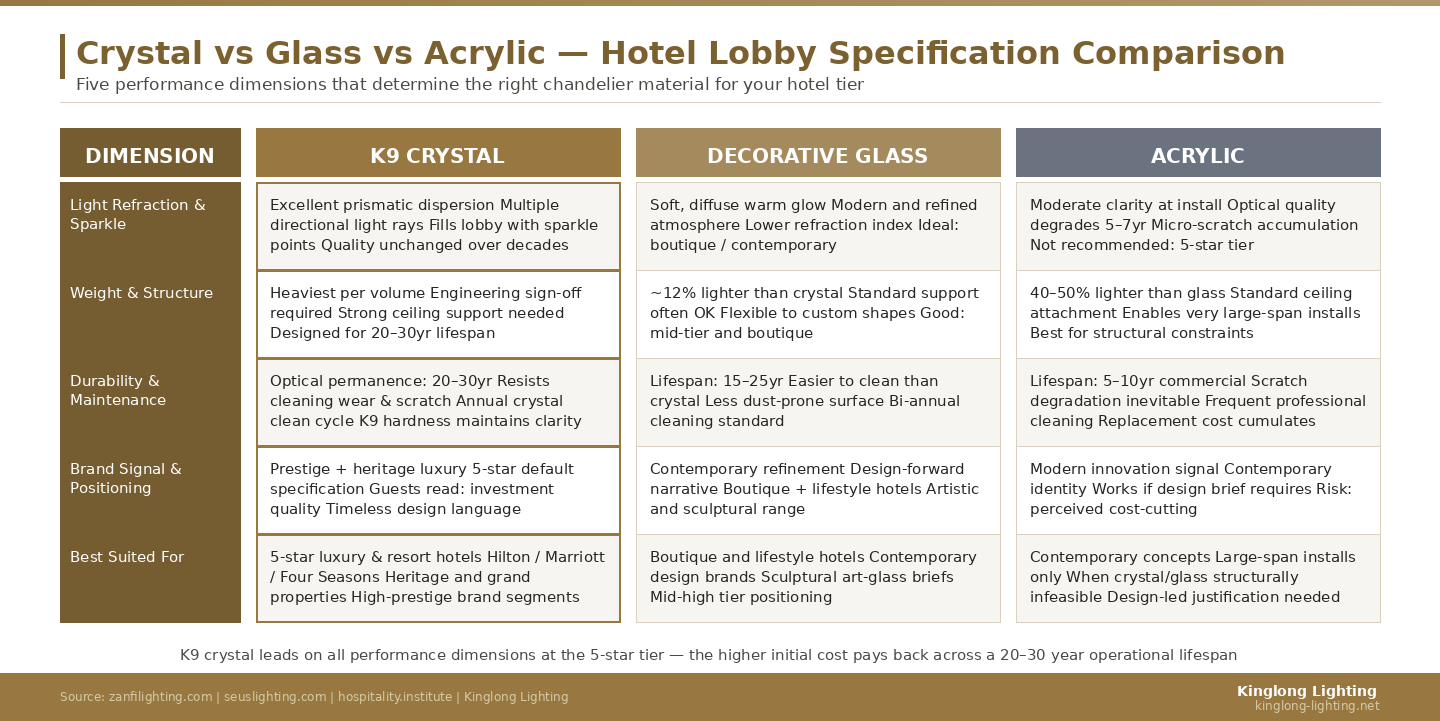
The practical recommendation for hotel lobby chandelier material selection, by property tier, is: K9 crystal for five-star and luxury resort properties where prestige signaling is essential; art glass (hand-blown or custom formed) for boutique and lifestyle hotels where contemporary design differentiation is the primary brand narrative; acrylic for contemporary properties where large-span structural constraints preclude crystal or glass at the required scale, or where the design brief explicitly calls for the non-traditional aesthetic that acrylic enables. Explore our hospitality chandelier range across all three material categories.
Material Comparison at a Glance
| Dimension | K9 Crystal | Decorative Glass | Acrylic |
|---|---|---|---|
| Light refraction / sparkle | Excellent (prismatic) | Good (diffuse glow) | Moderate (degrades) |
| Weight per volume | Heaviest | Medium | Lightest (40-50% less) |
| Optical durability | Excellent (20-30yr) | Good (15-25yr) | Moderate (5-10yr) |
| Maintenance frequency | Annual crystal clean | Bi-annual | Frequent (scratch risk) |
| Brand positioning signal | Prestige / Heritage | Contemporary / Design | Modern / Innovative |
| Best suited for | 5-star, luxury resort | Boutique, lifestyle | Contemporary, large-span |
For a comprehensive discussion of chandelier material specifications for your specific hotel lobby project, request a consultation with our hospitality design team. With over 30 years of manufacturing experience across crystal, glass, and contemporary lighting materials — and installations in more than 300 luxury hotel projects in 60 countries — we provide material specification guidance as standard for every commercial project brief.
Frequently Asked Questions
Is K9 crystal the same as real crystal?
K9 crystal is a lead-free optical glass formulated to achieve a high refractive index comparable to traditional lead crystal. It does not contain the lead oxide that defined Bohemian crystal historically, making it compliant with modern commercial materials standards including RoHS. Its light refraction performance — the characteristic that produces prismatic sparkle in hotel lobby chandeliers — is comparable to lead crystal and significantly superior to standard decorative glass or acrylic.
How long does a crystal chandelier last in a hotel lobby?
A K9 crystal chandelier on a solid brass or copper armature, with annual professional cleaning, has an operational lifespan of 20–30 years in a hotel lobby environment before any structural consideration is warranted. The LED light sources integrated into modern crystal chandeliers require driver replacement every 10–15 years, but the crystal elements themselves maintain their optical performance indefinitely with proper maintenance. This compares favorably to acrylic, which may show optical degradation within 5–7 years under commercial cleaning cycles.
Can glass chandeliers look as luxurious as crystal in a hotel lobby?
Yes — in boutique and contemporary hotel lobbies where the design brief explicitly calls for refined understatement or sculptural form rather than traditional prestige signaling, a well-specified art glass chandelier can look more appropriate and more sophisticated than crystal. Hand-blown glass, Murano-style glass, or custom-formed geometric glass fixtures carry their own distinctive luxury register. The distinction is that glass produces a softer, more diffuse glow rather than crystal’s directional sparkle — a design choice, not a quality deficit.
When is acrylic appropriate for a hotel lobby chandelier?
Acrylic is appropriate in three specific hospitality scenarios: when the installation scale required by the lobby’s architectural proportions exceeds the structural capacity of the ceiling (acrylic’s 40–50% weight advantage over glass makes very large spans feasible); when the design brief calls for a contemporary, non-traditional visual identity that crystal would undermine; and when the project’s capital budget constrains the initial specification cost without compromising the programmatic requirements. Acrylic should be specified with realistic expectations about its optical lifespan under commercial maintenance conditions.