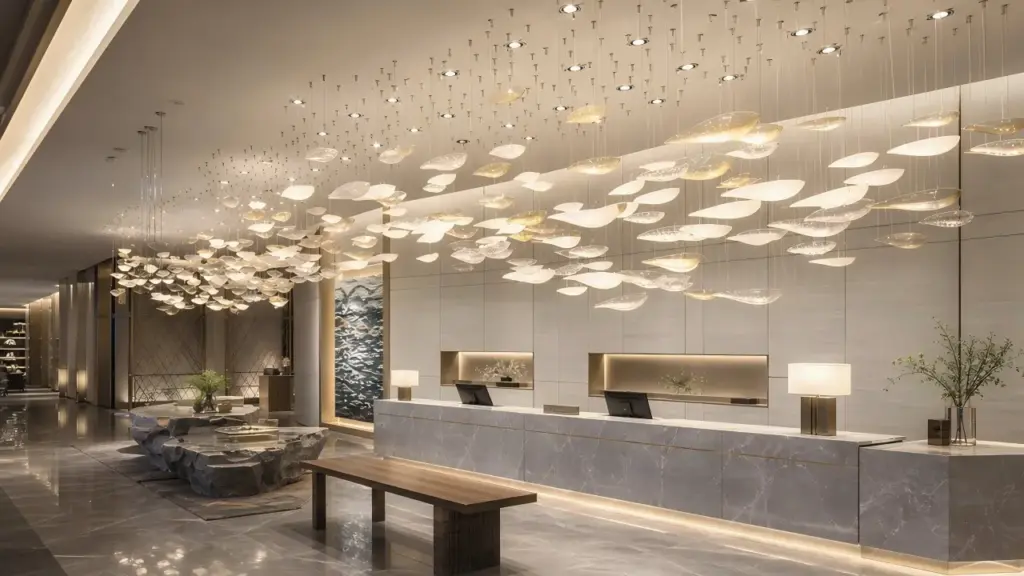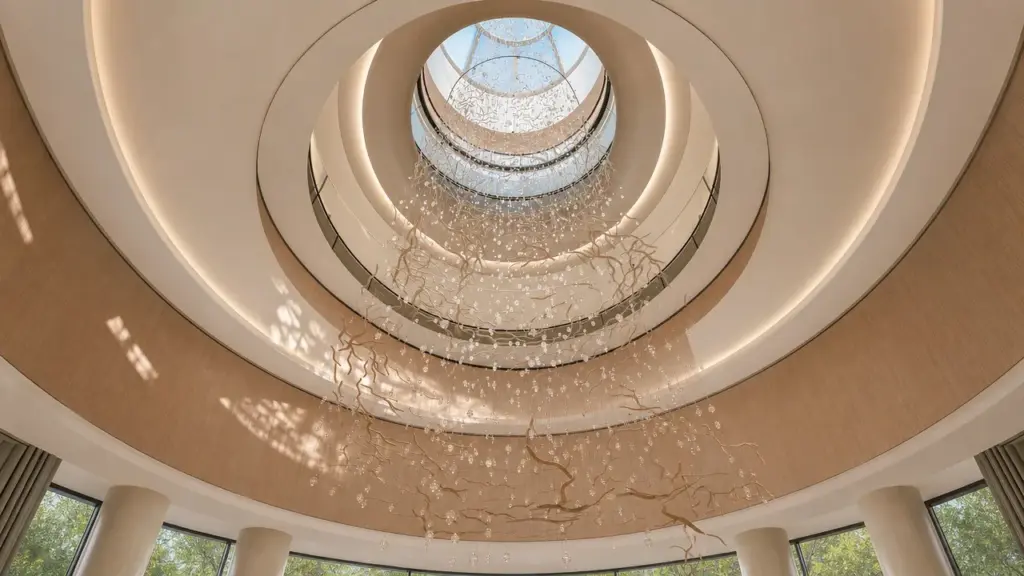
L’éclairage d’un salon exécutif hôtelier fonctionne lorsque confidentialité, cohérence de marque et atmosphère sont contrôlées comme des zones séparées, et non comme une seule scène de luxe assombrie. Le salon n’est pas un petit hall : c’est un espace hybride pour courriels, conversations calmes, petit-déjeuner, appels, lecture, réunions informelles, détente nocturne et service discret.
Si l’éclairage est seulement chaud et décoratif, la pièce peut paraître haut de gamme en photo tout en exposant les clients. Un client assis avec un ordinateur ne veut pas se sentir sur scène. Un client qui prend un appel ne veut pas être éclairé comme dans un bar. Une équipe de service doit voir le buffet, les passages et les plateaux sans casser l’atmosphère. Le salon exécutif doit donc protéger le confort psychologique autant que l’image de marque.
Le design doit traiter le salon comme une suite de micro-espaces : arrivée, assises calmes, tables de travail, buffet, zone boissons, conversation, service et parfois vue extérieure. Chaque zone demande un niveau, une direction, une CCT, une intensité décorative et une relation différente à la confidentialité.
Points clés à retenir
- La confidentialité est un résultat lumineux : les clients doivent se sentir protégés, pas mis en scène.
- La cohérence n’est pas l’uniformité : les luminaires partagent un langage matière sans aplatir chaque zone.
- L’atmosphère demande des scènes : matin, travail, cocktail et soirée ne doivent pas partager un seul niveau.
- Faible éblouissement : les salons punissent les sources exposées, reflets durs et contrastes au niveau du visage.
- Preuve fournisseur : demander plan de zones, CCT, protocole de gradation, échantillons, vues assises et logique de service.
Traiter le salon comme quatre pièces dans une pièce
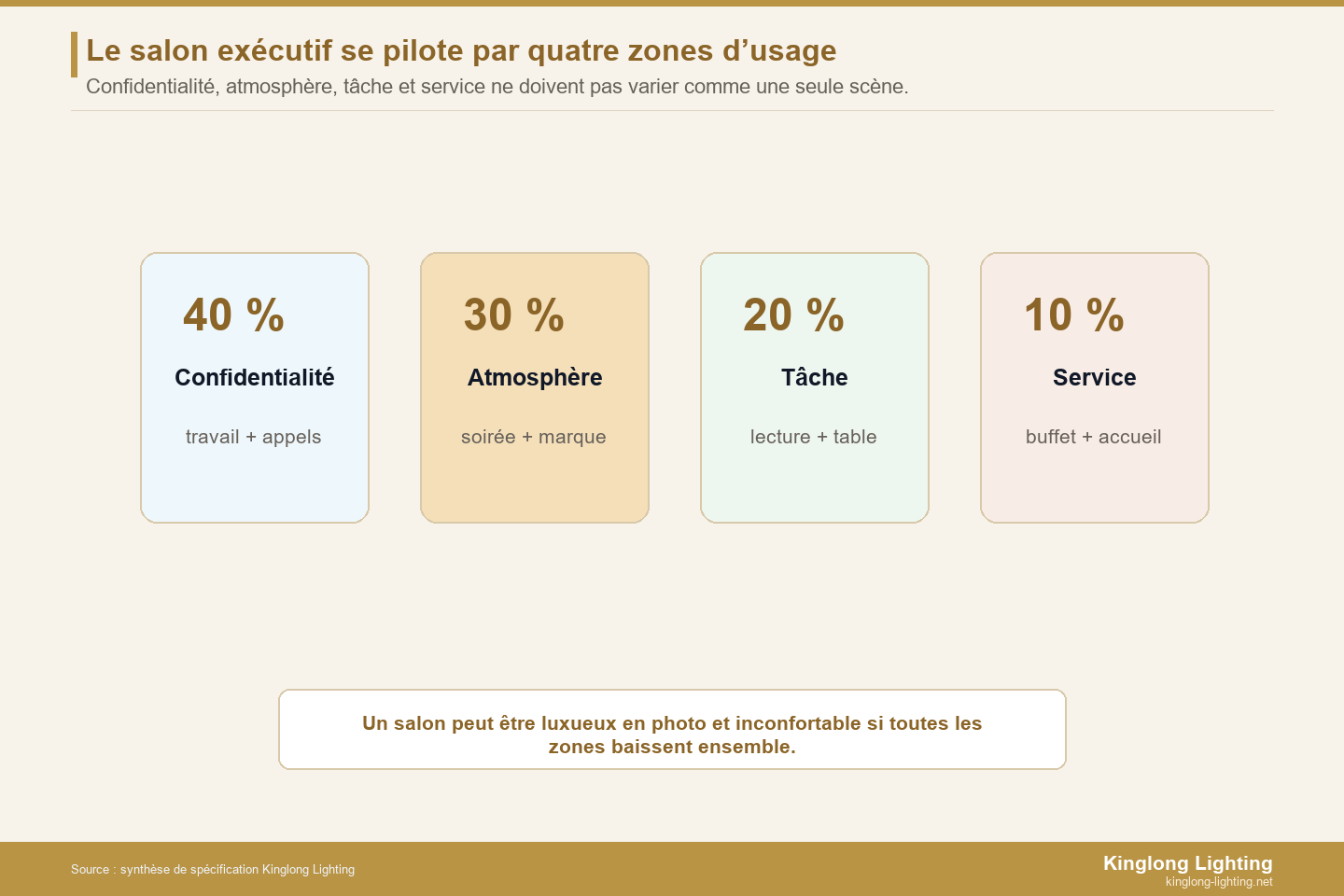
Un salon exécutif échoue lorsque toutes les zones baissent ensemble.
Un modèle pratique donne 40 % du poids à la confidentialité, 30 % à l’atmosphère, 20 % au soutien de tâche et 10 % à la visibilité de service. Selon ce modèle, une pièce peut perdre l’expérience client même si elle photographie bien. Si la confidentialité échoue, le salon ressemble à un hall secondaire. Si l’atmosphère échoue, il ressemble à une cantine premium. Si la tâche échoue, il n’aide pas les clients d’affaires. Si le service échoue, l’exploitation compense avec des lumières trop fortes.
Les quatre zones ne sont pas toujours séparées par des murs. Elles peuvent être définies par le mobilier, les hauteurs de suspension, les appliques, les lampes de table, les accents, les matériaux et les scènes. Le designer doit donc composer des poches de lumière plutôt qu’un niveau moyen. Une zone peut être intime sans être sombre, et une zone de buffet peut être lisible sans devenir froide.
La confidentialité dépend du contraste et de la position des sources
La confidentialité n’est pas uniquement une question de cloison, de fauteuil haut ou de distance. Elle dépend aussi de la direction de la lumière. Une source au-dessus ou devant le visage peut rendre un client très visible depuis l’entrée. Une lumière trop uniforme enlève les zones de retrait. À l’inverse, une lumière latérale douce, des niveaux maîtrisés et des contrastes modérés peuvent créer des assises plus protégées sans rendre la pièce sombre.
Le test doit se faire à hauteur assise. On vérifie si les visages sont trop exposés depuis l’entrée, si les écrans produisent des reflets, si les tables de travail restent confortables et si les coins de conversation gardent une sensation de discrétion. Les vues debout ou les rendus larges ne suffisent pas.
La cohérence de marque dépend du rythme matière
Un salon exécutif doit appartenir au même hôtel que le hall, les couloirs et les suites, mais il ne doit pas répéter exactement la même intensité. La cohérence peut venir d’une finition métallique, d’une famille de verre, d’un motif discret, d’une température de couleur ou d’une proportion. Le but est de créer un langage commun, pas d’utiliser le même luminaire partout.
Si le hall utilise un grand lustre très expressif, le salon peut reprendre une matière plus calme : appliques, suspensions basses, pièces de table ou modules décoratifs plus petits. Cette hiérarchie évite que le salon rivalise avec le hall tout en gardant une signature reconnaissable.
Utiliser confort visuel et qualité de couleur comme garde-fous
Le salon exécutif contient souvent des matériaux sensibles : bois chaud, pierre, cuir, tissus, métal champagne, verre, buffet, fleurs et parfois vue extérieure. Une CCT mal choisie peut rendre le bois lourd, les aliments ternes ou les visages fatigués. Un rendu de couleur faible peut casser la perception premium. Un éblouissement trop visible peut transformer un espace calme en lieu de passage.
La qualité visuelle doit donc être vérifiée par zone. Le buffet demande une lecture claire des aliments, sans refroidir tout l’espace. Les tables de travail demandent une lumière suffisante pour lire et écrire, sans reflets dans les écrans. Les assises demandent de la douceur et une source peu visible. L’arrivée demande un signal de marque, mais pas un point lumineux qui attire tout le regard vers la porte.
La CCT peut rester cohérente dans la famille générale, mais les niveaux et directions doivent varier. Beaucoup de salons fonctionnent mieux avec une lumière chaude contrôlée, des accents précis et une gradation stable. Le point critique est la transition jour/soir : le salon doit être clair le matin, professionnel l’après-midi et plus intime le soir sans changement brutal de caractère.
Construire un score de préparation par zones
Le score de préparation aide à éviter une discussion uniquement décorative. Pour chaque zone, l’équipe attribue une note à quatre critères : confidentialité, atmosphère, tâche et service. Une zone de travail peut exiger un bon score de tâche et de confidentialité. Une zone de buffet exige service et couleur. Une zone de conversation exige confidentialité et atmosphère. Le salon n’est prêt que lorsque chaque zone atteint son objectif principal sans détruire les autres.
| Zone | Besoin | Risque | Preuve |
|---|---|---|---|
| Travail | concentration discrète et lecture | client exposé ou reflets écran | vue assise et test ordinateur |
| Assises souples | conversation calme | éblouissement décoratif ou visages trop brillants | scène basse et vue depuis l’entrée |
| Buffet | service lisible et aliments valorisés | aliments ternes ou lumière trop froide | CCT, rendu et niveau de service |
| Arrivée | repère de marque et accueil | entrée plate ou trop théâtrale | accent, finition et hiérarchie |
| Service | circulation sûre et discrète | personnel visible ou zones sombres | plan de parcours |
Ce score est utile parce qu’il révèle les compromis. Une zone de buffet parfaite peut nuire à l’atmosphère si sa lumière déborde sur les assises. Une suspension magnifique peut devenir gênante si elle est visible dans le champ d’un client qui travaille. Une scène de soirée peut être trop sombre pour l’équipe de service. Le score pousse l’équipe à corriger la répartition, pas seulement à baisser toute la pièce.
Spécifier les scènes avant de choisir les familles décoratives
Le choix des familles décoratives doit venir après les scènes principales. Le salon a souvent besoin d’au moins quatre moments : matin/petit-déjeuner, travail calme, cocktail ou fin d’après-midi, soirée intime. Chaque moment change la priorité entre buffet, tables, assises, entrée et service. Si la famille décorative est choisie avant cette logique, elle peut manquer de profondeur de gradation, de tailles adaptées ou de sources suffisamment protégées.
La scène du matin doit soutenir les aliments, le journal, le café et les premiers courriels. La scène de travail doit réduire les reflets et garder les visages confortables. La scène cocktail doit renforcer la matière et les accents. La scène du soir doit préserver la confidentialité sans rendre le service difficile. Ces scènes doivent être écrites avec les niveaux relatifs, les zones actives, les luminaires décoratifs impliqués et les exceptions.
Relier l’atmosphère du salon à l’éclairage sur mesure Kinglong
Kinglong Lighting peut fournir familles décoratives, finitions coordonnées et dossiers de scènes pour les espaces hôteliers. La personnalisation aide à adapter suspensions, appliques, lampes décoratives et éléments sur mesure aux zones du salon. Le travail peut porter sur taille, diffusion, CCT, finition, module LED, profondeur, méthode d’installation et maintenance.
Envoyez plan, zones, mobilier, palette de matières, scènes souhaitées, exigences de gradation, service buffet, vues assises, contraintes de nettoyage et relation avec les autres espaces via la page contact. Demandez une réponse par zones, pas une seule sélection décorative. Pour un salon exécutif, le bon fournisseur doit aider à protéger l’intimité et l’exploitation, pas seulement proposer une belle suspension.
Guides associés
- Continuité lumineuse des couloirs d’hôtel
- Éclairage de hall Sheraton Grand
- Glossaire de l’éclairage hôtelier
Un dossier de libération doit protéger l’intimité avant l’effet dramatique
Le livrable utile pour un salon exécutif est un dossier de libération par zones. Il doit montrer où les clients travaillent, où ils discutent, où ils mangent, où le service passe, où l’entrée donne un signal de marque et où les sources décoratives sont visibles. Il doit aussi décrire les scènes, la CCT, la gradation, les finitions, les vues assises, l’accès de maintenance et les limites de remplacement.
Noter le salon par zones, pas par beauté du luminaire
Un luminaire peut être beau et mal placé. La notation par zones force l’équipe à vérifier si chaque partie du salon remplit son rôle. Une zone de travail doit d’abord fonctionner pour le client assis. Une zone de buffet doit d’abord servir la nourriture et le personnel. Une zone de conversation doit d’abord protéger la discrétion.
Tester la luminosité depuis le niveau des yeux assis
Beaucoup d’erreurs se voient seulement à hauteur assise : source dans le champ, reflet sur écran, visage trop éclairé ou angle de suspension trop agressif. Les rendus larges peuvent cacher ces problèmes. Le test de maquette doit inclure au moins quelques vues assises réalistes.
Coordonner buffet, travail et scènes du soir
Le buffet demande une lumière claire, le travail demande un confort stable et la soirée demande une atmosphère plus basse. Une seule scène ne peut pas servir ces trois usages. Les commandes doivent permettre des transitions simples, compréhensibles par l’équipe du salon.
Garder les routes de service visibles sans casser l’ambiance
Le personnel doit pouvoir circuler, nettoyer et réapprovisionner sans allumer une lumière générale trop forte. Les routes de service doivent donc avoir une couche discrète, contrôlée et séparée de la lumière décorative principale.
Questions fréquentes
Qu’est-ce qui différencie l’éclairage d’un salon exécutif de celui d’un hall ?
Le hall accueille et impressionne ; le salon exécutif protège, soutient et retient. Il doit gérer confidentialité, travail, conversation, buffet et service sur une durée plus longue. Il peut rester cohérent avec le hall, mais avec des niveaux, sources et scènes plus intimes.
Quelle CCT convient le mieux à un salon exécutif ?
La CCT dépend des matériaux, du buffet, de la lumière du jour et des usages. Une lumière chaude contrôlée fonctionne souvent bien pour l’atmosphère, mais les zones de buffet et de travail peuvent demander une lecture plus claire. L’important est de tester la CCT par zone, pas seulement dans l’espace entier.
Les luminaires décoratifs doivent-ils être sur mesure ?
Ils ne doivent pas toujours l’être, mais le sur mesure devient utile lorsque le salon exige une taille précise, une finition coordonnée, une source mieux protégée, une gradation plus fine ou une cohérence avec d’autres espaces de l’hôtel. La décision doit suivre les zones et les scènes, pas seulement l’apparence.