What Successful Villa Lighting Projects Share: A Cross-Project Analysis is a project-control topic before it is a decorative lighting topic. The buyer is not only choosing a chandelier, sconce, or decorative lighting package. The buyer is deciding how design intent, supplier proof, site constraints, production sequence, and final acceptance will stay aligned.
The common failure is to treat successful villa lighting projects as a document or meeting that can be cleaned up late. By then, the ceiling interface, samples, control scenes, packaging, shipping terms, and installation responsibilities may already point in different directions.
Kinglong Lighting approaches this kind of article from the manufacturer’s side of the table. A useful lighting supplier should help the project team turn preferences into evidence, evidence into release gates, and release gates into a handover file the hotel can actually operate.
Key Takeaways
- Proof beats preference: every key decision should name the evidence needed before release.
- The supplier file must be useful on site: drawings, samples, labels, and access notes should reduce installation questions.
- Local review still matters: factory information supports local professionals but does not replace them.
- Acceptance should be defined early: final quality cannot be judged only by whether the fixture turns on.
- Soft CTA belongs before FAQ: buyers should know what to send when they ask Kinglong Lighting for help.
Success is usually visible before the chandelier ships
A successful villa lighting project looks effortless because the hard decisions were made early.
Across villa lighting projects, the strongest outcomes usually share one behavior: the team refuses to let beauty float away from site proof. The room may look calm at handover, but behind that calm are measured views, approved finishes, ceiling answers, control scenes, and a handover record.
The DOE lighting design page is useful because lighting should be planned around whole-space quality, efficiency, and use rather than fixture appearance alone. For villa owners, interior designers, and project managers comparing several lighting project outcomes, that turns the discussion into a cross-project checklist that separates repeatable success patterns from luck instead of a preference argument.
Pattern 1: the room brief leads the fixture
The best projects do not begin with a product screenshot. They begin with how the room should work.
The DOE LED lighting page is useful because LED performance, efficiency, heat, and service expectations belong in the luminaire decision. For villa owners, interior designers, and project managers comparing several lighting project outcomes, that turns the discussion into a room intent brief with views, use cases, and comfort targets instead of a preference argument.
Use comes before style
Room intent becomes important when a villa hall, dining room, stair, and bedroom are treated as the same decorative problem. The project team should not treat this as a late coordination detail, because the choice changes cost, sequence, drawing responsibility, and the evidence a buyer can reasonably approve. If the issue is left open, the supplier may quote an attractive fixture while the building team silently carries an unresolved constraint.
The practical answer is to name a written room role and scene priority before release. That proof gives the owner a decision rule: choose the fixture that supports the room behavior, not the one that wins a showroom comparison. It also keeps Kinglong Lighting’s role honest. The factory can provide drawings, samples, product information, packing logic, and manufacturing options, while local professionals still confirm the building, code, and site-specific safety requirements.
Views reveal scale truth
Scale proof becomes important when the chandelier is approved from one rendering angle. The project team should not treat this as a late coordination detail, because the choice changes cost, sequence, drawing responsibility, and the evidence a buyer can reasonably approve. If the issue is left open, the supplier may quote an attractive fixture while the building team silently carries an unresolved constraint.
The practical answer is to name entry, seated, stair, gallery, and service views before release. That proof gives the owner a decision rule: change diameter, drop, or density before production if a key view fails. It also keeps Kinglong Lighting’s role honest. The factory can provide drawings, samples, product information, packing logic, and manufacturing options, while local professionals still confirm the building, code, and site-specific safety requirements.
Pattern 2: materials are approved under project light
Finish and glass choices should be judged in the lighting conditions they will actually live in.
The UL 1598 standard page is useful because decorative chandeliers remain luminaires that need product and installation evidence. For villa owners, interior designers, and project managers comparing several lighting project outcomes, that turns the discussion into finish boards, sample modules, and light-source notes instead of a preference argument.
A finish sample is not a mood board
Material approval becomes important when brass, crystal, glass, stone, and fabric are reviewed in different rooms or under different light. The project team should not treat this as a late coordination detail, because the choice changes cost, sequence, drawing responsibility, and the evidence a buyer can reasonably approve. If the issue is left open, the supplier may quote an attractive fixture while the building team silently carries an unresolved constraint.
The practical answer is to name a sample board under target CCT and dimming before release. That proof gives the owner a decision rule: approve the material only when it still matches the room palette at night. It also keeps Kinglong Lighting’s role honest. The factory can provide drawings, samples, product information, packing logic, and manufacturing options, while local professionals still confirm the building, code, and site-specific safety requirements.
Product evidence protects design language
Product proof becomes important when the fixture is treated as craft only and not as a luminaire. The project team should not treat this as a late coordination detail, because the choice changes cost, sequence, drawing responsibility, and the evidence a buyer can reasonably approve. If the issue is left open, the supplier may quote an attractive fixture while the building team silently carries an unresolved constraint.
The practical answer is to name component notes, installation instructions, and replacement logic before release. That proof gives the owner a decision rule: keep the design beautiful without losing serviceability or safety evidence. It also keeps Kinglong Lighting’s role honest. The factory can provide drawings, samples, product information, packing logic, and manufacturing options, while local professionals still confirm the building, code, and site-specific safety requirements.
Pattern 3: site constraints enter the design early
Access, support, and protection should change the fixture before they become installation conflict.
The OSHA aerial lifts page is useful because overhead installation and service need planned access, qualified operation, and site hazard awareness. For villa owners, interior designers, and project managers comparing several lighting project outcomes, that turns the discussion into route, lift, floor protection, and service access notes instead of a preference argument.
The route can design the module
Access planning becomes important when the chandelier is drawn as one impressive object but the building receives it through narrow routes. The project team should not treat this as a late coordination detail, because the choice changes cost, sequence, drawing responsibility, and the evidence a buyer can reasonably approve. If the issue is left open, the supplier may quote an attractive fixture while the building team silently carries an unresolved constraint.
The practical answer is to name module size and packing sequence matched to the route before release. That proof gives the owner a decision rule: redesign the module before shipment instead of improvising on site. It also keeps Kinglong Lighting’s role honest. The factory can provide drawings, samples, product information, packing logic, and manufacturing options, while local professionals still confirm the building, code, and site-specific safety requirements.
Handover is a success pattern
Handover planning becomes important when the team treats completion as the day the chandelier turns on. The project team should not treat this as a late coordination detail, because the choice changes cost, sequence, drawing responsibility, and the evidence a buyer can reasonably approve. If the issue is left open, the supplier may quote an attractive fixture while the building team silently carries an unresolved constraint.
The practical answer is to name maintenance notes, spare map, final photos, and scene records before release. That proof gives the owner a decision rule: judge success by what the owner can operate six months later. It also keeps Kinglong Lighting’s role honest. The factory can provide drawings, samples, product information, packing logic, and manufacturing options, while local professionals still confirm the building, code, and site-specific safety requirements.
Pattern 4: delivery responsibility is named early
International villa projects succeed when logistics are part of the design file, not a separate panic.
The WBDG building commissioning page is useful because commissioning turns design intent into verified operation and handover evidence. For villa owners, interior designers, and project managers comparing several lighting project outcomes, that turns the discussion into Incoterms, destination, crate handling, and receiving readiness instead of a preference argument.
Shipping is not separate from quality
Delivery planning becomes important when fragile chandelier components cross borders without clear responsibility. The project team should not treat this as a late coordination detail, because the choice changes cost, sequence, drawing responsibility, and the evidence a buyer can reasonably approve. If the issue is left open, the supplier may quote an attractive fixture while the building team silently carries an unresolved constraint.
The practical answer is to name delivery terms, insurance expectations, crate count, and receiving plan before release. That proof gives the owner a decision rule: do not release production until the owner knows who owns each handoff. It also keeps Kinglong Lighting’s role honest. The factory can provide drawings, samples, product information, packing logic, and manufacturing options, while local professionals still confirm the building, code, and site-specific safety requirements.
Villa project success pattern table
Use this table as a compact release gate. It is not a legal contract, but it shows which proof should be visible before the next project stage.
| Decision | Risk if vague | Proof to request | Release rule |
|---|---|---|---|
| Room brief | fixture solves the wrong room | use case and view map | approve room role first |
| Scale | rendering hides real proportion | multi-view proof | hold if key view fails |
| Materials | finish shifts at night | sample under target light | approve in context |
| Site | installation route blocks fixture | module and route plan | pack around route |
| Handover | owner cannot maintain result | spare and service record | close before final acceptance |
How Kinglong Lighting supports successful villa lighting projects
Kinglong Lighting can support successful villa lighting projects by connecting design intent to factory evidence: drawings, finish samples, driver notes, packing logic, installation assumptions, and handover records. The useful output is a project file that reduces avoidable questions for designers, procurement teams, contractors, and owners.
Kinglong Lighting can connect this work to the hotel lighting solution and the custom chandelier manufacturing workflow. The point is not to turn a technical article into a catalogue page. The point is to give villa owners, interior designers, and project managers comparing several lighting project outcomes a practical next step when the project file already shows real risk.
When the issue reaches budget, sample, delivery, or site timing, the safer action is to send the successful villa lighting projects brief with drawings, destination, room schedule, target finish, control expectation, and the proof items already requested in this article.
Soft next step for a villa lighting project file
The next step should be a focused file, not a vague request for price. Buyers get better answers when they send the supplier the same evidence they expect the supplier to return.
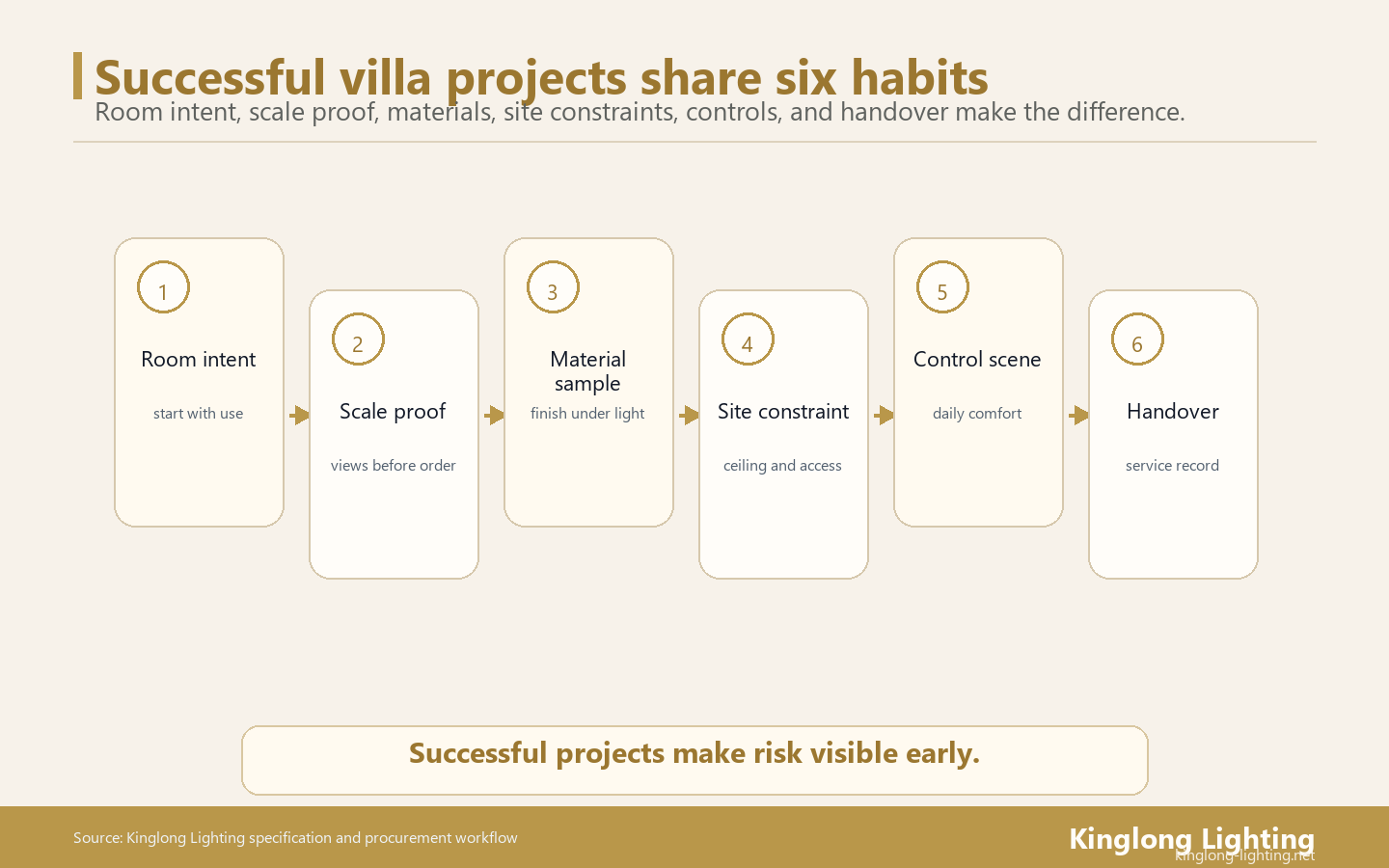
- Define the room role and primary viewing positions.
- Request scale proof before final size approval.
- Review finish samples under the target scene.
- Confirm access route, ceiling support, and service access.
- Keep the final handover record with the owner file.
FAQ
What is the strongest predictor of villa lighting success?
The strongest predictor is early alignment between room intent, scale proof, material approval, site constraints, controls, and handover. A beautiful product helps, but a complete project file prevents most avoidable failures.
Should villa lighting be selected room by room?
It should be specified room by room but coordinated as one visual system. Each room has a different role, yet finish, color temperature, control logic, and maintenance expectations should feel consistent.
How many samples should be approved?
Approve samples for the highest-risk decisions: finish, glass or crystal behavior, light color, module detail, and any visible custom part. The goal is not endless sampling; it is answering the risks that would force rework later.
When should Kinglong be involved?
Kinglong should be involved when room drawings, design intent, target materials, and site constraints are available. Early involvement lets the factory advise on module, finish, driver, packing, and service choices before the design freezes.