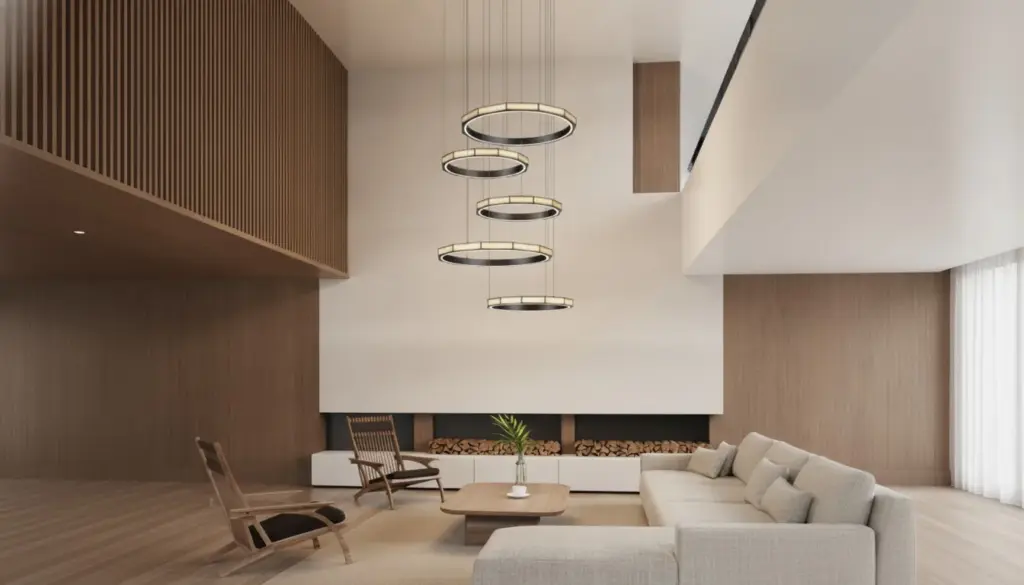
A villa lighting package can contain individually approved rooms and still be unready to order. The dining pendant may use a newer finish reference than the entrance chandelier; a corridor pair may be counted twice; the proposed dimmer may suit one source but remain unverified for another. Before ordering, compare the rooms as one package and trace each disagreement to every affected fixture position. The ten checks below cover document identity, quantities, shared views, appearance, controls and installation handover. They finish with a reusable review sheet and an illustrative example you can follow with your own schedule.
Start With One Current Package, Not Separate Room Approvals
Review the villa lighting package against one current room schedule, drawing issue and set of identified product references. Separate room approvals do not establish that those references agree across the complete package.
Collect the latest floor plan, ceiling plan, room elevations, fixture schedule, supplier proposal and relevant sample records. Give each fixture location a unique reference, or position ID: entry E1, living L1 and dining D1, for example. A product code identifies a design; a position ID identifies where its ordered version belongs. Keep both, because one design can have different drops, finishes or control components in different rooms.
On the review sheet, write the issue date or revision of each input and name who can resolve design, technical and purchasing questions. Older approvals remain useful history, but they cannot silently override a later agreed change. If two documents disagree about which issue is current, settle that first rather than choosing whichever produces the most convenient order.
Use lighting specification and procurement resources to help organize the preparation work, then bring the actual project documents to the review. General guidance cannot supply the missing room dimensions, selected models or approval authority.
Conflicts 1–4: Drawings, Quantities and Shared Views
Start by comparing revisions and reconciling quantities by position, then inspect competing focal points and changes of visual scale along connected room views. These are different failures: a correct count cannot resolve a composition problem, and a convincing rendering cannot correct an outdated schedule.
1. The same fixture is approved under different revisions
Compare every repeated product code across room sheets and the supplier proposal. Look for a changed shade, drop, canopy, finish or source that appears in one room but has not reached the others. A tick beside the product name can conceal these differences. Mark the exact conflicting fields and their document revisions; ask the responsible designer and supplier to identify the intended version at each position. Close the item when the current schedule and ordered specification agree, with any deliberate room-specific variation stated. Do not erase useful distinctions by forcing every occurrence back to one generic catalogue code.
2. Room quantities do not reconcile with the order
Count locations from the agreed drawings, then reconcile them with schedule rows and proposal quantities. Check pairs, repeated corridors, stair landings and spaces that appear on two sheets. Distinguish one multi-part fixture from several separately ordered fittings. Retained items, client-supplied products and proposed spares need their own status so they cannot inflate the supplier’s installation count. Resolve each missing or duplicated position in the drawings and order schedule together. The observable result is a traceable location for every ordered fitting, plus an explicit list of items excluded from that order.
3. Two rooms compete for the same focal view
Review the approach from the entrance, the seated view through adjoining rooms and any relevant reflection. Two statement fixtures that work in isolated room images can compete when they occupy the same line of sight. Use the normal approach view rather than an extreme wide-angle image. Identify which element should lead that particular view and what role the other should take. The correction might be a different form, position or visual density; it does not automatically require deleting a fixture. Record the agreed view and revised selection so that subsequent product substitutions are checked against the same design intention.
4. Fixture scale jumps unexpectedly between connected spaces
Compare fittings against their own ceiling, furniture and surrounding openings, then against the next visible room. A slender large fixture can appear quieter than a compact, dense one, so diameter alone is a weak comparison. Use consistent views with the actual furniture arrangement and proposed suspension positions. Compare the daytime silhouette and the evening lit composition separately. Ask whether the transition is deliberate or accidental. For candidates from Kinglong’s decorative collections, identify the exact size and configuration being compared; a family name or catalogue photograph does not confirm the version available for each room.
Conflicts 5–6: Finish References and Light Appearance
5. A shared finish name points to different samples
A finish comparison needs more than a color name. X-Rite’s explanation of material appearance includes texture, gloss and transparency, and describes the influence of illumination and viewing context. Two finishes called brushed brass can therefore still need a direct appearance review.
Put the sample ID and revision beside every position intended to share that reference. Compare identified samples with adjacent joinery, metalwork and glass under relevant viewing conditions. Decide which differences are acceptable to the design rather than inventing a universal matching tolerance. When a supplier proposes a different surface treatment, record the change as a new comparison; a similar finish name does not inherit the previous sample approval.
6. Matching white-light labels hide a visible difference
DOE’s LED Basics distinguishes the color appearance of the light itself from how it renders object colors. It also notes that reducing light appearance to CCT—correlated color temperature—loses information. Identical CCT labels alone do not establish that two proposed sources will look the same.
Check the actual fixture variants against the shared finish reference and the intended light appearance. Neither a finish label nor a white-light label closes consistency on its own.
Review adjacent fittings switched on together, including the intended dimmed condition where relevant. A source change, tinted shade or different diffuser may alter the result. If a representative comparison is unavailable, state which appearance decision remains open and request the product or sample information needed to resolve it.
Conflicts 7–8: Control Hardware and Room Scenes
7. “Dimmable” conceals different equipment requirements
Identify the equipment, not just the promise of dimming. Lutron’s Maestro guidance asks for the lamp type and dimmer model and directs LED users to its compatibility tool. That model-specific approach cannot be replaced by assuming all LED products behave alike.
For the proposed package, have the assigned electrical or controls specialist check the exact source, driver and control combination, applicable manufacturer information and site conditions. A driver is the component supplying the LED with the required electrical output. Record unresolved substitutions and equipment identifiers by position. A compatible combination in one room is not evidence for a different driver hidden in a similar-looking fitting elsewhere.
8. The switching plan contradicts how the rooms will be used
YourHome’s residential lighting guidance relates lighting type and position to the room and activity. Apply that functional principle to the proposed scenes; its Australian regulatory context is not a substitute for the villa’s local requirements.
Equipment compatibility and scene grouping are separate checks. A functioning dimmer does not prove that the intended fixtures operate together when a room scene is selected.
Walk through arrival, dining and late-evening use with the designer and controls specialist. Write which positions should operate together, separately or remain off. Compare that intention with circuit and control assignments. Use published decorative-lighting projects to discuss installation context if useful, while keeping the proposed system’s compatibility and scene evidence specific to this villa.
Conflicts 9–10: Ceiling Interfaces and Room Allocation
9. A repeated fitting meets a different ceiling condition
Check the selected version at every mounting location. A canopy agreed for one flat ceiling may meet a recess, slope, service zone or access constraint elsewhere. Compare the current fixture drawing with the ceiling interface, support arrangement, suspension adjustment and access needed for the actual components. Assign unresolved electrical and structural questions to qualified project professionals; the decorative selection review cannot approve them.
UL Solutions’ marking and application guidance explains how product markings and certification information help assess UL-certified equipment for a particular installation. A certification mark has a defined scope; it does not establish that any proposed fixture suits every ceiling or destination market.
10. Correct products are allocated to the wrong rooms
Once each ordered version has been checked against its ceiling interface, allocate its supplied components and room labels to the installation sequence. Otherwise, fittings with similar appearances but different drops or components can lose their identity during handover.
This differs from the quantity check: the total can be correct while the entry fixture receives the dining room’s suspension set. Agree how each position will be identified on the packing information and which components are supplied together or separately. Confirm who supplies lamps, drivers and special mounting parts. Where delivery is phased, show which components the installer needs for that phase and how any shared items will be allocated.
Use a Conflict Log That Leads to a Specific Correction
A useful finding states the disputed evidence, every affected position, who must act and what revised reference will demonstrate closure. Copy the matrix below into the project review sheet; for each row, enter “clear” with the checked reference or open a finding using the record underneath.
| Check | Compare | Record when resolved |
|---|---|---|
| 1. Revision identity | Repeated codes across room sheets and proposal | Agreed version for each position |
| 2. Quantities | Drawn locations, schedule and order lines | Reconciled counts and exclusions |
| 3. Focal competition | Fixtures within the same actual view | Leading element and revised shared view |
| 4. Scale transition | Fixture, furniture and connected architecture | Accepted sizes and configuration |
| 5. Finish references | Sample IDs and revisions across rooms | Named accepted references by position |
| 6. Light appearance | Actual sources and lit fixture variants | Agreed comparison and any remaining limit |
| 7. Compatibility | Source, driver, control and site information | Specialist-reviewed equipment combination |
| 8. Scenes | Intended activities and control assignments | Position list for each agreed scene |
| 9. Ceiling interfaces | Ordered version and each mounting location | Resolved drawing and technical approvals |
| 10. Allocation | Room labels, supplied parts and phases | Position-linked packing and supply scope |
Finding record to copy: Review issue: ___; check number: ___; conflicting documents or samples: ___; affected positions: ___; correction or missing evidence: ___; responsible person: ___; closure reference and revision: ___; approval by/date: ___; order status: open / closed / excluded.
“Clear” means the listed comparison agrees for the defined scope; “open” means a decision or required input is unresolved. Use “excluded” only with an explicit supply boundary and any retained interface checked. If resolving a finding requires a replacement, the decorative-lighting value engineering guide can help frame the alternative review. A replacement should still answer the original design and technical requirements.
Try the Review on an Illustrative Villa Package
In this illustrative villa package, dining pendant D1 points to finish sample F1 revision B, while entry chandelier E1 and living wall lights L1 still reference F1 revision A. The disagreement opens review of all three positions, even though each room sheet has a separate design approval.
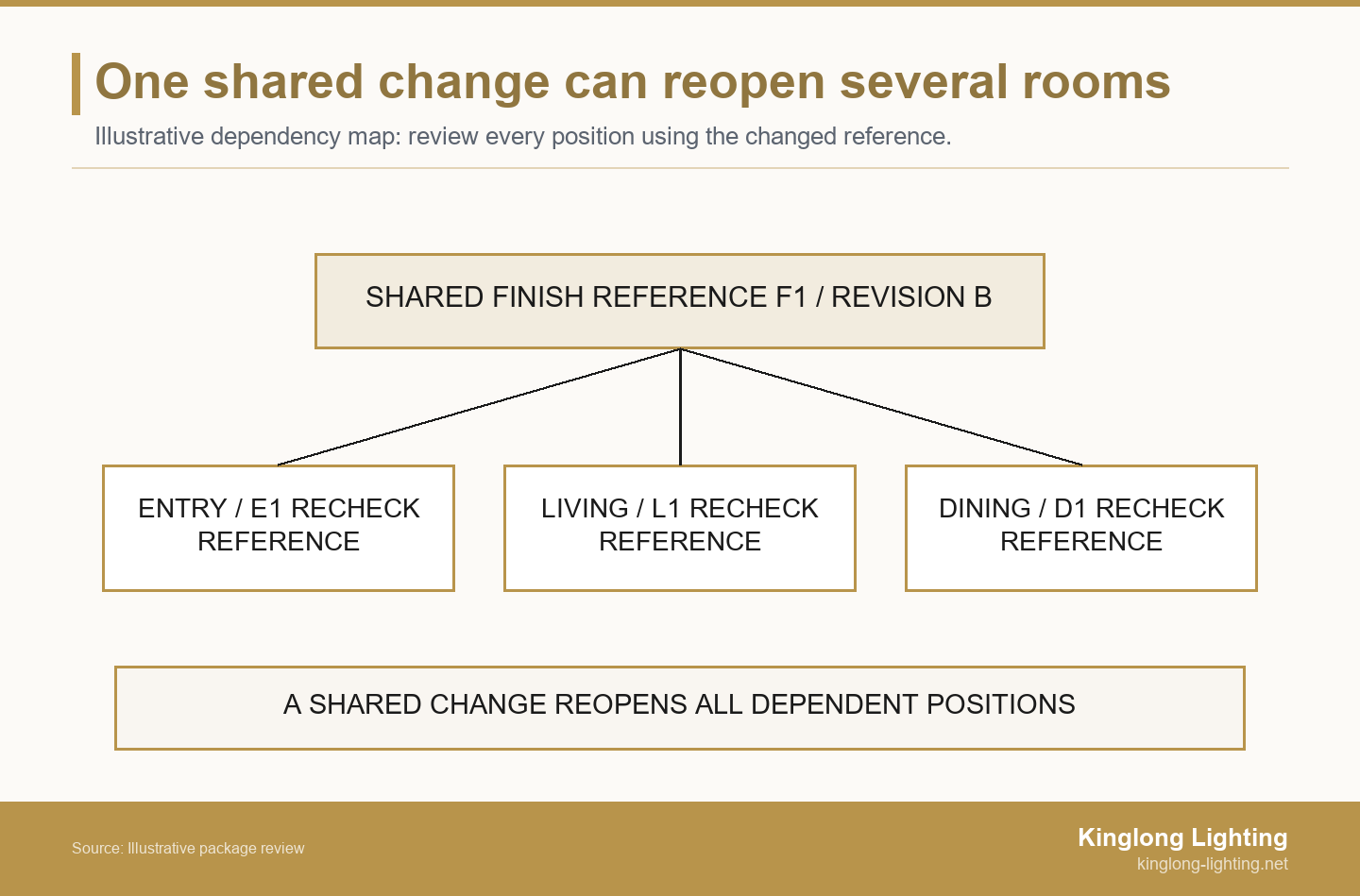
Enter check 5 in the finding record and list E1, L1 and D1 as affected. The designer first determines whether the new finish should apply across the connected view or only to D1. The supplier identifies which proposed variants can use the intended reference and provides the relevant sample information. The team then compares that choice in the shared view rather than approving D1 in isolation.
If revision B is accepted for all three positions, update their sample references in the current schedule and proposal. Close the finding against those revised documents and the recorded design approval. This closes the finish disagreement; it does not close a separate unresolved driver or mounting question.
If the revision B sample has not arrived, keep the appearance decision open. Request the identified sample or another agreed evidence route and state its limitations. Do not approve E1 and L1 merely because their sheets are older. A proposed early order for other rooms also needs a check that none depends on F1 or another unresolved shared item.
Close the Affected Scope Before Sending the Order
- Use the same current references in the room schedule, supplier proposal and order.
- Close each critical finding for every position it affects, including shared dependencies.
- Keep exclusions, supplied components and approval authority explicit.
An unresolved critical input or shared dependency keeps the affected positions open. Reconcile the agreed scope before sending the order; do not assume the rest of the package is independent until those relationships have been checked.
To review the villa lighting brief with Kinglong, bring the floor plan, ceiling height, preferred mood and budget requested on its villa page. Add the reconciled room schedule, identified references and open findings. Kinglong Lighting’s published process includes physical sample or detail mock-up review; confirm the actual product and review options available for the enquiry. The resulting discussion should define the next product or sample questions, while project design and technical approvals remain with their assigned decision-makers.
Frequently Asked Questions
Does paying a deposit mean the package is approved for manufacture?
Paying a deposit does not by itself establish manufacturing approval; the agreed contract must define which decisions authorize each action. Separate payment, sample work, material procurement and production milestones in the actual order terms. If the supplier is being authorized to start a limited activity before complete approval, identify that activity and its unresolved dependencies explicitly rather than relying on the word “deposit.”
Should client-supplied lamps and retained fittings appear in the package review?
Client-supplied lamps and retained fittings should appear as interfaces in the review, even when they sit outside the supplier’s purchase order. Label who provides them and which decisions depend on them. Their dimensions, light appearance or control requirements may affect new fittings. Keep their quantities out of the supplier’s ordered total unless the commercial scope expressly includes them.
What happens if a product changes after the package review?
A product change after review needs a check of the decisions that depended on its previous specification before approval is carried forward. Identify the changed fields, then reopen the relevant findings and linked positions. A different driver calls for a compatibility review; a revised shade may affect appearance and clearances. Preserve unaffected approvals when their inputs and dependencies genuinely remain unchanged.
Who should make the final decision when the review is remote?
Remote review needs named decision-makers for design, technical and purchasing decisions, with each approval tied to the current documents and references. A video call can support discussion, but it should not blur who accepted a finish or who checked an electrical interface. Record unresolved questions after the call and issue the agreed updates through the project’s normal approval route.