A whole-home lighting allowance should follow what the owner wants the villa to look and feel like, while protecting the lighting it needs to function. Dividing the total equally between rooms hides those differences. Start with a defined budget scope, group fixtures by their main budget role, then test the allocations against comparable quotations. The matrix below gives an owner or owner representative a record of priorities, quantities, ceilings and open decisions before individual selections consume the available funds.
What a Defensible Lighting Allocation Needs
- One stated budget boundary: currency, included work, exclusions and unresolved costs.
- One primary budget role per fixture group, with required performance protected in every category.
- A named source of funds for each proposed upgrade, followed by an equal-scope quotation check.
Define What the Lighting Allowance Includes
An allowance is a provisional planning ceiling for stated scope, not a supplier quotation. A villa lighting allowance matrix gives each fixture group one primary budget line and keeps its requirements and open costs visible. The owner can then explain why one focal installation deserves more discretion without assuming every room needs the same spend.
Begin with the dated room and fixture schedule. Give each group an ID, identify its locations and count the fittings. Drawings, references and lighting design and procurement resources can help organize that brief. The working schedule should be specific enough for another person to see which items the allowance covers, including repeated fittings across different rooms.
Write a scope statement above the matrix: project currency; schedule revision; total ceiling; and whether the amount covers fixture supply alone or a broader package. Explicitly locate lamps or light engines, drivers, controls, samples, packaging, freight, insurance, taxes, installation and commissioning. Mark each as included in an identified row, separately budgeted, excluded by agreement, or still to be priced. A supplier exclusion does not remove the owner’s need to fund the work elsewhere.
GAO’s cost-estimating guide includes purpose and scope, assumptions, risk analysis, documentation and updates. Its context is government program estimation. The transferable lesson for this owner worksheet is to write down what the allowance assumes and revise it when the information changes; it does not prescribe a private-villa budget or allocation method.
Keep unresolved costs in a visible action list. If controls are required but their extent is undecided, record the missing scope, the person obtaining it and the next review point. An unassigned hold is money the owner has retained within the ceiling; it is not evidence that every unknown will fit. Separately budgeted items also need an owner and a funding record before anyone describes the whole installation as funded.
Give Each Fixture One Budget Role
Use hero, supporting, functional, repeated and low-visibility as proposed budget roles. Give each fixture group one primary role and use secondary tags for its other characteristics. A repeated wall light can support the main composition, for example, without appearing in two totals. Required performance remains part of the brief whichever role receives the cost.
Hero identifies a chosen focal point: perhaps an entrance installation or a pendant composition above a principal dining table. Supporting describes visible fittings that complete the composition without taking its lead. Functional covers groups whose main budget justification is the lighting task. Repeated highlights a family used in enough locations that quantity needs explicit attention. Low-visibility identifies fittings with less visual exposure, where decorative complexity may be less important.
This distinction still sits within the balance of scope, quality and budget described in WBDG’s cost-management guidance. Visual priority helps allocate discretion; it does not establish which technical requirements can be removed. Ask the designer and responsible technical team to identify the required light, control behavior, installation conditions and access needs before proposing a lower ceiling for a less visible fitting.
Read the proposed priorities against the actual villa views. Is the entrance installation important from the arrival route, or mainly in a rendering? Does the owner value a quieter dining composition more than a dramatic stair feature? Kinglong’s published lighting projects can provide discussion references for placement and scale. Portfolio imagery cannot establish what another villa should cost or which fittings belong in its allowance.
Record a short reason for each protected choice, such as “retain the silhouette seen from the entrance” or “maintain the agreed reading function beside the chair.” These reasons let the owner compare alternatives without defending a product merely because it appeared first. Keep room names as location fields. The purpose of the role is to explain the budget decision, while the room field tells the team where the fitting belongs.
Copy This Villa Lighting Allowance Matrix
Fill the matrix with fixture IDs, locations and quantities, protected requirements, a ceiling and the quotation’s inclusions. Give every unknown cost or missing decision an open action and a responsible person. Duplicate category rows when groups need different decisions; do not combine unrelated fixtures so tightly that nobody can reconcile their quantities or prices.
Header to copy: Project [ ]; currency [ ]; schedule revision/date [ ]; allowance scope [ ]; total ceiling [ ]; separately funded/excluded work and owner [ ]; decision owner [ ]; next review [ ]. In each row, “quoted” means a dated offer for the identified scope, not an allowance entered by the owner.
| Primary budget line | Schedule reference | Protect / may change | Allowance and quote | Open action / owner |
|---|---|---|---|---|
| Hero | IDs [ ]; rooms [ ]; quantity [ ] | Priority reason [ ]; required function [ ]; flexible detail [ ] | Ceiling [ ]; quoted [ ]; included scope/revision [ ] | Evidence needed [ ]; responsible person [ ] |
| Supporting | IDs [ ]; rooms [ ]; quantity [ ] | Visual relationship [ ]; required function [ ]; flexible detail [ ] | Ceiling [ ]; quoted [ ]; included scope/revision [ ] | Alternative to review [ ]; responsible person [ ] |
| Functional | IDs [ ]; rooms [ ]; quantity [ ] | Lighting task [ ]; agreed performance/controls [ ]; flexible detail [ ] | Ceiling [ ]; quoted [ ]; included scope/revision [ ] | Technical question [ ]; responsible person [ ] |
| Repeated | IDs [ ]; all locations [ ]; total quantity [ ] | Family consistency [ ]; required function [ ]; flexible detail [ ] | Ceiling [ ]; unit price × quantity [ ]; included scope [ ] | Count or variant to confirm [ ]; responsible person [ ] |
| Low-visibility | IDs [ ]; rooms [ ]; quantity [ ] | Required function/access [ ]; optional decoration [ ] | Ceiling [ ]; quoted [ ]; included scope/revision [ ] | Scope gap [ ]; responsible person [ ] |
| Shared package costs, if inside the ceiling | Cost IDs [ ]; identify items not assigned above [ ] | Included work [ ]; prevent duplicate charging [ ] | Ceiling [ ]; quoted [ ]; basis [ ] | Unpriced scope [ ]; responsible person [ ] |
| Unassigned hold | Retained amount [ ]; do not duplicate fixture rows | Named unresolved items [ ]; release condition [ ] | Held ceiling [ ]; this is not a quotation | Who can allocate it [ ]; next review [ ] |
Reconcile all assigned ceilings plus the unassigned hold to the stated total. Use the shared-cost row only for work inside that total which has not already been assigned to fixture rows. Keep a missing quotation marked “unpriced”; blank or unknown entries must not quietly become zero in the sum. The ceiling can be fully allocated while the cost forecast remains incomplete.
Describe requested lighting behavior precisely. DOE’s overview of color-tunable LED products distinguishes dim-to-warm, white-tunable and full-color-tunable products, considering their applications, control options and possible complications. If one of those functions belongs in the brief, name it in the protected requirement. The overview supplies no price premium and does not show that a particular proposed system is compatible.
For model references, identify which item from Kinglong’s decorative-lighting collections starts the discussion, then list the proposed size, finish and functional changes against the schedule ID. This ties selection to a budget line without treating an image or collection listing as a quotation. Attach the relevant drawing or reference version so later alternatives can be compared against the same brief.
Test a Change Against the Whole Allowance
The following illustrative allowance example uses a deliberately narrow scope: fixture supply, the named drivers and agreed packaging. Freight, taxes, installation, the wider control system and commissioning sit outside this example ceiling and need separate owner budgets. Assume the included costs are assigned to the relevant fixture rows, with no additional shared-cost row in this illustration.
Start with 100 notional planning units: hero 30, supporting 20, functional 20, repeated 15, low-visibility 5 and unassigned hold 10. A revised proposal changes hero to 35 and supporting to 15, leaving the other lines unchanged and the total 100. These are illustrative owner choices, not currency, market prices, supplier quotations or a recommended allocation split.
| Budget line | Baseline | Revised proposal | Decision to verify |
|---|---|---|---|
| Hero | 30 | 35 | What added visual value is being requested? |
| Supporting | 20 | 15 | Can the alternative preserve the agreed composition and function? |
| Functional | 20 | 20 | Retain the agreed technical brief. |
| Repeated | 15 | 15 | Retain the counted locations and quantities. |
| Low-visibility | 5 | 5 | Retain required function and access. |
| Unassigned hold | 10 | 10 | Keep unresolved items visible. |
| Total | 100 | 100 | Balanced proposal; feasibility remains unconfirmed. |
The baseline adds as 30 + 20 + 20 + 15 + 5 + 10 = 100. The revised allocation adds as 35 + 15 + 20 + 15 + 5 + 10 = 100. The owner has named the supporting category as the source of the transfer, rather than spending the same hold twice or silently reducing functional lighting.
Now try the proposal against evidence. Ask the designer to identify a supporting alternative and explain which visible details change. Ask for a matching quotation against the unchanged quantity, required function and supply scope. Until that offer supports the lower supporting ceiling and the hero offer fits its higher ceiling, record “proposal awaiting quotations,” not “saving achieved.”
If the supporting alternative cannot meet that ceiling, the transfer has no confirmed funding source. The owner must reconsider the hero choice, another explicitly identified discretionary change or the total allowance. The retained hold is not automatically available: its unresolved items need review first. Even successful fixture-supply reconciliation leaves the separately budgeted work outside this illustration to be funded and confirmed.
Compare Quotations on the Same Scope
Compare offers for the same schedule, quantities, required function, controls and stated delivery or installation scope before treating a lower figure as a saving. Mark a missing item unpriced. A reduced total caused by omitted fittings or different inclusions answers a different purchasing question; reconcile those differences before bringing the owner an apparent budget improvement.
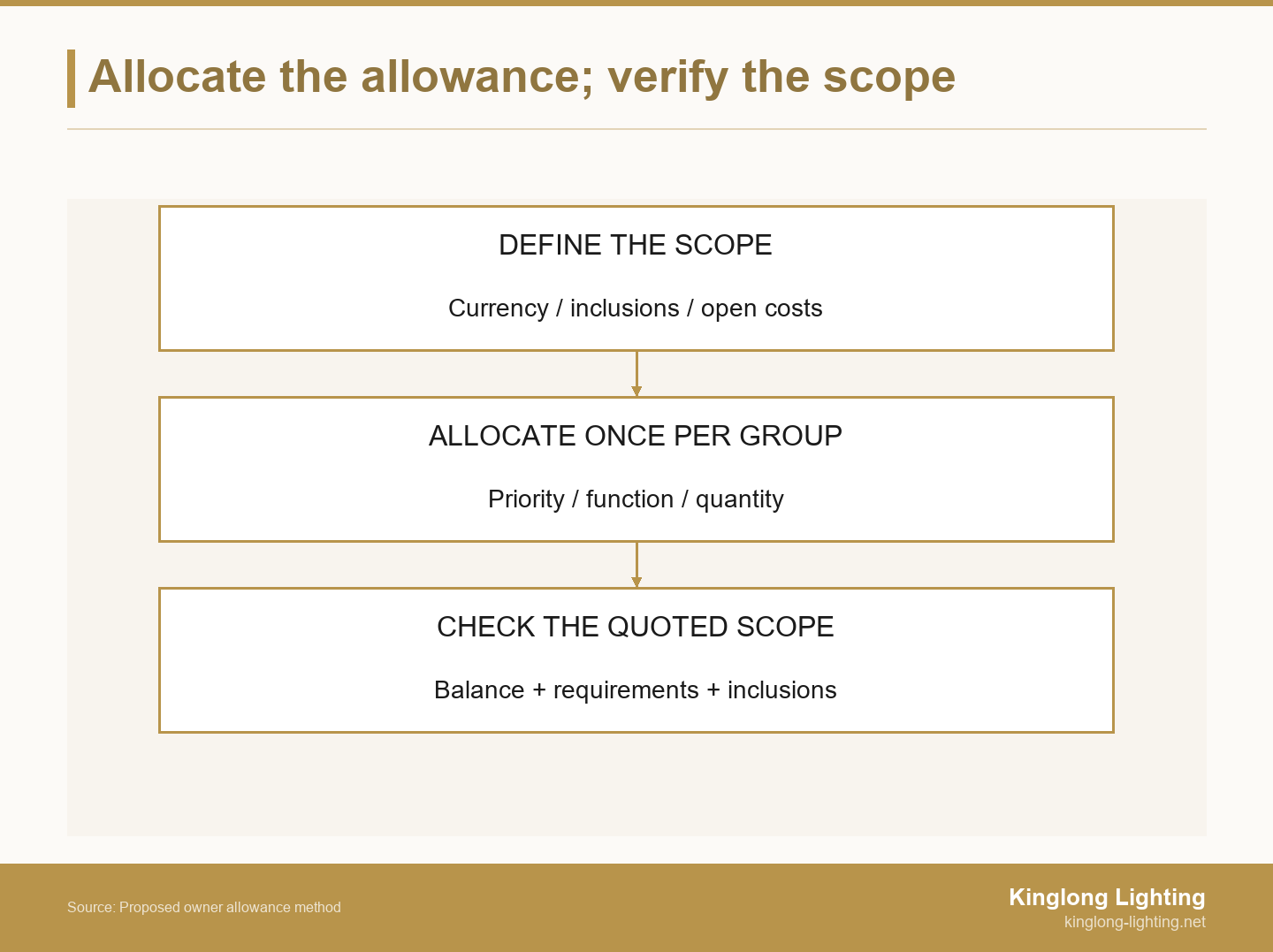
For repeated groups, check the unit price against every location on the schedule, including variants. Count the whole family before discussing a discretionary upgrade elsewhere. If an option changes the number of fittings, make that a visible design revision with the responsible designer’s explanation. Do not compare the revised quantity with the original total as though only the price changed.
Ask the supplier to identify the quoted fixture, size, finish, light source, driver and requested control behavior. Ask the relevant installer or controls party to confirm their own included work. Where one quotation includes a driver and another leaves it to others, carry the missing scope into the comparison rather than guessing a balancing figure. Record quote date, currency and exclusions alongside the matrix row.
If DALI is specified, the DALI Alliance product database helps identify certified components and the specific tested product and version conditions. It does not list luminaires. Check the proposed components and versions with the responsible technical team; a component entry alone does not certify the decorative fitting or demonstrate that the complete installed system will perform as intended.
Turn the comparison into a short decision note: “Offer matches the current schedule; these inclusions differ; this item remains unpriced; this party will confirm it.” Where delivery terms, destination charges or installation responsibility differ, show those boundaries rather than presenting a fixture subtotal as an installed cost. Keep offers in their stated currencies until the owner agrees the conversion basis for the comparison.
A useful outcome may be a precise request for information rather than a selected supplier. For example, keep a row open because the proposed control arrangement is unidentified, while allowing an unrelated fixture reference to proceed to further design discussion. This limits the unresolved decision to its actual scope and avoids reopening every choice merely because one quotation lacks a necessary detail.
Keep a Decision Record as the Design Changes
Before treating a change as agreed, record the matrix revision, amount moved, donor line, retained requirements, quotation evidence, unresolved action and owner decision. Keep the previous version. The record should explain both the extra value being requested and the change that funds it, so the designer, supplier and owner representative work from the same allocation.
When a lower-cost alternative changes cleaning access, the replaceable component or an agreed finish, record that consequence before approval. Kinglong’s decorative-lighting value engineering guide provides a related way to discuss alternatives against agreed functions. The matrix keeps the owner’s money decision attached to that design discussion, rather than allowing a lower ceiling to imply that an unreviewed substitute is acceptable.
Use this compact entry: Change [ ]; affected IDs [ ]; from/to ceilings [ ]; donor line [ ]; visual change [ ]; required functions retained [ ]; quote references [ ]; open items and owner [ ]; decision/status [ ]; date [ ]. Mark the decision as proposed, approved for allocation, or returned for revision. State which separate design or commercial confirmations remain outstanding.
Consider how the fitting will be looked after as well as how it appears. CIBSE’s public LG20 overview describes guidance for facilities managers who maintain, modify and update electric lighting installations. For the owner matrix, ask who will access and service the proposed fitting and what replacement information is available. The overview does not supply a project-specific lifespan or maintenance saving.
At each review, reconcile the assigned ceilings and hold again, then separately check quotations and open costs. A revised ceiling is an owner decision about available funds; a supplier’s revised price is evidence about an offer. Keeping those records distinct lets the team see whether the next action is a design revision, a missing quotation or a decision to change the total.
Turn the Matrix Into a Whole-Home Brief
A useful whole-home enquiry combines the matrix with the schedule, room references, drawings and the owner’s ranked priorities. Include quantities, project currency, dated budget scope, required functions and the unresolved list. Identify which ceiling is a firm owner limit and which remains a proposal, so a response can address a real decision.
Ask for a response against the identified rows: which starting designs suit the brief, what customization needs review and which evidence is needed before a quotation can be compared. Request explicit inclusions and exclusions. This gives the owner a clearer next action than a request to “fit everything into the budget” without a defined package.
You can review the whole-home villa lighting brief with Kinglong using those inputs. The published villa service path describes design and visualization, physical sample or detail mock-up review, progress photography and installation documentation. Ask which deliverables apply, and agree their availability, charges and responsibilities for the proposed scope. The useful response is a clarified design and evidence request with remaining questions identified, rather than an assumed quotation or authorization to proceed.
Frequently Asked Questions
Can we still report the budget room by room?
Yes: keep the primary allocation by budget role, then map the fixture IDs back to rooms for location reporting without counting any item twice. A repeated family can span several rooms while retaining one reconciled quantity. If the owner needs room subtotals, derive them from the same schedule and confirm that they reconcile to the role-based total.
Should every villa use the same category percentages?
No: category ceilings should reflect the specific owner’s priorities, required functions, fixture quantities and stated quotation scope, rather than a fixed split copied from another villa. The notional units illustrate how to reconcile a change. They do not establish a suitable hero share, a contingency allowance or a price benchmark for a different design or market.
What if like-for-like quotations exceed the allowance?
Return to the owner with explicit choices about discretionary design details, agreed package scope or the total ceiling, while retaining the required functional brief. Show the affected rows and what each option changes. If none is supported by a matching quotation, keep the funding gap open instead of entering an assumed saving or quietly omitting necessary work.
Does an approved matrix authorize the supplier to start?
No: approval of an allocation does not by itself authorize manufacture, procurement or installation; any release is a separate decision against agreed design and commercial documents. The matrix explains where funds are intended to go. Keep the relevant drawings, specifications, quotation scope and outstanding confirmations attached to the actual release process so budget approval cannot be mistaken for acceptance of an unfinished design.