This tropical resort villa chandelier article is a composite case. It is not a named resort or completed client project. It distills recurring decisions from coastal hospitality-style villas where ocean air, humidity, open terraces, frequent cleaning, and owner expectations change the meaning of “luxury chandelier.”
The first installation photo is not the real test. A tropical chandelier has to survive five years of salt air, cleaning touchpoints, driver access, finish aging, spare-part matching, and service visits without looking tired. If the specification only protects handover day, it is too shallow.
Kinglong Lighting can help resort villa teams build a release file that treats the chandelier as a service system: material, finish, driver location, cleaning method, spare kit, packing, and maintenance handover.
Key Takeaways
- Composite case only: this article explains recurring tropical resort villa risks without claiming a named site.
- Five years is the acceptance horizon: handover beauty matters, but service reality decides ownership quality.
- Salt air hides in details: clips, screws, cable exits, and canopy seams need exposure thinking.
- Cleaning creates risk: repeated access can protect or damage glass, crystal, metal, and alignment.
- Spare parts are design proof: a tropical chandelier needs replacement logic before shipment.
Why five years changes the specification
A tropical villa chandelier is approved for handover only when it can also explain year five.
The NOAA note on sea spray aerosols helps frame the environment: sea spray contains salt-rich particles that can travel in coastal air. A villa chandelier may be indoors, but resort use patterns often blur indoor and outdoor life through open terraces, ocean breezes, humid nights, and frequent cleaning.
The chandelier should therefore be specified with a five-year service question. What will the finish look like after repeated wiping? Can drivers be reached without damaging the ceiling? Are the spare crystals or glass pieces labeled? Can a cleaning team reach the fixture safely? Will clips and hidden fasteners age faster than the visible frame?
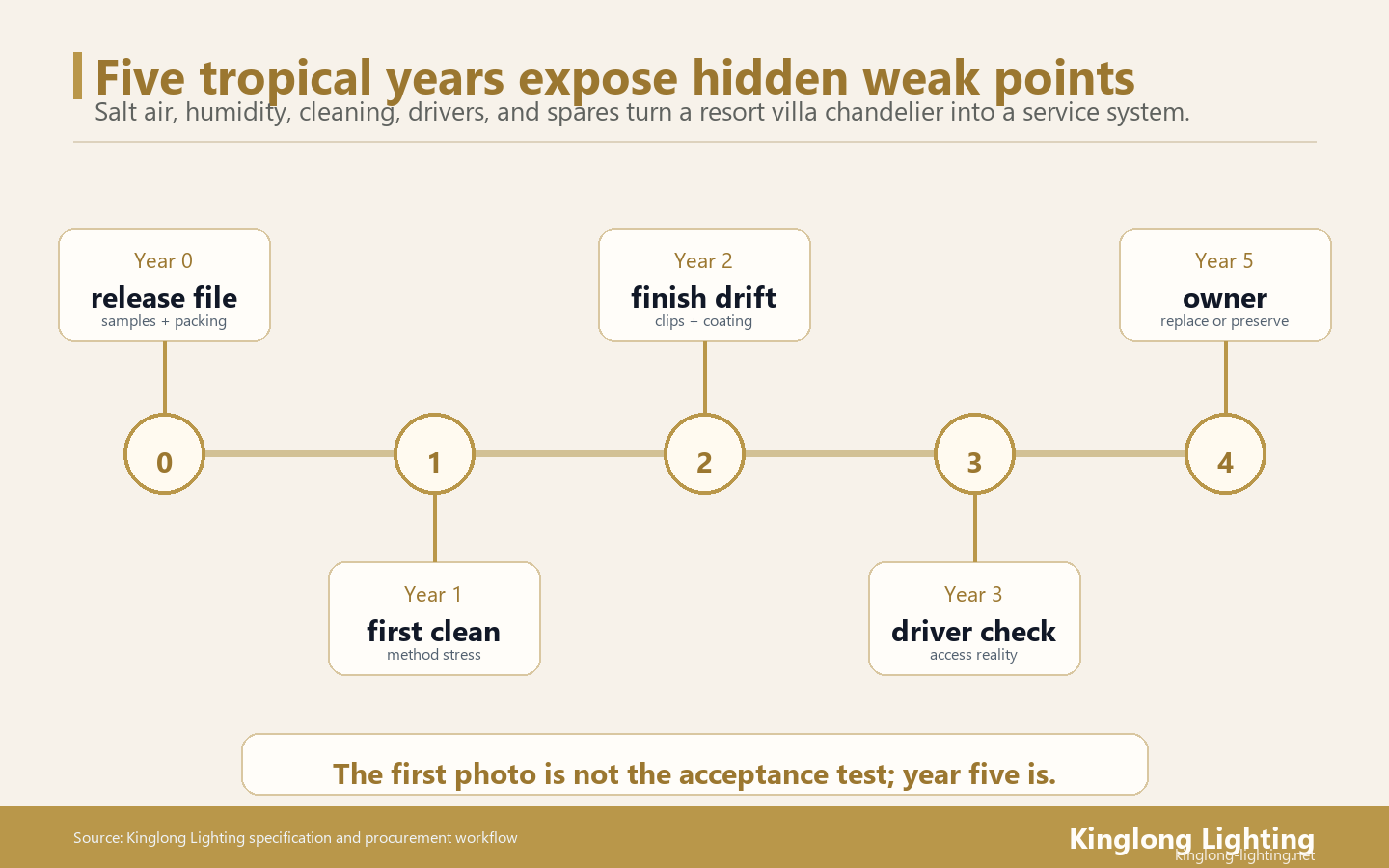
Year 0: release the service file, not only the design
At production release, the team should already know the exposure zone, finish master, cleaning method, driver location, spare kit, packing method, and installation route. This does not make the project slower. It prevents the team from discovering service problems after the chandelier is already hanging above finished floors.
Finish master plus cleaning note
A tropical finish master should be approved with a cleaning note. The note should say what cloth, what solution, what frequency, and what not to use. If the finish cannot tolerate the expected service rhythm, the fixture may still be beautiful but unsuitable for the villa’s operating reality.
Hidden metal parts need exposure logic
The USDA Forest Products Laboratory report on salt damage and fastener corrosion is not about chandeliers, but it is a useful reminder that salt exposure can affect small metal parts. For lighting, that means screws, clips, cable exits, retaining rings, and canopy details deserve attention.
Years 1-2: cleaning reveals weak decisions
After the first year, the issue is often not dramatic failure. It is dullness, slight finish drift, a bent clip, a lost decorative piece, residue in glass, or a service team that avoids cleaning because access is too difficult. These small issues can make a luxury villa feel neglected.
Cleaning access should be specified before handover
The OSHA aerial lift page reinforces the importance of planning elevated work with hazard awareness and qualified operation. A villa owner does not need the chandelier manufacturer to manage site safety, but the chandelier brief should avoid designs that can only be cleaned through improvisation.
Piece maps prevent visual drift
A tropical chandelier with many crystal, glass, or metal details should have a piece map. A cleaning team may remove parts, inspect them, or replace a damaged item. Without a map, pieces return in the wrong location, spares mismatch, and the fixture slowly loses its intended rhythm.
Years 3-5: drivers and spares decide longevity
LED technology can last a long time, but real ownership depends on access, heat, controls, and replaceable components. The DOE LED lighting page explains the efficiency and longevity advantages of LEDs. For custom chandeliers, the next question is where the driver lives and how it can be replaced.
Driver access is part of tropical luxury
A driver sealed above a finished ceiling can turn a minor service event into a disruptive repair. In a resort villa, where guest readiness and owner use matter, service should be predictable. Remote driver locations, access panels, labeled wiring, and control documentation should be considered before the fixture is built.
Spare parts should match the five-year expectation
Spare glass, crystal, clips, fasteners, and drivers should be specified before shipment. A spare part that arrives three years later may not match color, finish, or production batch. For hospitality-style villas, a small spare kit is often less costly than a future mismatch visible in the main room.
Five-year decision table
| Time horizon | Risk signal | Proof before release | Owner decision |
|---|---|---|---|
| Handover | finish looks correct only when new | finish master and cleaning note | approve material or revise |
| Year 1 | cleaning access is awkward | lift route and service method | simplify or add access support |
| Year 2 | small parts show aging | hardware material and spare kit | upgrade hidden details |
| Year 3 | driver service becomes disruptive | remote access and labels | hold if service is sealed |
| Year 5 | fixture no longer feels premium | maintenance record and replacement logic | preserve, refresh, or replace |
How Kinglong turns longevity into a release package
Kinglong Lighting’s custom chandelier release workflow can make five-year reality visible before production. The team can connect material choice, finish master, driver location, module size, packing, spare parts, and service assumptions into one project file.
The UL 1598 standard page is a reminder that decorative resort chandeliers are still luminaires with product evidence. Longevity should combine aesthetics, service access, electrical documentation, and market-specific review by qualified local professionals.
Kinglong’s hospitality project references are relevant because resort-style villas often borrow expectations from luxury hotel work: durability, repeatable maintenance, visual consistency, and operational readiness.
Operational maintenance plan
A tropical resort villa should receive an operational maintenance plan before the chandelier is handed over. The plan should be short enough for a property team to use, but specific enough to prevent the fixture from being treated like generic housekeeping. It should name frequency, access, approved methods, inspection points, spares, and escalation rules.
Quarterly visual checks protect the finish
A quarterly visual check can catch salt residue, loose clips, dull glass, driver noise, or early finish drift before the owner sees a major problem. The check should not require full dismantling. It can be a structured review from floor level, lift level, and service access points. If the same issue appears twice, the plan should trigger a deeper inspection.
Annual technical review protects the system
An annual technical review should look beyond visible beauty. Driver access, wiring labels, connector condition, suspension points, spare part inventory, and control scenes should be reviewed. The resort villa lighting support conversation should include these service points, because the chandelier is part of the villa’s operating standard.
Guest readiness changes the tolerance for delay
In resort-style villas, the room may need to be ready for owner visits, guests, or rental windows. That makes service timing more important. If a driver replacement requires ceiling work or a missing glass part must be ordered internationally, the room may be unavailable at the wrong moment. A spare kit and access strategy reduce that operational risk.
Refresh decisions should be planned before year five
By year five, the property team should know whether to preserve, refresh, or replace parts of the chandelier. Preservation may mean deeper cleaning and minor part replacement. Refresh may mean updating drivers, replacing selected glass, or reworking finish details. Replacement should be a deliberate decision, not the result of neglected maintenance.
Five-year RFQ evidence checklist
A tropical chandelier RFQ should ask for evidence that survives operations, not only evidence that wins the first design review. The buyer can keep the checklist short, but it should be specific enough to change the quote. If a supplier cannot answer these items, the risk may be hidden in maintenance rather than visible in purchase price.
Ask for exposure assumptions
The RFQ should state whether the fixture is fully interior, near operable terrace doors, exposed to humid air, or close to an ocean-facing opening. This helps the manufacturer choose finish, hardware, driver location, and cleaning guidance. A tropical villa with sealed air-conditioning does not carry the same risk as a breezy beach villa.
Ask for component replacement logic
Replacement logic should identify which parts are standard, which are custom, which should ship as spares, and which may require a future production run. The owner should know whether a broken glass piece or driver can be replaced quickly. Longevity depends on availability as much as durability.
Ask for cleaning method boundaries
The quote should not simply say “clean regularly.” It should name what is safe for the finish and what is not. Cleaning method affects coating, glass clarity, crystal alignment, and small connectors. A service team needs practical boundaries, especially if the fixture is installed in a resort-style property with repeated guest turnover.
Ask for inspection photos before packing
Pre-packing photos should show finish, modules, labels, fragile parts, spares, and any assembled reference. They give the owner and installer a baseline before shipment. If a part arrives damaged or missing, the team can compare against the packing record instead of guessing what the factory intended.
Define the owner acceptance standard for year five
A five-year tropical reality check should not be vague. The owner should decide what “still acceptable” means before the chandelier is purchased. Some natural patina may be acceptable in a relaxed resort villa. Corroded fasteners, cloudy glass, loose clips, failed drivers, stained ceiling marks, or repeated cleaning complaints are different. They point to specification or service planning gaps.
Separate cosmetic aging from functional failure
Cosmetic aging may include minor finish softening, small variations in hand-cleaned crystal, or normal dust patterns after use. Functional failure includes unsafe suspension, electrical faults, parts that cannot be accessed, missing spares, or cleaning methods that damage the finish. The acceptance standard should make this distinction so the property team can act without arguing over taste.
Record the first-year baseline
The first annual inspection should become the comparison baseline. Photograph the fixture from the same angles, record cleaning method, note any replaced parts, and confirm driver behavior. By year five, the owner can compare real change against the baseline instead of relying on memory. That record also helps Kinglong Lighting or the local service team recommend whether to clean, repair, replace parts, or adjust the maintenance schedule.
Soft next step for tropical resort villas
If your tropical villa project is near salt air or uses open terrace living, prepare a five-year service brief before approving the chandelier. Include exposure zones, cleaning frequency, ceiling height, access route, finish expectations, driver location, spare requirements, and destination market. Kinglong Lighting can help you send the five-year salt-air brief and decide which details must be proven before production.
FAQ
Is this a real tropical resort case study?
No, this is a composite case based on recurring tropical villa chandelier decisions. It does not claim a named resort, owner, or completed project. The article shows how salt air, service, and maintenance should affect the specification.
How often should tropical chandeliers be cleaned?
The cleaning interval depends on exposure, room use, humidity, and material choice. A quarterly visual check plus scheduled cleaning may be appropriate for many resort-style villas, but the actual plan should be set by the owner, property team, and installer.
Do salt-air conditions require outdoor-rated chandeliers indoors?
Not always. Indoor chandeliers near coastal exposure may still need stronger finish notes, hardware attention, driver access, and maintenance planning. The key is to define exposure zone and service expectations rather than using one rating label as the whole decision.
What should be included in a tropical chandelier spare kit?
A spare kit may include glass or crystal pieces, clips, fasteners, lamps or drivers where appropriate, labels, and a piece map. The exact kit depends on the chandelier design, production batch, destination, and maintenance plan.