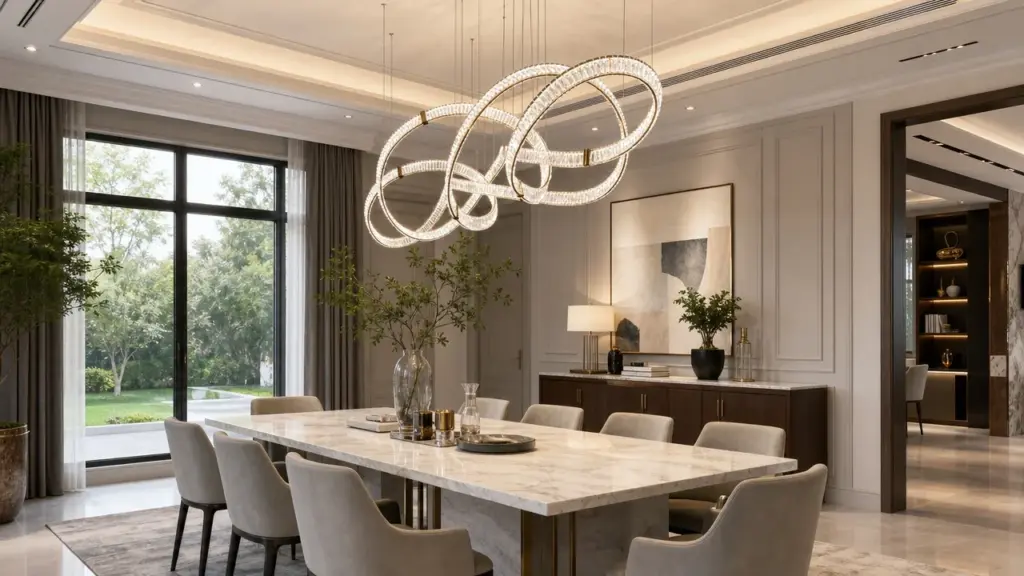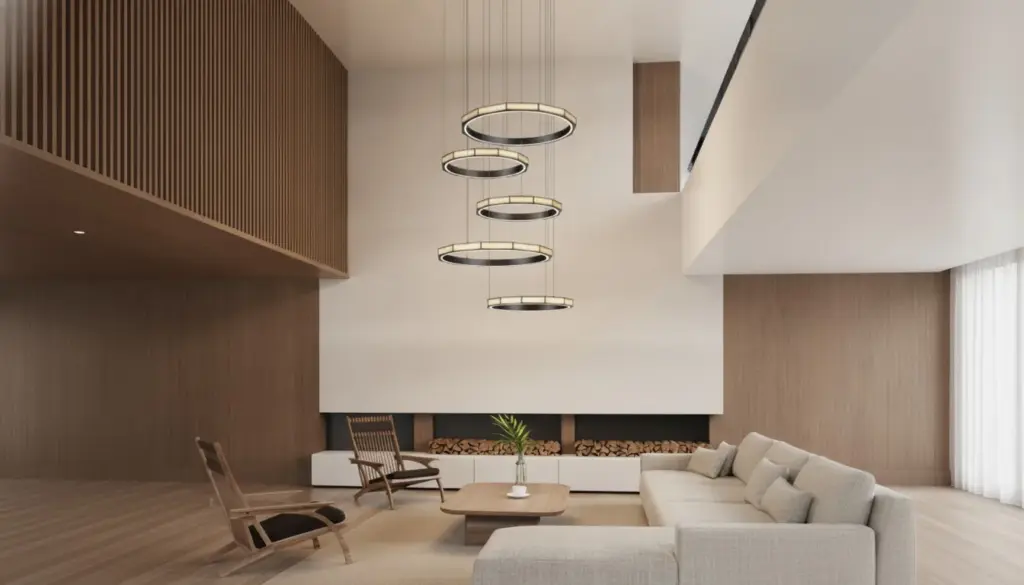
A villa can have a sculptural stair cluster, quiet bedroom lighting and a distinctive dining composition without treating every fitting as an unrelated development. The useful starting point is to preserve what gives each room its identity, then ask which parts, connections and manufacturing processes can genuinely remain common. Sharing becomes valuable when it removes repeated decisions without hiding a change that still needs checking. A common driver or finish name alone does not establish a dependable lighting package.
Share the Work That Does Not Define the Room
For custom villa lighting, propose shared components where their actual applications support reuse, while protecting the visible choices that distinguish the rooms. A small glass element might appear in different arrangements; a documented connection might support more than one decorative treatment; a repeatable finish process might serve separate designs. Each is a different kind of commonality. None means the complete fixtures are interchangeable, and a hidden part is not automatically suitable for every assembly.
For an interior designer or whole-home customization manager, the opportunity is to make the package easier to describe and review. Reusing an agreed part identity gives the team a stable reference. Reusing a drawing detail can reduce the number of separate connection proposals to discuss, provided the detail remains applicable. These are reasons to investigate sharing, not evidence of a particular saving, shorter lead time or lower defect rate.
Start with the whole-home brief: room roles, preferred design references, finish intentions and the decisions already fixed. Kinglong’s lighting design and procurement resources provide background for organizing those discussions. The component proposal should follow that brief, so a convenient factory part does not quietly become the reason every room receives the same visual treatment.
- For a proposed common part, identify the actual manufacturer, model or drawing reference before asking which fittings can use it.
- For a proposed common process, identify the polishing, coating or other sequence and the materials it covers.
- For an appearance reference, identify the physical sample and the features it represents; keep the designer’s visual acceptance separate from process reuse.
Specify What Makes Each Room Look Different
A distinct room design can come from silhouette, arrangement, material expression, luminous appearance and the treatment of visible fittings. Record those differences before discussing common components. The dining room may need a horizontal composition, the stair a vertical rhythm and the bedroom a soft shaded presence. Sharing a glass piece or concealed electrical component need not require repeating the entire composition.
Make the protected qualities observable. “Different but coordinated” is difficult to review remotely. A reference image annotated “separate pendants with visible space between them” says more than “lighter dining design.” For the bedroom, identify whether the shade should read as an opaque volume when unlit, a glowing surface when lit, or both. For the stair, show the intended grouping and the viewpoints from which the arrangement matters. These descriptions give the supplier something specific to preserve.
Pay attention to parts that cross the visible–hidden boundary. A canopy contains connections, but its outline, depth and finish can still be prominent on the ceiling. A glass holder may be concealed in one shade and exposed in another. Moving a part between those contexts can turn an acceptable construction detail into an unwanted design feature. Mark its visibility on each room drawing rather than classifying it once for the entire house.
Installed photographs are useful for discussing composition and how a fixture sits within an interior. Kinglong’s published lighting project portfolio can support that visual conversation. A photograph cannot confirm the driver, attachment detail or shared-part identity inside the pictured fittings. Keep visual selection and component confirmation as separate questions, even when both refer to the same image.
Give the supplier permission to propose a separate part when retaining the common one would change a protected quality. A bedroom shade should not become visibly larger merely to accommodate a preferred driver unless the designer accepts that change. The review can then compare a design-preserving exception with the proposed shared solution. This makes originality a stated requirement that can be assessed, rather than a subjective objection raised after engineering work.
Build a Component-Sharing Map
A component-sharing map records the proposed common item, the identity or detail to keep fixed, the room-specific change and the decision still needed. Use “retain” when supported sharing fits the design, “split” when a separate item is justified, and “confirm” when information is missing. At the first briefing stage, these are proposals for the supplier to answer. They are not evidence that the listed parts have already been accepted.
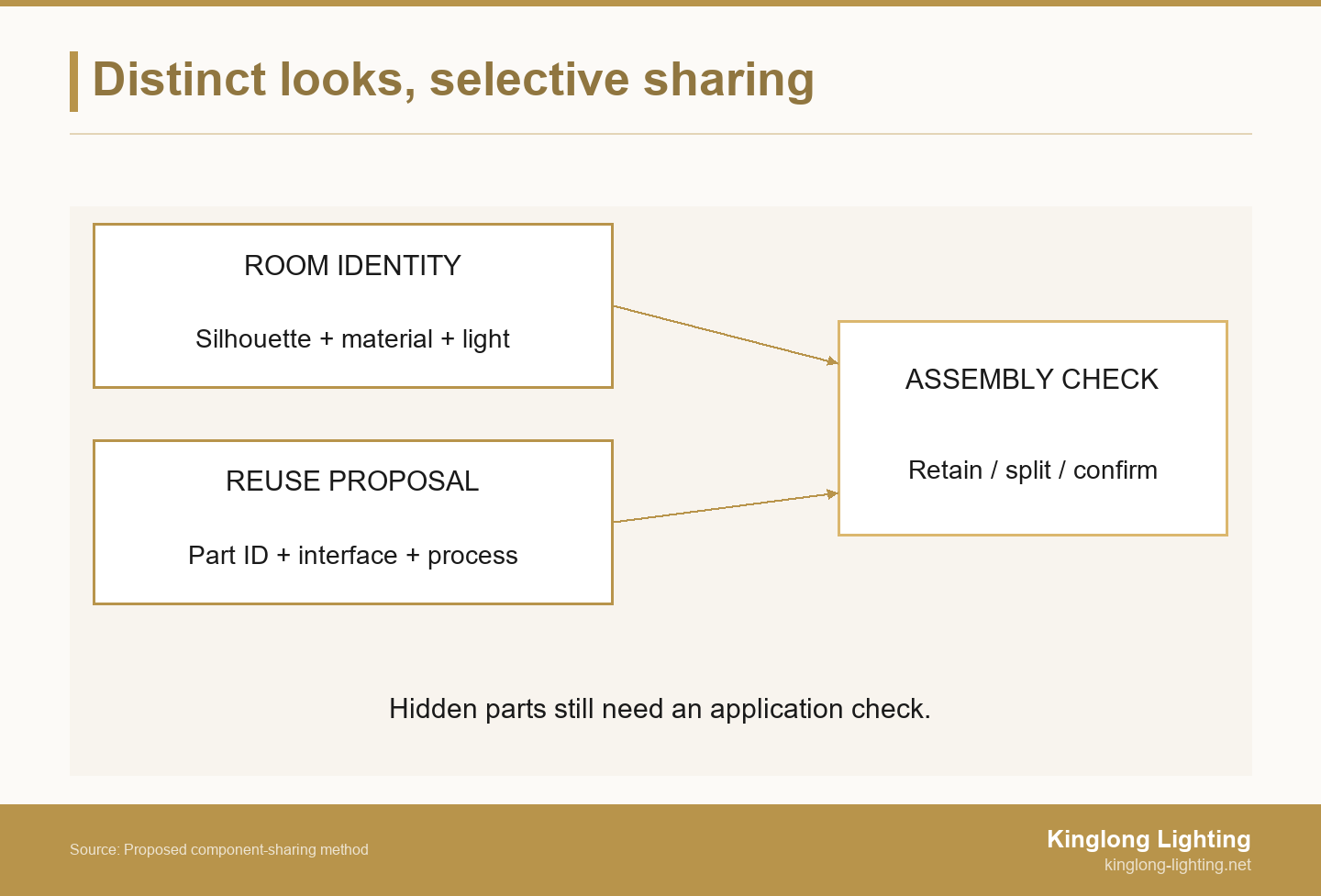
An interface is the defined connection between parts. Its description may include the mating geometry, attachment method or electrical connection, according to the item. Zhaga’s interface specifications define interoperability conditions for the LED luminaire components they address. The transferable lesson is to define the connection, rather than assume a familiar component name proves compatibility. This does not make decorative glass or custom metalwork Zhaga-compliant, nor require a villa package to adopt that system.
The illustrative three-room brief below proposes separate dining pendants, a bedroom shaded fixture and a stair cluster. DR-A, GL-A and FN-A are invented candidate references, not an actual supplier platform. The table shows how to ask about reuse while keeping different appearances. It contains no approved ratings, structural details or installation dimensions.
| Candidate item | Reference to keep fixed | Room-specific difference | Proposed decision and next evidence |
|---|---|---|---|
| Driver DR-A | Exact manufacturer, model and relevant application limits | Dining pendants and enclosed bedroom shade create different operating contexts | Confirm each application; leave bedroom use open until enclosure and thermal evidence are reviewed |
| Glass element GL-A | Glass identity, connection detail and retention method | Separate dining pendants versus a grouped stair composition | Consider retaining the element; confirm its actual mounting and service arrangement in each assembly |
| Canopy and mounting detail | Actual canopy, attachment drawing and supported application | Ceiling appearance, suspension arrangement and fixture loading differ | Confirm compatibility; split the design where the common detail is unsuitable or visibly intrusive |
| Finish process FN-A | Defined process, substrate and agreed physical reference | Different exposed shapes and material combinations | Consider process reuse; check representative pieces before accepting appearance across designs |
| Inspection method | Agreed inspection instructions and reference samples | Different visible surfaces, joints and access points | Retain applicable methods; add checks for features the common sample does not represent |
Copy the table into the brief and attach each row to the affected fixture drawings. Where an item is already known, replace the candidate reference with the actual part and revision. Where it is not known, ask a question instead of writing “same as dining.” For a process, record the process reference rather than inventing a common part number. The supplier’s reply should distinguish confirmed reuse from a suggestion that still needs development.
Starting models from Kinglong’s decorative-lighting collections can make those requests more concrete. Mark the features to preserve and the features allowed to change on each reference. A collection image is a useful starting point for discussion; the map still needs the actual proposed construction and covered applications.
Check the Assembly Around Every Shared Part
A shared component needs to be assessed in the assembly that surrounds it. Ask the technical reviewer to address attachment, loading, enclosure, thermal conditions, electrical ratings, control requirements and service access as applicable. Changing a shade, support or arrangement can change these conditions even when the proposed component itself stays identical. The design team identifies the intended differences; the manufacturer and appointed project specialists assess their technical consequences.
The distinction matters when reading certificates. UL Solutions explains Component Recognition as an assessment with specific conditions of acceptability, rather than certification of a complete standalone product. For a proposed recognized component, request its applicable conditions and the evidence relating to the finished assembly. This is not a statement that the villa fixtures are UL-certified or that one certification route applies in every destination.
Consider the bedroom entry in the map. The design calls for an enclosed shade, while the proposed common driver has been identified without evidence for that enclosure. A photograph showing that it physically fits does not answer the application question. Nor does acceptance of a dining pendant settle the bedroom fixture merely because both list DR-A.
Keep the bedroom driver entry unconfirmed. Request the actual enclosure arrangement, the driver’s relevant application information and the technical evidence needed to assess that combination. If the response supports reuse in the stated assembly, record the supported drawing and part revision. If it does not, request a separate suitable driver or a revised arrangement for review. Missing thermal information does not prove failure, but it also cannot be treated as a successful check.
Control compatibility is another application question. The DALI Alliance describes DALI-2 certification as including independent verification of test results. If that control system is proposed, identify the actual products and the room’s intended control arrangement. Product-level certification does not by itself approve the complete decorative luminaire or demonstrate the desired behavior of the installed room system. Other control approaches need their own relevant evidence.
The same discipline applies to mechanical sharing. A glass element used in a stair cluster may need a different support arrangement and a different route for replacement than the dining version. Ask which details remain common and which drawing addresses the changed arrangement. A sample should be accepted for the features it actually demonstrates. It can establish an appearance reference or a particular construction detail without representing every fixture in the package.
Share a Finish Process Without Assuming a Visual Match
A repeatable finish process can be a useful common reference, but it does not establish identical appearance across different substrates, shapes or viewing conditions. A flat sample, curved canopy and slender arm present different surfaces for the designer to judge. State whether the intent is a close match between adjacent pieces, a coordinated family of finishes or a deliberate contrast. Those are different acceptance decisions.
X-Rite’s explanation of metamerism describes colors that match under one lighting condition but cease to match when the light changes. This explains why one apparently successful comparison is not enough to settle every room condition. Ask to compare representative physical pieces under agreed viewing conditions relevant to the project. A possible metameric difference is a reason to check, not proof that the proposed finishes will fail.
Be precise about color references as well. RAL’s FAQ distinguishes selection charts from binding color templates. A color-selection reference should therefore be identified accurately rather than treated as the entire finish specification. A RAL code alone does not describe the proposed substrate, plating process, surface texture or the project’s appearance acceptance criteria. Record those choices separately where they matter.
In the sharing map, FN-A can remain a candidate process while appearance approval stays specific to representative parts. Identify the retained sample, the materials it covers and any intentional differences. Agree who judges the comparison and how a disputed match will be reviewed; do not invent a numerical tolerance without an applicable basis. When a proposed simplification changes appearance or another agreed function, Kinglong’s decorative-lighting value engineering guide provides a useful way to frame the design and commercial discussion together.
Ask for Confirmed Sharing and Explicit Exceptions
Before accepting the lighting package, ask the supplier to return the component-sharing map with actual references and revisions, the assemblies covered, proposed exceptions and unresolved questions. A general “common components confirmed” response leaves too much interpretation. The answer should let the team tell which fixtures use the same item, why a different item is needed elsewhere and which proposals are still awaiting evidence.
Read the returned map alongside the drawings and commercial offer. A separately developed canopy, an additional representative sample or a different bedroom driver should appear where it affects scope. Commonality is useful only if the quotation describes the same package the designer is reviewing. Ask the supplier to identify exclusions and development assumptions so that a visually acceptable option is not mistaken for a fully defined order.
For the illustrative bedroom branch, the observable result is a revised entry identifying either the supported DR-A application or a separate proposed solution, together with the relevant assembly reference. “We normally use this driver” does not close the specific enclosure question. A valid exception is preferable to a common reference that obscures a different operating condition.
Keep the accepted map with the fixture schedule. It becomes a practical index for future enquiries about a damaged glass element, a changed room fitting or a replacement electrical component. Record the replacement reference against the affected fixture revision; a spare described only as “villa glass” loses the very distinction the map was intended to preserve.
Kinglong’s customization page describes blueprint review for feasibility, material selection and structural optimization. Bring the room compositions and model references, sharing map, known enclosure and mounting conditions, finish references, intended viewing conditions, destination requirements and unresolved questions to discuss the component-sharing brief with Kinglong. These inputs support a specific development conversation about the proposed designs; the actual sharing, exceptions and scope still need to be agreed.
Frequently Asked Questions
Will shared components guarantee a lower minimum order?
No. The supplier still needs to confirm quantities, development work and the commercial basis for each variant. A common part can coexist with separate assembly, finishing or sampling work. Ask which quantities apply to the complete fitting and which apply to a proposed component or process. Do not use a sharing proposal as evidence of Kinglong’s accepted minimum order or pricing policy.
Can one spare-part kit cover the whole villa?
Only explicitly identified common parts can be grouped that way. Build the spare list from accepted part identities and fixture revisions, including any room-specific exceptions. Check whether apparently similar glass pieces use the same retention detail and whether a replacement can be accessed in each installed arrangement. A common kit can include shared items alongside separately labeled parts; it need not imply every spare fits every fixture.
Can different suppliers share the same component reference?
A matching description is insufficient. Reconcile the actual manufacturer, model, revision and connection information, and ask who is responsible for confirming the application in each assembly. Two suppliers may use the same generic label for different parts. Even an identical purchased component does not establish that the surrounding fixtures have the same construction, installation requirements or acceptance evidence.
May the factory substitute a similar shared part later?
A shared reference does not authorize substitution. Require an identified replacement proposal and an assessment of the fixtures it affects, including appearance, application limits and existing acceptance evidence. Record the agreed decision and update the affected references before treating the replacement as common. If only one assembly supports the change, keep that exception visible rather than silently extending it across the villa.