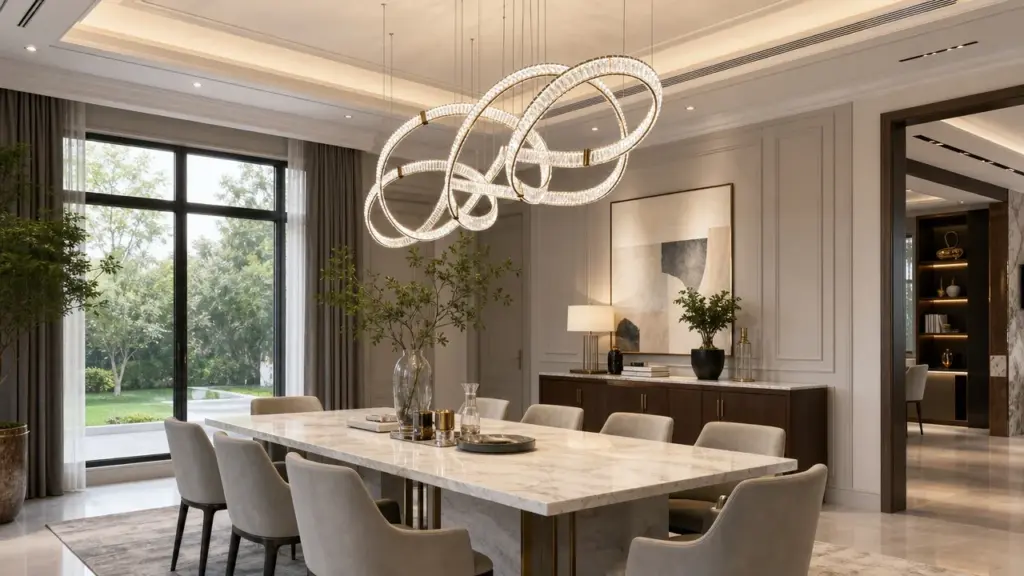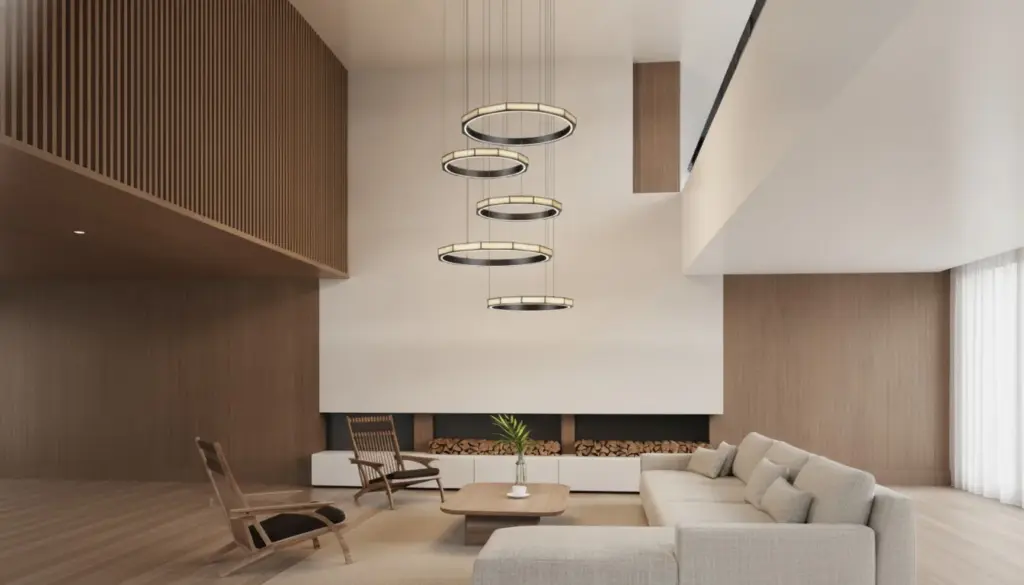
Private villa chandelier procurement is not a shopping trip that ends when the owner chooses a beautiful fixture. It is a controlled path from room intent to selection, quotation, samples, engineering, production, packing, delivery, installation, and final scene approval.
The risk is that homeowners often make the emotional decision early and the technical decision late. By the time ceiling support, access route, driver location, color temperature, dimming, or cleaning method is discussed, the design may already be frozen and expensive to change.
Kinglong Lighting helps villa owners and designers turn that path into a practical release file, so every attractive chandelier choice has a next proof gate before money, production time, and site work are committed.
Key Takeaways
- Procurement starts with the room: define purpose, scale, views, ceiling condition, and owner expectations before comparing products.
- Selection needs proof: a favorite image should lead to samples, drawings, and engineering checks.
- Quotes must be normalized: compare material, finish, driver, suspension, packing, delivery, installation support, and spares.
- Installation is a procurement issue: lift route, floor protection, access, and commissioning should be planned before shipment.
- The owner needs gates: each stage should end with approve, revise, or hold.
Procurement starts before fixture selection
The best chandelier is the one the room can support, service, and enjoy after installation.
The DOE lighting design page is useful because lighting decisions should improve the quality and efficiency of the whole space. A private villa foyer, stairwell, double-height living room, dining room, spa suite, gallery corridor, and master bedroom do not ask the chandelier to do the same job.
Start with room intent. Is the chandelier meant to announce arrival, soften a dining table, pull the eye upward, create a sculptural silhouette, add sparkle to stone, or provide a quiet luxury accent? Then identify what the chandelier should not do: produce glare, block a view, overpower art, make maintenance unsafe, or force ceiling repair.
This first gate prevents a common owner mistake: comparing chandelier images before knowing the room’s real constraints. A fixture that looks perfect in a catalog can be too wide for a stair void, too warm for pale stone, too fragile for frequent cleaning, or too difficult to install after the villa is furnished.
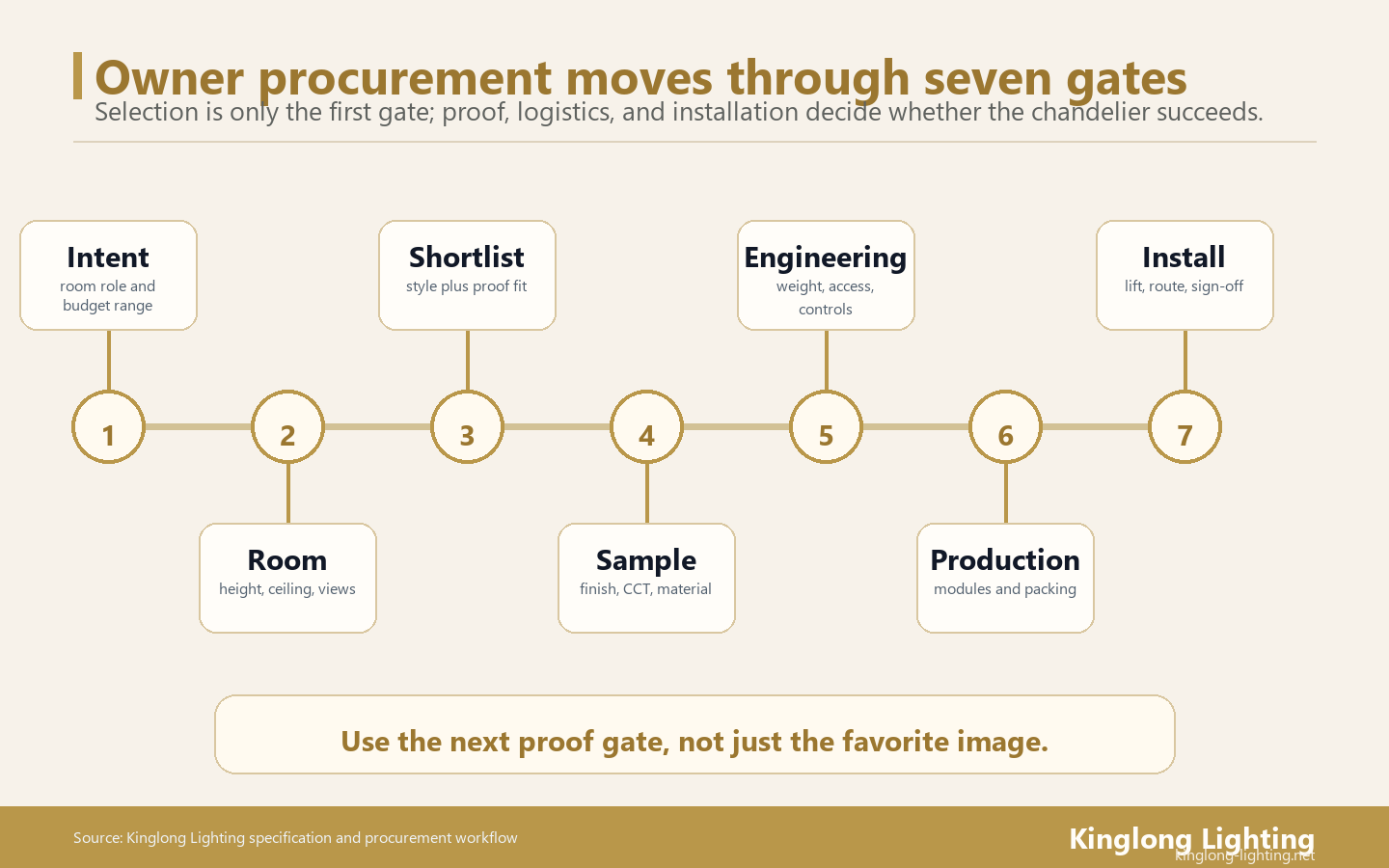
The seven-gate owner roadmap
Use the roadmap as a decision sequence. Do not skip a gate because the owner likes an image. If a gate is not ready, mark it as open and assign an owner. That makes delay visible and avoids pretending that uncertainty is production time.
Gate 1: room intent and emotional target
Write a short room sentence before looking at products. For example: “The stair void needs a vertical crystal feature that feels calm from the entry, does not glare from the upper corridor, and can be cleaned once a year without removing major parts.” This sentence guides size, density, material, and access.
Kinglong Lighting’s villa lighting project support is relevant at this stage because the design should connect decorative ambition with room type. A villa owner may want a dramatic object, but the project team must also decide what light role the object should play.
Gate 2: room data and site constraints
Collect ceiling height, room width, stair or furniture position, ceiling structure, power point, view lines, window reflections, finish palette, control system, lift access, and installation timing. If the room is under construction, save current drawings and site photos. If it is a renovation, mark what cannot be opened or damaged.
This data turns a chandelier from a wish into a scope. It also helps the factory decide whether the fixture should ship as one piece, modules, branches, strands, or a partly assembled system. A missing measurement can become a late redesign; a missing access route can become a failed installation day.
Gate 3: shortlist and quote normalization
Shortlist by room fit, not only by beauty. Compare diameter, drop, weight, material, finish, light source, driver, dimming, suspension, canopy, packing, delivery, warranty, spares, and installation support. A quote that looks lower may exclude drawings, samples, spares, or freight responsibility.
The ICC Incoterms 2020 page is useful because delivery terms allocate responsibility between buyer and seller. Even for a private villa owner, shipment terms, insurance, customs documentation, unloading, and site delivery should not be vague.
Gate 4: sample and visual proof
Samples should answer the largest aesthetic risk. For a crystal chandelier, that may be clarity, cut, sparkle, and cleaning. For hand-blown glass, it may be color variation, bubble tolerance, and weight. For metal, it may be brass tone, coating, patina, and fingerprint behavior. For LED, it may be color temperature and dimming.
The DOE TM-30 FAQ helps explain why color quality can require more than a warm/cool label. In a villa with stone, art, fabrics, and skin tones, the owner should review the light source against real finishes whenever possible.
Gate 5: engineering and buildability
Engineering is where the beautiful choice becomes a suspended object. The team should confirm weight, suspension points, canopy design, driver location, ceiling support, access panels, module size, and local installer responsibilities. A qualified local engineer or electrician should review site-specific safety and code requirements.
The UL 1598 standard page is a reminder that a chandelier is a luminaire, not only decoration. Product evidence, electrical construction, market requirements, and installation context belong in procurement before the owner approves production.
Gate 6: production, inspection, and packing
Production should begin only after the release file is clear: approved drawing, finish master, sample notes, electrical notes, control assumptions, packing method, spare list, and inspection standard. If the chandelier is large, the packing plan should match the installation route. A module too large for the elevator or stair turn is a production error disguised as logistics.
Ask for pre-shipment photos, packing labels, piece maps, and an inspection checklist. The goal is not to micromanage the factory. The goal is to prevent a fragile custom fixture from arriving as a puzzle the site team cannot verify.
Gate 7: installation and commissioning
Installation should have a method statement: delivery timing, lift access, floor protection, unpacking area, assembly order, wiring, leveling, cleaning, and final scene check. The OSHA aerial lift page is not a villa design manual, but it reinforces the importance of qualified elevated-work planning.
Commissioning is the final owner gate. Check whether the chandelier hangs level, dims cleanly, matches the approved finish, avoids glare from key views, and can be maintained without risky improvisation. The owner should receive a maintenance note, spare part record, and piece map where relevant.
Owner decision table
| Gate | Owner question | Proof to collect | Decision |
|---|---|---|---|
| Intent | What should the room feel like? | one-sentence room target | approve direction or rewrite |
| Data | Can the room support this idea? | drawings, photos, ceiling notes | shortlist or resize |
| Quote | Are scopes comparable? | normalized quote matrix | select vendor or clarify |
| Sample | Does the finish and light work? | sample, CCT, material proof | approve, revise, or hold |
| Engineering | Can it be installed and serviced? | weight, suspension, access notes | release or redesign |
| Production | Is the factory building the approved scope? | inspection, packing, piece map | ship or correct |
| Commissioning | Does the installed room match the promise? | scene check and handover file | accept or punch list |
Common procurement mistakes
Choosing diameter before checking volume
Many owners ask for a diameter too early. Diameter only makes sense with ceiling height, viewing distance, stair void, furniture layout, and drop. A wide chandelier in a low room can feel heavy. A narrow chandelier in a tall void can disappear. Review proportion in elevation, not only in plan.
Approving finish from a phone photo
Metal and glass finishes shift under camera, screen, daylight, and warm artificial light. A phone photo is useful for communication, but it should not be the final approval of a custom premium finish. Use physical samples, room finishes, and a signed finish master.
Ignoring the service route
Owners often think about installation once and cleaning later. A large chandelier may need repeated access for dusting, lamp or driver service, crystal replacement, or alignment. If the lift cannot reach the fixture after furniture and flooring are complete, maintenance will become a luxury failure.
Letting the quote hide exclusions
A chandelier quote should say what is included and excluded. Drawings, samples, spares, taxes, duties, freight, insurance, installation, site lifting, and after-sales support can change the real cost. A lower quote with unclear exclusions can become more expensive after the owner has fewer options.
What to ask before paying the deposit
The deposit is the moment where a private owner should stop treating the chandelier as an image and start treating it as a project. Before paying, ask for a written release path. It does not need to be complicated, but it should say which drawing, sample, engineering, payment, production, inspection, packing, and shipping steps remain open.
Ask which decisions freeze after deposit
Some decisions can still change after deposit, while others create cost or schedule impact immediately. A finish change may require new sampling. A size change may alter structure, crystal quantity, packing, and price. A driver change may affect dimming, wiring, and certification evidence. The owner should know which decisions become expensive once production materials are ordered.
Ask what the factory needs from the site team
The manufacturer cannot guess every local condition. Before deposit, ask what information is still needed from the architect, electrician, installer, or builder. This may include ceiling backing, junction box location, control protocol, lift access, delivery window, or room protection. If those inputs are missing, mark them as conditions rather than pretending the order is fully ready.
Ask how changes will be documented
Private villa projects often change because the owner sees a sample, the designer updates a finish, or the site condition shifts. Changes are normal; undocumented changes are dangerous. The project should have one current drawing set, one current finish reference, and one current approval record. That record protects the owner from paying for a scope nobody can reconstruct later.
Procurement timeline reality
A simple chandelier may move quickly, but custom villa work usually follows a proof rhythm. Initial direction can be fast. Drawing and quotation require room data. Samples require material and finish decisions. Engineering requires site input. Production requires approval freeze. Packing and shipping require route planning. Installation requires site readiness.
The owner should therefore avoid asking only “How many weeks?” A better question is “Which gate controls the next week?” If the open gate is a sample, faster production does not help. If the open gate is ceiling support, a beautiful sample does not help. A good roadmap makes the controlling gate visible and keeps responsibility with the right party.
How Kinglong supports the roadmap
Kinglong Lighting can support the owner’s roadmap through its custom chandelier workflow: concept interpretation, design development, material and finish proof, engineering coordination, sample review, production, packing, and documentation. The goal is to make the owner’s decision visible at every gate.
The Mofun Design Platform can help early-stage owners and designers test scale before physical sampling. This is especially useful when the owner likes an image but has not yet seen how the chandelier behaves in the actual room volume.
Soft next step before purchase order
If your villa chandelier shortlist already exists, do not move straight to purchase order. Prepare the room data, desired mood, ceiling condition, power point, finish palette, control requirement, destination, and installation timing. Then send the procurement checklist to Kinglong Lighting so the team can identify missing proof before production locks in cost and site risk.
FAQ
When should a villa owner contact a chandelier manufacturer?
A villa owner should contact the manufacturer after the room intent and basic dimensions are known, but before the chandelier design is frozen. Early input helps confirm scale, ceiling support, access, finish proof, control requirements, packing, and installation assumptions.
What documents should be ready before quotation?
Prepare floor plans, elevations, ceiling height, room photos, finish palette, preferred style references, control system information, destination, installation timing, and any ceiling restrictions. The more complete the package, the easier it is to compare quotes fairly.
Should installation be included in procurement planning?
Yes, installation should be planned during procurement even if a local installer performs the work. Module size, lifting route, floor protection, canopy design, wiring, and commissioning affect the chandelier specification before it is manufactured and shipped.
How can owners compare two chandelier quotes?
Compare two quotes by normalizing scope: material, finish, size, light source, driver, dimming, suspension, canopy, samples, drawings, packing, freight, spares, warranty, and support. A price difference is meaningful only when the included responsibilities are clear.