An off-grid luxury villa chandelier is not selected only by diameter, crystal, or style. It is selected inside a power budget. Solar production, battery autonomy, inverter behavior, LED driver placement, dimming scenes, and emergency priorities all decide whether the chandelier supports the house or becomes a beautiful load the energy system resents.
The common mistake is to approve the dramatic fixture first and ask the solar or electrical team to absorb the consequence later. That can create clipped scenes, oversized backup equipment, driver heat, poor dimming, or a chandelier that looks impressive only when other loads are sacrificed.
For Kinglong Lighting, the right brief starts with room ambition and power reality together. The fixture can still be ceremonial, but its modules, drivers, zones, controls, and maintenance access should be designed around the villa’s energy envelope before production starts.
Key Takeaways
- Power budget before shape: the chandelier load should be visible before final size and lamping are approved.
- Battery autonomy changes luxury: evening scenes should be prioritized so daily comfort does not fight spectacle.
- LED drivers are part of the design: driver location, heat, service, and dimming must be included in the fixture file.
- Local electrical review remains essential: off-grid status does not remove code, safety, or qualified installation requirements.
- Scene hierarchy protects ownership: arrival, dinner, service, and backup scenes should not draw the same energy.
Why off-grid power changes chandelier selection
In an off-grid villa, the chandelier must earn its watts before it earns the ceiling.
A grid-connected villa can sometimes hide poor load discipline inside a larger utility connection. An off-grid villa cannot. Every watt assigned to a chandelier is a watt that affects battery sizing, backup duration, inverter behavior, and the owner’s confidence during evening use.
The DOE How Does Solar Work page is useful because solar supply depends on available resource, system design, and operating assumptions. For villa owners, designers, and electrical consultants planning an off-grid luxury residence, that turns the discussion into a measured load budget, autonomy target, driver location, and local electrical review instead of a preference argument.
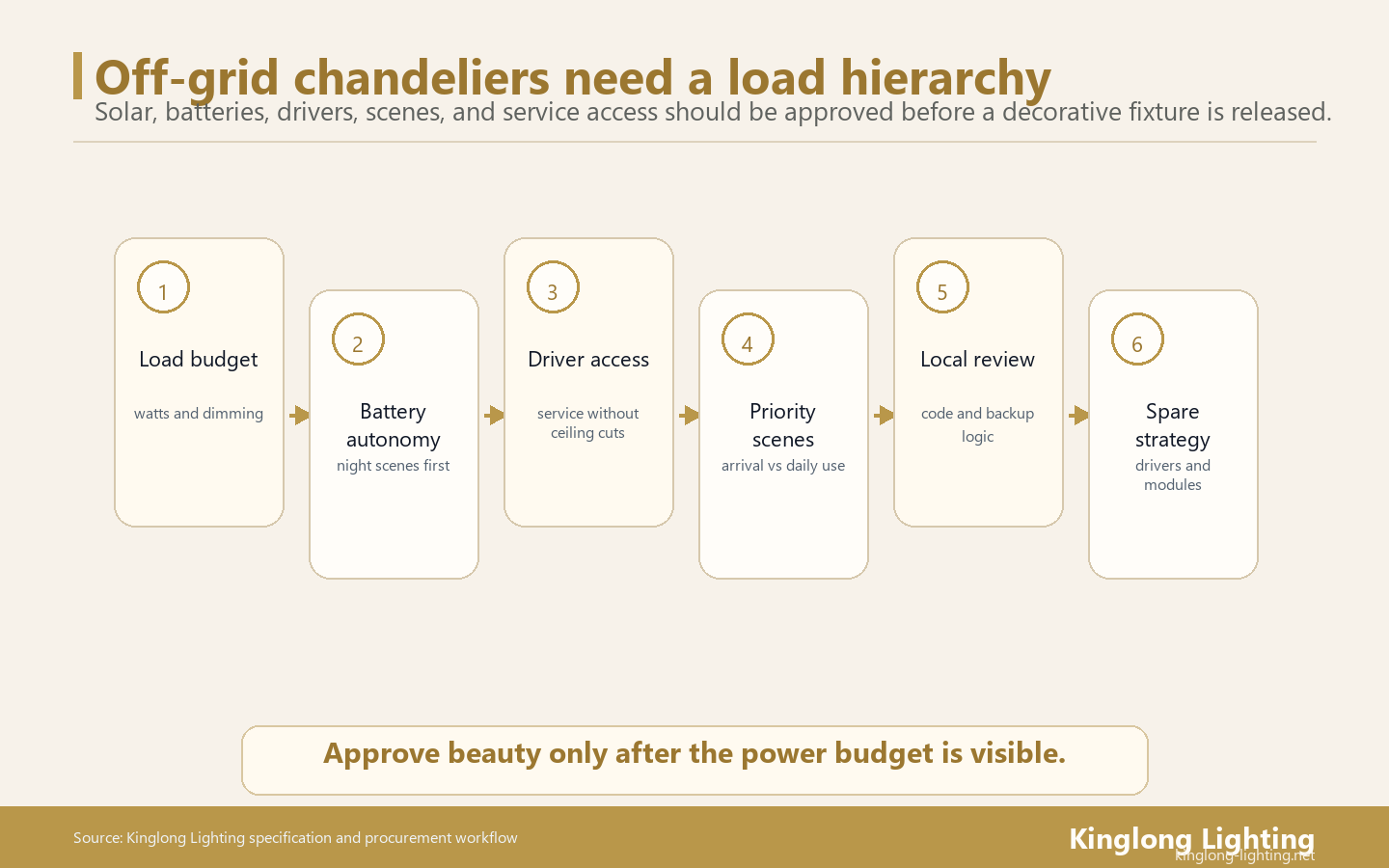
Start with the night-use load budget
Luxury villas use chandeliers when solar production is usually falling or gone. That makes evening load the first constraint.
The DOE energy storage page is useful because battery storage planning changes how loads, backup duration, and operating priorities are judged. For villa owners, designers, and electrical consultants planning an off-grid luxury residence, that turns the discussion into a solar-resource assumption and evening-load schedule instead of a preference argument.
Separate ceremonial load from daily load
Ceremonial lighting becomes important when the same chandelier is expected to serve arrivals, dinners, family evenings, and cleaning. The project team should not treat this as a late coordination detail, because the choice changes cost, sequence, drawing responsibility, and the evidence a buyer can reasonably approve. If the issue is left open, the supplier may quote an attractive fixture while the building team silently carries an unresolved constraint.
The practical answer is to name separate wattage and dimming targets for each scene before release. That proof gives the owner a decision rule: release the full-bright scene only if the battery model can support it without sacrificing daily comfort. It also keeps Kinglong Lighting’s role honest. The factory can provide drawings, samples, product information, packing logic, and manufacturing options, while local professionals still confirm the building, code, and site-specific safety requirements.
Model the fixture at realistic dimming levels
Dimming discipline becomes important when buyers compare catalog wattage but operate most luxury scenes at partial output. The project team should not treat this as a late coordination detail, because the choice changes cost, sequence, drawing responsibility, and the evidence a buyer can reasonably approve. If the issue is left open, the supplier may quote an attractive fixture while the building team silently carries an unresolved constraint.
The practical answer is to name driver data at low, normal, and full scenes before release. That proof gives the owner a decision rule: if 30 percent output delivers the desired atmosphere, the system should not be sized around constant spectacle. It also keeps Kinglong Lighting’s role honest. The factory can provide drawings, samples, product information, packing logic, and manufacturing options, while local professionals still confirm the building, code, and site-specific safety requirements.
Treat the battery as a design stakeholder
The battery is not a hidden technical room detail. It shapes how the chandelier behaves after sunset.
The DOE LED lighting page is useful because LED performance, efficiency, heat, and service expectations belong in the luminaire decision. For villa owners, designers, and electrical consultants planning an off-grid luxury residence, that turns the discussion into an autonomy target that connects backup hours to fixture scenes instead of a preference argument.
Define how many hours matter
Autonomy planning becomes important when the owner expects the villa to feel normal during a cloudy evening or backup event. The project team should not treat this as a late coordination detail, because the choice changes cost, sequence, drawing responsibility, and the evidence a buyer can reasonably approve. If the issue is left open, the supplier may quote an attractive fixture while the building team silently carries an unresolved constraint.
The practical answer is to name a scene-by-scene runtime target before release. That proof gives the owner a decision rule: a four-hour dinner scene may matter more than a one-hour maximum-output photo scene. It also keeps Kinglong Lighting’s role honest. The factory can provide drawings, samples, product information, packing logic, and manufacturing options, while local professionals still confirm the building, code, and site-specific safety requirements.
Protect low-power elegance
Low-power elegance becomes important when the room needs mood without burning through stored energy. The project team should not treat this as a late coordination detail, because the choice changes cost, sequence, drawing responsibility, and the evidence a buyer can reasonably approve. If the issue is left open, the supplier may quote an attractive fixture while the building team silently carries an unresolved constraint.
The practical answer is to name module grouping, warm dimming behavior, and independent decorative zones before release. That proof gives the owner a decision rule: approve a low-energy scene that still carries the room identity before adding dramatic load. It also keeps Kinglong Lighting’s role honest. The factory can provide drawings, samples, product information, packing logic, and manufacturing options, while local professionals still confirm the building, code, and site-specific safety requirements.
Driver placement decides service quality
Drivers, dimmers, heat, and access are where many off-grid lighting concepts become hard to own.
The NFPA 70 National Electrical Code page is useful because electrical installation decisions need qualified local code review. For villa owners, designers, and electrical consultants planning an off-grid luxury residence, that turns the discussion into driver location, heat notes, dimming protocol, and replacement access instead of a preference argument.
Do not seal drivers behind decorative confidence
Driver access becomes important when the ceiling design hides every service part to preserve a clean interior. The project team should not treat this as a late coordination detail, because the choice changes cost, sequence, drawing responsibility, and the evidence a buyer can reasonably approve. If the issue is left open, the supplier may quote an attractive fixture while the building team silently carries an unresolved constraint.
The practical answer is to name remote or accessible driver placement before release. That proof gives the owner a decision rule: hold production if a future driver replacement would require damaging the finished ceiling. It also keeps Kinglong Lighting’s role honest. The factory can provide drawings, samples, product information, packing logic, and manufacturing options, while local professionals still confirm the building, code, and site-specific safety requirements.
Coordinate controls before production
Control coordination becomes important when the solar system, battery system, wall control, and chandelier driver are selected by different teams. The project team should not treat this as a late coordination detail, because the choice changes cost, sequence, drawing responsibility, and the evidence a buyer can reasonably approve. If the issue is left open, the supplier may quote an attractive fixture while the building team silently carries an unresolved constraint.
The practical answer is to name a controls compatibility note and scene list before release. That proof gives the owner a decision rule: the fixture should not arrive with unknown dimming behavior that the electrician must solve under pressure. It also keeps Kinglong Lighting’s role honest. The factory can provide drawings, samples, product information, packing logic, and manufacturing options, while local professionals still confirm the building, code, and site-specific safety requirements.
Safety and luminaire evidence still apply
Off-grid status changes the supply context, but it does not make a decorative chandelier less of a luminaire.
The UL 1598 standard page is useful because decorative chandeliers remain luminaires that need product and installation evidence. For villa owners, designers, and electrical consultants planning an off-grid luxury residence, that turns the discussion into local electrical review and luminaire documentation instead of a preference argument.
Keep the local electrician in the decision loop
Local review becomes important when the villa uses a customized power system that may tempt the design team to improvise. The project team should not treat this as a late coordination detail, because the choice changes cost, sequence, drawing responsibility, and the evidence a buyer can reasonably approve. If the issue is left open, the supplier may quote an attractive fixture while the building team silently carries an unresolved constraint.
The practical answer is to name fixture electrical data, driver data, voltage assumptions, and local professional review before release. That proof gives the owner a decision rule: no final decorative approval should outrun the electrical answer. It also keeps Kinglong Lighting’s role honest. The factory can provide drawings, samples, product information, packing logic, and manufacturing options, while local professionals still confirm the building, code, and site-specific safety requirements.
Ask for product evidence with the same discipline
Product evidence becomes important when the owner sees an artisanal chandelier and forgets the technical file. The project team should not treat this as a late coordination detail, because the choice changes cost, sequence, drawing responsibility, and the evidence a buyer can reasonably approve. If the issue is left open, the supplier may quote an attractive fixture while the building team silently carries an unresolved constraint.
The practical answer is to name luminaire data, component notes, installation instructions, and market-specific evidence before release. That proof gives the owner a decision rule: treat the chandelier as both an architectural object and a product that must be installed and serviced. It also keeps Kinglong Lighting’s role honest. The factory can provide drawings, samples, product information, packing logic, and manufacturing options, while local professionals still confirm the building, code, and site-specific safety requirements.
Use scene hierarchy instead of blanket reduction
The answer is not always to make the chandelier small. It is to make the high-value scenes intelligent.
The DOE lighting design page is useful because lighting should be planned around whole-space quality, efficiency, and use rather than fixture appearance alone. For villa owners, designers, and electrical consultants planning an off-grid luxury residence, that turns the discussion into a room-based scene hierarchy and whole-space lighting plan instead of a preference argument.
Prioritize the moments guests remember
Scene hierarchy becomes important when all fixture zones are treated as equally important. The project team should not treat this as a late coordination detail, because the choice changes cost, sequence, drawing responsibility, and the evidence a buyer can reasonably approve. If the issue is left open, the supplier may quote an attractive fixture while the building team silently carries an unresolved constraint.
The practical answer is to name arrival, dining, relaxed evening, service, and backup scene priorities before release. That proof gives the owner a decision rule: spend energy where it changes the room and reduce it where other layers can carry the task. It also keeps Kinglong Lighting’s role honest. The factory can provide drawings, samples, product information, packing logic, and manufacturing options, while local professionals still confirm the building, code, and site-specific safety requirements.
Let the chandelier share work with the room
Layered design becomes important when the chandelier is asked to provide all atmosphere and visibility. The project team should not treat this as a late coordination detail, because the choice changes cost, sequence, drawing responsibility, and the evidence a buyer can reasonably approve. If the issue is left open, the supplier may quote an attractive fixture while the building team silently carries an unresolved constraint.
The practical answer is to name coordination with coves, wall lights, table light, and task light before release. That proof gives the owner a decision rule: a lower chandelier load can feel richer when surrounding layers do their work. It also keeps Kinglong Lighting’s role honest. The factory can provide drawings, samples, product information, packing logic, and manufacturing options, while local professionals still confirm the building, code, and site-specific safety requirements.
Off-grid chandelier release table
Use the table to decide which proof belongs before final fixture approval.
| Decision | Risk if vague | Proof to request | Release rule |
|---|---|---|---|
| Solar supply | oversized fixture fights generation reality | evening load schedule | approve only with energy model |
| Battery autonomy | beautiful scene shortens backup comfort | runtime target by scene | rank daily scenes first |
| Drivers | future service damages ceiling | accessible driver plan | hold if sealed |
| Controls | flicker or poor low-end dimming | protocol and scene test | test before production |
| Fixture zones | all zones draw power together | independent grouping | separate ceremony and daily use |
How Kinglong supports off-grid chandelier planning
Kinglong Lighting can translate an off-grid villa brief into a chandelier package that respects both the room and the power system. The useful factory output is not just a quotation. It is a set of module, driver, finish, scene, packing, and service decisions that the owner’s energy and electrical teams can review.
Kinglong Lighting can connect this work to the villa lighting project support and the custom chandelier workflow. The point is not to turn a technical article into a catalogue page. The point is to give villa owners, designers, and electrical consultants planning an off-grid luxury residence a practical next step when the project file already shows real risk.
When the issue reaches budget, sample, delivery, or site timing, the safer action is to send the off-grid chandelier brief with drawings, destination, room schedule, target finish, control expectation, and the proof items already requested in this article.
Soft next step before buying
Before selecting the final off-grid chandelier, prepare a small power-and-room file. It should make the decorative ambition visible to the energy team and the energy constraint visible to the lighting manufacturer.
- List evening scenes and desired brightness levels.
- Ask for estimated fixture wattage by zone.
- Confirm driver location and service access.
- Share battery autonomy targets with the lighting supplier.
- Hold final release until local electrical review is complete.
FAQ
Can an off-grid villa use a large chandelier?
Yes, but the fixture should be planned around load zones, dimming, battery autonomy, and driver access. A large chandelier can work when its daily scene is efficient and its full-output scene is treated as occasional, not constant.
Should the solar supplier size the chandelier?
The solar or energy team should model the load, but the lighting manufacturer must provide realistic wattage, driver, and scene information. The best decision comes from both teams reading the same room and power brief.
Is LED always enough to solve the power problem?
No. LED helps, but fixture size, driver losses, dimming behavior, runtime, and scene grouping still matter. A poorly zoned LED chandelier can still waste battery capacity or create service problems.
What should be sent before quotation?
Send room dimensions, ceiling drawings, target style, expected scenes, battery autonomy target, control system, destination market, and any local electrical constraints. That lets the supplier quote a buildable off-grid fixture rather than a decorative guess.