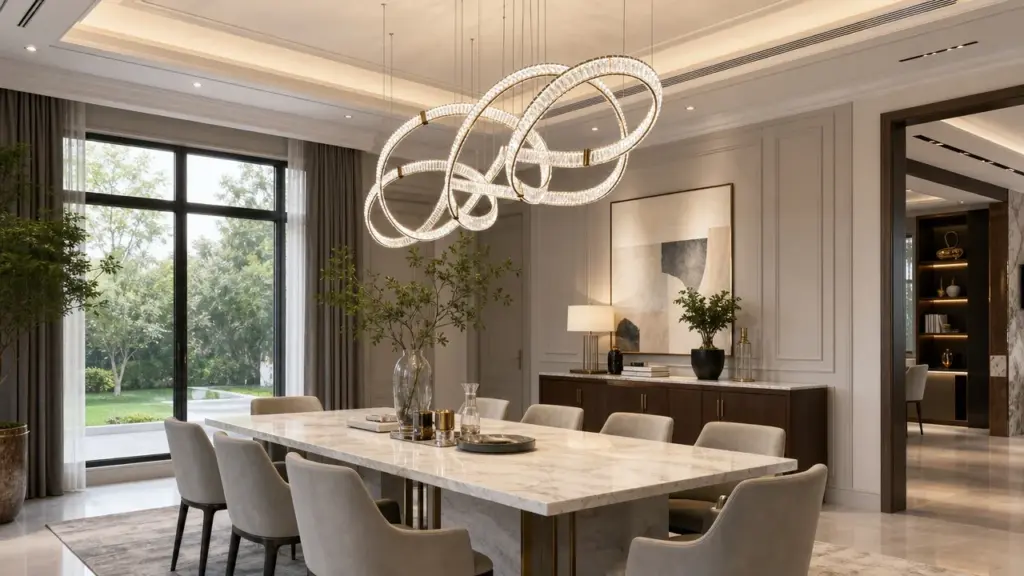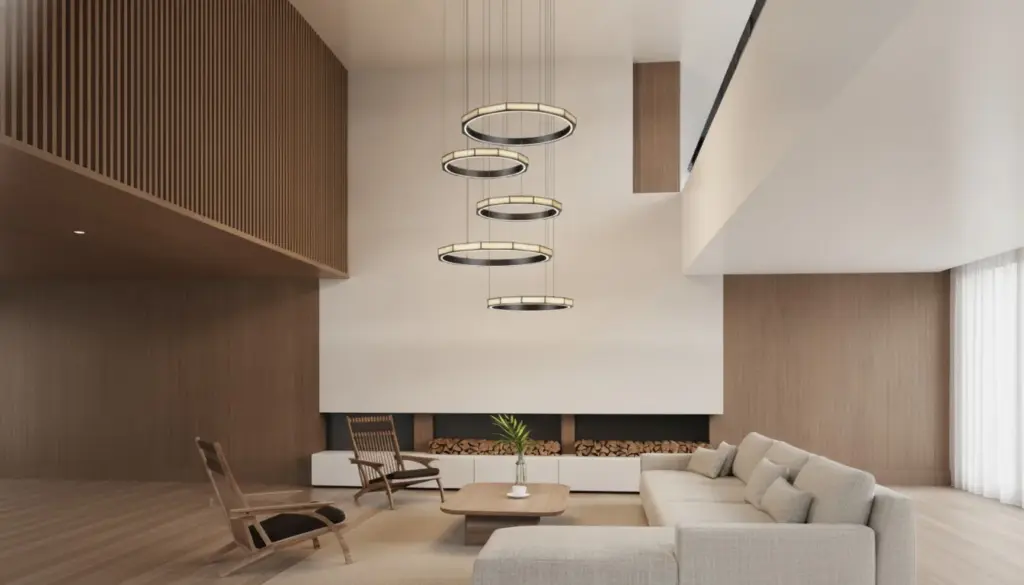
This North American penthouse chandelier renovation article is a composite case. It does not describe one named project. It combines recurring renovation problems: finished plaster ceilings, hidden structure, limited access, existing wiring, owner disruption limits, and a desire for a larger decorative chandelier without turning the residence into a construction site.
The existing-plaster reality changes the whole specification. In new construction, the team can coordinate ceiling support, driver location, wiring, access panels, and repair sequence before finishes close. In renovation, the ceiling is already part of the luxury interior. Every opening, anchor, dust event, and finish repair has a cost.
Kinglong Lighting can support penthouse renovation teams by turning the chandelier idea into a constraint file: what can be opened, what must be verified locally, what should be modular, where service should live, and what evidence is needed before production release.
Key Takeaways
- Composite case only: the article illustrates recurring renovation decisions without claiming a specific North American site.
- Existing plaster is a constraint: ceiling repair, dust, hidden structure, and owner disruption affect chandelier design.
- Survey comes before styling: weight, support, wiring, access, and route should be checked before final fixture geometry.
- Remote service can protect finishes: driver and control access should avoid unnecessary ceiling disturbance.
- Local professionals decide code and structure: the manufacturer supports evidence, but site-specific approval belongs to qualified local teams.
Composite renovation brief
In a penthouse renovation, the ceiling is not empty space. It is an existing condition with limits.
Imagine a North American penthouse with a finished plaster ceiling, concealed structure, existing recessed lighting, a central power point that may not align with the desired chandelier, tall glazing, limited elevator access, and an owner who wants minimal visible disruption. The design team wants a sculptural chandelier that feels lighter, larger, and more current than the previous fixture.
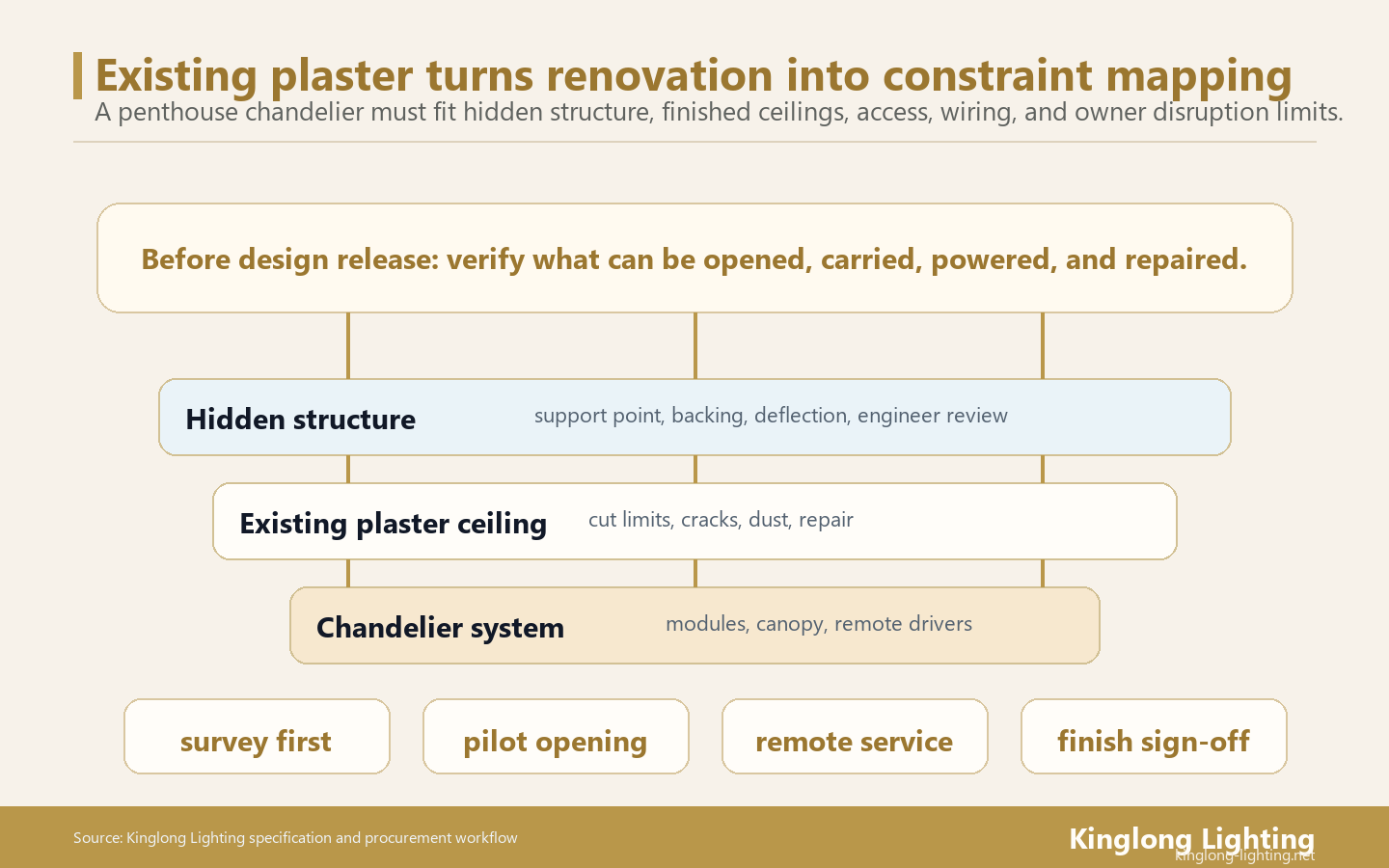
The first question is not style. It is disturbance. What can be opened? What cannot be touched? Where can dust be contained? Who verifies structure? Can drivers be located in an accessible service zone? Can modules reach the room through elevator, corridor, and door turns? These questions decide the chandelier long before the final silhouette is beautiful.
Survey before design release
A renovation survey should happen before the owner approves the chandelier shape. The survey does not need to answer every aesthetic question, but it should identify the ceiling’s known and unknown limits. If the chandelier is designed first and the ceiling is checked later, the team may have to shrink the fixture, add awkward canopy covers, or accept intrusive repair.
Hidden structure must be verified locally
The ASCE Hazard Tool is useful as a reminder that structural design depends on site-specific parameters and professional judgment. A decorative lighting manufacturer should not replace the local structural engineer. The manufacturer should provide weight, suspension points, canopy assumptions, and module information so the engineer can review the actual ceiling condition.
In a penthouse, hidden structure can be complicated by transfer slabs, mechanical systems, acoustic layers, sprinkler routes, and previous renovation work. The fixture may need a new support frame, a relocated support point, or a different module strategy. None of that should be discovered after production.
Existing wiring may not match the new chandelier
The NFPA 70 National Electrical Code page reinforces that electrical installations belong with code-aware professionals. For the chandelier team, the practical task is to provide clear load, driver, dimming, and connection information. The local electrician decides how the existing wiring and code requirements should be handled.
A renovation often has a power point in the wrong place, a dimmer that does not match new LED drivers, or an old control system with limited compatibility. The chandelier design should account for that early. Otherwise the owner may approve a fixture that requires ceiling cuts the project was trying to avoid.
Existing plaster changes canopy and service strategy
Plaster is unforgiving. A canopy that is too small may expose old repair marks. A canopy that is too large may look like a patch. A driver hidden above plaster may make future service destructive. A suspension layout that requires multiple new openings may create finish mismatch across the ceiling.
The EPA RRP work practices page is relevant for older North American renovation contexts because disturbing certain painted surfaces can require specific dust and debris controls. Not every penthouse has this issue, but the broader lesson is clear: existing finishes should be treated as a project risk, not as a blank background.
Remote drivers can reduce ceiling disturbance
Where the design allows it, remote driver locations can protect the finished ceiling. Instead of sealing every service item inside a decorative canopy, the team can place drivers in an accessible cabinet, service hatch, or mechanical zone, subject to code and product requirements. That makes future replacement less invasive and gives the owner a cleaner maintenance path.
The canopy should solve both structure and repair
A renovation canopy has two jobs. It must support or conceal the suspension interface, and it must make the ceiling finish look intentional. If the canopy is designed only as a decorative plate, it may fail to hide old openings or coordinate with reinforcement. If it is designed only as a repair cover, it may look heavy. The best canopy strategy starts with both engineering and finish repair in view.
Module size controls the installation day
A penthouse chandelier may be physically possible in the room but impossible in the route. Elevator height, freight access, corridor turns, door width, floor protection, unpacking area, and lift position all affect module design. The chandelier should be broken into modules that can travel and assemble without damaging finished interiors.
The OSHA aerial lift page is not a residential design checklist, but it is a useful reminder that elevated work requires planning and qualified operation. In a furnished penthouse, lift access is also an interior protection issue: floor load, stone protection, furniture removal, overhead clearance, and worker movement should be planned before shipment.
Large does not have to mean one-piece
A large chandelier can often be designed as a controlled module system. The visible result may feel continuous, while the production and installation plan uses branches, rings, strands, or subassemblies. Module strategy should be agreed before production because it affects seams, wiring, labels, packing, installation time, and future service.
Commissioning should include owner disruption checks
Commissioning is not only light on, light off. It should include dimming scenes, driver noise, glare from seating positions, reflection in glazing, fixture leveling, canopy finish, plaster repair quality, and whether the owner can live with the service plan. The renovation goal is not simply to hang a chandelier; it is to improve the room without creating a maintenance burden.
Destination-market product evidence still matters
The UL 1598 standard page is useful because a chandelier remains a luminaire even when it is custom and decorative. For a North American renovation, the project team should discuss product evidence, electrical components, driver selection, labels, local inspection expectations, and any required documentation before production.
Kinglong Lighting can provide manufacturing-side information, drawings, component notes, and production documentation for the custom chandelier renovation workflow. The local electrical and structural professionals should confirm what is acceptable for the actual building and jurisdiction.
Renovation decision log
| Renovation issue | What can go wrong | Proof to collect | Release decision |
|---|---|---|---|
| Hidden structure | support point cannot carry load | local engineer review plus fixture weight | release only after support path is clear |
| Existing plaster | opening or canopy creates visible repair | cut and repair boundary | adjust canopy or module plan |
| Wiring and controls | driver or dimming mismatch | load, driver, protocol notes | confirm with local electrician |
| Access route | module cannot reach room safely | elevator, corridor, lift, unpacking plan | resize modules before production |
| Service strategy | future repair requires ceiling damage | remote driver or access note | hold if service is hidden |
Three renovation paths
After the survey, the project usually falls into one of three paths. Naming the path helps the owner understand why the chandelier can remain ambitious, why it must change, or why ceiling work is unavoidable. The path should be chosen before production, because each path changes module design, canopy strategy, driver location, and installation cost.
Path 1: minimal disturbance
Minimal disturbance works when the existing support, wiring, canopy location, and access route can carry the new chandelier with limited change. The fixture may still need a custom canopy, modular assembly, and remote service planning, but the ceiling is not heavily opened. This path is attractive for occupied penthouses, but it only works when the survey confirms the assumptions.
Path 2: controlled opening
Controlled opening accepts that a small area of plaster must be opened to add support, relocate wiring, or create a service route. The design should then make that opening count. The canopy, support frame, access panel, and finish repair should be coordinated together so the result looks intentional rather than patched.
Path 3: redesign around constraints
Sometimes the ceiling, access route, or owner disruption limit makes the original chandelier concept impractical. Redesign does not mean failure. It may mean a lighter cluster, a wider but shallower fixture, smaller modules, a different suspension rhythm, or a design that uses multiple smaller points instead of one heavy central object. The owner still gets a premium room, but the design respects the building.
Owner approval packet
The owner should approve a renovation packet, not only a rendering. The packet should include the visual direction, ceiling survey assumptions, fixture weight, suspension concept, canopy approach, driver location, module size, route check, finish sample, plaster repair note, and commissioning checklist. If any item remains unknown, it should be marked as open with a responsible party.
This packet protects everyone. The owner sees what disruption may happen. The designer keeps the aesthetic promise realistic. The local engineer and electrician know what they are being asked to verify. The manufacturer can build around actual constraints. The installer receives a system instead of a collection of fragile parts and hopeful assumptions.
How Kinglong turns constraints into a chandelier brief
The Mofun Design Platform can help test scale and visual mass before the renovation team commits to ceiling disturbance. This is valuable because an owner may want a larger statement chandelier but still need a design that works with existing plaster and access limits.
The villa and penthouse decorative lighting support path should then connect design intent to evidence: module size, finish sample, driver location, canopy concept, suspension information, packing plan, installation sequence, and maintenance note. A renovation brief is successful when it respects the existing room as much as the new chandelier.
Soft next step for renovation teams
If your penthouse renovation involves existing plaster, hidden structure, or limited access, do not approve the chandelier shape from renderings alone. Prepare a constraint file with ceiling photos, drawings, power locations, owner disruption limits, elevator dimensions, finish repair concerns, and local professional contacts. Then send the renovation constraint file to Kinglong Lighting so the factory-side design can respond to the real ceiling before production begins.
FAQ
Is this a real North American penthouse project?
No, this is a composite case based on common penthouse chandelier renovation constraints. It does not identify a specific building, owner, or completed project. The goal is to show the decision structure needed when existing plaster and hidden structure affect the chandelier specification.
Can a chandelier be installed without opening plaster?
Sometimes a chandelier can be installed with minimal plaster opening, but only if support, wiring, canopy, and service access already work or can be solved through existing routes. A local engineer and electrician should verify the actual ceiling condition before the fixture is released.
Where should LED drivers go in a renovation?
LED drivers should be placed where they meet product and code requirements while remaining serviceable. In renovations, remote accessible locations can reduce ceiling disturbance, but the local electrical team must confirm wiring, ventilation, control compatibility, and inspection expectations.
What should the owner approve before production?
The owner should approve the visual direction, finish sample, canopy concept, module plan, service strategy, and known ceiling constraints before production. The local professionals should confirm support and electrical conditions. Production should not start while major plaster or structure assumptions remain unknown.