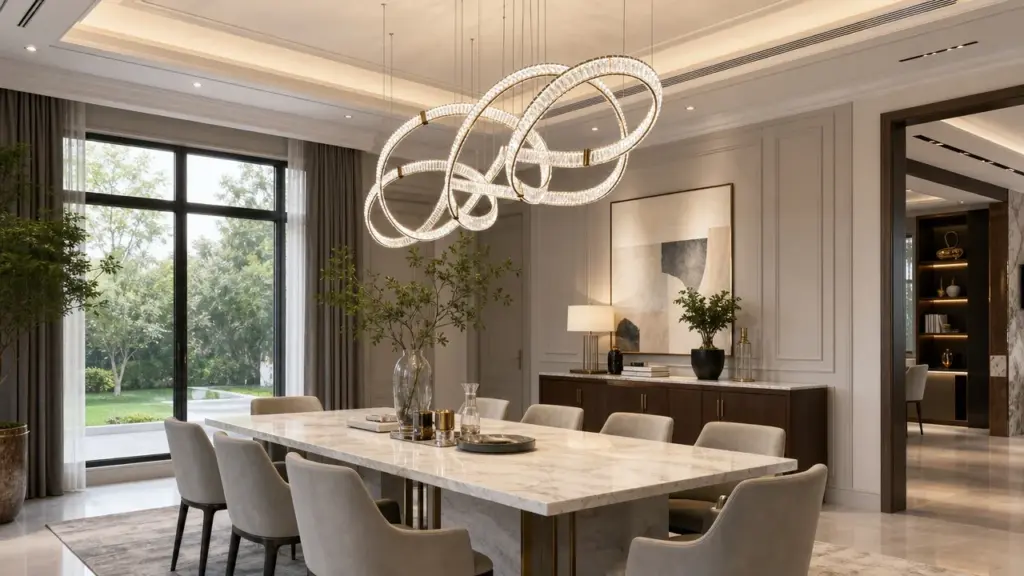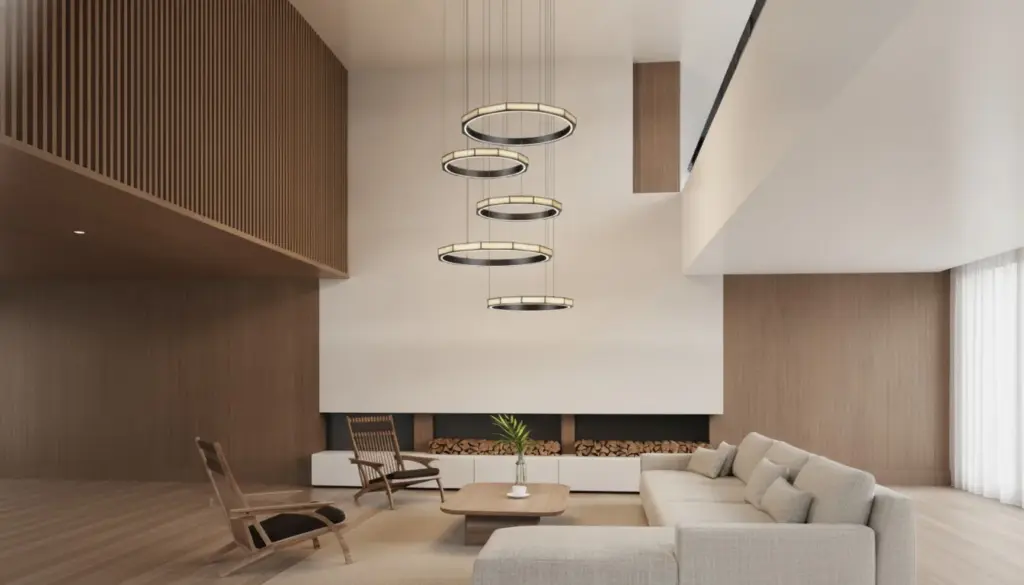
Mediterranean villa lighting is specified correctly when climate, surface warmth, color temperature, and material aging are treated as one decision, not four separate style preferences.
The common mistake is to copy a warm resort image and assume 2700K, brass, and textured plaster will automatically feel luxurious. In a real villa, strong daylight, stone floors, limewash walls, terrace doors, sea air, and evening scenes can make the same chandelier feel either calm or overly yellow.
Kinglong Lighting can help designers convert that climate-sensitive mood into samples, finish masters, dimming notes, and a custom release file before the chandelier body is produced.
Key Takeaways
- Climate first: Mediterranean rooms need daylight, heat, humidity, and sea-air exposure in the brief.
- CCT is not isolated: Warm light behaves differently on stone, plaster, timber, brass, and fabric.
- Glare hides in beauty: Polished floors, mirrors, and terrace glass can multiply chandelier sparkle.
- Materials must age well: Coastal villas need finish, cleaning, and corrosion notes before release.
- Proof beats mood boards: Samples should be reviewed under the room’s actual evening scene.
Start with climate before choosing fixture style
Mediterranean lighting is a climate decision before it is a decorative decision.
The IES Lighting Library is useful here because it treats lighting as an application-specific discipline. A Mediterranean villa is not only a residential room type; it is a strong daylight, reflective-surface, indoor-outdoor, sometimes coastal environment.
A chandelier that looks warm and elegant in a shaded showroom can look heavy in a white plaster room at noon, too yellow at dinner, or too glittering against a polished limestone floor. The brief should therefore name the room’s climate behavior before naming the fixture family.
The practical rule is simple: describe the light effect in the real villa, then select the chandelier material. If the team starts with style alone, the factory can satisfy the image while missing the environmental behavior that made the image desirable.
Sun-baked surfaces change how warm light reads
Mediterranean interiors often combine pale walls, stone floors, timber beams, bronze or brass details, and terrace openings. Those surfaces already carry warmth, contrast, and texture. A chandelier that adds too much amber can flatten the stone, make white plaster look tired, or reduce the crisp transition between daylight and evening. Color temperature should therefore be reviewed against actual finish samples, not chosen from a generic warm-white rule.
Indoor-outdoor movement changes glare tolerance
A villa with terrace doors, pool views, or open courtyards creates several viewing states. During arrival, the eye may adapt from bright outdoor light into a shaded interior. At night, terrace glass can reflect chandelier points back into the room. The lighting brief should mark where sparkle is welcome and where it becomes visual noise. This is especially important for crystal, polished metal, and high-output decorative lamps near glass or stone.
Release color temperature and material together
A Mediterranean chandelier should not be approved by CCT label alone. The same 2700K source can feel refined with pale stone, overly warm against terracotta, or flat beside yellow brass. The sample review should join lamp spectrum, dimming level, material tint, and nearby finishes.
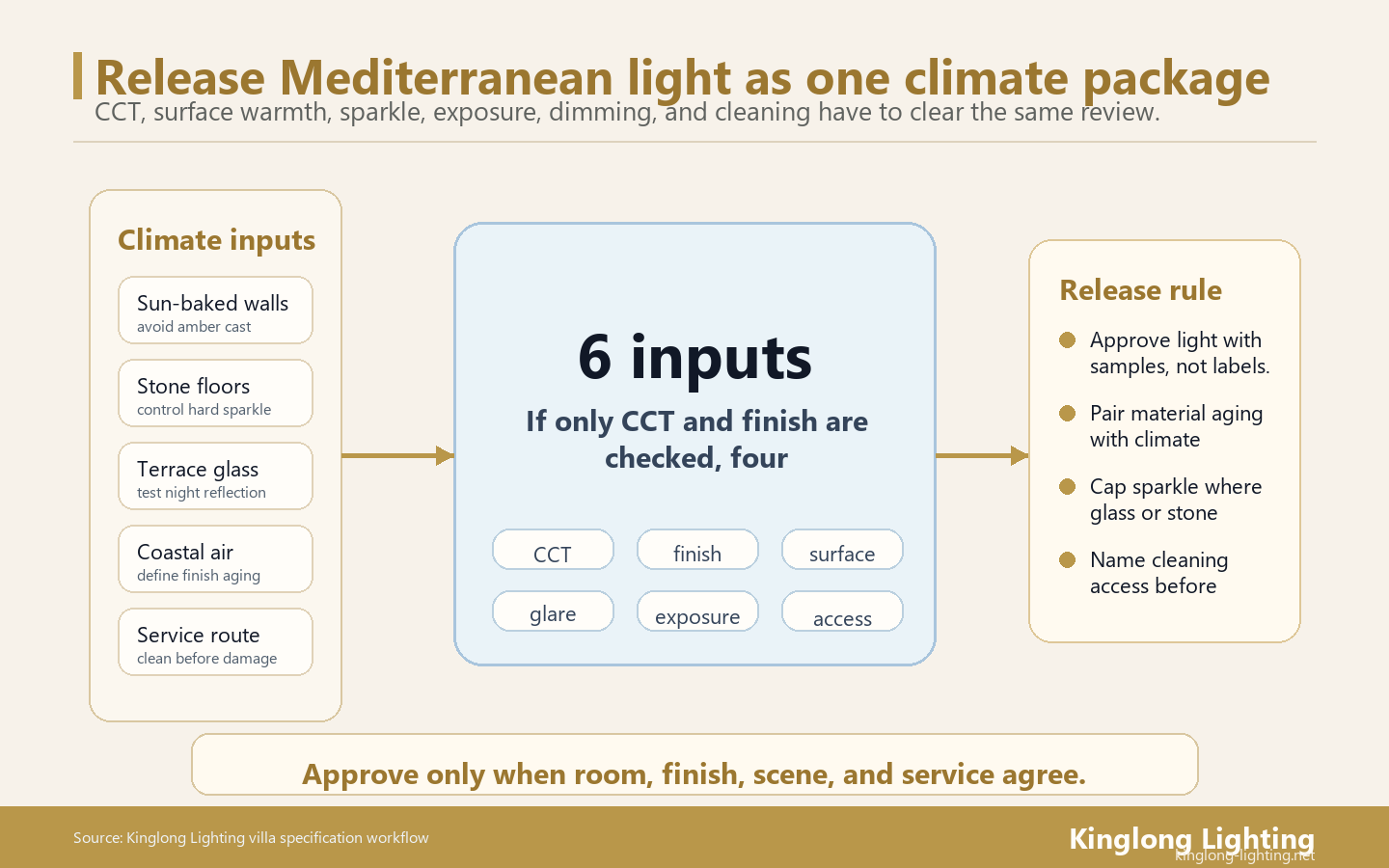
Use a six-input release model: 6 inputs minus 2 checked inputs equals 4 unresolved inputs, or roughly 67 percent of the environmental risk left outside the approval file. Climate, surface, CCT, material, dimming, and service exposure should all be visible before the chandelier is released.
| Design input | Mediterranean risk | Release evidence | Decision implication |
|---|---|---|---|
| Plaster and limewash | warm light can look dull | sample under dimmed scene | avoid CCT by label only |
| Stone or marble floor | sparkle can multiply | glare view from seated level | cap crystal density |
| Terrace glass | night reflections appear | evening reflection check | separate identity from glare |
| Bronze or brass finish | finish may age unevenly | finish master and cleaning note | approve patina boundary |
| Coastal exposure | salt and humidity accelerate wear | material and service note | write maintenance interval |
The DOE TM-30 FAQ and PNNL TM-30 guidance both support evaluating color quality beyond a single generic metric. For Mediterranean interiors, the point is not to chase a number; it is to make stone, plaster, timber, fabric, and skin tone read correctly under the approved scene.
The Lutron layered lighting guide also matters because the chandelier should not carry every layer. Ambient softness, task support, and accent focus can be assigned to other sources so the decorative chandelier stays warm without becoming the only working light.
Material selection must include exposure and service
The FEMA coastal corrosion guidance is written for coastal building materials, but the underlying reminder is relevant: salt spray, moisture, and wind-driven exposure can accelerate deterioration of metal components. A coastal Mediterranean villa should therefore treat finish durability as part of the chandelier specification.
The UL indoor and decorative lighting page reinforces the product side of the decision. Decorative luminaires still need product evidence, component planning, and appropriate market documentation; a beautiful finish does not replace electrical, suspension, or maintenance proof.
A Mediterranean brief should separate dry interior zones, semi-exposed terrace-adjacent rooms, and truly outdoor or damp areas. The chandelier may stay indoors, but sea air can still influence finish selection, cleaning frequency, driver access, and spare-part planning.
The release note should also say whether aging is a desired part of the atmosphere or a defect boundary. Hand-brushed brass, bronze, seeded glass, and textured metal can look better with gentle patina, but the owner should know where natural change ends and finish failure begins. That distinction helps the designer defend the mood while giving the factory a practical quality limit.
How Kinglong Lighting can make the style buildable
Kinglong Lighting’s villa lighting and customization workflow pages are directly relevant because Mediterranean projects often need custom finish, scale, and material proof rather than a stock catalog answer.
The next step is to send room photos, finish samples, terrace orientation, climate exposure, desired evening mood, and ceiling information through the project inquiry page. Ask Kinglong Lighting to review CCT, material, finish aging, glare, and cleaning access in one release note, not as isolated choices.
Write a Mediterranean finish and climate release sheet
The release sheet should turn Mediterranean atmosphere into checkable decisions. It does not need to make the design less romantic. It protects the romance by defining how warmth, texture, sparkle, and aging should behave after the fixture is manufactured and installed.
For designers, this sheet prevents late disputes over whether a finish is too yellow, a crystal cluster too bright, or a glass shade too cloudy. For Kinglong Lighting, it turns mood language into production boundaries that can be sampled, drawn, quoted, packed, installed, cleaned, and repeated.
Define the evening scene before approving CCT
The CCT decision should be made under the room’s actual evening behavior. A Mediterranean dining room may need a warm dimmed scene, while a vaulted living room may need a cleaner neutral warmth to prevent pale walls from turning beige. The release sheet should include target CCT range, dimming level, nearby finish samples, and a note about which other layers carry task or accent light.
Define the finish aging boundary before production
Bronze, brass, hand-finished metal, tinted glass, and textured surfaces can all age beautifully when the team agrees on the boundary. The problem appears when natural patina is confused with corrosion, staining, or batch inconsistency. The release sheet should distinguish acceptable aging from unacceptable finish failure, especially for villas near sea air or high humidity.
Define the sparkle cap around reflective surfaces
Sparkle should be treated as a controlled dose. A crystal or polished-metal chandelier may be appropriate in a stair or foyer, but the same density can become distracting beside terrace glass, mirrors, polished stone, or a night view. The release sheet should mark the viewpoints where sparkle is allowed, capped, or softened by diffuser, glass, spacing, or dimming.
Define the cleaning route while the room is still accessible
Mediterranean villas often use tall rooms, exposed beams, layered ceiling details, and hard finishes that make access planning visible. The cleaning route should be recorded before furniture and final finishes close the room. The note should include ladder or lift access assumptions, spare parts, cleaning materials, and which components can be removed without disturbing the decorative balance.
Use room-by-room climate tests before final quotation
Mediterranean villa lighting becomes more reliable when the same chandelier family is tested against different room climates. The foyer, dining room, lounge, bedroom, and terrace-adjacent spaces may share a design language, but they do not share the same surface reflectance, daylight behavior, or service exposure.
This is where the specification should move beyond a single mood board. A room-by-room test helps the designer decide where the chandelier can be warmer, where it should be cleaner, where sparkle should be reduced, and where a more serviceable material should replace a more delicate one.
Use a 3-scene check before release: daylight entry, evening at about 30 percent output, and cleaning at 100 percent output. If 2 of the 3 scenes show glare, color cast, or weak room identity, the chandelier needs a material, density, or control adjustment before quotation.
Test the foyer for daylight transition and first impression
A Mediterranean foyer often receives strong daylight through doors, arches, or upper windows. The chandelier should create arrival identity without looking dull during the day or overly yellow at night. The test should compare daylight entry, evening arrival, and cleaning output. If the fixture disappears by day, increase form or material rhythm. If it dominates at night, reduce sparkle, lower output, or move supporting light to wall or cove layers.
Test the dining room for food, faces, and finish warmth
Dining rooms expose color problems quickly because food, skin tone, timber, stone, table linen, and metal tableware all appear together. A warm chandelier that flatters plaster may make food look flat or brass look too orange. The test should use a dimmed evening scene, table-height viewpoint, and actual finish palette. The release decision should name CCT, dimming range, material tint, and whether other layers provide task clarity.
Test bedrooms for privacy instead of resort drama
Mediterranean bedrooms can easily become too theatrical when chandelier sparkle is copied from foyers or hospitality spaces. A bedroom test should start from bed height, mirror reflection, wardrobe color, and night movement. The chandelier may need softer glass, less exposed sparkle, and a lower output scene. The goal is to keep the material language consistent with the villa while protecting privacy and rest.
Test terrace-adjacent rooms for aging and cleaning access
Rooms beside terraces, courtyards, pools, or sea-facing openings deserve a harsher service assumption than sealed interior rooms. The test should identify whether salt, humidity, pollen, dust, or insects can reach the fixture, and how often the chandelier can be cleaned without damaging floors or furniture. This may change finish, fastener, glass density, or driver access even when the visual style remains Mediterranean.
Mediterranean release action card
- Review CCT beside real stone, plaster, timber, and metal samples.
- Mark reflective surfaces before choosing crystal density.
- Separate dry, terrace-adjacent, and coastal exposure zones.
- Approve finish aging boundary before production.
- Send climate, room photos, and finish palette with the inquiry.
Related Guides
- Complete Luxury Villa Chandelier Guide
- Hand-Blown Glass vs Crystal for Villas
- Smart Lighting for Luxury Chandeliers
Frequently Asked Questions
What color temperature works best for Mediterranean villa lighting?
A warm range around 2700K to 3000K often works, but the final choice should be checked against real stone, plaster, timber, fabric, and metal finishes. The right answer depends on surface warmth, dimming level, and the evening scene.
Are crystal chandeliers suitable for Mediterranean villas?
Crystal chandeliers can work in Mediterranean villas when sparkle is controlled around glass, mirrors, and polished stone. The design should cap glare and reflection instead of assuming more brilliance always feels more luxurious.
Should coastal Mediterranean villas use different chandelier materials?
Yes, coastal exposure should influence finish, fastener, coating, driver access, and cleaning strategy. Even indoor fixtures can face humidity and salt-laden air, so the release file should include a service and aging note.
What should I send Kinglong Lighting for this style?
Send room photos, ceiling height, finish samples, terrace orientation, desired CCT, material preference, control scenes, and any coastal exposure concerns. Those inputs help turn Mediterranean atmosphere into manufacturable proof.