
A hotel lighting supplier reference check should not ask whether a past project team liked the supplier. It should test whether that team saw the same risks still open in your package: approval ownership, late changes, controlled records, packing for site use, and issue closure. That shifts the conversation from a courtesy endorsement to a practical decision input.
Use one short risk brief, a consented contact, and twelve operational questions. The output is not a score for the supplier. It is a clear record of which risks the reference supports, which need current-project proof, and who owns the next action before award.
A Reference Call Is a Risk Test, Not a Satisfaction Survey
A reference check is a structured conversation with an authorized past-project contact about relevant work and outcomes. For a final candidate, begin with the current hotel lighting risk, then ask for a comparable past event and the person or record that can make the answer reviewable. A favorable answer that still needs one named record, owner, or follow-up before it can support the award decision is conditional evidence. General satisfaction has no scope match; an answer without a current-risk link should remain conditional rather than receive full shortlist credit.
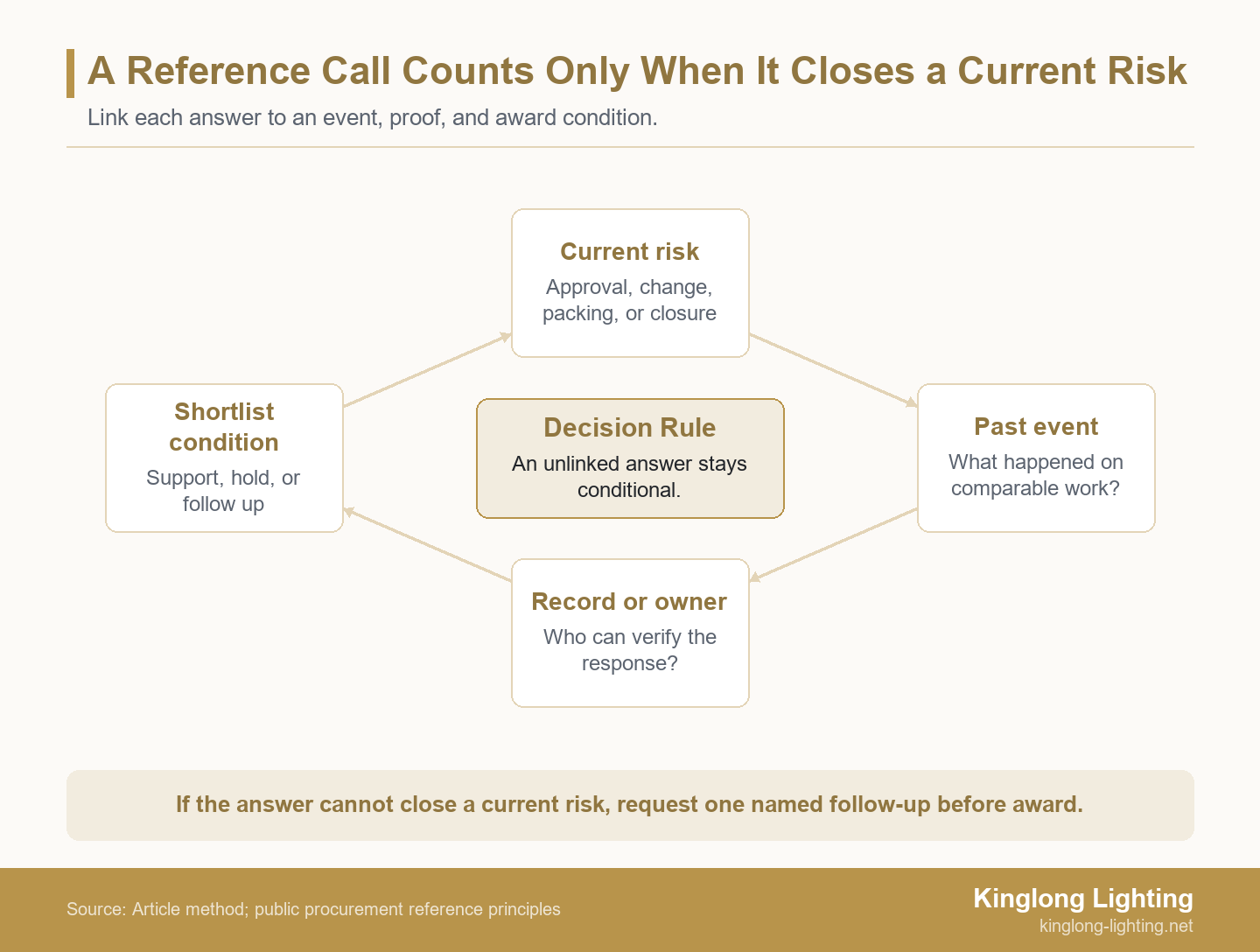
- Prepare: name the room area, fixture family, live risk, and decision the call must inform.
- Listen for: one event, one response path, and one owner or record—not a broad claim that the supplier was “good.”
- Decide: mark the risk supported, conditional, or open, then state the specific follow-up before award.
Set Up the Call Before You Ask the 12 Questions
Preparation is what makes the reference proportionate. First define the risk; then choose the contact who can speak to it. A public project page cannot replace a past team’s direct account of approvals, changes, or closeout, even when a buyer can review available public project information.
First, send the current-project risk brief
Keep the brief to one screen. State the package context, the comparable element, and the decision you need to make. For example: “Guestroom and corridor decorative fixtures; a late finish adjustment remains possible; we need to understand how the past team received, recorded, and released an equivalent change.” U.S. federal source-selection guidance considers relevance, source, context, trends, and corrective actions when evaluating past performance. That is a useful reference principle, not a private-hotel rule: the more precisely you define the current risk, the less likely the call will drift into vague praise.
Include only the facts needed to establish scope match: room or public area, fixture type, whether the package was standard or custom, the approval point at risk, and the expected decision. Do not send the full quotation or ask the contact to disclose confidential specifications. The objective is to ask a fair question that a past team can answer from experience.
Then confirm a consented, scope-matched contact
Ask the supplier for a contact who was close enough to the relevant work to describe what occurred, not simply someone able to repeat a company endorsement. Confirm that the contact has agreed to speak, what may be recorded, and whether the buyer may quote the answer internally. UK public guidance on references emphasizes contract-specific, authorized, record-backed accounts with a written call record. In a private hotel project, use that as a sensible discipline: record the contact’s role, the comparable scope, the date of the call, and the limits of what they could confirm.
If a supplier cannot share a customer contact, do not force the issue. Narrow the credit you give that reference and ask for another permitted proof route, such as a defined project role, a non-confidential drawing reference, or current-project process evidence. Confidentiality is a boundary on evidence, not proof of either good or bad performance.
Questions 1–3: Approval and Scope
Start with the approval path because it establishes what the supplier was actually responsible for. Public procurement guidance treats past-performance information as more than a project association; it can include conformance, schedule, and reasonable, cooperative conduct. For a hotel reference call, that means asking how scope and decisions moved, rather than whether the room looked successful at handover.
When reviewing Kinglong Lighting, use the same distinction you would use for any final candidate: public project material can provide context, while a scope-matched past team account must establish what happened during the comparable part of the work.
- Question 1: What lighting scope did the supplier actually own? Ask for room areas, fixture families, and the supplier’s role in plain language. Listen for a boundary: supplied decorative pendants, coordinated an approval pack, supported installation queries, or another defined contribution. A named hotel alone is not a comparable scope.
- Question 2: Which approval steps involved the supplier? Ask whether the past team worked through drawings, samples, finish approvals, mock-ups, or technical clarifications, and which of those are comparable to your live package. The useful answer names an approval event and who accepted it.
- Question 3: When an approval decision was delayed or challenged, what did the supplier do next? Ask for the response route, not a promise of speed. Did the supplier clarify the question, identify the affected fixtures, and provide a revised item for review? If your package has a similar hospitality application, use it to review the hospitality lighting application context before deciding whether the past approval path is truly comparable.
The second and third questions are deliberately event-based. FAR guidance also directs evaluators to consider context, trends, problems, and corrective actions. Your interview does not need federal-procurement formality, but it should distinguish a single smooth approval from a supplier’s behavior when the project needed a decision under pressure.
Questions 4–6: Changes and Controlled Records
Late changes are where a friendly reference can become misleading. A contact may remember that the supplier “handled it well” without knowing whether the affected fixtures, drawings, finishes, cartons, and replacements were kept aligned. FAR procedures state that performance evaluations should be clear, relevant, accurate, and based on objective facts supported by records. For the call, that principle means asking for a traceable story, not requesting confidential files.
- Question 4: What was the first material change after an approval? Ask the contact to describe one change in finish, dimensions, wiring, quantity, room allocation, or fixture detail. The specific trigger matters because it shows what the supplier had to control.
- Question 5: How did the team know which instruction was current? Listen for an observable method: a dated drawing issue, a revision list, a written confirmation, or a responsible person who checked the change. “Everyone knew” is not a control you can carry into your own project.
- Question 6: What happened to fixtures or materials already affected by the change? Ask whether the supplier identified the affected scope, separated old and current instructions, and explained the recovery path. If the contact only knows that a replacement arrived, mark the response as useful but incomplete until the current project has its own change-control route.
The key boundary is simple: a past change can inform confidence, but it cannot prove that your current finish, drawing, or wiring change will be controlled. Use the answer to name the current record you need before award, such as a revision log or a defined approval owner.
Questions 7–9: Packing and Site Handoff
A good historical reference does not replace current operational-readiness checks. FAR responsibility standards list a satisfactory performance record separately from present organization, experience, operational controls, and technical skills. Apply that separation to the call: ask what worked on the past site, then ask the supplier how the current packing and handoff plan will show the same control.
- Question 7: How did the packing match the site sequence? Ask about room labels, zone labels, carton marks, fragile parts, or a sequence that helped the receiving team. The answer should reveal whether the contact could identify what arrived where, not merely that the packaging looked professional.
- Question 8: What happened when something arrived damaged, incomplete, or hard to identify? Ask for one example and the first response. Did the team have a record of the affected item, a visible owner, and a replacement or clarification path? This exposes whether the supplier’s support reached the people unpacking the fixtures.
- Question 9: What handoff information helped installation or maintenance? Listen for fixture identification, spare-part handling, assembly information, or a person who could answer a site question. For a custom package, first organize the fixture and finish inputs for a customization discussion so you can test the same details in the current handoff plan.
Do not turn a reference call into a packaging inspection. Its value is diagnostic: it tells you whether current labels, spare handling, and site contacts deserve a defined pre-award check.
Questions 10–12: Issue Closure and Repeatability
The last questions test recovery without demanding that the contact name every problem. UK guidance on supplier past performance treats it as an input to assessing reliability. For a hotel owner representative, reliability is more useful when it describes one issue, who carried it, and what would need to be true to use the supplier again.
- Question 10: What was the most important issue that needed closure? Ask for the scope, when it appeared, and why it mattered to the project team. A small but concrete example is more valuable than an answer that nothing ever went wrong.
- Question 11: How was the issue closed? Ask who responded, what they did, and how the past team knew the matter was finished. You are testing ownership and a checkable outcome, not assigning blame to the supplier or the reference.
- Question 12: Would you use this supplier again for a comparable package, and under what conditions? Ask the contact to name the conditions: a similar scope, earlier approvals, clearer site access, a defined contact, or another real constraint. A conditional “yes” often teaches more than an unconditional recommendation.
Record the limitation as carefully as the praise. A reference from a simpler project may still support a narrow point, such as carton identification or change response, while leaving your broader hotel-package risk open.
When a Positive Reference Still Leaves a Hold Condition
Hold the candidate only on the record that matters
Consider this composite example. A hotel owner representative and FFE lead are deciding whether to keep one decorative-lighting supplier as a final candidate. The illustrative renovation includes 6 fixture families across 96 guest rooms and public corridors, with a finish adjustment still possible before release. The supplier provides a consented contact from a prior hospitality renovation with a similar mix of decorative fixtures.
The past project team describes prompt replies when a late finish adjustment appeared. The contact recalls useful carton labels and a quick replacement response for damaged shades. Neither the contact nor the supplier can identify a dated revision record or a written closeout record for that event. The first two answers support responsiveness and site awareness, but the missing records limit how much decision weight they can carry.
The reference therefore supports response behavior, not the record chain needed for the new project. The buyer cannot tell whether the prior finish change was controlled from approval through the affected cartons and replacement, or whether the outcome depended on informal coordination. The fair decision is not to reject the supplier or request a second generic endorsement. Keep the candidate conditionally shortlisted while the current-project control remains open.
Ask for a current-project revision log, a sample packing-label convention, and the person who owns issue closure before the award meeting. That is a narrow, proportionate hold condition: it asks the supplier to show how the live package will be controlled, rather than to disclose the past customer’s files. It also gives the award team a specific date, owner, and evidence request rather than an open-ended request for reassurance. Move the risk from conditional to supported only when the record, owner, and response route are clear. This is a composite illustration, not a Kinglong Lighting customer case or a claim about a named hotel.
Turn the Call Into a Shortlist Decision Record
End the call by translating each answer into a project decision. The status is not a supplier grade. It tells the award team whether the reference has resolved a live risk, whether a limited follow-up is needed, or whether the point should not affect the shortlist at all.
| Current risk | What the reference established | Current proof or owner needed | Shortlist status |
|---|---|---|---|
| Finish change after approval | Past team recalls a prompt response | Revision log and approval owner | Conditional |
| Room-by-room delivery | Past labels helped receiving staff | Current carton-label sample and site contact | Conditional or supported |
| Damaged decorative part | Past team received a replacement | Current spare and issue-closure route | Conditional |
For Kinglong Lighting, or any supplier under review, bring this record together with the fixture schedule, room-use context, and the one question the reference could not answer. The buyer still owns technical approval, commercial terms, and the final award decision. For a scoped conversation about the brief and the open question, request a scoped discussion around the fixture brief and open questions.
Frequently Asked Questions
How many references should a hotel lighting buyer check?
Start with one scope-matched reference for a final candidate, then add another only if a decision-critical risk remains unresolved. One focused call can be stronger than several generic endorsements when it covers the approval, change, packing, or closure condition that matters to the current package. Add a second contact when the first person did not own the relevant phase or could not discuss it within the confidentiality boundary.
May a supplier refuse to share a past customer contact?
Yes; a supplier may be unable to share a contact, and that limitation should narrow the evidence credit rather than automatically disqualify the candidate. Ask what the supplier is permitted to provide instead, such as a defined role, a non-confidential project identifier, or current-project records. Do not treat a confidentiality boundary as a reason to invent certainty on either side.
What if the reference project is not a hotel?
A non-hotel reference can still help if the contact can speak to the same approval, change, packing, or closeout risk in a comparable package. A retail or residential project may offer useful evidence about a custom finish change or fragile-part replacement, for example. Record the narrower relevance and avoid treating it as proof of hotel-specific room sequencing or stakeholder approvals.
Should a reference call decide the supplier award?
No; the call should confirm or challenge defined delivery risks, while commercial, technical, approval, and contract decisions remain separate. Its strongest role is to show whether a supplier’s claimed experience can be connected to a current control and accountable owner. If the call is positive but incomplete, use a conditional evidence status and request the exact follow-up that would close the remaining risk.