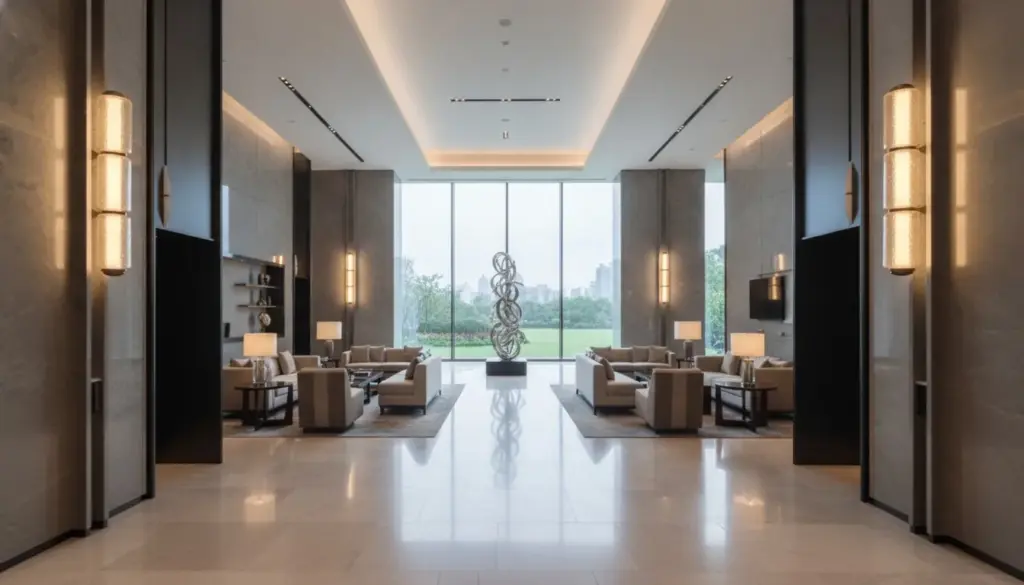
Hotel lighting terms are useful only when specifiers tie each word to a decision because vague vocabulary turns fixture selection into supplier interpretation. A word such as “warm,” “premium,” “dimmable,” or “crystal” sounds harmless until procurement, engineering, and manufacturing each translate it differently. The result can be a chandelier that matches the mood board but misses the control system, energy model, maintenance plan, or guest comfort target.
The practical value of a hotel lighting glossary is not memorization. It is decision discipline. Each term should answer three questions: what does the word mean, what does the specifier need to ask for, and what evidence proves the supplier understood it. For decorative hospitality lighting, that evidence may be a photometric file, a material sample, a control protocol, a drawing revision, a driver specification, a finish master, or a mock-up photo.
Key Takeaways
- Vocabulary risk: Undefined lighting terms create hidden decisions for suppliers and installers.
- 25 core terms: The useful terms fall into four groups: light quality, comfort, controls, and manufacturing release.
- Evidence rule: Every important term should connect to a measurable value, sample, drawing, or test record.
- Hotel relevance: Five-star spaces need emotional atmosphere, but approvals still depend on precise technical language.
- Kinglong usage: Use the glossary when briefing Kinglong Lighting on custom chandeliers, lobby features, ballroom lighting, and guestroom decorative fixtures.
Light quality terms that shape how materials look
The color of a chandelier is not only a finish decision; it is a light-source decision, a material decision, and a scene-setting decision.
Official vocabulary matters. The CIE International Lighting Vocabulary exists because lighting terms need shared definitions across countries and professional disciplines. For hotel specifiers, the so what is direct: a supplier cannot prove “warm luxury ambience” unless the specification names the values and references that make the phrase buildable.
Terms 1-7: Color and output
| Term | Decision meaning | Specifier question |
|---|---|---|
| CCT | Correlated color temperature, usually shown in kelvin | Should this lobby read 2700 K, 3000 K, or another target under final finishes? |
| CRI | A familiar color rendering metric | Is CRI enough for this material palette, or should additional color data be reviewed? |
| TM-30 | A richer color rendition method with fidelity and gamut information | Can the supplier provide color data that supports stone, brass, fabric, and food appearance? |
| Luminous flux | Total visible light output, usually in lumens | Does the chandelier provide ambient contribution or mostly sparkle? |
| Luminous intensity | Light in a direction, often relevant to sparkle and beam effect | Will guests see brilliance or uncomfortable points from key viewing angles? |
| Illuminance | Light arriving on a surface, often measured in lux | What illuminance should the reception desk, table, or circulation path receive? |
| Luminance | Brightness as perceived from a surface or source direction | Will the chandelier feel luminous without becoming a glare source? |
The DOE TM-30 FAQ helps frame this because color rendition can be discussed through multiple metrics, not only a single legacy shorthand. Based on our analysis, the practical decision is to ask for at least 3 color records on high-value hotel mock-ups: CCT target, color rendition evidence, and an approved material photo under the proposed light source. That combination gives the designer a visual decision and gives the supplier a production reference.
Comfort terms that protect guest experience
Five-star hotel lighting is judged by how guests feel before they understand why. A chandelier may be technically compliant yet still create eye fatigue, reflected glare, or a cold impression in a warm material palette. The WELL v2 Light concept emphasizes visual comfort and the human experience of light, which makes these comfort terms worth defining early.
Terms 8-13: Comfort and atmosphere
| Term | Decision meaning | Evidence to request |
|---|---|---|
| Glare | Visual discomfort or reduced visibility from brightness contrast | Viewing-angle photos and dimming scene checks |
| Sparkle | Controlled point brilliance from crystal, glass, or metal | Mock-up video and close-range material review |
| Uniformity | How evenly light is distributed across a surface or zone | Lighting layout and measured or calculated values |
| Layering | Use of ambient, accent, decorative, and task light together | Scene schedule and fixture responsibility map |
| Scene | A programmed lighting state for time, event, or mood | Control schedule with levels and fixture groups |
| Visual hierarchy | What the guest notices first, second, and third | Rendered views and on-site mock-up comments |
The hidden cost is that comfort language becomes subjective when it is not tied to a viewing position. “No glare” means little until the team names the reception approach, seated lounge view, balcony view, elevator arrival, and photography angle. In practice, the best glossary entry is a question: from where should this term be judged?
Control and energy terms that affect operation
Decorative lighting decisions can fail at the control layer. A chandelier may pass the sample review but flicker in the final dimming range, split into the wrong circuit group, or conflict with the building energy plan. The ANSI/ASHRAE/IES Standard 90.1 page is a reminder that lighting is part of a building energy and controls system, not just a fixture schedule.
Terms 14-19: Controls and integration
| Term | Decision meaning | Approval risk |
|---|---|---|
| Dimming curve | How output changes as the control level changes | Visible jumps, low-end flicker, or poor mood transition |
| Driver | Electronic device powering LED modules | Noise, heat, service access, or compatibility failure |
| Channel | A controlled group of light sources | Wrong grouping limits scene flexibility |
| DALI | Digital addressable lighting control ecosystem | Protocol assumptions need confirmation with the control vendor |
| Emergency lighting interface | How decorative lighting relates to life-safety lighting | Decorative fixtures may be wrongly expected to solve emergency requirements |
| Standby load | Power used when controls or drivers are not actively lighting | Energy model and owner operation cost can be affected |
The DALI Alliance is a useful reference point for digital control language, but the project still needs a local control narrative. Calculated from a simple 6-zone lobby scene: 1 wrong channel / 6 zones = 16.7 percent of the scene map affected, and the impact can touch every scene that uses that zone. The decision rule is to approve channeling and dimming behavior during mock-up, not after the ceiling is closed.
Manufacturing terms that decide whether the chandelier can be built
Manufacturing language is where decorative intent becomes a purchase order. The supplier needs to know what is locked, what can vary, and what must be tested. Official references such as UL luminaire testing and certification, the IEC 60598 luminaire standard family, and the Zhaga Consortium show why component, interface, and safety language cannot be left vague.
Terms 20-25: Production and release
| Term | Decision meaning | Supplier evidence |
|---|---|---|
| BOM | Bill of materials for the approved fixture version | Versioned material list with driver, module, finish, and crystal details |
| Finish master | Approved physical reference for color and texture | Signed sample, photo record, and batch control note |
| Shop drawing | Manufacturing and installation drawing | Dimensioned drawing with ceiling interface and fixing detail |
| Mock-up | Sample used to approve appearance and build logic | Version record, photos, test notes, and open comments |
| Lot traceability | Link from approved sample to production batch | Lot record, inspection note, and packing list |
| Value engineering | Cost or schedule optimization without losing design intent | Written trade-off showing what changes and what remains protected |
This vocabulary is especially important for custom work. If a hotel team says “value-engineer the chandelier,” the factory needs to know whether it can change crystal count, metal thickness, module type, finish process, suspension method, packing, or installation labor. Without that boundary, value engineering can become design erosion.
Use the glossary in Kinglong project briefs
Kinglong Lighting should receive glossary terms as requirements, not decoration. For a lobby chandelier brief, combine design words with measurable requirements: CCT target, color evidence, finish master, dimming protocol, driver location, mock-up scope, installation method, and lot traceability. The customization process can then convert vocabulary into drawings, samples, and production release details.
The soft next step is to send Kinglong Lighting a short glossary-based brief through the project inquiry page. List the 8 to 12 terms that matter most for the space, state the evidence expected for each term, and flag which decisions belong to the designer, MEP consultant, control vendor, contractor, and factory. That turns language into responsibility.
Related Guides
- Hotel Lobby Color Temperature Standards
- Ballroom Lighting Layered Design
- Hotel Chandelier Mock-Up Approval
Lighting Terms Action Card
- Group glossary terms by light quality, comfort, controls, and manufacturing release.
- Attach a value, sample, drawing, or test record to every high-risk term.
- Review color terms under the final material palette, not only under showroom light.
- Confirm dimming protocol, driver location, and channel grouping before ceiling closure.
- Send the glossary-based brief to Kinglong Lighting for fixture-specific review.
A hotel lighting glossary should turn vocabulary into decisions
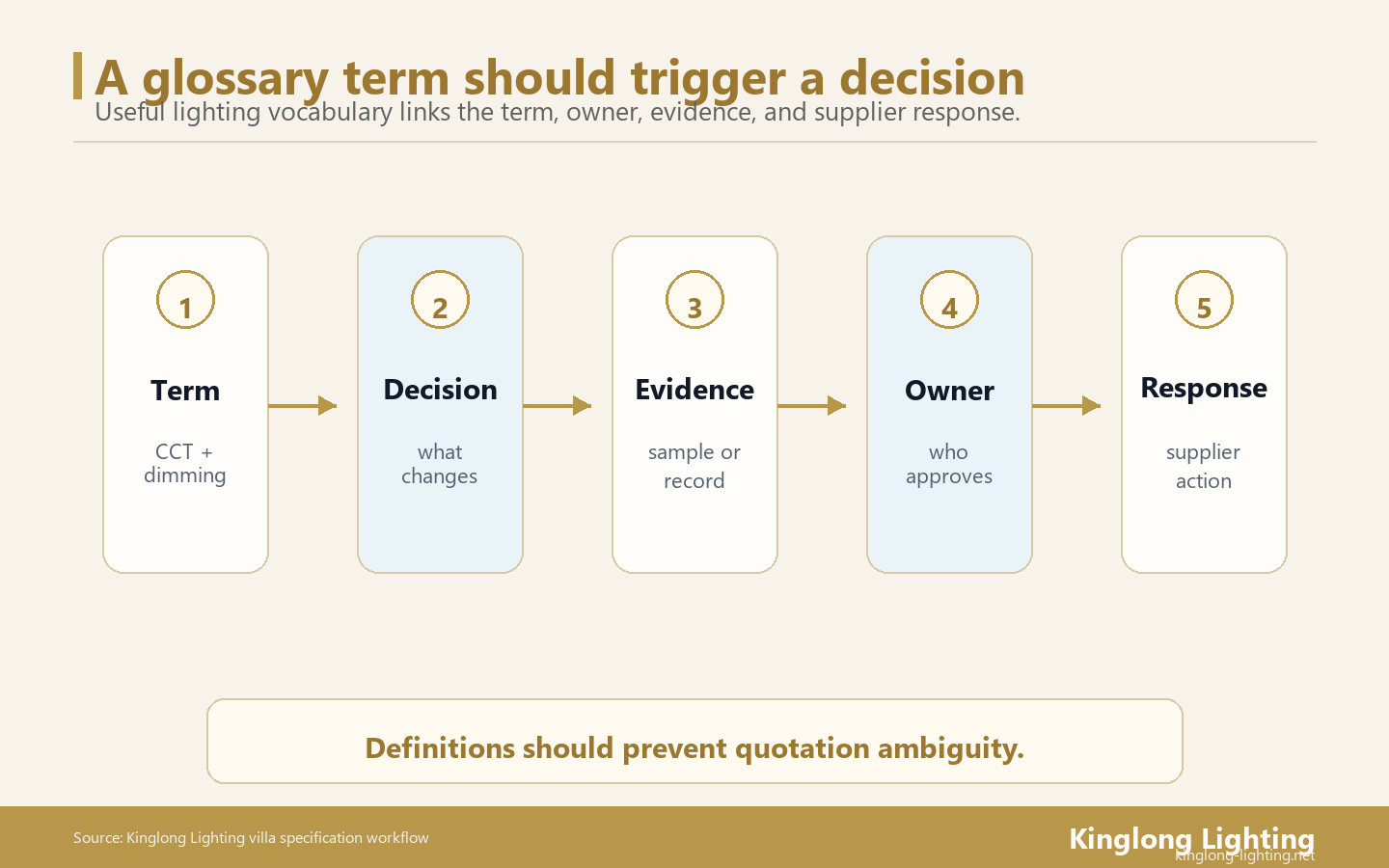
A glossary is useful only when it changes how the project team asks questions. Terms such as CCT, CRI, TM-30, luminance, glare, dimming curve, channel, BOM, finish master, shop drawing, and value engineering can all sound familiar while different teams mean different things. The glossary should therefore connect each term to an owner, a decision, evidence, and a supplier response. That makes language practical for procurement instead of merely educational.
Turn glossary terms into procurement questions
Every term should generate a question. If the term is CCT, the question is which target and tolerance apply to this room and material palette. If the term is dimming curve, the question is how the chandelier behaves at the low end of the scene. If the term is finish master, the question is which physical sample controls production. If the term is BOM, the question is whether the approved version matches the quoted and manufactured version. The glossary becomes valuable when it pushes the team to ask for proof.
Mark which terms need evidence, not explanation
Some terms need a definition; others need evidence. A buyer may need a plain explanation of luminance or channel, but a project cannot approve a chandelier with definitions alone. CCT needs a target record. A finish master needs a signed sample. A shop drawing needs revision control. Lot traceability needs a record. Value engineering needs a written trade-off. This distinction prevents technical language from becoming a polite substitute for missing proof.
Use definitions to prevent quotation ambiguity
Quotation ambiguity often starts with loose words. If the team asks to value-engineer, the supplier needs to know what can change: crystal count, metal thickness, driver brand, module type, packing, installation labor, or finish process. If the team asks for warm white, the supplier needs the target range and material context. If the team asks for a mock-up, the supplier needs to know whether it approves appearance, construction, controls, or all three. A glossary decision map closes those gaps before pricing becomes misleading.
Keep technical language tied to buyer decisions
The final glossary should be embedded in Kinglong project briefs as a small decision map. Each term should have a project definition, evidence request, decision impact, and supplier response field. That way, the hotel owner, designer, purchasing team, site contractor, and manufacturer can use the same vocabulary when reviewing drawings, samples, controls, and production release.
The best glossary does not make the article sound more technical. It makes the next project easier to approve because everyone knows which words require proof.
For a supplier brief, the glossary should be compact enough to use during quotation. A practical version can live beside the fixture schedule, with one row for the term, one for the project meaning, one for the required evidence, and one for the person who accepts it. That format turns terminology into a working checklist.
The same glossary should travel into installation discussions. Words such as access, suspension, aiming, dimming, replacement, and commissioning can mean different things to designers, contractors, and hotel engineers. When the glossary names the expected proof for each word, site questions become easier to answer and fewer decisions are reopened after the fixture has already shipped.
Frequently Asked Questions
What is the most important hotel lighting term for chandeliers?
There is no single term. For chandeliers, the most important cluster is CCT, color rendition, glare, dimming curve, finish master, shop drawing, and mock-up approval.
Should hotel lighting specifications use CRI or TM-30?
CRI is still common, but TM-30 can provide richer color rendition information. For luxury interiors, ask the lighting consultant which color evidence is appropriate for the material palette.
How should a hotel team use a lighting glossary with suppliers?
Turn each term into an evidence request. For example, “dimmable” should become a driver specification, control protocol, low-end test, and scene review.
Planning guides for your project
Use these guides to compare materials, prepare specifications and coordinate the next approval.