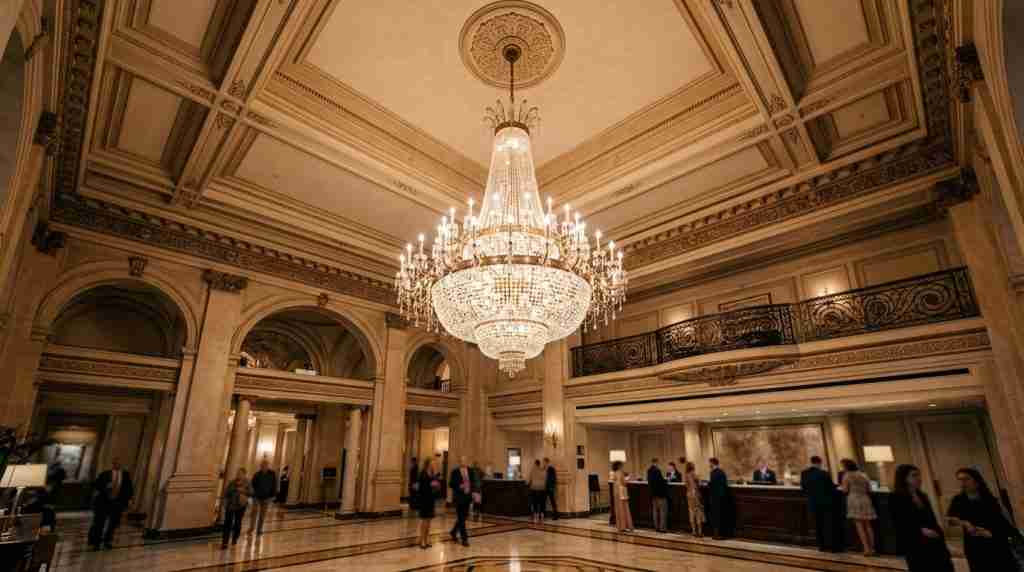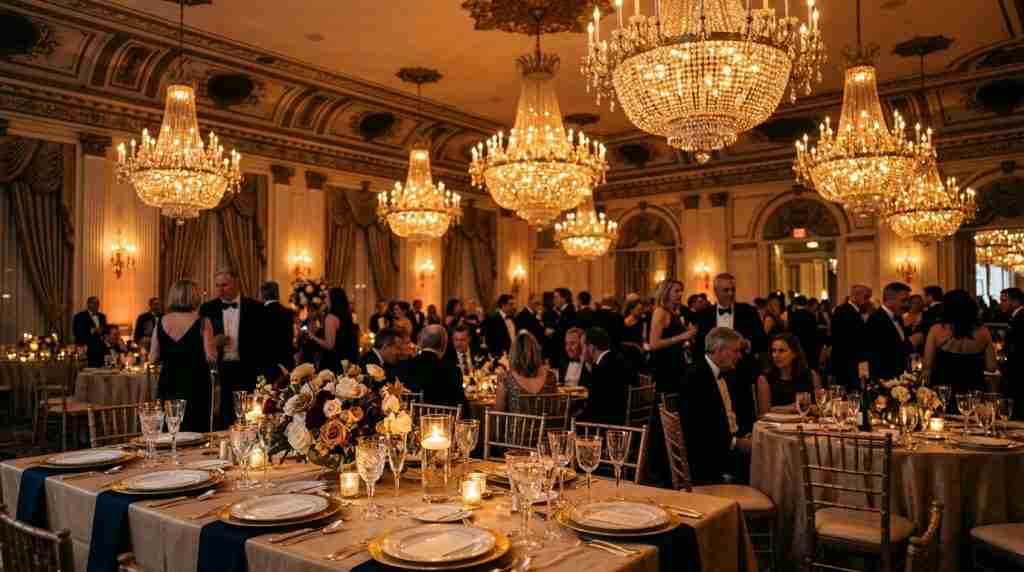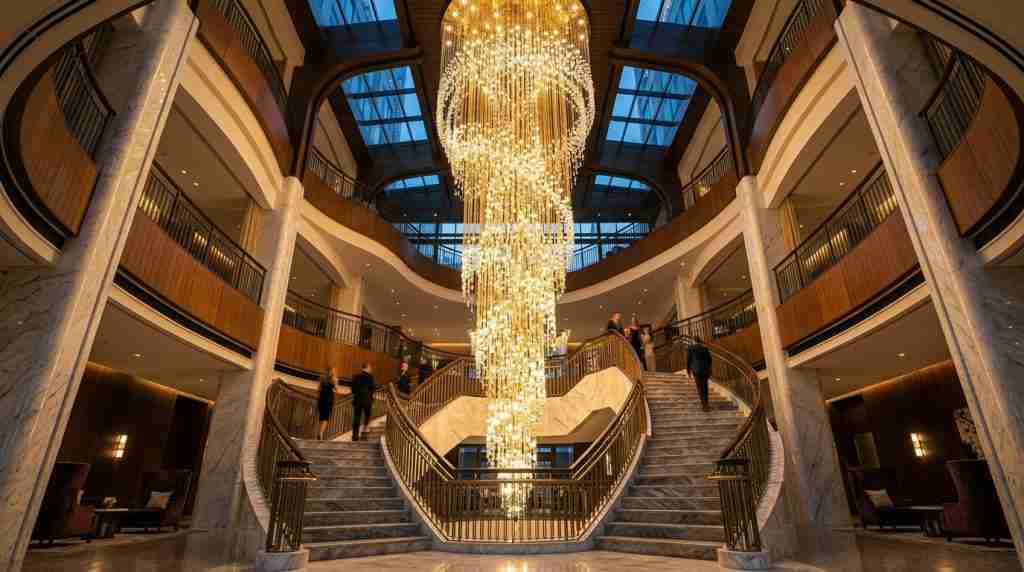
A double-height hotel lobby or atrium is, by its nature, a statement of ambition. The architecture says: this is a place of consequence. But that architectural promise collapses without lighting that can match the scale. A fixture that would dominate a standard-height room reads as lost in a 10-metre void; a fixture that commands an atrium creates the “arrival moment” that defines a guest’s entire perception of the property. Getting this right is not primarily a design problem — it is an engineering one. As hospitality lighting specifiers note, grand-scale lobbies and ballrooms present requirements that fall completely outside catalog SKU ranges, making custom manufacturing the only viable path for serious projects.
Key Takeaways
- Scale, not style, is the primary design challenge in atrium lighting — an undersized fixture is worse than no feature fixture at all.
- Structural engineering review is mandatory for any chandelier system exceeding 50 kg in commercial installations.
- Modular design is the industry standard for large-format chandeliers — it enables factory pre-assembly, safer shipping, and manageable on-site installation.
- KD (knock-down) packing, secondary safety cables, and coordination with structural engineers should be specified from the design phase, not added as afterthoughts.
- LED sources with CRI 95+ and tunable white capability ensure the fixture performs beautifully across the full range of lobby lighting scenarios.
Why Atrium Lighting Is Different
The design logic that governs standard-height room lighting breaks down completely in an atrium or double-height lobby. In a typical room, the chandelier is read at close range — guests perceive individual elements: crystal facets, metalwork detail, lamp quality. In a 9–15 metre atrium, the fixture is read as a silhouette against volume. The questions change entirely: Does the fixture’s footprint match the floor plate below? Does its vertical dimension fill the void meaningfully, or does it float awkwardly mid-air? Does it anchor the space or compete with the architecture?
MOSS Objects’ specification guide for hotel lobby lighting identifies scale as the first-order design decision: fixtures designed to expand across ceiling planes handle open voids and atrium structures differently from those designed for intimate spaces, and conflating the two categories produces consistently unsatisfying results. A chandelier that works at 400 cm diameter in a standard lobby becomes a footnote in a 2,000 m² atrium.
The Scale Calculation Framework
The starting point for any atrium chandelier specification is a proportionality calculation anchored in the room’s dimensions. The commonly used rules of thumb provide a baseline:
| Space Parameter | Calculation Method | Notes |
|---|---|---|
| Fixture diameter | Sum of room length + width (ft) = fixture diameter (inches) | For atria, increase by 15–20% to account for visual distance |
| Fixture height/drop | Ceiling height (ft) × 2.5–3 = fixture height (inches) | Taller fixtures fill vertical voids; allow minimum 3 m clearance at base |
| Bottom clearance | Minimum 3 m above floor level in atriums | Safety and sightlines for front desk, wayfinding |
| Visual reading distance | Primary viewing angles from entrance and floor-level zones | Silhouette legibility trumps fine detail in tall spaces |
| Multiple fixture groupings | For very wide floors: 2–3 coordinated fixtures rather than one oversized piece | Distributes structural load; allows varied visual rhythm |
These ratios are starting points, not absolutes. A narrow, tall atrium (say, a staircase void) demands different proportions than a wide, shallow one. The designer must always validate the calculation visually — ideally with a 3D model or photometric study — before committing to manufacturing.
Structural Engineering: The Non-Negotiable Foundation
Large-format chandeliers are structural elements, not decorative ones. A fixture of 200 kg suspended from a concrete ceiling requires different engineering than a 5 kg residential pendant, and the consequences of getting it wrong in a public hotel lobby are catastrophic. The structural requirements for commercial chandelier installations cascade across several disciplines.
Load Calculations and Safety Margins
The fundamental principle governing chandelier structural safety is that the ceiling support system must be rated for significantly more than the fixture’s static weight. Dynamic loads — vibration, seismic movement, thermal expansion and contraction of materials over time — all add stress beyond the fixture’s mass alone. International installation practice typically requires the support structure to be rated for at least 1.5 times the chandelier’s weight as a conservative minimum; commercial projects in high-traffic environments often specify higher factors. For any fixture exceeding 50 kg in a commercial installation, a licensed structural engineer must sign off on the support design — this is not optional in most jurisdictions and is required for compliance with UL 1598 and equivalent international standards.
Secondary safety cables — independent of the primary suspension — are standard practice in professional chandelier installation. These are sized to support the full weight of the fixture independently, ensuring that a primary suspension failure does not result in the fixture falling. For seismic zones, additional detailing is required to prevent swing-induced failures.
Ceiling Infrastructure Planning
The ceiling infrastructure requirements for a large atrium chandelier must be coordinated at the design development phase of construction, not specified after the concrete is poured. Key infrastructure elements include: dedicated reinforced hanging points integrated into the structural slab; conduit runs for power feeds and control cabling sized for the fixture’s electrical load; access provisions for future maintenance (hoist points, walkways, or approved cleaning platforms); and junction boxes appropriately rated for the fixture weight they support.
As the Waldorf Astoria New York restoration demonstrates, even landmark heritage ballrooms require dedicated structural engineering when introducing or restoring monumental lighting — the architects specified brand-new rigging points capable of handling heavy-duty loads alongside the lighting systems, treating the chandelier infrastructure as a structural, not decorative, specification.
Modular Design: The Industry Standard for Scale
Any chandelier exceeding roughly 2 metres in diameter presents a fundamental logistics challenge: it cannot ship as a single unit, cannot be installed by a single team in one lift, and cannot be accessed for maintenance without specialized equipment. The solution adopted by every serious large-format chandelier manufacturer is modular design.
ANC Lighting’s production approach for hotel lobby chandeliers illustrates this principle: breaking large chandeliers into manageable modules that can be pre-assembled in the factory dramatically simplifies on-site installation and reduces the risk of damage during shipping. Each module is independently tested before dispatch, arrives with detailed assembly documentation, and can be inspected individually if a component requires replacement during the fixture’s operational life.
For hotels, the modular approach has a specific operational advantage: replacement and maintenance can be performed module-by-module rather than requiring the entire fixture to be lowered. In a double-height atrium where scaffolding or a hoist system is needed for any ceiling-level access, this distinction translates directly into lower lifecycle maintenance costs.
KD Packing: The Shipping Standard for Large Fixtures
KD (knock-down) packing is the professional standard for shipping large decorative lighting fixtures. Rather than assembling the fixture and shipping it fully formed — a practice that guarantees transit damage for anything over a metre in diameter — KD packing ships components disassembled in custom foam-lined wooden crates engineered to the fixture’s specific geometry. Each crate is labelled for assembly sequence, components are individually wrapped and protected, and spare parts for fragile elements (crystal drops, glass elements, finials) are included. For hotel projects with long-lead freight, typically from manufacturers in China or Europe, KD packing is the difference between a fixture that arrives installation-ready and one that arrives damaged and requires extensive remediation.
Kinglong Lighting’s manufacturing standard includes KD packing for all large-format hospitality fixtures, with foam-engineered crates, component-level labelling, and spare parts inclusion — the same logistics approach used for the 300+ luxury hotel projects the company has supplied across 60+ countries. For hotels planning major FF&E procurement, this should be a standard specification requirement rather than an optional upgrade. View completed hotel projects to see how large-format lobby installations are delivered and installed across different atrium configurations.
LED Specification for Atrium Chandeliers
The transition from traditional lamp sources to LED in large-format hotel chandeliers is now essentially complete in new construction and major renovation projects. The operational case is overwhelming: LED chandeliers use up to 80% less energy than incandescent equivalents, with lifespans exceeding 25,000 hours that dramatically reduce the frequency of maintenance interventions at height. In an atrium where every maintenance operation requires specialized access equipment and operational disruption, this lifespan advantage is particularly valuable.
The critical LED specifications for a luxury atrium chandelier are:
Color Rendering Index (CRI): Minimum CRI 90; CRI 95+ for luxury and flagship properties. Industry guidance is clear that high CRI is essential in hospitality environments — it determines how guests, décor, and architectural finishes read under the light. Low-CRI sources flatten colors and undermine the visual quality of the entire lobby environment.
Color Temperature: 2700–3000K for luxury hotel lobbies; tunable white capability (adjustable across this range) is preferred for flagship properties that host evening events and daytime functions with different ambiance requirements.
Dimming Compatibility: All LED drivers must be compatible with the building’s control protocol — DALI for professionally specified systems, 0–10V as a minimum for simpler installations. DALI’s bi-directional communication capability allows individual fixture monitoring as well as control, enabling proactive maintenance — the system reports when a driver is failing before the guest notices a dark section in the chandelier.
Thermal Management: LED drivers generate heat, and in a large multi-lamp fixture, thermal management must be designed into the fixture structure. Poorly managed heat shortens LED lifespan and — in extreme cases — can cause driver failures. Quality manufacturers integrate driver compartments with active or passive cooling appropriate to the fixture’s lamp count and power load.
The diagram below maps the key engineering decision points in an atrium chandelier project from initial brief to installation.
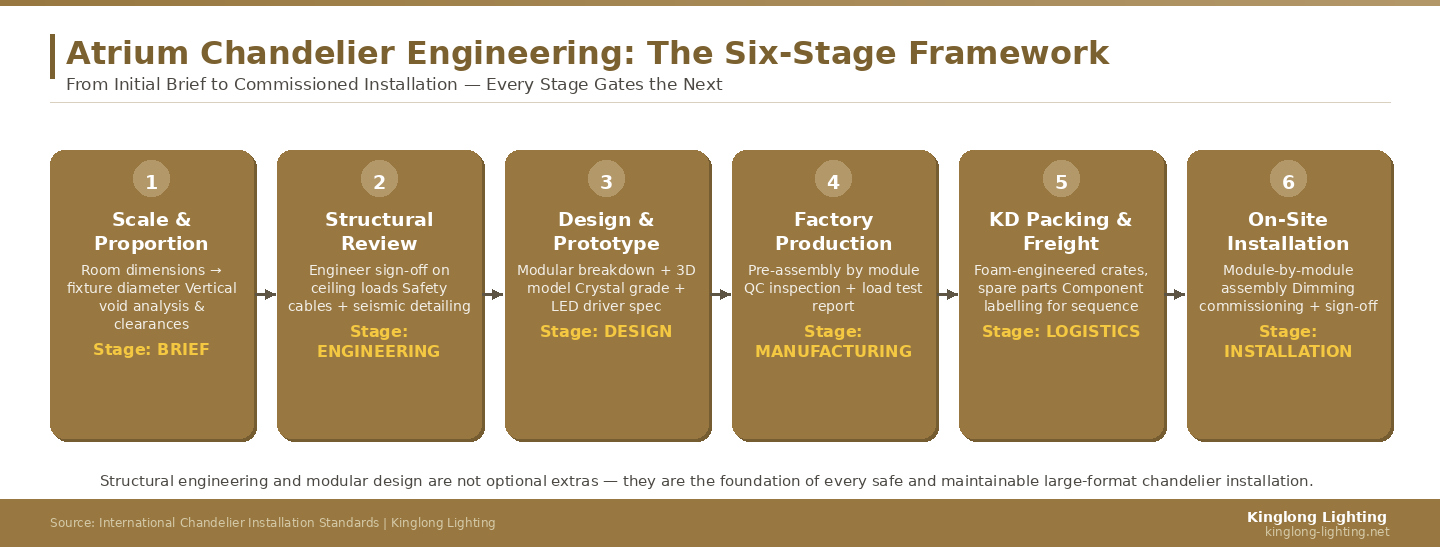
The six-stage engineering framework for large-scale atrium chandelier specification and installation — each stage gates the next.
The Maintenance Access Problem
A chandelier at 12 metres above a lobby floor is, by definition, inaccessible without planning. Yet it will require cleaning, lamp replacement, and eventually component maintenance. Hotels that specify impressive atrium fixtures without planning for their maintenance find themselves, within 18–24 months, operating with dusty, partially functioning feature lighting — the worst possible outcome for a fixture that is supposed to signal quality.
Maintenance access planning for atrium chandeliers should resolve several questions before the fixture is specified: Will a dedicated electric hoist be installed for lowering the fixture? Is there a maintenance cradle or platform system integrated into the atrium structure? Can the cleaning protocol be executed with the fixture in place? What is the access route for individual module replacement if a section fails? For multi-storey atriums, the answer often involves motorised lowering systems — a capital investment that should be priced into the project from the outset, not discovered as a surprise cost when the fixture is already installed.
Crystal Quality in Large-Format Fixtures
In an atrium chandelier, crystal quality has an outsized visual impact because the fixture is viewed against a high-contrast background — open ceiling, structural elements, natural light from skylights — rather than against a close, neutral wall. Any inconsistencies in crystal clarity, colour tint, or cutting precision are immediately apparent at scale. The specification standard for luxury hotel atriums is K9 crystal at minimum: high optical clarity, precise machine cutting, and consistent refraction characteristics across all elements of the fixture. For flagship properties or where the chandelier is the primary design statement of the lobby, higher-grade options including hand-cut crystal deliver superior performance.
Crystal quality also affects the fixture’s light distribution. Well-cut crystal with high refractive index scatters and distributes light across the entire lobby volume — a single central fixture can effectively illuminate a large floor area through crystal dispersion. Poorly cut or low-grade crystal transmits light without distributing it, creating a bright central fixture surrounded by darker peripheral zones. For custom large-format chandelier specifications, crystal grade should be confirmed in writing and validated against physical samples before production commences, as the difference between crystal grades is not reliably apparent from specification sheets or digital renderings.
Coordinating with the Interior Design Narrative
The most technically excellent atrium chandelier fails if it conflicts with the lobby’s design narrative. A contemporary minimalist lobby designed around clean planes and restrained materials cannot absorb a traditional multi-tier crystal chandelier without creating visual incoherence — and vice versa. The fixture must be specified as part of the interior design narrative, not appended to it after the fact.
Contemporary luxury hotel lobbies have moved toward three broad chandelier typologies: sculptural statement pieces that function as art objects (often in custom metal or glass); contemporary crystal interpretations that retain the material vocabulary of traditional chandeliers while adopting current geometric forms; and modular suspended systems that distribute light across a large ceiling plane rather than concentrating it in a single fixture. Each typology has different scale logic, different structural implications, and different maintenance requirements. The right choice is determined by the lobby’s architecture, the brand’s aesthetic register, and the operational realities of the property’s management team. Explore Kinglong Lighting’s hospitality collections for examples of each typology at hotel scale, or contact the team directly for a custom specification consultation on a specific project brief.
Frequently Asked Questions
How large should a chandelier be for a double-height hotel lobby?
The standard starting formula: add the room’s length and width in feet, and that number in inches is the baseline chandelier diameter. For double-height atriums, increase this by 15–20% to compensate for the increased visual distance and ceiling height. Always validate against a 3D model or to-scale drawing before committing to manufacturing — the formula is a starting point, not a final specification.
What structural support is needed for a large hotel atrium chandelier?
Any commercial chandelier exceeding 50 kg requires a structural engineer’s sign-off on the support design. The support system should be rated for at least 1.5 times the fixture’s static weight to account for dynamic loads. Secondary safety cables independent of the primary suspension are standard practice. All hanging points must be integrated into the structural ceiling — not attached to drywall or decorative ceiling systems.
What is modular chandelier design and why does it matter for hotel projects?
Modular design breaks a large chandelier into independently manufactured and tested sections that are assembled on-site. This is essential for any fixture too large to ship fully assembled or too heavy to lift as a single unit. Modular design also simplifies future maintenance — individual sections can be lowered and replaced without disturbing the entire installation. It is the professional standard for any fixture exceeding approximately 2 metres in diameter.
Should a hotel atrium chandelier use LED sources?
Yes. LED sources are now the standard for all new hotel chandelier installations. The energy savings (up to 80% versus incandescent), the dramatically extended lifespan (25,000+ hours), and the dimming compatibility with DALI control systems make LED the only practical choice for fixtures installed at heights where maintenance is expensive and disruptive. Specify CRI 90 minimum, ideally CRI 95+, and ensure LED drivers are rated for dimming to 1% with no flicker.
How do you maintain a chandelier in a high atrium?
Maintenance access must be planned before the fixture is specified — not after installation. Options include motorised lowering systems (for fixtures that can be lowered to ground level), integrated scaffold or cradle systems in the atrium structure, or long-handled cleaning equipment for in-situ cleaning. For any chandelier installed above 5 metres, the maintenance protocol and equipment should be specified alongside the fixture and budgeted as part of the total project cost.
Kinglong Lighting Editorial Team — Drawing on 30+ years of decorative lighting manufacturing expertise and insights from 300+ hospitality projects across 60+ countries.