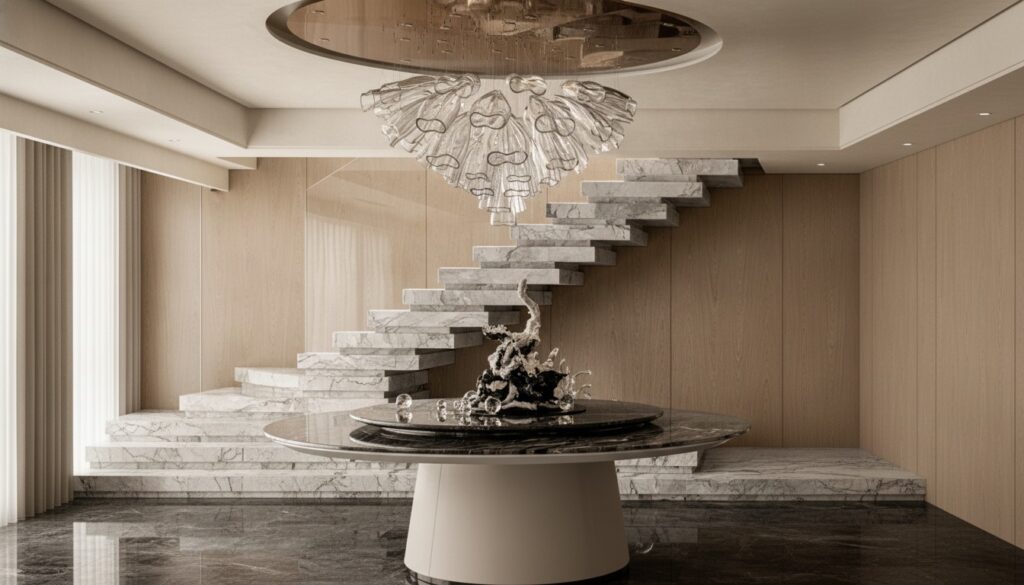
A tropical villa chandelier fails slowly when salt air, humidity, finish aging, driver access, and cleaning intervals are not specified before production.
The problem is rarely the first installation photo. The fixture can look perfect on handover day, then show tarnished metal, dull crystal, sticky residue, loose decorative parts, or service frustration after several humid seasons.
Kinglong Lighting can help tropical villa buyers turn the chandelier brief into a five-year maintenance file that covers finish selection, exposure zones, spare parts, cleaning rhythm, and release evidence.
Key Takeaways
- Salt air is hidden: Deposits often affect connectors, fasteners, and recesses before visible faces.
- Humidity changes service: Drivers, access points, finishes, and cleaning methods need climate notes.
- Five years is the test: Specify how the chandelier should look after repeated cleaning cycles.
- Salt tests have limits: Lab checks support quality control but do not predict every real exposure.
- Spare parts matter: A tropical chandelier needs replacement logic before the first shipment.
Salt air turns finish into a maintenance decision
In a tropical villa, the finish specification is also a service specification.
NOAA’s sea spray aerosol research page is a useful environmental reminder: sea spray produces salt-containing aerosols that can travel through the coastal air. A tropical villa chandelier may be indoors, but nearby ocean air, open terraces, and humid ventilation patterns still influence material aging.
The FEMA coastal corrosion bulletin discusses how salt spray and moisture accelerate corrosion in coastal construction. For decorative lighting, the same environmental logic means finish, fastener, canopy, suspension, and driver-access decisions should not be left to appearance alone.
The release file should separate what the owner sees from what the technician must maintain. A brushed metal face may look clean while hidden screws, cable ends, sockets, and access panels age faster. If the hidden details fail, the visible luxury eventually fails with them.
Chloride exposure appears first in small details
Decorative lighting teams often focus on the large visible body: arms, drops, glass, crystal, or shade. In coastal humidity, small details may age first. Screws, clips, cable exits, retaining rings, canopy seams, and unfinished edges deserve the same attention as the visible finish. The specification should name material, coating, access, and replacement assumptions for these small parts instead of assuming the main finish tells the whole durability story.
Humidity makes driver access part of the luxury result
A driver hidden deep inside a tropical ceiling can become a future maintenance problem. The owner may not notice the risk until dimming becomes unstable or a service call requires ceiling work. A tropical chandelier specification should say where drivers, connectors, and replaceable components live; how they are protected; and how a technician can reach them without damaging the ceiling, canopy, or decorative parts.
Treat five years as the real approval horizon
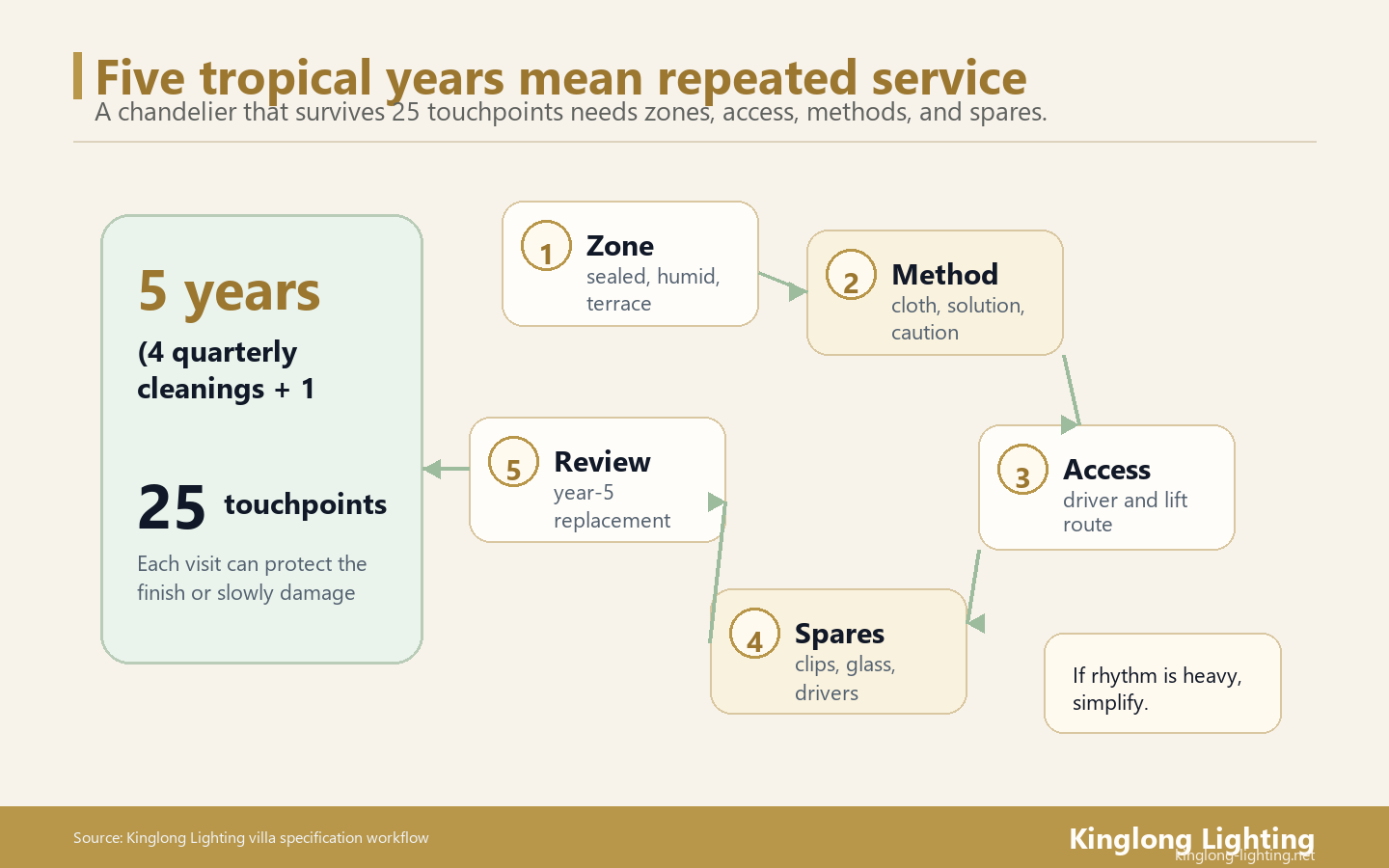
A tropical chandelier should be approved for its expected appearance after repeated cleaning, not only for its new appearance. The five-year question forces the team to think about residue, coating durability, spare parts, lift access, and the owner’s willingness to maintain a complex decorative object.
Use a simple service model: (4 quarterly cleanings plus 1 annual technical check) x 5 years equals 25 service touchpoints. If the fixture cannot survive those touchpoints without bending clips, dulling finish, or losing parts, the specification is too fragile for a tropical villa.
| Five-year item | What can go wrong | Release evidence | Owner decision |
|---|---|---|---|
| Quarterly cleaning | finish abrasion or streaking | approved cleaning method | accept service rhythm |
| Annual check | loose clips or corrosion | fastener and spare map | keep replacement kit |
| Driver access | ceiling damage during repair | access location note | approve hidden service route |
| Crystal or glass | salt film dulls surface | cleaning material test | select reachable density |
| Coating aging | patina becomes defect dispute | finish aging boundary | approve acceptable change |
The ISO 9227 salt spray standard page is useful because it states both the role and the limits of salt spray testing. The standard describes test methods for checking coating quality, but it also notes that details such as exposure period and interpretation belong in product specifications.
The UL indoor and decorative lighting page reinforces that decorative luminaires need product evidence. Tropical projects should ask for safety, component, and market-appropriate documentation together with finish and maintenance proof.
Specify exposure zones instead of one tropical label
Tropical is too broad to be a release condition. A chandelier in a sealed, air-conditioned master suite faces a different reality from one in an open-air dining pavilion, stair void beside a terrace, or foyer that receives sea breeze every evening.
The release file should define exposure zones: dry interior, humid interior, terrace-adjacent, semi-outdoor covered, and exterior. Each zone should have a finish expectation, electrical access rule, cleaning interval, and replacement-part note. If the chandelier sits between zones, specify to the harsher side.
This also protects procurement. A buyer comparing quotes should know whether each supplier priced the same exposure zone. Otherwise, the lowest quote may simply be the one that ignored salt, humidity, access, and maintenance.
Exposure zones also prevent the maintenance plan from becoming unrealistic. A sealed suite can accept a more delicate decorative density if access is simple and cleaning is light. A terrace dining room may need fewer crevices, stronger coating discipline, and a spare kit that includes small fasteners and clips. A stair void may need the most conservative rule because humidity and access difficulty appear together.
The owner decision should therefore be visible before purchase: accept the service rhythm, choose a more resilient finish, reduce fragile parts, or move the most delicate chandelier language to a lower-risk room.
How Kinglong Lighting can structure the five-year file
Kinglong Lighting’s customization workflow can translate tropical exposure into sample review, finish selection, component planning, packing, and after-service notes. The goal is not to make the chandelier industrial; it is to preserve luxury through realistic service planning.
Send site location, distance from sea if relevant, room ventilation, air-conditioning pattern, ceiling access, cleaning route, preferred material, and owner maintenance expectations through the project inquiry page. Ask Kinglong Lighting for a five-year maintenance recommendation before final release.
Build a five-year coastal maintenance file
The maintenance file should be short enough for a villa owner to understand and precise enough for a service team to follow. It should answer what gets cleaned, how often, with what method, by whom, and which parts are expected to be replaced or checked.
That file belongs in the specification stage, not after the first service problem. Once the chandelier is installed above a stair, foyer, dining table, or vaulted lounge, access becomes part of the cost and risk.
The file should also define what counts as normal aging. Light patina, slight cleaning variation, or small service adjustments may be acceptable when they are expected and documented. Pitting, loose clips, water marks, driver instability, or a finish change that no longer matches the approved sample should trigger review. That boundary prevents a tropical villa owner from accepting slow deterioration as unavoidable.
Map each exposed material to a cleaning method
Glass, crystal, plated metal, painted metal, leather, resin, acrylic, and fabric do not respond to the same cleaning method. A tropical maintenance file should assign each material a permitted cloth, solution, frequency, and caution. The goal is to avoid a well-intentioned cleaning team using one chemical or abrasive method across the entire chandelier and damaging the finish that made the fixture valuable.
Map each service part to an access route
Every replaceable driver, connector, LED module, crystal strand, glass piece, retaining clip, and suspension element should have an access assumption. The file should explain whether the part can be reached from below, through the canopy, by lift, or only during major service. If access requires moving furniture or protecting floors, record that before the villa is occupied.
Map spare parts before visual matching becomes impossible
A tropical villa may need spare glass, crystal, clips, screws, drivers, and finish components. Waiting until year three can make matching difficult because batches, tint, coating, or supplier parts may change. A spare-parts map should identify critical pieces, recommended quantity, storage condition, and how each spare relates to the installed fixture.
Map inspection rhythm to the room's real exposure
A sealed bedroom chandelier may not need the same rhythm as a terrace-adjacent dining chandelier. The maintenance file should connect inspection frequency to exposure zone, ceiling height, material density, and owner tolerance for visible aging. That rhythm should be realistic; a complex fixture that requires frequent specialist cleaning should be specified only when the owner accepts the service commitment. Record the first inspection month.
Translate exposure into a room-by-room service schedule
A tropical maintenance plan should not apply one interval to every chandelier. The same villa can contain a sealed bedroom, an air-conditioned foyer, a humid stair void, a terrace dining room, and a semi-outdoor lounge. Each room creates a different cleaning and inspection rhythm.
The service schedule should therefore classify rooms by exposure and access difficulty. That classification helps the owner decide where to accept complex decorative density and where to choose fewer pieces, stronger finishes, or easier service routes.
A useful first pass is a 3-zone schedule: sealed rooms, terrace-adjacent rooms, and semi-outdoor covered rooms. Give each zone a 6-month inspection trigger, a 12-month technical check, and a 5-year spare-part review so the maintenance plan survives more than one season.
Sealed suites can prioritize comfort and quiet aging
A sealed master suite may face less salt and dust than terrace-adjacent rooms, but it still needs humidity-aware driver access and gentle cleaning rules. The maintenance file can prioritize quiet operation, soft appearance, low-glare scenes, and occasional inspection of hidden components. The fixture can often use more delicate materials if the owner understands that air-conditioning, housekeeping rhythm, and careful cleaning protect the long-term appearance.
Open dining rooms need higher cleaning discipline
A tropical dining area near a terrace, pool, or open-air wall can collect salt film, moisture, cooking residue, and dust faster than a sealed room. The chandelier should be designed for reachable cleaning, stable finish, and fewer fragile hidden crevices. If the design requires many small pieces, the specification should include trays, maps, spare parts, and a stronger cleaning interval before the owner approves the look.
Stair voids combine exposure with difficult access
A stair void can be humid, tall, and hard to service at the same time. That combination should push the team toward modular parts, stable suspension, known lift access, and a service route that does not depend on risky reach. The release file should specify what can be cleaned in place, what can be lowered, and what requires specialist equipment. Without that answer, the five-year cost is still unknown.
Spare kits should match exposure, not only piece count
A tropical spare kit should not simply include a few decorative extras. It should match the parts most likely to age or be damaged in each exposure zone: clips, screws, drivers, glass pieces, crystal strands, finish components, and small connectors. The kit should also include storage instructions because humidity can damage spares before they are used. A spare that cannot match the installed fixture is not really a spare.
Tropical maintenance action card
- Define dry, humid, terrace-adjacent, and semi-outdoor zones.
- Approve finish aging and cleaning method before production.
- Map drivers, clips, glass, and crystal to access routes.
- Keep spares for parts that must visually match.
- Use five-year service rhythm as a buying criterion.
Related Guides
Frequently Asked Questions
How does salt air affect a villa chandelier?
Salt air can accelerate finish aging, fastener corrosion, residue buildup, and service problems, especially around hidden metal details. A tropical chandelier should include exposure-zone, finish, cleaning, and spare-part notes before production.
Is salt spray testing enough for coastal chandeliers?
Salt spray testing can support coating quality checks, but it does not replace a real project specification. The release file should still define exposure, maintenance interval, material choice, and interpretation of acceptable finish aging.
How often should tropical villa chandeliers be cleaned?
Frequency depends on exposure, air-conditioning, material, height, and owner expectations. A practical starting model is quarterly light cleaning plus an annual technical check, then adjustment after the first season.
What should Kinglong Lighting review for tropical projects?
Kinglong Lighting should review room exposure, ventilation, distance from sea, material preference, finish requirements, driver access, cleaning route, spare parts, and expected maintenance rhythm before release.