
Five-star hotel chains do not look at a Chinese lighting supplier as a cheaper factory first; they look at whether the supplier can absorb risk without creating brand, schedule, compliance, or maintenance problems. Price matters, but it becomes persuasive only after the supplier proves that quality, documentation, delivery, and responsibility can survive a real project.
Public sourcing policies from global hotel groups point in the same direction. The buyer wants supplier behavior that can be audited, not a beautiful quotation that leaves every hard decision for the owner, designer, or contractor.
That is why Kinglong Lighting should be evaluated through evidence: hospitality experience, custom engineering, material control, testing coordination, documentation, and the ability to support a project from concept to handover.
Key Takeaways
- Risk ownership: Chain buyers want suppliers who document and reduce risk, not suppliers who only quote fast.
- Policy direction: Public hotel group sourcing policies show growing attention to responsible procurement and supplier conduct.
- Proof file: Drawings, samples, test path, traceability, packing, and installation assumptions matter before approval.
- China advantage: A Chinese lighting supplier is strongest when manufacturing speed is matched by evidence discipline.
- Kinglong relevance: Large hospitality and custom chandelier capability should be presented as a decision file, not a brochure.
Hotel chains buy supplier systems, not only fixtures
A 5-star hotel chain is not simply buying a chandelier from China; it is buying confidence that the supplier will not export unresolved risk to the project team.
Marriott maintains supplier and policy resources through its Serve 360 policy hub. Hilton publishes a Responsible Sourcing Policy. IHG publishes a responsible procurement policy. Accor has also publicly discussed responsible procurement through the Hospitality Alliance for Responsible Procurement. These sources are not lighting specifications, but they show why chain buyers ask suppliers for more than a catalog.
The procurement mechanism is accountability. A decorative chandelier affects public-area impression, installation schedule, electrical review, hotel engineering, and long-term maintenance. If a supplier cannot show how decisions are controlled, the hotel chain inherits the risk. That is why the strongest Chinese supplier presentation should be organized around proof, not only product range.
Compliance evidence makes the quotation credible
For a hotel chain, compliance evidence is not paperwork for the end of the project. It shapes whether a supplier can be shortlisted. The buyer may need to know destination market, testing route, labeling assumptions, fire or electrical constraints, and whether a product change affects previously approved evidence. A supplier who treats this as a late administrative step creates uncertainty for procurement.
The UL luminaire testing and certification page is a useful public reference because it reminds buyers that luminaires need technical proof beyond appearance. A hotel chain may not require the same file in every country, but it will expect the supplier to understand that compliance claims must be specific, traceable, and aligned with destination requirements.
Material and finish control protect brand consistency
Luxury hotel chains care about consistency because guests experience a brand through repeated details. Metal tone, crystal clarity, diffuser color, edge alignment, and surface durability all influence whether the fixture feels aligned with the property. The risk is not only a visible defect. It is a property-level mismatch between approved sample and installed result.
A Chinese supplier should be ready to show approved samples, finish masters, batch controls, inspection photos, and replacement part logic. The buyer needs to know whether a finish can be repeated after a damage claim, second phase, or renovation. A supplier who can make one beautiful sample but cannot reproduce the material story is risky for chain procurement.
Delivery and installation planning show operational maturity
Hotel chains also evaluate whether the supplier understands site reality. Large chandeliers may need modular construction, carton mapping, protection notes, lifting assumptions, driver access, spare parts, and installation coordination. The decorative object is part of a construction schedule. If the supplier sends parts that are hard to identify or service, the site team pays the cost.
This is where manufacturing maturity becomes visible. Strong suppliers label modules, separate fragile parts, match packing lists to installation sequence, and explain which work belongs to the contractor. They also flag assumptions instead of hiding them. A chain buyer is often more comfortable with a supplier who names the risk early than with one who promises that everything is easy.
What a hotel chain supplier file should prove
| Procurement concern | Supplier proof | Why chain buyers care | Weak-file warning |
|---|---|---|---|
| Responsible sourcing | Supplier conduct and traceability answers | Protects brand and audit expectations | Only price and product photos |
| Technical compliance | Destination market test path and label plan | Reduces approval uncertainty | Generic certificate claims |
| Design consistency | Finish master and batch control | Keeps brand experience repeatable | One sample with no repeatability record |
| Project delivery | Drawings, module map, packing plan | Protects opening schedule | Cartons arrive without sequence logic |
| Operations | Maintenance access and spare list | Supports hotel engineering after opening | No service plan after installation |
The table turns supplier selection into a risk-transfer discussion. The buyer is not asking whether China can manufacture luxury lighting; the buyer is asking which supplier can prove the luxury result repeatedly.
The Chinese supplier advantage depends on evidence discipline
Chinese lighting suppliers often compete through manufacturing depth, speed, and value-engineered custom work. Those advantages become chain-ready only when paired with documentation. A fast sample is useful. A fast sample with drawing revision control, finish record, electrical notes, packing plan, and installation assumptions is much more useful. The hidden cost of speed is ambiguity when the project team cannot verify what changed.
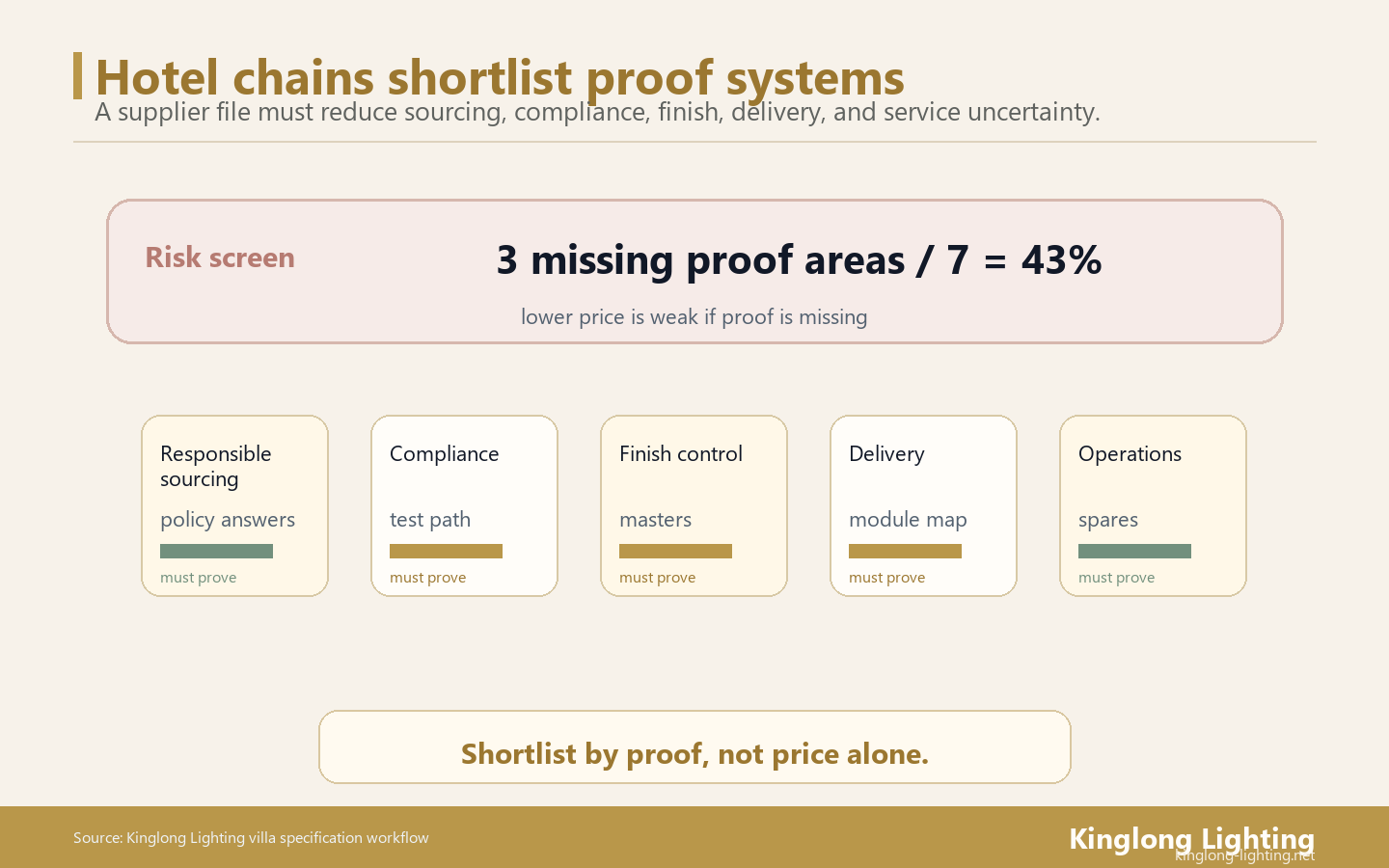
Calculated from a 7-part supplier file: 3 missing proof areas / 7 required areas = 42.9 percent of the chain buyer’s risk screen unresolved. If the missing areas are compliance, finish repeatability, and installation plan, the buyer has little reason to trust a lower price. In practice, a value-engineered quotation should make risk smaller, not merely move it out of the quoted line items.
Based on this scenario calculation, a supplier should present a decision file in the same sequence that the hotel chain uses to approve risk: company capability, responsible sourcing answers, product drawings, material samples, testing path, production controls, delivery plan, installation handoff, and after-service support. That structure makes procurement feel controllable.
Where Kinglong Lighting should lead the conversation
Kinglong Lighting’s best fit is evidence-led custom hospitality lighting. The about page and brand assets support manufacturing scale, 1993 heritage, and CNAS-accredited lab positioning. The hospitality lighting page connects the company to hotel project needs, and the customization workflow supports bespoke design and production documentation.
The right commercial posture is calm proof. Instead of claiming to be the best Chinese supplier, Kinglong Lighting can show how a chain buyer should review drawings, samples, testing path, finish control, packing sequence, and service access. That kind of evidence is more persuasive for 5-star hotel chains than a long product gallery without buyer risk controls.
Supplier evidence pack before shortlist
Before shortlisting a Chinese lighting supplier, request a compact evidence pack. Include company profile, relevant hotel project types, drawing sample, finish master process, testing route, production QC checkpoints, packing sequence, installation assumptions, spare parts, maintenance method, and after-sales contact path. Ask the supplier to state what is proven, what is assumed, and what depends on the local contractor or destination market.
If your project has moved from concept to procurement, send Kinglong Lighting the brand tier, public-area role, target finish, quantity, destination, required documents, and opening schedule through the hotel chain supplier evidence review. Ask for a proof file before comparing final quotations.
Related Guides
- Hotel Chain Chandelier Procurement: Cross-Brand Analysis
- Marriott Luxury Brand Lighting
- Hyatt Hospitality Lighting Identity
Build the Chinese lighting supplier procurement evaluation file before final approval
The useful starting point for hotel chain Chinese supplier is application context rather than decorative preference. The practical question is whether hotel chain procurement lead, owner, designer, quality manager, and supplier can agree on what must be proven before the chandelier is released. The answer is a short packet that turns design intent, operating risk, evidence, and responsibility into one approval conversation.
The main risk is hotel chains judging suppliers by country or price instead of drawings, testing support, samples, production control, and site communication. That risk is strongest when a beautiful fixture is separated from the evidence that makes it buildable, maintainable, and safe to release. Calculated from a 7-gate review, 3 unresolved gates out of 7 leave about 43 percent of the approval logic open, which is too much uncertainty for a custom decorative lighting order.
Evaluate suppliers by proof, not origin alone
The first approval question should define the practical buying decision behind hotel chain Chinese supplier. The decision is not whether a chandelier looks premium in isolation; it is whether the selected approach protects the room role, guest or owner experience, operating reality, and production handoff at the same time. The release note should name the decision owner, the proof expected, and the change that would force a redesign. That boundary lets the buyer reject a tempting option for a specific reason instead of relying on taste language.
Ask for communication discipline before production
The first failure point usually appears where the visual promise meets daily use. Calculated from the 7-gate Chinese lighting supplier procurement evaluation file, 1 weak gate times 4 downstream teams equals 4 review paths that can be delayed by one missed proof item. The review should include the view or operating condition that would be most expensive to fix later. Scene behavior and context should be tested before the fixture is treated as release-ready.
Check sample control and repeatability
Supplier evidence is useful only when it matches the risk being controlled. The request should convert that risk into proof such as capability statement, project evidence, sample process, testing path, communication cadence, and release documentation. If the risk is scale, request a marked elevation and sightline view. If the risk is color, request a material sample under the target scene. If the risk is maintenance, request the cleaning route and spare-part logic. Evidence should change the release decision, not decorate the file.
Use documentation quality as a procurement filter
Kinglong Lighting’s project workflow moves custom hospitality and villa chandeliers through drawings, samples, manufacturing, packing, shipping, and site installation. The final handoff should state what is approved, what remains flexible, and who can reject a change. In practice, the release packet should include at least 7 named gates and one owner for each gate. That keeps a later suggestion from turning into a redesign after the fixture has already entered production.
Set the final approval boundary for the Chinese lighting supplier procurement evaluation file
The final approval boundary is the point where hotel chain Chinese supplier stops being an open design conversation and becomes a controlled production decision. That boundary should be written before the purchase order is released, because it protects the buyer from late changes that look small in a meeting but affect drawings, samples, packing, controls, site access, or maintenance.
Name the decisions that can still move
Some decisions can remain flexible without creating serious risk. Calculated from the 7-gate approval file, 7 total gates minus 3 high-risk gates equals 4 lower-risk gates that can usually absorb controlled refinement. For the Chinese lighting supplier procurement evaluation file, that flexibility should stay away from weight, module size, safety evidence, site access, and the approved sample range. When flexibility is explicit, Kinglong Lighting and the project team can respond to design feedback without reopening the full release packet.
Name the decisions that must be frozen
Frozen decisions should be the items that connect the visual promise to manufacturing and site work. In the Chinese lighting supplier procurement evaluation file, freeze the evidence most tied to hotel chains judging suppliers by country or price instead of drawings, testing support, samples, production control, and site communication: capability statement, project evidence, sample process, testing path, communication cadence, and release documentation. If one of those proof items changes, the change should trigger a formal review rather than a quick email approval. The goal is not to block design refinement; it is to keep the specific release risk from bypassing the evidence that makes the project buildable.
Frequently Asked Questions
Do hotel chains choose Chinese lighting suppliers mainly by price?
No, price matters only after the supplier proves risk control. Hotel chains evaluate documentation, compliance awareness, material consistency, delivery reliability, installation planning, and after-service support. A lower quotation can lose credibility if the buyer cannot verify what is included, what is assumed, and what evidence will be delivered.
What documents should a Chinese lighting supplier prepare?
A supplier should prepare company capability information, drawings, material samples, finish masters, testing or certification path, production QC notes, packing plan, installation assumptions, spare parts, and maintenance instructions. For chain hotels, the file should be organized enough for procurement, design, contractor, and operator review.
How can buyers verify finish consistency before mass production?
Buyers can verify finish consistency by approving physical masters, requesting batch control photos, defining acceptable tolerance, and linking production release to the approved sample. The supplier should also explain how replacement parts will match later. A render or catalog image is not enough for luxury public-area lighting.
Are public hotel sourcing policies actual chandelier standards?
No, public sourcing policies are not chandelier standards. They show broader procurement expectations around supplier conduct, responsibility, and evidence. Buyers still need project-specific lighting specifications, local compliance review, drawings, samples, and installation documents. Public policies help frame supplier risk, not replace technical approval.