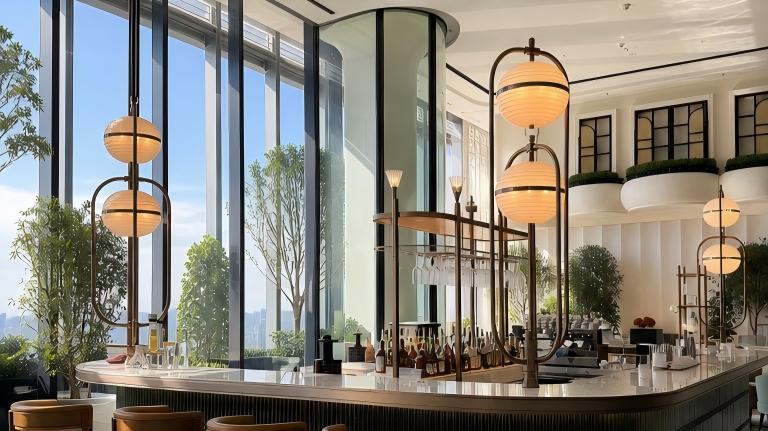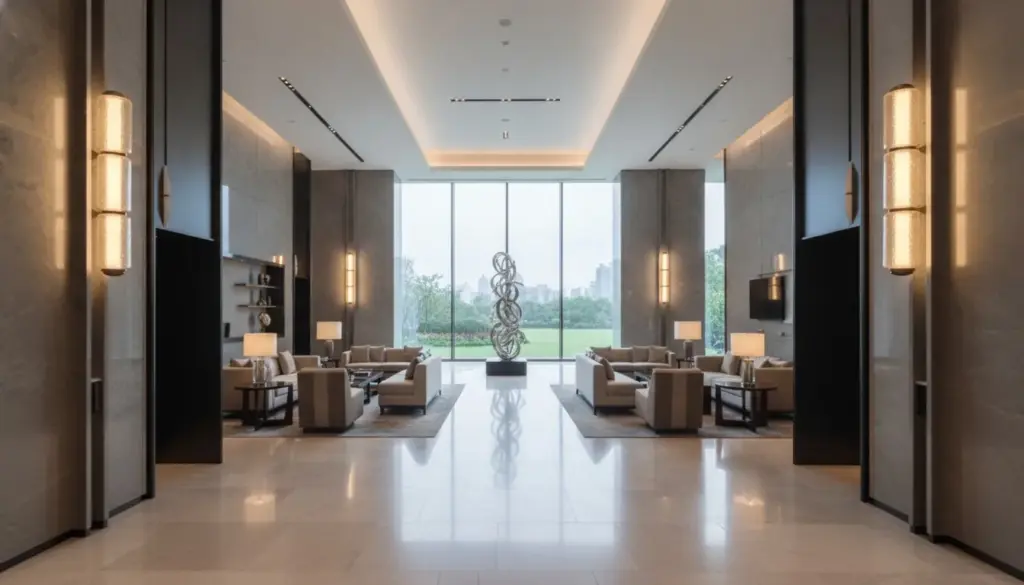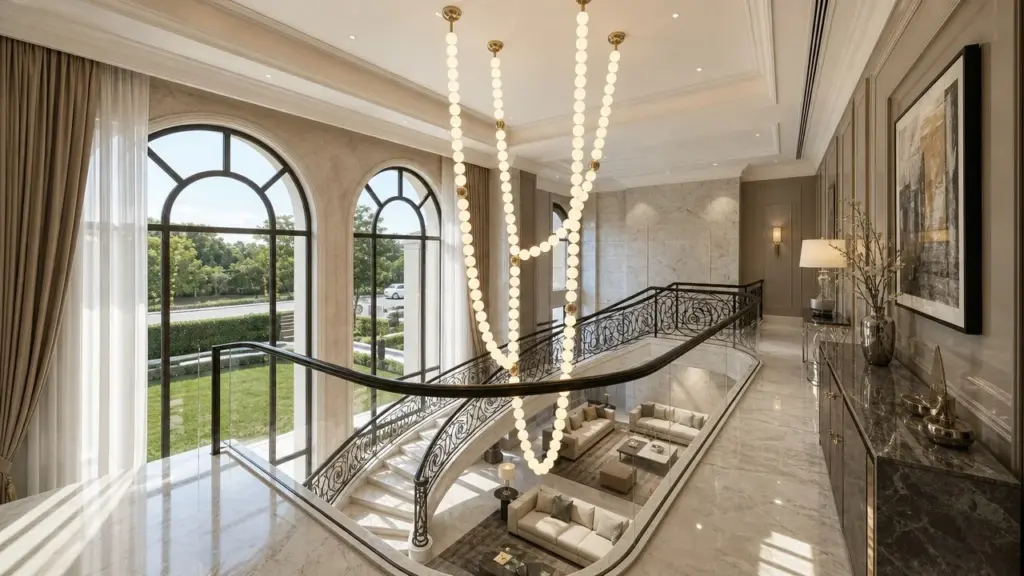
Hilton hotel lighting should not be specified as one universal brand look because Conrad and Curio Collection solve different guest promises. Conrad lighting needs polished luxury, calm control, and purposeful visual clarity. Curio Collection lighting needs a stronger local story and more tolerance for individual personality. The same chandelier supplier can serve both, but the approval file should not read the same.
Public Hilton brand and sourcing information can guide design context, but it is not a Hilton specification and does not imply that Hilton endorses Kinglong Lighting or any other supplier. For specifiers, the useful question is practical: how should public brand cues be translated into lighting evidence, mock-up decisions, material samples, controls, and manufacturing release language?
Key Takeaways
- Brand range: Conrad and Curio Collection should not receive identical chandelier briefs.
- Luxury clarity: Conrad-style spaces reward controlled sparkle, refined material tone, and quiet technical precision.
- Local personality: Curio Collection-style spaces can justify bolder feature lighting when the story is property-specific.
- Evidence rule: Public brand cues must become drawings, finish samples, color targets, control scenes, and service notes.
- Supplier framing: Kinglong Lighting should present custom capability and evidence readiness, not hotel-brand endorsement language.
Conrad and Curio start from different lighting questions
In Hilton-branded projects, the chandelier question is not “does it look premium?” It is “does it express the right type of premium for this brand and property?”
The official Conrad Hotels by Hilton page positions Conrad in a luxury context, while the official Curio Collection by Hilton page emphasizes remarkable, handpicked stays with singular personality. Those public signals do not provide a lighting standard, but they do help shape the brief. Conrad should usually feel composed, tailored, and globally polished. Curio can be more narrative, place-based, and surprising as long as the guest experience remains coherent.
Conrad asks for restraint with evidence
For a Conrad-style public space, the lighting brief should protect refinement before novelty. A chandelier can be sculptural, but it should not dominate the room without a reason. Warm metal, crystal, glass, and indirect glow should be evaluated against the material palette, not judged from a catalogue image. The supplier should provide finish masters, color evidence, dimming behavior, driver access, and maintenance planning so the luxury impression stays stable after installation.
The practical review should ask whether the chandelier feels intentional from the first arrival view and still comfortable after ten minutes in the lounge. Conrad-style lighting often benefits from tighter control of contrast, quieter sparkle, and materials that reward close inspection. A specifier can ask for a low-glare view set from reception, seating, lift lobby, and long-axis circulation. If the fixture only looks convincing from the dramatic render angle, the proposal is not yet refined enough for a luxury public-space decision.
Curio asks for personality with boundaries
For a Curio Collection-style property, individuality is more central. A chandelier may reference a building history, local craft, art scene, landscape, or unusual guest journey. The risk is that “unique” becomes undisciplined. The lighting brief should state what story the fixture carries, where guests encounter it, and which elements are allowed to vary. The stronger the personality, the more important the control file becomes: approved motif, material, color, scale, service access, and replacement parts.
A useful Curio brief names both the story and the stop line. For example, a local craft reference may guide glass texture, bronze tone, or hanging rhythm, but it should not create impossible cleaning access or fragile one-off parts. The owner should know which features are custom essentials and which can be value-engineered if budget or schedule shifts. That distinction protects individuality while preventing the fixture from becoming hard to procure, install, or maintain.
The shared baseline is comfort, controls, and supplier responsibility
Even when brand expression differs, the baseline does not disappear. The IES Lighting Library helps frame this because lighting practice draws on application guidance, controls, maintenance, and professional vocabulary. The WELL v2 Light concept reinforces visual comfort and human experience. The DOE TM-30 FAQ shows why color quality should be discussed with more than a loose “warm white” label.
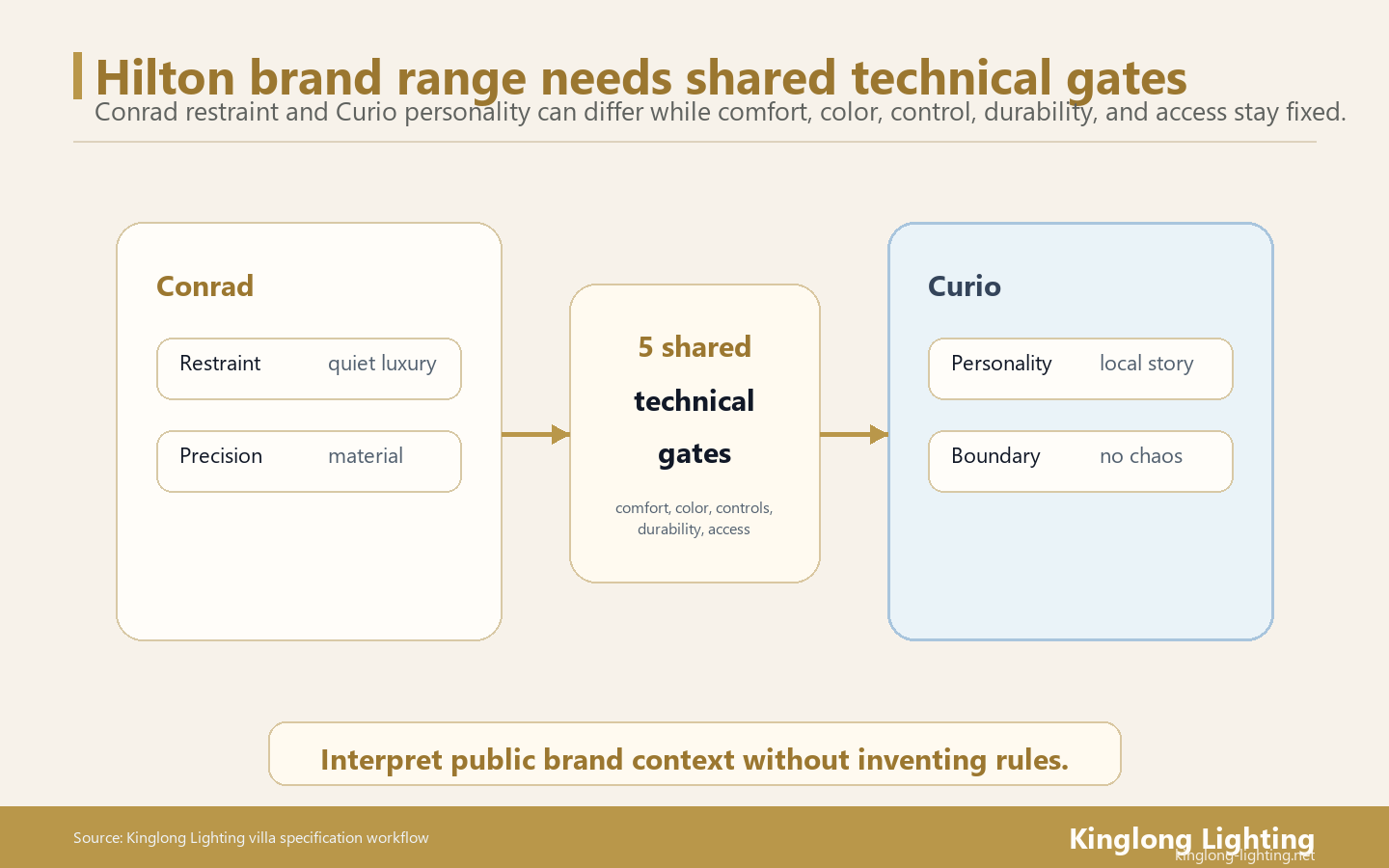
Based on our analysis, a Hilton-branded decorative lighting brief should use 5 shared evidence gates before brand-specific design is approved: guest-view comfort, color quality, dimming control, material durability, and maintenance access. If a fixture clears only the story gate but not the comfort gate, it may photograph well and still fail the stay. If it clears the comfort gate but not the story gate, it may be acceptable but forgettable.
The most useful approval meeting separates these gates on purpose. The designer can lead the discussion on brand expression, proportion, material emotion, and local relevance. The engineer can focus on driver location, heat, dimming, ceiling interface, and destination-market evidence. Procurement can ask whether each custom decision changes cost, lead time, packing, or spare parts. When the meeting uses one combined “approve or reject” decision, the loudest opinion tends to win. When it uses evidence gates, the team can approve the story while holding a technical item, or approve the technical route while revising the expression.
Translate the brand range into an approval matrix
| Decision area | Conrad-style priority | Curio-style priority | Evidence to request |
|---|---|---|---|
| Lobby feature | Composed luxury and calm arrival | Memorable local signature | Scaled render, mock-up view set |
| Materials | Refined metal, crystal, glass, stone harmony | Story-rich texture and local palette | Finish master and material board |
| Color | Stable warmth and accurate material rendering | Atmosphere tied to property story | CCT target, TM-30 or color evidence |
| Controls | Quiet scene transitions and low glare | Scenes that support changing social use | Dimming curve and scene schedule |
| Maintenance | Discreet serviceability | Durable personality without fragile parts | Access plan, spare list, cleaning method |
The conclusion is not that Conrad needs less creativity or Curio needs less discipline. The conclusion is that each brand cue changes the weighting. A chandelier supplier should price and present the controlled baseline separately from the brand-expression layer.
Supplier governance belongs in the lighting file
Hilton’s Responsible Sourcing Policy gives public context for supplier expectations around responsible sourcing and business conduct. For lighting procurement, this means a custom chandelier proposal should include more than visual intent. It should include company information, material traceability where relevant, safety evidence, sample controls, packing assumptions, and quality inspection checkpoints.
Calculated from a 5-gate evidence file: 2 brand-expression gates plus 3 technical gates equals 5 approval gates. If the supplier only addresses the 2 visual gates, 60 percent of the decision file remains unresolved. This does not reject the design. It tells procurement what must be closed before a project can move from concept to production.
How Kinglong Lighting can brief Hilton-style projects
Kinglong Lighting should approach Hilton-branded opportunities with careful language: public brand context can guide the design conversation, but it should not be presented as official authorization. The hospitality lighting page and customization workflow can support a proposal that separates brand interpretation from manufacturing proof. The Mofun Design Platform can help test scale before a physical mock-up is built.
The soft next step is to send Kinglong Lighting the hotel brand context, public-area function, finish palette, ceiling plan, lighting control requirement, and desired guest impression through the project inquiry page. Ask for two concept routes: one restrained and polished, one more locally expressive, both with the same evidence package. That gives the owner creative comparison without losing procurement control.
For Hilton-style projects, Kinglong Lighting should also ask which spaces carry brand memory and which spaces simply need dependable atmosphere. A lobby feature, destination bar, ballroom pre-function area, and lift lobby do not deserve the same custom budget. The supplier can then concentrate expressive manufacturing where the guest journey will remember it, while keeping secondary areas consistent, serviceable, and cost-efficient.
That split also helps with renovation projects. A Conrad renovation may need continuity with existing premium finishes, while a Curio conversion may need lighting that quickly gives the property a new story. In both cases, the supplier should identify what can be reused, what needs a new finish master, and which chandelier components can be modularized to reduce closure time.
Related Guides
Hilton Lighting Action Card
- Label whether the brief is closer to Conrad refinement or Curio individuality.
- Approve shared evidence gates before debating decorative novelty.
- Request finish masters, color evidence, dimming behavior, and service access.
- Use public brand context carefully and avoid endorsement language.
- Send the brand-to-evidence brief to Kinglong Lighting for a custom concept review.
A Hilton brand-family file should separate public interpretation from project standards
Conrad and Curio can point to very different lighting instincts. Conrad may ask for refined restraint, while Curio may allow more local personality. Public brand context can help a designer understand that range, but it should not be treated as a proprietary project standard. The approval file should therefore separate interpretation from proof: public brand reading on one side, project-specific owner or brand requirements on the other, and shared technical gates in the middle.
Use Conrad restraint as an evidence question
Restraint is not the same as plainness. For a Conrad-style space, the chandelier may need precise material tone, calm sparkle, strong comfort control, and a finish that feels expensive without asking for attention. The supplier file should show how the fixture remains refined across arrival, seating, and service conditions. If the proposal only says luxury, the buyer still lacks the evidence that makes restraint intentional.
Give Curio personality a boundary
Curio-style personality can support local story, unusual proportion, stronger material contrast, or a more memorable focal point. The boundary is that personality still has to pass comfort, control, durability, access, and supplier responsibility. The file should identify which design elements carry the story and which technical gates cannot move. That allows the property to feel individual without turning every custom detail into a late approval risk.
Keep the shared baseline visible
Comfort, color quality, dimming behavior, material durability, and maintenance access should stay visible even when the brand expression changes. A 5-gate baseline gives procurement a stable way to compare options. Kinglong Lighting can present Conrad and Curio directions through the same evidence order, then highlight where the design personality changes. That makes the conversation easier for owners, designers, operators, and suppliers to share.
Ask for the missing project-specific rules
The final file should clearly state what is public interpretation and what must be confirmed by the owner or brand team. If project standards, approval templates, or property-specific constraints exist, they should be requested before production release. This prevents the article’s public-context reading from being mistaken for a formal rule set. It also gives the supplier a clean boundary for drawings, samples, control scenes, and production commitments.
The strongest Hilton-style chandelier brief is therefore neither generic nor speculative. It is a controlled interpretation that waits for project-specific standards before locking the final file.
Use the same supplier packet for both brand directions
Conrad and Curio options can be compared through the same supplier packet: design interpretation, property role, sample proof, control scene, drawing status, access plan, and open approvals. The difference should be visible in the brand column, not hidden in a different document structure. That makes it easier for Kinglong Lighting, the designer, and procurement to discuss two different atmospheres without losing control of the technical evidence.
Decide what stays flexible after concept approval
The concept approval should not freeze every detail, but it should freeze the items that carry risk. Fixture envelope, main finish, visible density, light source behavior, service access, and owner approval path should be clear. Decorative refinements can continue inside that boundary. Without this split, a small brand-expression change can accidentally reopen engineering, sampling, packing, or site coordination.
This also helps the supplier price honestly. A clear flexible-versus-frozen list tells Kinglong Lighting which changes can remain design development and which changes affect engineering, sourcing, or production timing.
Frequently Asked Questions
Does Hilton publish one public chandelier standard for all brands?
Not in the public sources reviewed here. Specifiers should treat public brand pages as design context and request project-specific standards from the owner or brand team.
How should Conrad and Curio lighting briefs differ?
Conrad-style briefs usually prioritize refined luxury and controlled calm. Curio-style briefs can carry more local personality, but still need comfort, controls, and maintenance evidence.
Can Kinglong Lighting say it is approved by Hilton?
Only if authorized by Hilton. Otherwise, the safe language is custom hospitality lighting capability and public-info-based brand interpretation.