
Manage decorative lighting through the same room references, drawing revisions and decision records as the rest of the interior. Assign a coordinator who connects the designer’s selections, the manufacturer’s response and the site team’s checks. Then make each next action depend on the information it actually needs: a finish decision before a finish instruction, current ceiling details before the affected mounting work, and an identified fixture before installation handoff. This lets a whole-home customization company control the lighting workstream while keeping manufacturing and specialist responsibilities clear.
Define What the Interior Company Controls
A whole-home customization company can coordinate decorative lighting by maintaining one room-linked schedule, named supplier and site interfaces, and explicit approval and handoff records, without assuming it manufactures or technically approves the fixtures.
- Keep each fixture tied to its room, current design reference and proposed supplier scope.
- Connect ceiling, joinery and control questions to the people who can answer them before issuing the affected instruction.
- Carry unresolved conditions into delivery and installation records instead of losing them when a purchase order is issued.
An interface is a point where one party’s information or work depends on another’s. The joinery designer may set the position of a dining table, the lighting supplier provides the pendant drawing, and the appointed site reviewers assess the proposed location and mounting. The coordinator brings those inputs together. Name the person who accepts appearance, the person who authorizes spending, the supplier contact and the relevant site reviewers. Holding the interior contract does not tell everyone who performs those separate tasks.
APM’s explanation of scope management describes identifying, defining and controlling outputs, outcomes and benefits. Applied here, the useful distinction is between coordinating the package and supplying every part of it. The map below is a proposed operating method, rather than an APM-prescribed procurement form. Start by identifying the room inputs and actual buying task using the lighting specification and procurement resources.
Use This Lighting Workstream Integration Map
The integration map connects brief, selection, finishes, ceiling conditions, commercial scope, changes, delivery and installation handoff to their inputs, project interfaces, checked outputs and blocked next actions.
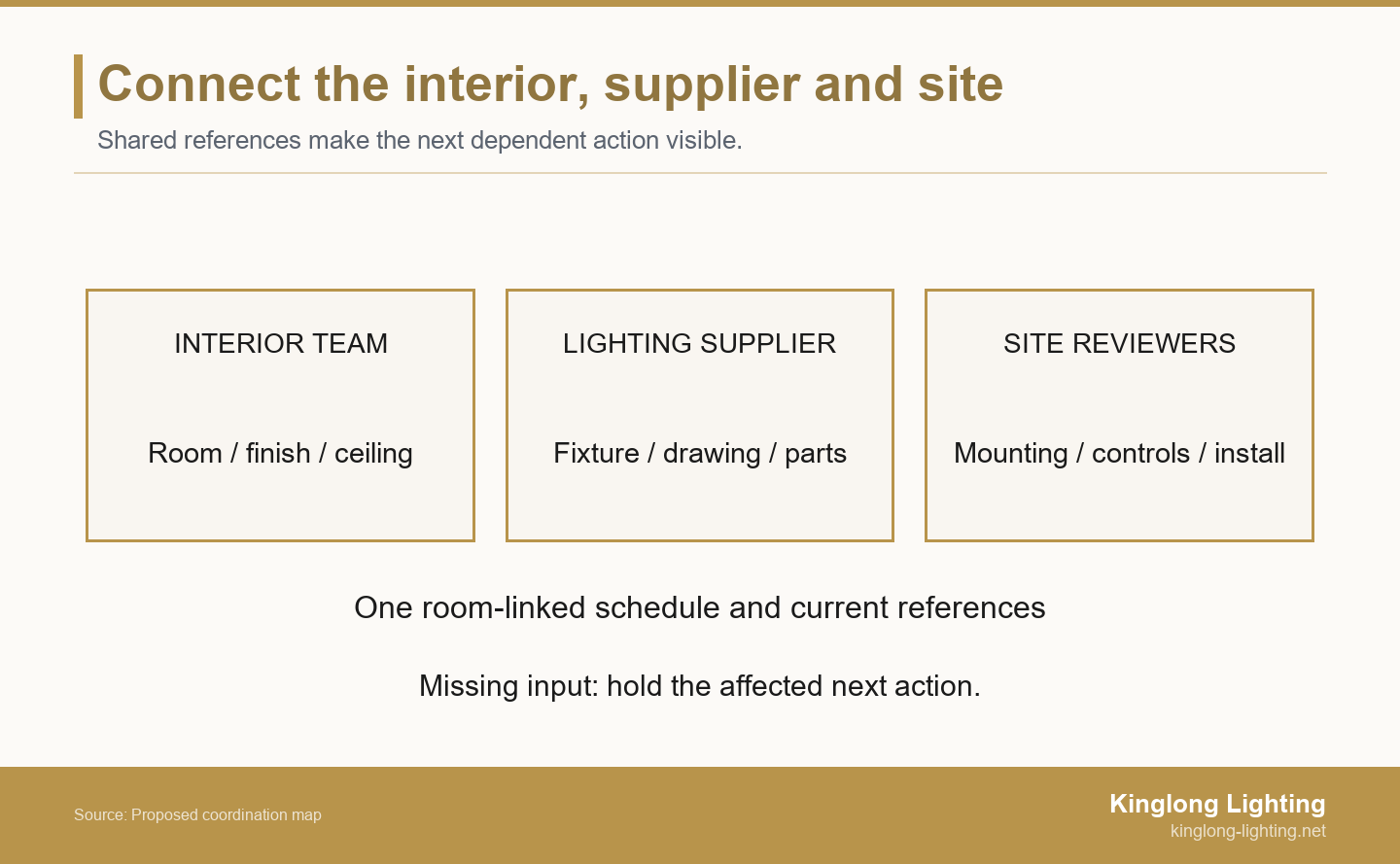
Copy the map into the project’s working record. Replace the role descriptions with actual names and link each relevant room or fixture to its current documents. “Checked output” means an identifiable result from the agreed reviewer, not a universal approval certificate. Where an input is missing, record the question and its owner, then hold the action that depends on it. Keep unrelated preparation moving only where the team has confirmed that it does not share the unresolved dependency.
| Lighting task | Required input | Interface to name | Checked output | Hold if unresolved |
|---|---|---|---|---|
| Room brief | Room use, furniture plan, mood and budget basis | Interior coordinator and owner’s decision contact | Current room scope and open questions | Definitive selection against an incomplete room brief |
| Fixture selection | Model, variant, dimensions and intended placement | Designer and lighting supplier | Identified candidate and design decision | Instruction based only on an inspiration image |
| Finish coordination | Material references and relevant finish samples | Interior finish reviewer and supplier | Accepted reference and its actual coverage | Unconfirmed finish or material substitutions |
| Ceiling and controls | Current ceiling/joinery plans, mounting proposal and control details | Supplier and appointed site specialists | Reviewed interface details and remaining conditions | Affected ceiling closure, mounting or control instruction |
| Commercial scope | Room quantities, quotation, exclusions and programme assumptions | Buyer, spending approver and supplier | Comparable scope and defined spending decision | Unbounded package commitment |
| Change review | Changed drawing, component or commercial term | Coordinator and affected decision owners | Impact decision and updated references | Reuse of an approval whose basis changed |
| Delivery receipt | Packing list, fixture IDs and room allocation | Supplier and receiving party | Identified contents, condition record and discrepancy actions | Treating an unchecked delivery as complete |
| Installation handoff | Current instructions, parts record and site-review status | Coordinator and appointed installer | Room-specific handoff with unresolved questions visible | Affected installation or acceptance without required information |
Installed interiors can help a team discuss how lighting relates to furniture and finishes. Portfolio photographs do not establish a documented coordination method or prove that a proposed fixture suits your site. For visual context, review Kinglong’s published decorative lighting projects.
Use a separate record when two rooms need different decisions. A family of wall lights may share an appearance reference while the mounting background differs between a timber panel and a masonry wall. The shared visual choice does not settle both interfaces. Conversely, a changed dining ceiling does not automatically reopen an unrelated bedroom finish decision. Link the affected rows so the team can see which assumption changed and which instruction now waits.
Coordinate Fixture Families and Finish References
Room and fixture IDs, a controlled reference set and specifically scoped finish samples help the team compare low-quantity variants without assuming one approved sample proves every material and room combination.
Give every selected fitting a stable identifier, including small quantities and special variants. Record the supplier model separately from the room assignment, so a model change does not erase where the fitting belongs. For related pendants, table lamps and wall lights, describe what should be consistent: visible metal tone, glass character, shade material or another design relationship. Record intentional differences as well. Coordinated interiors do not require every fixture to be identical.
A finish name such as brushed brass is insufficient on its own when the interior combines handles, metal trims and lighting from different sources. Have the designated reviewer compare the relevant references under agreed viewing conditions and state which sample governs which part. If the accepted reference covers a metal frame, do not silently extend it to glass, fabric or another supplier’s hardware. Keep the accepted sample identifier with the drawing, and ask for a clearly identified alternative when the proposed material changes.
Close this part of the schedule with a concrete candidate, its proposed variant, the current drawing and a recorded finish question where necessary. When building a coordinated selection, identify actual models from Kinglong’s decorative lighting collections. A collection page starts the discussion; enquiry-specific dimensions, finishes and availability still need confirmation with the supplier.
Resolve Ceiling, Joinery and Controls Interfaces
Bring current ceiling and joinery drawings, proposed fixture dimensions and mounting information, and relevant light-source and control details to the appointed reviewers before treating the interface as settled.
Check the location against the actual interior arrangement. The center of the room, the center of a ceiling feature and the center of the furniture may be different points. Show the intended relationship on the current drawing, including nearby joinery, doors or other fittings where they affect the choice. Ask the supplier for the relevant fixture and canopy details. Give the appointed electrical or structural reviewer the information needed to assess the proposal; the coordinator’s drawing compilation is not that technical assessment.
UL Solutions’ marking and application guidance explains how certification and marking information helps assess UL-certified equipment for a particular installation. This does not establish that a proposed Kinglong fitting is certified. Request evidence for the actual configuration and destination where applicable, and have the appointed reviewer identify what remains necessary for the project. A generic certificate name cannot close a missing mounting detail.
Control coordination is another dependency, where one answer relies on another input. Asana’s explanation of project dependencies describes a task relying on another task’s completion before it can start or be completed. Applied to lighting, give the electrical reviewer the proposed light source, driver where relevant and control model, rather than only a request for “dimmable lighting.” Ask who confirms the combination and what information supports the answer. This task-planning principle does not prove product compatibility. Keep that question attached to the affected fixture; an accepted finish does not answer it.
Ask for a Comparable Supplier Scope and Delivery Plan
Ask the supplier to return the same identified scope with deviations, exclusions, information dependencies and delivery assumptions so the interior company can connect the proposal to the wider programme.
For a package containing many designs in small quantities, a total price alone makes changes difficult to trace. Request room or fixture references, quantities, proposed materials and finishes, and the particular drawing basis. Separate fixture supply from samples, delivery, installation, site support or other items where they are not included. Record who prices excluded project-side work. A stated spending limit should identify its cost boundary instead of assuming the supplier’s quotation covers the complete installed interior.
ICC’s Incoterms rules clarify delivery-related tasks, costs and risks between trading parties. Identify the agreed rule, version and named place where applicable, then check the quotation’s actual inclusions. That allocation does not establish the project’s installation responsibilities or select a suitable rule for the buyer.
Supplier return requested: For each room/fixture ID, state your proposed model and revision, quantity, material/finish reference, departures from the brief, included and excluded scope, outstanding information needed from us, and delivery assumptions. Identify what must be confirmed before you can confirm the next step. Keep unresolved technical and sample questions visible.
Use that response to discuss dependencies with the wider interior team. Ask which decisions affect the supplier’s proposed programme and when the site actually needs each room’s fixtures. Confirm actual arrangements for storage, room identification and receiving responsibility. Do not turn an indicative supplier date into a guaranteed interior completion date.
Work Through a Joinery Change Before Releasing the Pendant
In an illustrative three-room interior package, a dining joinery revision changes the table position and ceiling setting-out. The owner still likes the accepted pendant, but its revised location and mounting interface remain open until the current information is checked. The other rooms are a living room and bedroom. This is a constructed example, not a reported Kinglong project or a company’s documented operating procedure.
The coordinator first records the changed joinery and room drawing references against the dining fixture ID. The designer confirms the intended relationship between pendant and table. The supplier provides the applicable fixture and canopy information, and the appointed site reviewers assess the revised location and mounting proposal. The spending approver is consulted if the change alters the priced scope. Each person answers the affected question; the owner’s continued visual preference does not answer the new site question.
Suppose the revised mounting information is not yet available. Mark that input open, name the person obtaining it and hold the affected mounting or ceiling-closure instruction. Do not fill the gap with an assumed fixing detail. Once current information is returned, obtain the required site review and record its result before issuing the revised instruction. Check that the installer receives the same drawing revision. Living-room or bedroom preparation can continue only after confirming it does not depend on the unresolved dining detail.
This applies the principle in APM’s explanation of change control: requests affecting an approved baseline are captured and evaluated before being approved, rejected or deferred. The lighting-specific routing here is a practical application. Keep the earlier drawing and decision as history, then identify the revision that now governs the affected work.
If the team instead proposes a smaller or differently detailed pendant, assess the new appearance and supplier scope as well as the site interface. Use the decorative-lighting value engineering guide to structure that substitution discussion without assuming a price reduction preserves the accepted design.
Hand Over Fixtures by Room and Verified Reference
Match delivered fixture identities and parts to current room references, record condition issues and send applicable instructions and open questions to the installer; receipt does not establish technical acceptance or successful installation.
Agree who receives the shipment and what record they return. Reconcile the packing information with the fixture schedule, including room allocation, separately packed components and any discrepancies. Record visible condition issues with references and photographs for the responsible party to investigate. A delivery can be physically present while parts, identification or damage questions remain unresolved. Keep those questions attached to the affected fixture rather than giving the installer a general statement that everything has arrived.
For each room, hand over the current schedule and drawing references, applicable supplier instructions, the identified parts and the status of required site reviews. Name the contact for unresolved questions. Ask the installer to flag a mismatch before proceeding with the affected work. Keep receipt, technical review and installation completion as distinct records so a receiving signature is not mistaken for acceptance of appearance, electrical suitability or performance.
Close the handoff by reconciling what was actually installed with the current room record. Record approved substitutions and where the final instructions or relevant product information are kept. Agree with the appointed project parties what inspection, operation checks and acceptance evidence are required for their scope. The coordinator collects and routes those results; a complete folder alone does not establish that an installation has been technically accepted.
Send Kinglong the Current Interior and Lighting Brief
Kinglong’s villa page asks for a floor plan, ceiling height, preferred mood and budget. Add the current room schedule, identified fixture references, finish questions and the ceiling or joinery interfaces still requiring information. State the actual budget basis and which decisions your team has made, then contact Kinglong about the villa lighting brief.
Ask which product references, drawings or sample/detail-review materials can be provided for this particular enquiry and which further inputs are needed. That gives the discussion a defined output: clarification of the proposed product details and the materials needed for the next review. Keep your internal spending decisions and the appointed site specialists’ technical responsibilities explicit. The enquiry itself does not approve an installation or commit the package.
Frequently Asked Questions
What if the owner buys the decorative lighting directly?
Keep client-purchased fixtures in the shared schedule, and agree who obtains product information and coordinates the site interface. Identify who communicates changes, tracks delivery and supplies the installer’s documents. Direct purchase does not make the room’s ceiling, furniture or control dependencies disappear. Record the interior company’s actual agreed scope instead of assuming it includes procurement, warranty handling or technical review of every owner-selected item.
Can the interior package use several lighting suppliers?
Yes, provided supplier responsibilities stay distinct while the team keeps a shared room and fixture reference. Name which supplier provides each product, finish sample, drawing and instruction. Compare the relevant shared appearance references across suppliers, and route cross-package questions to the appointed reviewers. Do not assume one supplier warrants another supplier’s fixtures or interfaces. The coordinator keeps the dependencies visible without merging separate supply obligations.
What if the final finish sample is not available yet?
Record the finish decision as open or conditional and name the evidence and reviewer still required. An earlier photograph or sample can remain a discussion reference, provided its limits are clear. Ask what can be supplied for the actual proposed material and which decision waits for it. Do not label the finish finally accepted merely because an interior presentation or another material in the room has already been approved.
Can completed rooms proceed while another room remains unresolved?
Separate the rooms and dependencies explicitly before allowing any unaffected scope to proceed. Check whether they share a finish decision, shipment arrangement, control component or site detail that is still open. If a shared dependency exists, dividing the room list alone does not remove it. Record the scope allowed to move forward, its current references and the person authorized to give that instruction, leaving the unresolved balance visible.