Write a factory brief around the commercial job of the range: who will buy it, where it will sell, what product gap it fills and which price boundary it must meet. Then translate that job into product requirements and a consistent supplier response. Inspiration images belong in the brief, but each needs an explanation of what the factory should learn from it. A useful first brief lets the manufacturer propose solutions without silently changing the market, product family or cost assumptions.
Define the Market Problem Before the Lighting Concept
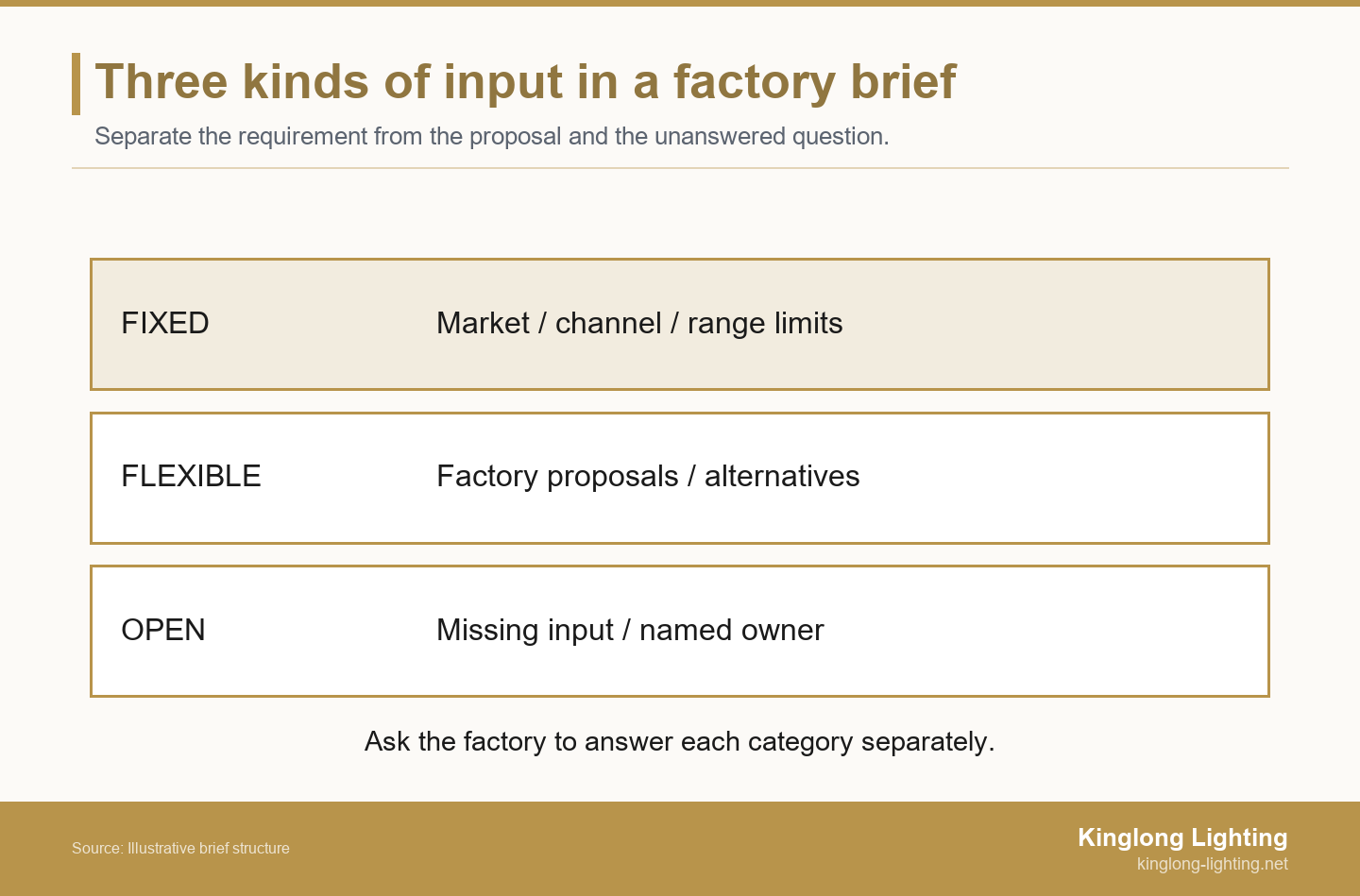
A decorative lighting factory product brief connects the target customer, selling channel and gap in the brand’s range to three categories of input: fixed requirements, flexible design choices and open questions awaiting evidence. Fixed means the concept must meet the condition to remain a candidate. Flexible means the factory may propose an alternative for review. Open means a named person still needs to supply information; it is not permission to choose an assumption unnoticed.
Begin with a short range-positioning sentence: “For this customer, through this channel, we need these products to perform this role beside our existing offer.” Add the destination countries and intended use. A showroom-led family that customers inspect closely presents a different brief from a range sold mainly through product photographs. State the actual channel priorities rather than claiming that an entire country shares one style preference.
The Design Council’s Double Diamond separates discovering and defining the problem from developing and delivering solutions. For a lighting brand, the useful lesson is to agree the product gap before asking a manufacturer for concepts. The brief below applies that distinction; it is not a Design Council factory form.
Use existing sales feedback, assortment gaps and buyer objections where they are available. Mark an untested preference as a hypothesis and name who will check it. For background terminology and preparation questions, consult the lighting design and procurement resources; the brand still supplies its own market evidence.
Copy This Decorative Lighting Factory Product Brief
Give the document a range name, version, date and product-manager contact. Complete the entries below, then mark each requirement fixed, flexible or open. Split a row when its contents have different statuses. A SKU is a separately identified product variant: distinguish the variants you want developed now from possible later extensions, so a broad family image does not become an undefined request for every size and finish.
This fillable brief covers market, user, channel, price basis, range scope, style, size, material, compliance, packaging, intellectual property and launch dependencies. For each row, write the requirement, its status and the person who will resolve any open input. Use actual references and decisions in place of the prompts; a blank technical field should remain an explicit question rather than become an assumed specification.
| Brief field | What the product manager enters | What the factory should answer |
|---|---|---|
| Market and user | Name destination countries, intended room/use, target buyer and the unmet buying need. Identify evidence separately from a market hypothesis. | Explain how the proposed concept addresses that use and identify assumptions needing the brand’s answer. |
| Channel and positioning | State showroom, distributor, retail or online route; range position; and the features the channel must demonstrate. | Show the concept in the stated selling context, including information or display requirements needing agreement. |
| Range and SKU scope | List product types, initial variants and excluded extensions. Separate launch assortment from possible future sizes or finishes. | Map each proposed item to the requested scope; identify shared parts and item-specific development. |
| Price and quantities | Enter target quotation currency, cost boundary, quantity per variant, mix assumptions and separately budgeted development charges. | Return pricing on that basis, with exclusions, quantity conditions and unresolved assumptions visible. |
| Style and references | Annotate desired silhouette, proportions, light effect and family details. Identify what may change and the origin of reference material. | Explain how the concept interprets each important characteristic; flag deviations rather than presenting them as equivalent. |
| Size and installation | Enter required dimensions and units, installation setting, adjustment needs and any known clearance constraints. Name who confirms missing limits. | Return proposed dimensions, installation assumptions and questions for the appropriate technical reviewer. |
| Materials and finish | Identify intended visible materials, finish references and appearance priorities. Separate required characteristics from supplier recommendations. | Declare substitutions, proposed finish samples and manufacturing constraints affecting the visible result. |
| Light and electrical configuration | State intended light effect, source format, supply/control requirements and service expectations, as known for each SKU. | Identify the proposed configuration, supporting information and details still requiring technical confirmation. |
| Compliance evidence | Specify destinations, intended use and requested evidence. Name the person responsible for confirming applicable requirements and reviewing the response. | Identify the model/configuration covered by available documents and any gap or proposed verification work. |
| Packaging and service | Describe distribution route, assembly expectations, branding, labeling, spare parts and after-sales needs. List uncertain transport conditions. | Propose the pack, assembly information and relevant validation plan, with responsibilities and exclusions. |
| Design work and rights | Identify supplied assets, permitted reference use and questions about new drawings, tooling, ownership, use rights and any requested exclusivity. | State the proposed development scope and issues requiring a separate written agreement before work proceeds. |
| Launch and milestones | Enter the intended launch event and backward dependencies: concept, sample, evidence, packaging, content and production decisions. | Return a dependency-based sequence, information needed to estimate timing and the decisions that could change it. |
A material row might contain a fixed visible finish and a flexible concealed construction. Write these as separate requirements rather than labeling the whole row flexible. Ask the supplier to preserve that distinction in its response. The manager can then accept a manufacturing suggestion without accidentally relaxing the feature that gives the family its identity.
Also say whether you seek a new concept from supplied design work or a variation of an existing family. Reviewing Kinglong’s decorative lighting collections can establish an existing-family reference for discussion. It does not establish that every illustrated design, configuration or customization is available for a particular branded programme.
Put the Target Price on a Comparable Cost Basis
A retail positioning statement does not define the factory’s target quotation. The product manager needs to state the currency, included cost scope, quantity per variant and any mix assumptions. Separate recurring product cost from proposed design, tooling, sample, testing or packaging-development charges. A concept that appears to meet the unit target may still rely on a different quantity or leave required work outside the price.
Keep the consumer price in the commercial context where useful, but do not ask the supplier to infer the brand’s margins or distribution economics from it. Purchasing and finance should identify the quotation boundary the factory can actually answer. If that boundary is not approved, request an exploratory proposal and mark the commercial decision open. Do not compare it directly with a supplier’s quotation against an approved quantity and specification.
ICC describes Incoterms® 2020 as allocating cost, risk and obligations between trading parties. Record the proposed trade rule, version and named location when defining the quote basis, rather than using “delivered price” without a boundary. Selecting a suitable rule for the transaction remains a separate commercial decision; the brief does not settle that choice by naming the rules.
Request an alternative against the same assumptions if the concept misses the target. For example, ask the factory to explain which concealed construction change could reduce cost while retaining the agreed visible finish. If it instead changes the product’s size or visible material, treat that as a different proposition requiring review. Keep the original requirement visible beside the alternative so price reduction cannot conceal a changed product.
Specify the Evidence Needed for the Range
Give technical reviewers a destination, intended use, SKU configuration and requested evidence, then identify who will review the factory’s reply. A certificate name alone does not answer whether the proposed item and its components are covered. Distinguish information available now from a proposed test or review that has yet to occur.
Use installation references to communicate context: the proportions, visible details and setting the brand wants to serve. The published decorative lighting projects provide visual contexts for that discussion. Project photographs do not establish a proposed SKU’s technical suitability, retail demand or distribution performance; those need their own evidence.
UL Solutions’ marking and application guidance explains how markings and certification information help assess UL-certified equipment for a particular installation. Keep that product-and-use scope in the brief: ask which configuration a document covers. This is not evidence that the new range, or every product from its manufacturer, has UL certification.
Packaging needs a similarly specific question. ISTA’s procedure descriptions distinguish screening tests that do not simulate shipping environments from simulation tests addressing transport motions, forces, conditions and sequences. Describe the actual distribution route and handling assumptions before asking the responsible specialist to propose relevant validation. “Export packaging” alone does not identify what the pack has been evaluated to withstand.
Appearance also deserves its own development question. WIPO describes industrial design as an article’s ornamental aspect, including shape, patterns, lines or color. That definition does not clear an inspiration image for reproduction. Identify the reference origin, explain the characteristics to explore and resolve permitted use of supplied assets. Agree ownership and use of new work separately, with appropriate advice where needed; an attractive reference is not evidence of permission.
Work Through an Illustrative Three-Product Range
Consider an illustrative three-product range comprising a pendant, wall light and table lamp for a brand’s showroom channel. This is a worked brief, not a Kinglong customer case. The manager fixes the shared visible finish and shade language, permits alternative concealed supports, and leaves packaging suitability open. The factory proposes an acrylic table-lamp shade in place of the requested glass, while quoting with the original packaging assumption. The substitution affects both family appearance and a pack assumption; neither change is accepted automatically.
The manager records three initial SKUs, with dimensions and electrical configurations to be entered from the brand’s actual requirements. Annotated references identify the rounded shade profile and warm metal detail that should connect the family. The response request asks for one drawing per product and a shared-versus-unique parts explanation. This gives the factory enough direction to discuss construction without inventing market dimensions or promising that the three items will sell together.
Apply the template to the returned concept. Mark the acrylic shade as a deviation against the fixed visible material, ask for a glass-based response on the same price and quantity basis, and retain acrylic only as a separately identified alternative if the brand wants to explore it. Record whether the revised response restores the shared shade language. The product manager can advance that visual direction for further development while purchasing checks the revised quotation scope.
Now follow the missing-input branch. If the supplier has no relevant packaging evidence for the proposed distribution route, keep that row open, assign a packaging reviewer and request a validation proposal. The observable result is a revised concept response with the material decision explicit and the pack question still visible. It is not a launch-ready product approval. If the brand later permits acrylic, review the altered appearance and packaging assumptions on that new basis rather than carrying forward the glass decision.
For a substitution discussion, the decorative-lighting value engineering guide offers a related way to examine design and commercial consequences. Keep the original requirement beside each proposal so the team can see what value is retained and what has changed.
Require a Factory Response You Can Compare
Ask the factory to answer each brief row with its proposed solution, any deviation, the assumptions and exclusions, the evidence available, and the next dependent action. A rendering may answer the appearance question while leaving the cost, configuration and validation questions unresolved. Evaluate those replies separately before deciding what merits the next development step.
Copy this instruction into the enquiry: “Reply against this brief version and identify each proposed item. For every requirement, state meets, proposed deviation or information needed. Describe the deviation and its effect on price, appearance, configuration or timing. Identify evidence supplied and work not included. List the information you need from us before you can confirm your proposal.” Ask for distinct alternatives rather than one proposal that mixes incompatible assumptions.
Treat launch timing as dependent on decisions. Ask what must be supplied or approved before the factory can estimate concept work, samples, verification, packaging and production. Record who provides each input and which milestone depends on it. A desired launch date communicates the commercial objective; it is not evidence that development can fit that date. Resolve the dependency before converting an estimate into an agreed programme.
What a Usable Factory Brief Makes Clear
- The market, channel and initial range scope define the concept’s commercial job.
- Fixed requirements, flexible proposals and open evidence questions receive different responses.
- Price comparisons retain the same quantity and cost boundary; deviations remain visible.
Send a Development Brief With Its Open Questions
Kinglong describes OEM manufacturing from supplied designs and ODM customization of collections, including blueprint review and sample approval steps. To discuss the development brief with Kinglong, bring the target market and channel, initial range scope, quotation basis, annotated references and open evidence questions. Use the enquiry to discuss which collaboration route fits and which inputs are needed next. Confirm the actual development scope, deliverables and timing for the request rather than assuming a prototype commitment from an initial concept discussion.
Frequently Asked Questions
What if the brand has not set a factory target price?
Ask for an exploratory costed proposal with explicit assumptions, keeping it separate from a quotation against an approved commercial target. Tell the factory which channel position and product characteristics are already known. Ask purchasing or finance to resolve the missing price boundary. The early proposal can reveal choices worth investigating, but should not be ranked as if every supplier priced the same agreed specification.
Can the same brief go to more than one factory?
A common brief can support comparison if each factory receives only material the brand is authorized to share for that development task. Keep the same version and response format across participants. Separate shared requirements from a supplier’s confidential proposal, drawings or tooling information. Where proposals differ, compare declared deviations first; distributing one supplier’s solution to another is a different action from issuing the brand’s common brief.
Who should own the brief inside a lighting brand?
Give one product or category manager responsibility for the current brief, while naming colleagues who decide commercial, technical and design questions. The document owner maintains the version and consolidates responses; that does not make the manager the qualified reviewer for every technical question. Record changes from each decision-maker in one controlled update so the factory does not receive contradictory instructions from parallel email conversations.
Does the brief still matter after the first order?
Keep the approved brief as a versioned reference for replenishment and iteration, recording proposed changes before treating the next batch as equivalent. Identify the approved product configuration and the scope of any new component, material or finish proposal. Route the changed item back to the appropriate reviewer. This preserves the distinction between continuing the approved range and developing a revised version with different assumptions.