
A flexible MOQ for project lighting is a project-specific agreement about what can be made at the required quantity and which tooling, material, setup or packaging commitments remain. It is not an unconditional promise to manufacture any design in any quantity. For an FF&E procurement manager, the useful question is therefore not simply “Can you lower the minimum?” It is “What creates this minimum, and which change would actually remove it?” A fixture schedule can stay small while its upstream purchases or development costs remain substantial.
Negotiate the Constraint, Not Just the Fixture Count
MOQ means minimum order quantity. Before negotiating it, identify the object being counted: a complete luminaire, a purchased component, a finish batch or a packaging item. A lower fixture quantity can still require an upfront charge or excess component purchase; paying a charge does not automatically remove a technical minimum. Separate a supplier’s commercial acceptance condition from a process that cannot produce the requested result at the proposed scale.
- Ask for the minimum in its actual unit, not an unexplained factory-wide number.
- Keep one-time development and setup charges distinct from the price of each finished fixture.
- Combine designs only where their purchased parts or processing requirements are genuinely compatible.
- Accept residual material consciously, with an agreed cost and disposition, rather than ordering unwanted finished lamps.
Separate Finished Fixtures from Purchased Components
Keep the number of finished fixtures separate from the quantity of each purchased component. A quotation that says “minimum quantity” is incomplete until it identifies which of those quantities it means.
This distinction also appears in production-planning terminology. Microsoft Dynamics 365 distinguishes a minimum order quantity from an order multiple, with separate quantity settings for purchase, inventory and sales orders. A minimum sets a floor; a multiple restricts the increments in which an order is planned. These are software definitions, not evidence of Kinglong’s order policies.
For a lighting package, ask the supplier to identify the relevant part number, purchase unit and consumption per fixture. A shade bought individually, metal bought by sheet and coating bought by weight cannot be compared as though each were a finished lamp. The buyer also needs to know whether the quoted purchase allowance includes expected production losses or replacement parts.
Start with an exact fixture schedule rather than a total project count. Separate locations, dimensions, materials, finishes and electrical configurations; mark which alternatives the designer may consider. The lighting specification and procurement resources can help frame the supporting specification questions before quotations are compared.
If two fixture families use different parts, adding their lamp quantities together does not establish a common purchasing lot. Conversely, if the same approved part can serve both, the supplier may be able to assess the combined requirement. Compatibility is the condition that matters, not the fact that the items appear on one purchase order.
Tooling: Separate the Upfront Investment from the Run
Tooling can make a small run costly without making it physically impossible. The important distinction is between creating a dedicated production asset and repeating the manufacturing operation.
In its injection-molding cost guidance, Protolabs explains that upfront mold design and machining cost is spread over more parts as quantity increases. That establishes the fixed-cost mechanism for injection molding; its production quantities and tooling choices are not benchmarks for custom decorative lighting.
Identify What the Tool Actually Does
Ask which component or operation needs dedicated tooling before agreeing how its cost is charged. “Tooling” might refer to a mold, a forming tool or a holding fixture for a specific operation; the quotation should name the actual asset rather than using the term as a general development surcharge.
Then ask which design feature makes that asset necessary. A supplier can evaluate whether an existing component, a revised geometry or another manufacturing route would avoid it. The designer should assess the resulting appearance, structural interfaces and assembly implications before accepting the alternative. Avoiding a tool is useful only if the revised fixture still meets the project brief.
Price the First Run and the Reorder Separately
Compare the first run and reorder separately, identifying which tooling charge is non-recurring and which setup charges return. Request the finished quantity, recurring unit price and separately charged development work for each option. This makes a small first order comparable with an offer that hides tooling recovery inside a higher piece price.
Also agree the tool’s identification, permitted use, storage, maintenance and reuse conditions in writing. Paying for tooling should not be treated as proof that ownership, transfer or indefinite future availability has been agreed. If a future phase is uncertain, evaluate the first order on its own rather than spreading its investment over uncommitted purchases.
Materials and Finishes: Pool Only Compatible Requirements
Combine material or finish requirements only after confirming that the component specification, process and approved appearance are compatible. Similar-looking fixtures do not necessarily use interchangeable stock or the same finishing route.
For purchased materials, identify the grade, thickness, dimensions and usable form. Ask whether stock already available to the supplier is suitable, or whether the project creates a separate purchase. If a larger purchase is unavoidable, distinguish material that will be consumed from material that remains. Any proposal to retain the remainder should identify who funds it, how it is labelled and whether another approved use actually exists.
Small material purchases are possible in some specific supply channels. Interpon offers a curated ready-to-ship powder-coating collection in small quantities through its US Mini-Packs channel with Prismatic Powders. This is not a promise of availability in China, an unrestricted custom-colour service or evidence that a particular lighting supplier uses that channel. It does show why the exact product and sourcing route matter more than a universal claim about powder-coating minimums.
A finish discussion needs more than a colour name. Put the approved substrate, surface preparation, texture, gloss and appearance reference beside the proposed batch. Ask whether differently shaped parts can follow the same process and whether the finish supplier accepts the combined load. Do not assume that one colour description allows unlike substrates or processes to be pooled.
For a design-dependent constraint, the next step is a feasibility review. Kinglong describes blueprint review for feasibility, material selection and structural optimisation within its custom lighting development scope. Use that discussion to identify which parts of the brief can change; it does not establish a pre-approved minimum or guarantee that a proposed substitution will be accepted.
Setup and Labor: Fewer Units Do Not Remove Every Operation
Reducing the number of lamps reduces some repeated work, but it does not necessarily remove preparation. Separate setup labor from assembly labor before deciding that a short run is overpriced or that a larger run is better value.
The Lean Enterprise Institute explains that the interval between production of different part numbers depends on changeover times and how many part numbers are assigned to a machine. That production concept helps explain why several variants are not equivalent to one uninterrupted run. It does not supply a measured setup time or labor rate for a lighting factory.
Ask which preparation is repeated when a size, finish or assembly configuration changes. Depending on the proposed process, the answer might involve machine adjustment, holding fixtures, work instructions or a first-piece check. The useful quotation separates that preparation from recurring fabrication, wiring, assembly and inspection. A setup charge should identify the operation it covers and whether it recurs for every release or only for a changed configuration.
There are different responses to different constraints. Paying an identified setup charge may preserve the design and low quantity. Reducing unnecessary variants may remove repeated preparation. Waiting to combine compatible work may change timing. None should be presented as a free concession: compare the accepted configuration, total commitment and actual delivery consequences.
Ask the quotation to distinguish labor that repeats for every fixture from work performed once for the run. Wiring and assembly do not disappear when the quantity falls. Have the supplier explain whether a repeated charge covers another setup, extra hand assembly or a changed inspection activity, so it is not accepted twice under different labels.
When evaluating the supplier, use published project examples to understand the kinds of installations and design contexts it presents. They can inform a relevant discussion, but a project photograph is not evidence of a particular minimum, available production slot or cost for your order.
Packaging Can Have Its Own Minimum
A low fixture quantity does not settle the quantity or cost of its packaging. Separate decorative printing from the protective structure, internal supports, identification and handling requirements of the actual shipment.
In its own packaging offer, Packhelp says its exact custom-print threshold depends on the product type and describes digital printing for listed box types, with offset or flexographic printing for larger volumes. This supports checking the product and print route rather than assuming one printed-packaging minimum. It is not a protective-packaging specification for a chandelier.
For a project rather than a retail launch, ask whether an approved plain outer pack with project labels can replace bespoke printing. That changes a presentation requirement, not the required protection. The supplier still needs to assess fit, support, component separation and the intended handling route. A smaller run should not be achieved by quietly deleting an insert or reusing an unsuitable carton.
Record any excess packaging separately from spare luminaires. If the buyer funds unused printed cartons, agree their storage or disposition and the design revision they belong to. Packaging ordered for a future phase may become unusable if fixture dimensions or delivery arrangements change.
An MOQ Breakdown to Request with the Quotation
Request a minimum in its actual unit, its reason, the quantity consumed, the residual commitment and the approved alternative. Use the following breakdown beside the fixture schedule, asking the supplier to complete the applicable rows with project-specific quantities and terms.
| Driver | Ask the supplier to identify | Alternative to evaluate |
|---|---|---|
| Purchased component | Part reference, minimum or purchase multiple, consumption and remainder | Approved common part; buy the excess without increasing finished lamps |
| Tooling | Dedicated asset, upfront charge, reuse and storage terms | Existing tool or revised geometry; retain the design and fund the tool |
| Material or finish batch | Specification, batch unit, process compatibility and residual stock | Approved stocked material or finish; pool only compatible demand |
| Setup and assembly | Preparation by operation, recurring work and repeat-release charges | Reduce variants; accept a named setup charge for the small run |
| Packaging | Protective specification, print quantity, excess packs and disposition | Approved plain packaging with identification, retaining protection |
A useful response connects the proposed concession to the constraint it changes. If removing custom printing leaves a component purchase minimum untouched, it has not solved the whole problem. Compare each revised offer against the same required fixture quantities and identify any specification changes separately.
The decorative-lighting value engineering guide provides a broader way to evaluate design alternatives. Use it when an MOQ-related redesign is proposed, so a lower commitment is weighed against the function and appearance that the project is trying to preserve.
Illustrative Order: 20 Fixtures, 24 Purchased Components
In this illustrative order, eight pendants and twelve wall lights each use one compatible component, giving twenty components consumed from a hypothetical twenty-four-component purchase lot and four components left over.
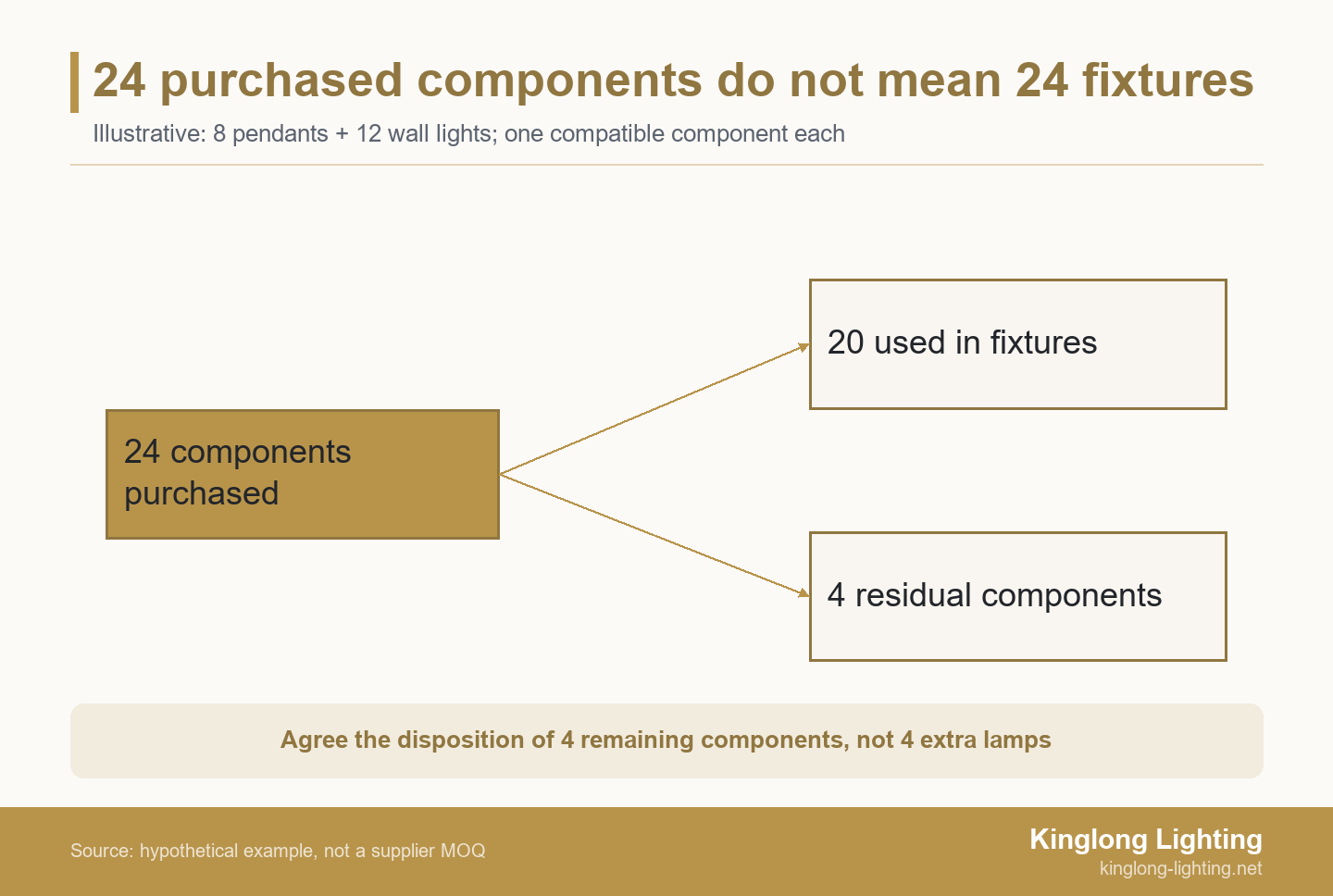
The arithmetic is 8 + 12 = 20 finished fixtures, then 24 − 20 = 4 residual components. Assume the common part has been approved for both designs and all purchased components are usable; no process-loss allowance is included. These quantities explain the distinction, not Kinglong’s minimums or an actual order.
The buyer can now ask for comparable options. One keeps the specified component and pays for the purchase lot, with the remainder’s ownership and disposition agreed. Another uses an approved stocked alternative if the supplier can propose one. A third revises the design to remove the constrained part. Each option still needs a price for the required 20 finished fixtures; the original lot should not silently become an order for 24 lamps.
Four leftover parts are not four complete spares. Producing spare lamps would require the remaining components, finishing, assembly, inspection and packaging to be priced as well. If the parts are retained for maintenance instead, identify their configuration, storage arrangements and intended use before treating them as a useful asset.
Finally, test the common-part assumption. If the wall lights require a different dimension, the combined demand may no longer belong to one component lot. If only the finishes differ, ask which minimum applies before and after finishing. The buyer’s decision changes when the underlying unit changes; project totals alone cannot resolve it.
Give the Supplier a Quantity Brief It Can Evaluate
Prepare the fixture schedule by type and location, drawings, material and finish references, permitted substitutions, delivery groups and spare requirements for a project-specific discussion. Mark what is fixed by the design approval and what the supplier may propose changing. Include the MOQ breakdown so the discussion can distinguish a purchased quantity from a finished quantity or an upfront charge.
For a custom package, discuss the project quantity brief with Kinglong Lighting. Ask for the drawing-feasibility and material-selection review relevant to the proposed designs, then agree the missing inputs and scope for a project-specific proposal. The useful outcome is a clearly defined next quotation basis—not an assumed MOQ waiver before the design and its constraints have been evaluated.
Frequently Asked Questions
Is a minimum order value the same as an MOQ?
No; a minimum order value is a spending condition, while an MOQ is a quantity condition. Ask whether the stated value applies to the whole project, each design or each release, and which charges count toward it. A supplier might accept a small fixture quantity subject to an order-value condition, but that commercial agreement does not establish that every upstream purchase can be made in the exact quantity consumed.
Will a repeat order automatically avoid the original minimum?
No; a repeat order may reuse tooling but still face material, finish, setup or packaging constraints. Confirm that the tool remains usable and available, the configuration is unchanged and the required components are still obtainable. Request the reorder basis rather than assuming the first price minus tooling. An unchanged drawing alone does not guarantee that purchasing conditions, storage arrangements or the supplier’s commercial offer remain unchanged.
Does acceptance of a sample prove that the production quantity is accepted?
No; sample approval and agreement to manufacture the project quantity are separate decisions. A sample can demonstrate an agreed appearance or construction while using a development route that differs from the proposed production route. Confirm the accepted production configuration, quantity, charges and any remaining conditions in the commercial offer. Sample acceptance should not be used to infer a bulk-order minimum or a guaranteed recurring unit price.
Can split deliveries solve a minimum-quantity problem?
Only if the supplier accepts one committed production quantity with agreed storage and delivery terms; splitting shipments alone does not reduce it. Establish when the buyer commits to the total, who holds the stock and who pays storage, handling and extra packing or freight. If later quantities remain optional, ask the supplier to price that uncertainty explicitly rather than treating unplaced future orders as part of today’s accepted run.