A custom chandelier can look convincing in a rendering and still have an unresolved construction problem. Before seeking a committed manufacturing quote, review its geometry, weight, suspension, materials, lighting configuration and route into the building. Define the quote scope and make open assumptions visible. The useful answer is not simply “yes, we can make it,” but an explanation of what can be priced now, what needs confirmation and which proposed changes would affect the design.
Manufacturable Is Not the Same as Ready to Quote
A custom chandelier feasibility review is an early check of whether a concept can become a buildable fixture under the project’s constraints. It separates defined quote scope from assumptions: an unknown finish may permit a conditional budget, an unproven joint may need a prototype, and a conflict between the fixture and the installation route may require redesign. These are different decisions, not interchangeable versions of approval.
The review should protect the intended appearance while exposing the construction behind it. Ask the manufacturer to identify uncertainties and explain proposed alternatives, rather than silently replacing difficult details. Ask the project team to identify site conditions the factory cannot establish from a product image.
At this stage, a credible response can be conditional. “Feasible if the support arrangement is confirmed” is more informative than an unconditional promise. Neither an early review nor a quotation replaces final engineering, applicable product certification, installation planning or permission to start production.
Protect the Design Intent Before Changing the Construction
Separate the chandelier’s non-negotiable visual features from construction details that can change. The silhouette, proportions, rhythm of decorative elements and visible finish may define the concept. Hidden frame sections, assembly joints or the location of serviceable components may offer more flexibility.
Send annotated views rather than an attractive image alone. Mark which sightlines matter, whether supports should remain discreet and where a joint would be visible. Include overall dimensions, the intended suspension height and the relationship to nearby ceilings, walls or furniture. A perspective rendering without scale leaves the manufacturer guessing about both appearance and construction.
Invite alternatives in a format the designer can assess: original detail, proposed replacement, reason for the change and visible consequence. A thicker frame might solve a fabrication problem yet change the lightness of the composition. A modular connection might preserve the silhouette but introduce a seam that needs approval.
Lighting design resources can help develop the brief, but the project’s own annotated concept remains the reference for this review. Agree who can approve departures from it before suppliers price different interpretations.
Check the Physical Design, Not Just the Rendering
The chandelier’s geometry, support, materials and tolerances determine its construction route. Review the complete shape, not only decorative components: overall envelope, repeated-element spacing, frame junctions, hanging points and interfaces with the ceiling. Ask which dimensions are established and which depend on engineering development. A dimension that matters to appearance may differ from one that controls assembly or site clearance.
Separate Fixture Construction from Building Support
The manufacturer should explain the fixture construction and supply relevant weight and suspension information; the project team should arrange approval of the building support by the appropriate qualified specialist. Knowing how to fabricate a chandelier does not establish that the proposed ceiling can carry it.
Distinguish decorative ceiling finishes from the actual supporting structure. Request the proposed hanging-point arrangement, connection details and an identified weight basis. A preliminary estimate can inform the review, but it should not quietly become the final installation figure after materials or dimensions change.
The designer, manufacturer and installer also need a shared understanding of the ceiling interface. Who provides the support detail? Who checks the site conditions? Who coordinates access and lifting? Record these responsibilities before a quotation excludes work that another party assumed was included.
Do not resolve an uncertain support arrangement by choosing hardware from a generic online calculation. This review identifies the information and responsible specialists needed; it is not a structural design method.
Turn Materials, Finishes and Tolerances into Approval Points
Identify critical dimensions and representative material or finish samples instead of applying one arbitrary tolerance to the whole chandelier. A tolerance is the permitted variation from an agreed dimension or criterion. Frame alignment, decorative spacing and handmade surface variation may need different approval methods.
Ask what the proposed material changes: weight, visible thickness, translucency, surface texture, joining method or serviceability. A material name alone does not define the finished effect. Review a finish sample under relevant lighting, and identify whether the approval concerns color, gloss, texture or the assembled appearance.
For solid-state lighting, IES describes LM-79 measurements of optical and electrical performance under standard conditions. Such measurements can support performance assessment; they do not establish how a particular decorative surface will look in the project room. Keep measured light performance and visual sample approval separate.
This is where decorative-lighting value engineering becomes useful: compare alternatives against the design intent and the actual constraint. Do not accept a different finish or simplified element merely because it makes the first price easier to prepare.
Resolve the Light Source, Controls and Certification Scope
Review the complete chandelier configuration, not an idealized glow or a component label. For integrated LEDs, an LED driver is the electronic device that supplies power to the LEDs. Ask the manufacturer to identify the proposed light source, driver, electrical configuration and control arrangement for the destination project.
Give the lighting or electrical team the intended dimming behavior, site supply and control-system details. Ask for confirmation against the actual proposed models. “Dimmable” does not explain the control interface, minimum usable output, replacement arrangement or how the finished fixture will be assessed.
Where DALI-2 is specified, the DALI Alliance certification overview explains that certified products are listed in its public database, which buyers can use to check certification status. Check the proposed product identity, rather than accepting a generic statement about the supplier’s range.
Likewise, UL’s lighting guidance distinguishes certification of complete end products from recognition of components for use under conditions of acceptability. A recognized component is not, by itself, evidence that the assembled bespoke chandelier has the required end-product certification.
Before price comparison, ask what evidence applies to the proposed complete fixture and destination. Record unresolved assessment costs or design changes as assumptions. Review heat management and access to electrical parts with the manufacturer and qualified project specialists; do not infer either from the rendering.
Prove That the Chandelier Can Be Delivered and Serviced
A chandelier’s feasibility depends on shipping, site access, assembly and maintenance as well as fabrication. Review these as separate constraints. A fixture that can be built in one piece may need a different construction route to pass through a loading entrance, lift or finished corridor.
Ask for the proposed module arrangement and the largest item to be moved on site. The project team should provide the relevant route dimensions and identify changes expected before installation. A clear entrance today may become restricted after doors, ceilings or finishes are installed.
For a modular chandelier, ask how parts are identified, protected, connected and checked during assembly. Confirm whether specialist factory support is included or whether the local installer is expected to assemble from instructions. Review the visual effect of joints alongside their practicality; packaging decisions can change what appears in the finished room.
ISTA’s test-selection guidance connects packaging-test selection and interpretation to the actual distribution environment, handling and storage. The useful question is therefore what packaging evidence suits this product and shipping route—not whether a supplier can mention a test name. A test result is not a guarantee against every transport event.
Finally, review access after installation. Can decorative elements be cleaned or replaced without dismantling the entire fixture? Can electrical parts be reached with the planned access equipment? Record replacement-part references and responsibility for future servicing. An elegant appearance that depends on inaccessible components needs further development before a reliable manufacturing scope is agreed.
Make the First Review an Answerable Brief
Send one revision-controlled information set, with open decisions clearly identified. Name the person who can approve each change. The following brief makes it easier to distinguish a missing input from a genuine conflict.
| Review item | Information to provide | Answer to request |
|---|---|---|
| Concept and geometry | Annotated views, dimensions and protected features | Proposed construction and visible changes |
| Weight and suspension | Known support conditions and project reviewers | Weight basis, hanging arrangement and open interfaces |
| Materials and finishes | Material intent and physical or visual references | Available process, sample needs and proposed alternatives |
| Tolerances | Critical dimensions and appearance priorities | Measurable acceptance points and approval method |
| Light source and controls | Destination, supply and control requirements | Actual configuration and applicable evidence |
| Access and maintenance | Site route and future servicing constraints | Module sizes, assembly and component access |
| Packaging and installation | Shipping route and installer responsibilities | Protection, instructions and support inclusions |
| Commercial scope | Quantities, project timing and unresolved choices | Quote assumptions, exclusions and next approval points |
Kinglong’s customization process describes blueprint review for feasibility, material selection and structural optimization. For a project inquiry, use that drawing-review stage to discuss the proposed fixture construction; keep building-support approval with the project’s appointed specialists.
If a key input is unavailable, state who will obtain it and whether it could change the priced design. “Awaiting ceiling information” is an open item, not proof that the chandelier cannot be made.
How a Review Can Preserve the Concept Without Freezing Every Item
Keep uncertain design decisions attached to the affected items. A project fixture package can contain both defined repeatable products and feature pieces that need engineering development. The review becomes more useful when it shows which decision blocks which quotation.
Illustrative Example: Review the Feature Units Separately
Consider an illustrative package of 12 fixtures, with 3 feature chandeliers assessed separately. The designer has selected the feature silhouettes, but the assembly route and support interfaces remain unresolved. The remaining pendants have a defined design basis. This is a planning example, not a reported Kinglong client project.
During the review, the proposed single-piece feature assemblies conflict with the agreed site access route. That is a physical conflict, not merely a missing finish choice. The designer’s protected requirement is the visible silhouette—not necessarily a single-piece internal frame. The separately defined pendants do not share this access problem, so their quote scope need not be reopened solely because the feature units need further development.
A useful response would price the defined pendant scope separately and defer a committed manufacturing quote for the feature chandeliers. The manufacturer could propose a modular frame and a representative joint sample, showing where connections sit and whether they alter the appearance. The designer could then compare the proposal against the protected sightlines, rather than accepting an unexplained simplification.
Before commitment, the manufacturer would demonstrate the relevant assembly method, the designer would assess visible joints, and the project specialists would confirm site interfaces. A joint sample would not establish the final weight, building support or electrical certification of the complete chandelier. This illustrative example shows scoped review, not an approved engineering solution: preserve the concept where possible, but verify the changed construction before treating the price as settled.
Completed-project images can inform a discussion; they cannot prove that a new size, support arrangement or material combination is feasible. For relevant visual references with comparable compositions and settings, browse published decorative-lighting projects.
Choose the Quote Basis That Matches the Evidence
Ask the manufacturer to return a defined-scope quote, a conditional budget, a prototype-first proposal or a redesign/hold recommendation. These review outcomes match different evidence states. A sample should answer its stated uncertainty; approving its appearance does not approve unrelated installation or certification questions.
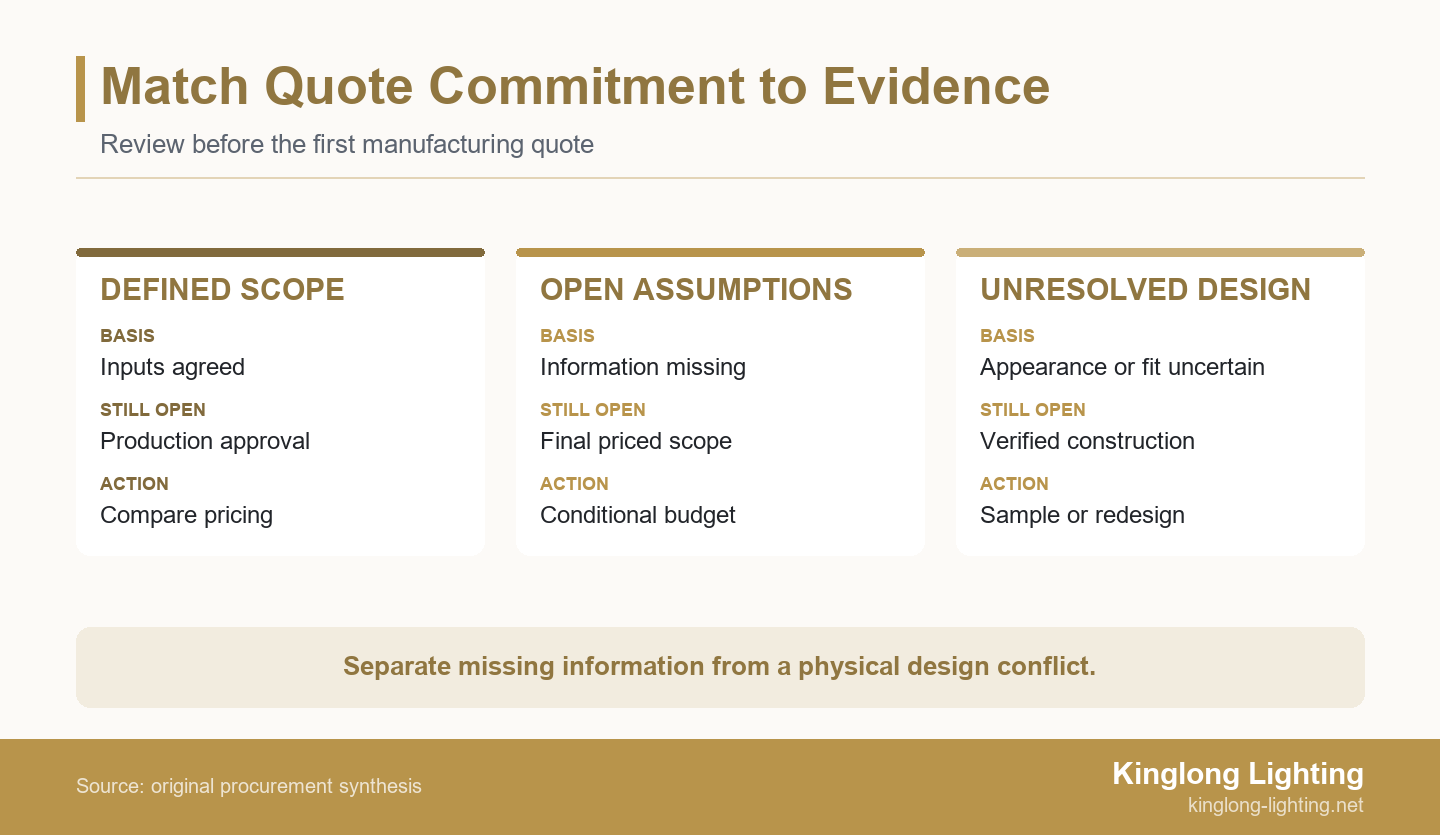
- Defined-scope quote: the priced dimensions, materials, configuration and inclusions are identified. Confirm which later approvals still precede production.
- Conditional budget: useful inputs remain open, but explicit assumptions allow early budget comparison. Identify what would trigger repricing.
- Prototype first: a representative sample or assembly is needed to resolve a construction or visual question. Specify what its approval will and will not cover.
- Redesign or hold: an identified constraint conflicts with the proposed design. Explain the conflict and the alternative to review before committing.
Certification assumptions deserve particular attention when designs change. UL’s General Coverage program description links varied luminaire designs to applicable standard requirements, documentation and production-line testing. That program description does not mean any modification automatically retains certification. Ask the manufacturer and relevant certification body to confirm the current scope for the actual configuration.
Request a marked-up concept, the drawing revision priced, an open-item list and named approval responsibilities with the quote. Compare those alongside exclusions for packaging, assembly, site work, samples and assessment. A lower figure based on an unapproved construction change is not the same offer.
Agree how the review response will be accepted. A purchasing team may use a conditional budget to assess project fit, while the designer still has a construction alternative to approve. Keep those decisions separate in the project record so a budget sign-off is not interpreted as approval to manufacture the unresolved design.
Include the concept and dimensions, material and finish references, quantity, destination, known support and access conditions, and unresolved choices. Request a review that distinguishes the defined scope from assumptions and proposed construction changes before committing to the manufacturing quote. For a project-specific starting point, send your feasibility brief to Kinglong Lighting.
Custom Chandelier Feasibility FAQ
Can I request a budget before the design is complete?
Yes, if the supplier clearly identifies assumptions, exclusions and unresolved decisions that could change the budget. Label the response as preliminary rather than treating it as a fixed manufacturing commitment. Ask which drawing revision it follows and which choices remain open. When comparing suppliers, give them the same assumed scope or identify the differences explicitly. Reconfirm the price after a material, dimension or assembly decision changes; the original budget may no longer describe the agreed fixture.
Does every bespoke chandelier need a full-size prototype?
No. The prototype should address the unresolved risk, so a component sample or partial assembly may be more useful than a full-size fixture. A finish coupon can help assess a surface, while a representative connection can help review a visible joint or assembly method. Define the question before choosing the sample. If the unresolved issue concerns overall scale, light distribution or the complete assembly, a smaller sample may not answer it. Agree the acceptance scope and any remaining verification separately.
Can an existing approved design simply be scaled up?
Not safely by assumption: a size change can alter construction, electrical configuration, shipping and installation requirements. Treat the existing design as a reference, not automatic approval of the enlarged version. Ask the manufacturer to identify what stays unchanged and what needs review, then update the project’s support and access information. Keep evidence tied to the actual proposed configuration. A photograph or report for the original fixture does not establish every condition for a different version.
How can I share a concept without giving away unrestricted design rights?
Agree the permitted use, ownership and sharing limits before sending detailed concept files to a manufacturer. Identify whether the material is your original work and whether third-party rights restrict its use. Ask who may access it for feasibility review, what may be shared with subcontractors, and how proposed engineering changes will be documented. Use an appropriate project agreement and obtain legal advice where necessary. A quotation request alone is not a clear statement of unrestricted reproduction rights.