
When a decorative-lighting supplier presents a portfolio full of recognizable hotels, resort interiors, or polished lobby images, it is tempting to read the display as completed proof of capability. It is not. A project name can show that a project exists; it may also signal a relationship worth investigating. It does not, on its own, show what the supplier designed, supplied, installed, was permitted to disclose, or can repeat for the fixture package in your brief.
For a hotel owner representative, developer, or project procurement team, the useful question is not “Is this portfolio impressive?” It is “Which part of this portfolio claim is supported, by whom, and how relevant is it to our quoted lighting scope?” The method below turns a broad impression into a controlled shortlist record without demanding that a supplier disclose confidential customer information.
A project name is a lead, not a verified supplier reference
Treat every portfolio entry as a bundle of claims. First, the project may be real. Second, the supplier may have had some involvement. Third, that involvement may or may not cover the fixture family, finish, volume, or delivery phase that matters to your current decision. These claims need different evidence.
That distinction is practical. A factory might have supplied one decorative element, developed a prototype, manufactured a defined package, or merely photographed a space where its work was not the quoted feature. None of these possibilities is automatically negative. The risk appears when the buyer turns an undefined relationship into full credit during supplier selection.
- Give a portfolio entry verified status only when its evidence is relevant to the current package and its open fields cannot change the shortlist decision.
- Give it provisional status when it is promising but still needs one specific role, scope, permission, or corroboration link.
- Give it do-not-count-yet status when the supplier cannot identify its role or the claimed fixture scope.
For FFE (furniture, fixtures, and equipment) procurement, this prevents a portfolio from silently becoming a substitute for the project brief, drawing review, sample process, or commercial evaluation that still has to happen.
Use a five-field evidence ladder: checks for a supported portfolio claim
An evidence ladder is a sequence of checks that shows how much of a portfolio claim is actually supported. For a decorative-lighting factory, use five fields: supplier role, fixture scope, disclosure permission, public corroboration, and product or visual match. The ladder is an illustrative buyer framework, not a certification standard; its value is that each open field has a different next question.
In formal procurement, prior examples and suitable references are assessed for relevance and proportionality, rather than simply collected for volume. U.S. federal guidance also treats past performance as information for future source selection, with substantive dimensions beyond a project association. Those systems do not set private lighting-project rules, but they support a disciplined buyer habit: ask for evidence that is relevant to the decision in front of you. Read the UK selection-stage guidance and the U.S. past-performance standard.
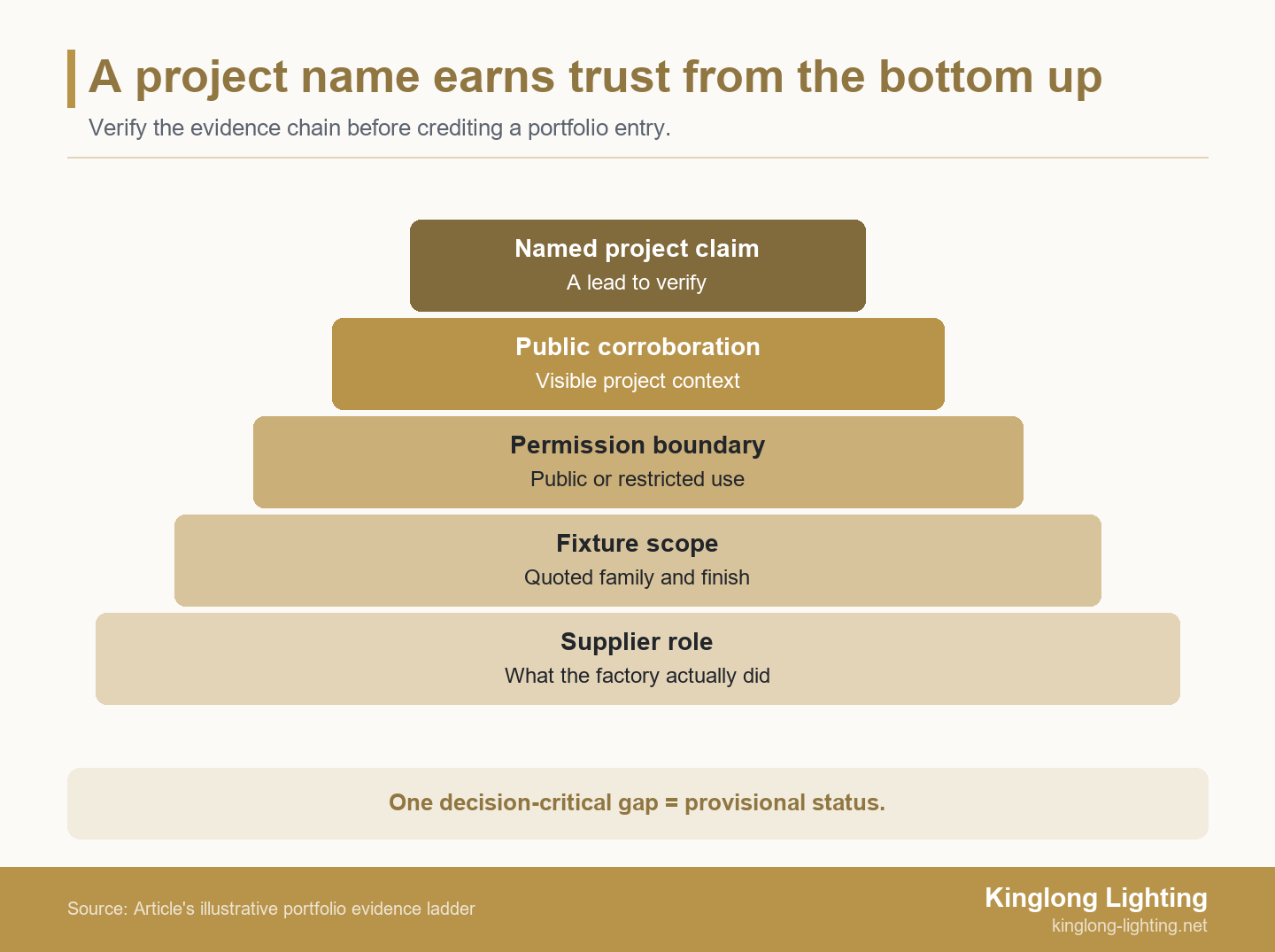
Start at the bottom. If the factory’s role is unclear, a beautiful project photo cannot repair that gap. If its role is known but the fixture family is not comparable to your brief, the reference may be true yet still weak for the current purchase. Permission and public material then establish what can be shown or checked openly. The final field—product or visual match—helps the buyer ask whether the photographed item is plausibly the same type of decorative lighting being quoted, not whether the room happens to have a similar style.
First, connect the claimed role to the quoted fixture scope
Ask the supplier to name its role in plain language: design development, production, supply, installation coordination, or another defined activity. Then ask for the relevant fixture family, finish, project phase, and an identifier that connects the claim to the record it can show. A project name without this link is not comparable experience; it is an untested association.
A useful request is narrow: “For the feature pendants in this named project, what did your team supply, which drawing or product identifier applies, and which finish or material reference can you link to the quoted family?” A poor request is “Send more cases.” The narrow version can be answered, reviewed, and recorded against the actual hotel or commercial brief. Kinglong Lighting can receive a defined package rather than a general style preference when buyers organize the fixture and finish inputs for a customization discussion.
Then separate permission to disclose from proof of performance
A supplier may be allowed to name a project publicly, allowed to show restricted material only to a prospective buyer, or not allowed to identify the customer at all. Those are disclosure conditions. They do not prove the supplier’s performance, and a strong record of work does not automatically create public permission to use the customer name or images.
UK public-procurement guidance on references makes a related point: comments about supplier performance should be supported by contemporaneous records, while subjective praise should be treated cautiously. That guidance does not decide a hotel’s confidentiality terms, but it is a useful prompt to record both the evidence and its permitted use. Read the public-reference guidance.
Use three labels in the shortlist file: public for material a buyer can independently view; restricted for material shared for this review under a stated boundary; and unavailable where the claim cannot be supported. Restricted evidence can still be useful, but it should never be rewritten in a proposal as a public case study.
Use public material to corroborate a claim, not to fill its missing scope
A public hotel webpage, architect post, or supplier projects page can be valuable corroboration. It may confirm that the property exists, show the design context, date the visible environment, or reveal whether the photographed decorative element resembles the claimed family. It cannot independently prove which supplier made that item, what percentage of the lighting package it handled, or whether the image came from the relevant delivery phase.
A sound reference review therefore pairs public context with a supplier-specific record. U.S. procurement rules call for relevant information that accurately depicts performance and is based on objective facts supported by contract or order data; responsibility standards also treat performance record, experience, and operational capability as distinct considerations. The rules are not a private-project checklist, but they reinforce the difference between visible context and evidence tied to actual work. Read the objective-evidence requirement and the responsibility standard.
| Portfolio signal | What it can support | What it cannot settle alone | Useful next request |
|---|---|---|---|
| Named hotel or resort | The project exists and is a possible reference lead. | The factory’s role or relevant package. | Name the supplier role and fixture family. |
| Interior photograph | Visible setting, approximate style, and design context. | Product source, finish record, or delivery scope. | Link an item to a drawing, product code, or schedule. |
| Customer permission statement | How the supplier may disclose or share material. | Whether the work performed well. | Provide a record-backed role and scope summary. |
| Public projects page | Publicly available context for a buyer review. | Unstated supply percentage or technical equivalence. | Cross-check visible information with the quoted package. |
Apply this test to any supplier, including material on Kinglong Lighting’s site. Ask the same role-and-scope questions rather than assuming that a public image settles them. That keeps the supplier standard consistent and protects the buyer from both over-crediting and unfairly dismissing a valid but confidential reference. To practice that limited review, compare the available public project information.
Ask for the smallest evidence pack that can change the decision
Once a field is open, request only the evidence needed to resolve that field. This is faster for the buyer and safer for the supplier’s customer confidentiality. The request should identify the project reference, the precise claim, the evidence owner, the allowed sharing boundary, and the decision that the material can change.
A supplier’s past-contract performance is a more useful signal of reliability than a broad assertion of association. That is the premise of UK guidance on taking account of supplier past performance. In a decorative-lighting review, translate the principle into a scope-matched request rather than a demand for a full client file. Read the past-performance policy note.
- Claim: “Supplier manufactured the guestroom pendant family for this project.”
- Scope link: a drawing, product code, approved finish, schedule excerpt, or other record that connects the claim to the fixture family.
- Role and owner: the supplier’s defined role and the person who can explain the record.
- Permission boundary: whether the material is public, restricted to buyer review, or cannot be shared.
- Resolution condition: the reason the item becomes verified, remains provisional, or is removed from portfolio credit.
For a hospitality brief, it is helpful to define the application context before requesting proof. Teams can review hospitality lighting application inputs and then ask about the comparable space, fixture family, finish, and decision stage. That avoids asking a supplier to prove a generic “hotel experience” when the real question concerns a particular decorative lighting package.
Composite example: a real hotel name, but an unverified fixture claim
Why this reference remains conditional
This composite example is not a Kinglong Lighting case and does not identify a real hotel. A hotel owner representative and an FFE team are shortlisting two decorative-lighting suppliers for a 96-room boutique-hotel renovation. The illustrative package contains 6 fixture families: a feature pendant group, corridor wall lighting, guestroom decorative pendants, and three supporting types. One supplier submits a polished portfolio entry with a luxury-hotel name, room photographs, and a statement that it handled “decorative lighting.”
The entry shows room photographs but no fixture-family schedule or stated supply scope. The named project is publicly visible, yet the supplier cannot identify whether the images depict its supplied pendants or another decorative element. A restricted project document names a similar fixture family, but the disclosure permission is limited to buyer review and not public citation.
The entry is neither disproved nor verified. The public page supports project context; the restricted document may support a limited scope discussion. Neither closes the role-to-fixture link that would make the reference comparable to the current package. The team records a provisional status instead of giving the supplier full portfolio credit or rejecting the claim because customer information is restricted.
The missing evidence is specific: one scope-matched record must connect the supplier role, the named fixture family, and a permitted way to confirm the relationship. The buyer asks for that record, the person who owns it, and the disclosure boundary. If that evidence closes the decision-critical gap, the reference can move to verified. If it does not, the supplier may still remain in the wider shortlist on other evidence, but this entry stays provisional and is not counted as verified project proof. This composite example is a teaching framework, not an assessment of any real factory or a prediction of project performance.
Record a conditional shortlist status instead of forcing a yes-or-no judgment
A conditional shortlist status is not indecision. It is a concise statement of what is known, what remains open, who owns the next evidence request, and what would change the decision. This protects the buying team when several stakeholders see the same attractive portfolio in different ways.
Use a one-line status for each reference: “Project context public; supplier role unverified; fixture scope pending drawing identifier; restricted evidence owner named; no portfolio credit until scope link is confirmed.” The line makes the next meeting more useful because it asks a resolvable question. It also keeps the factory from being asked for irrelevant or prohibited customer information.
If your team is evaluating a decorative-lighting brief and has identified an open portfolio field, prepare the fixture schedule, finish direction, and the unanswered role-or-scope question. Include the request for quotation (RFQ) reference so the evidence can be tied to the live package. The resulting discussion should help organize the inputs; it should not replace the buyer’s independent shortlist and approval process. Then request a scoped review of the fixture brief and evidence questions.
Frequently Asked Questions
Does a hotel logo on a supplier portfolio prove the supplier completed the lighting package?
No. A logo or project name may show an association claim, but it does not establish the supplier’s exact role, fixture scope, or permission to use the reference. Ask what the supplier delivered, which fixture family or phase is relevant, and what record connects that work to the current brief. Until those links are supported, treat the entry as a lead or provisional reference rather than completed portfolio proof.
What is the most useful evidence for a decorative lighting portfolio reference?
Start with one scope-matched record. It should identify the fixture family, the supplier’s role, the relevant project phase, and the permitted way to confirm the claim. A drawing identifier, product code, schedule excerpt, approved finish reference, or restricted buyer-review document can be useful when it connects those fields. The aim is not to collect the largest case file; it is to resolve the one question that changes the supplier decision.
Can a confidential project still help a buyer evaluate a supplier?
Yes. Confidential evidence can support a restricted review when the supplier states who may see it, what it supports, and whether the buyer may contact a reference or use the material elsewhere. Keep that boundary explicit. Do not turn restricted material into a public case study, and do not assume it proves more than the record actually shows. The buyer can still use it to assess a specific role or fixture-scope claim.
When should a portfolio claim move a lighting supplier onto the shortlist?
Move the claim forward when it is relevant to the quoted package and the remaining uncertainty cannot change the supplier’s shortlist status. In practice, that means the buyer has a supported role, a comparable fixture scope, a known permission boundary, and enough corroboration to avoid relying on appearance alone. A portfolio reference is only one input: technical review, commercial terms, samples, drawings, and project controls still need their own evidence.