
A custom-lighting supplier shortlist becomes defensible only when it rewards evidence that can survive a drawing revision, sample review, and project handoff—not when a low opening quote lifts an otherwise unproven supplier to the top. For an FFE procurement manager or consultant, the practical sequence is simple: first remove responses that cannot be reviewed against the current scope; then score the suppliers that remain. The comparison method below is an illustrative project method, not an industry rule. Its purpose is to make the trade-offs, unresolved gaps, and next decisions visible before price comparison takes over.
A shortlist scorecard must separate evidence from promises
For complex buying, the useful question is not “Which quote is lowest?” but “Which response gives the project the best basis for a controlled decision?” The UK government’s Sourcing Playbook makes the same distinction in a public-procurement setting: evaluation is meant to identify value, not merely the cheapest bid. A private lighting project has its own contract and approval process, but the decision discipline transfers well. A quote is only comparable when the underlying technical and commercial assumptions are comparable.
- Gate first: do not rank a supplier whose technical evidence or quoted scope cannot be checked.
- Weight the consequences: give more influence to evidence that controls engineering, coordination, and acceptance risk.
- Keep price visible: include it in the model, but do not let it compensate for an unresolved scope conflict.
- Record the reason: a shortlist needs an owner, evidence source, gap, and next action beside the total.
Set the gate before you calculate an average
A useful evaluation starts by specifying what evidence the buyer expects to see. The World Bank’s guidance on rated criteria says that criteria should be tailored to the project and that evaluation documents should state the required information, evidence, methodology, and weightings. That is a public-project reference, not a template for a private project request. Its practical lesson for custom lighting is narrower: do not score a supplier’s assertion when the project cannot review the material that would prove or qualify it.
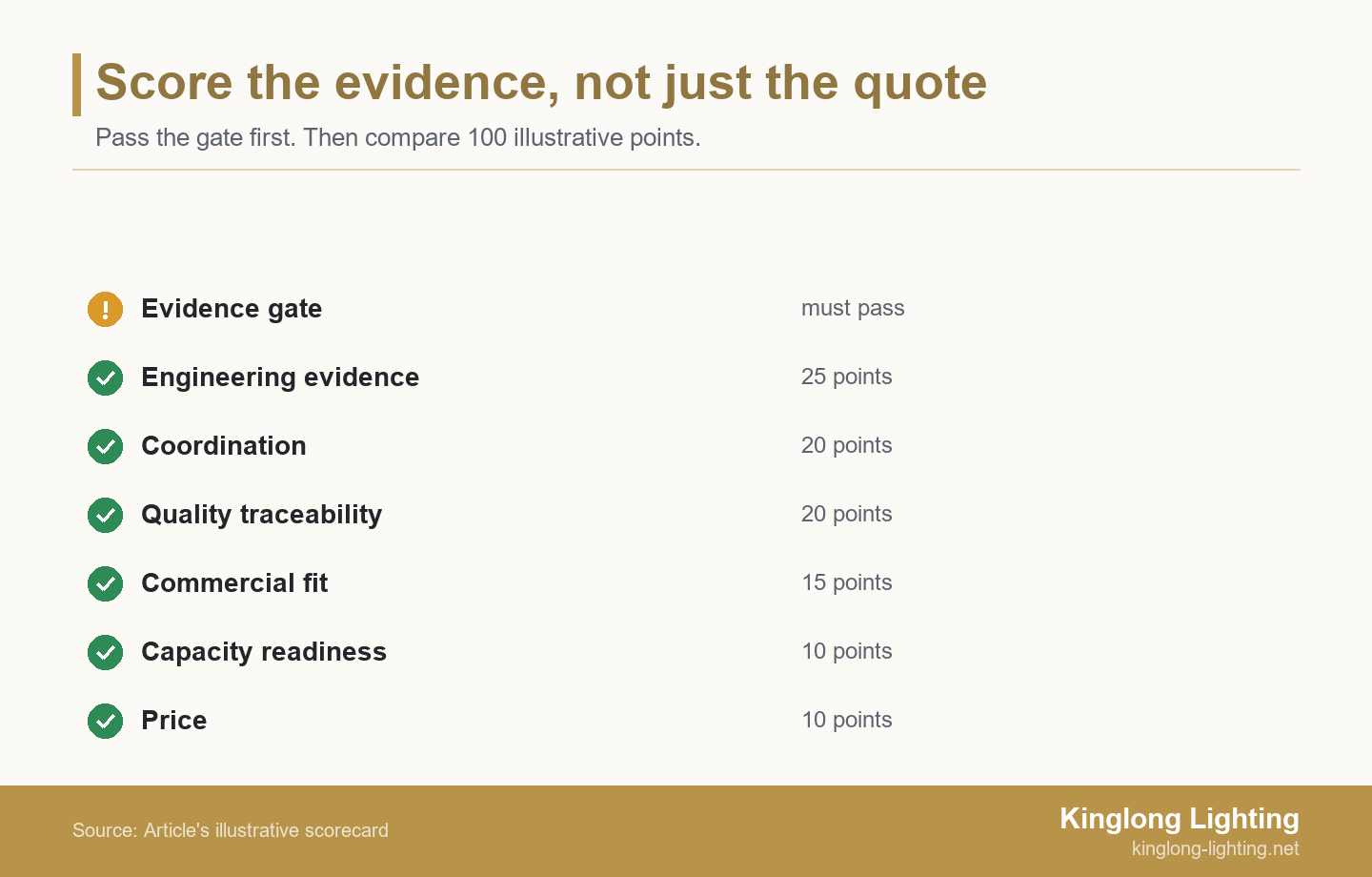
Use two gates before assigning points. The evidence gate asks whether the response can be traced to the current fixture schedule, relevant drawing or finish reference, sample identifier where one exists, and a named contact who can clarify discrepancies. The scope gate asks whether the quotation identifies the same fixture families, inclusions, exclusions, revision basis, and commercial assumptions that the reviewers are comparing. Here, the first gate means a condition a supplier must meet before its score can influence the shortlist. If either gate fails, mark the response pause for clarification; do not bury the issue in a low sub-score.
A pause should be specific and proportionate. “Need more information” creates another open loop. “Confirm whether finish F-12 in sample S-07 is the finish basis for pendant family P-3 in drawing revision C and quote line 14” creates a reviewable request. It also prevents a supplier from being penalized for a problem that has not been clearly described. The aim is not to make qualification slow. It is to stop an average from giving false certainty before the team knows what is actually being compared.
Weight six categories after the gate
Once a supplier clears the gates, agree the scoring model before reviewers compare the responses. European Commission guidance describes a sequence in which non-compliant responses are screened out before criteria of differing importance receive percentage weights in a weighted evaluation. A simpler UK government example likewise asks buyers to set criteria, a score range, and a weighting before they assess quotes. See its quote-evaluation guidance. Neither source supplies the weights below; they support the discipline of agreeing criteria and relative importance in advance.
A weighted scorecard is a comparison method that gives more points to criteria that matter more for the project. The following 100-point model is a starting point for a custom decorative-lighting package. Rate each category from 1 to 5, then calculate weighted points = score ÷ 5 × category weight. A score of 1 means the response is mostly an assertion or has an unclosed exception. A score of 3 means the supplier has provided usable but incomplete evidence. A score of 5 means the relevant evidence is current, traceable, and owned by someone who can answer the next project question. Change the weights before evaluation if the project’s actual risk requires it; do not alter them after the totals are visible.
Kinglong Lighting is a decorative-lighting manufacturer, and the same evidence questions should be applied to its project response as to any other supplier: what is the current technical basis, who owns the clarification, and which quotation line changes if the finish or drawing changes?
| Category | Illustrative weight | What the reviewer needs to see |
|---|---|---|
| Engineering evidence | 25 points | Current drawing or schedule reference, material or finish basis, sample link where relevant, and a written response to open technical questions. |
| Coordination | 20 points | A named project contact, a clarification route, and a workable way to control changes across fixture families. |
| Quality traceability | 20 points | Acceptance points and a traceable connection among approved sample, agreed requirements, and the documentation used for review. |
| Commercial fit | 15 points | A quote basis that names inclusions, exclusions, revision assumptions, and the treatment of changes. |
| Capacity readiness | 10 points | A project-specific plan for sequence, product-family coordination, and the milestones that need confirmation. |
| Price comparability | 10 points | A price that can be compared on the same scope, stated currency, commercial terms, and known exclusions. |
Give engineering evidence the highest weight
Engineering evidence receives the largest illustrative weight because it decides whether the rest of the comparison has a stable object. A supplier does not need to promise that every question is already closed. It does need to show how the current technical pack, proposed material or finish, sample reference, and quoted line relate to one another. For example, a pendant can look appropriate in a brochure yet still be impossible to compare if the drawing revision does not identify the material treatment used in the quoted option. The score should reflect that traceable link, not a broad statement of capability.
Where the project needs a supplier discussion around custom elements, the team can use the information needed to organize the custom-lighting development inputs as a prompt for its own review pack: fixture family, current design reference, finish or material direction, sample point, and questions that need a written answer. That is a service context, not evidence that any supplier meets the project specification. The buyer still chooses the acceptance criteria and decides whether the submitted proof is adequate.
Use price as a check, not a rescue score
Price belongs in the scorecard because a shortlist that ignores commercial fit is not useful. But price cannot make two different scopes comparable. In this model it receives 10 points, enough to expose a meaningful commercial difference after the gates have been cleared, but not enough to outweigh missing engineering evidence, unresolved coordination, or an untraceable acceptance basis. That 10-point limit is an illustrative choice, not a market benchmark. A project with a standardized specification may choose a different allocation; a project with active design development may choose a higher evidence weight.
Use the price row to test comparability, not just magnitude. Ask whether each response includes the same fixture families and quantities, names the same finish treatment, identifies the same exclusions, and describes its commercial assumptions in a form the team can reconcile. If the answer is no, the commercial work is still clarification. Awarding a higher price score at that stage only makes an incomplete comparison look precise.
Make the scorecard a decision record, not a ranking ritual
A total is useful only when the team can explain how it was reached. The UK government’s guidance for buyer evaluations calls for the same scoring scheme and relevant weighting to be applied consistently, and for the reasons behind scores, criteria, and weights to be documented in an audit trail. Its defence procurement guidance also lists quality, technical merit, delivery, and security of supply alongside price as possible evaluation criteria. Those are public-sector examples, but they reinforce a practical project rule: a technical, commercial, and coordination review should leave a record that a later stakeholder can understand.
Put five fields next to every category score: evidence reviewed, reason for the score, reviewer or owner, unresolved gap, and next action. This prevents a total of 74 from becoming a substitute for the conversation that produced it. It also makes an evaluator difference useful. If procurement gives commercial fit a 4 while the consultant gives it a 2, the team can identify the quote assumption that needs clarification instead of averaging the disagreement away.
Where a hospitality package is involved, the record should also name the application context that affects the decision—for example, how public-area fixture families, finish coordination, or schedule dependencies will be reviewed. The project team can review hospitality lighting requirements for a relevant application context, but that page does not replace the project’s own drawings, sample approvals, or score rationale. Keep those project-specific records in the shortlist file.
Illustrative scenario: a higher total does not excuse a document conflict
Why the higher total stays paused
Consider a composite example, not a Kinglong Lighting client case. An FFE procurement manager and consultant are narrowing two suppliers for a hotel public-area package of 48 decorative fixtures across 3 pendant and wall-light families. The schedule points to 2 finish references and a controlled drawing revision. Both suppliers have priced the package, so a price-only spreadsheet would appear ready to rank them. The scorecard changes the question from “Who is cheaper?” to “Whose response can the team actually review and carry into the next handoff?”
Supplier A totals 74 points. Its quote looks commercially attractive and its visual sample is close to the intended direction, but the sample label carries a finish code that does not appear in the latest fixture schedule. Supplier B totals 72 points. Its price is not the lowest, but it provides a drawing reference, a sample identifier, and a written quotation assumption for every family. The FFE team can identify the mismatch but has not received a signed clarification tying Supplier A’s sample to the current revision.
The two-point lead does not settle the decision. Supplier A has failed the scope gate because the team cannot trace the sample, current document, and quote line to one stated basis. Supplier B can move to the next clarification step because its review pack is coherent enough to test. The team records Supplier A as paused pending clarification, records Supplier B as advance for controlled review, and keeps the reason beside both totals. That decision is not a rejection of Supplier A; it is a refusal to let a higher average hide a document-to-sample conflict.
The pause ends only when the project team can reconcile the same three references: the sample identifier, the current drawing or schedule revision, and the relevant quotation line. Send a dated clarification request naming the relevant fixture family, drawing revision, finish code, sample identifier, quote line, and response owner. That turns a vague technical concern into a small, reviewable task. If Supplier A supplies the link, the team can update the evidence-gate status and then use its 74-point total again. If it cannot, the total remains provisional rather than becoming an accidental award recommendation.
This is a composite teaching scenario. It does not assess any real supplier, predict delivery performance, or replace a project’s contract review. Its point is operational: a gate needs a visible consequence. Otherwise, reviewers can acknowledge a conflict, assign a low note, and still let price or an average move the supplier forward without resolving the actual basis of comparison.
Turn the shortlist into a controlled next step
After the scores are reconciled, do not send an open-ended request for “best price.” Send a concise review packet that contains the current fixture schedule, the controlling drawing or finish references, the sample or acceptance points that matter, and the named reviewer who owns the next decision. An RFQ is a request for quotation; it becomes more useful when the supplier can see which documents and decisions define the requested scope. That reduces circular clarification and makes a revised response easier to score against the same model.
- Freeze the review basis: name the current schedule and revision date or code.
- List the evidence gap: identify the specific sample, material, finish, or commercial assumption that remains open.
- Name the decision owner: state who will accept the clarification and who will update the scorecard.
- Set the next comparison: tell suppliers which quoted line or evidence item will be reassessed after the response.
Kinglong Lighting is a decorative-lighting manufacturer serving overseas project, villa, and distribution channels. When a buyer has assembled the packet above and wants to discuss a defined custom decorative-lighting scope with the fixture schedule, current references, sample or approval points, and review owner, they can request a scoped custom-lighting brief review.
FAQ
What should be weighted most heavily in a custom-lighting supplier scorecard?
Weight the factors that most directly control whether the stated lighting scope can be delivered and reviewed, then assign price a visible but limited role. For a project with custom finishes or active drawing coordination, engineering evidence, coordination, and quality traceability usually deserve more attention than the opening quote. The exact allocation should follow the project’s specification, approval path, and risk—not a generic supplier checklist.
Should price be included in the supplier shortlist score?
Yes, include price only after the project team confirms that the quotations describe a comparable, reviewable scope. A price row helps the team see commercial differences once fixture families, finish bases, exclusions, and terms are aligned. If those assumptions are not aligned, the appropriate action is clarification or a pause, not a higher score for the cheapest number.
Can the highest weighted score still be paused?
Yes, the top-scoring supplier can still be paused when a required gating condition remains unresolved. A strong average cannot prove an unresolved drawing, sample, or quotation assumption. The pause should identify the exact missing link and the evidence required to close it. Once the response is traceable to the current project basis, the team can restore it to the ranking and reassess the affected score.
Who should score custom-lighting suppliers on a project team?
Use the people who own the commercial, technical, and coordination consequences, then reconcile scoring differences in one written decision record. That may include an FFE procurement manager, consultant, design representative, or project commercial owner, depending on the buying structure. The important point is not a fixed job-title list; it is that the people judging the evidence can explain their score, the unresolved gap, and the next action.