
In a hospitality lighting package, the fastest way to misroute a quotation is to treat an FFE title as a decision right. The FFE procurement vs FFE consultant question is therefore less about seniority and more about the document, deliverable, and approval that each person actually controls. A supplier should identify who owns the current brief, who accepts technical evidence, who compares commercial responses, and who can release the next commitment before treating an instruction as final.
The practical difference: authority follows the task, not the title
- Start with the live package: ask which brief version the supplier should answer and who issued it.
- Separate review from commitment: technical acceptance, commercial comparison, and release can sit with different people.
- Record a recommendation clearly: a preferred response is not automatically an instruction to proceed.
- Make uncertainty visible: quote or revise conditionally when one approval signal remains open.
This approach does not reinterpret a contract or delegation. It gives the project team a practical way to direct a supplier without asking that supplier to guess who can bind the buyer commercially.
Read the scope of services before you map the authority
FF&E delivery materials separate design, procurement, coordination, and contracting work according to the project route and scope. Public FF&E acquisition guidance and a public consulting record both show scope-bound role splits. FF&E means furniture, fixtures, and equipment used to outfit a project. A scope of services means the written work and decisions assigned to a person or firm. Those two records tell a supplier more than an organization chart does.
An official FF&E acquisition guide, for example, distinguishes design coordination, technical evaluation, acquisition activity, and contracting coordination in a project route. Its setting is public-sector procurement, not a rulebook for hotel projects, but it demonstrates why a lighting team should ask for the applicable role split rather than infer it from a job label.
Read the appointment, procurement plan, responsibility matrix, or issued package for four practical verbs: define, review, compare, and release. A person asked to define finish intent may be the correct technical contact. A person asked to compare offers may be the correct commercial contact. Neither verb proves that the same person may approve a change in price, scope, or supplier. When the project has no single role document, ask the buyer to name the owner for each verb in writing before the supplier relies on it.
FFE procurement and FFE consulting solve different parts of the supplier decision
The two functions should be compared by deliverable and decision right, not treated as interchangeable labels. Hospitality procurement commonly extends from sourcing and budgeting through purchasing, tracking, and coordination; that breadth explains why several stakeholders can touch the same lighting package. It does not make every participant the final approver. A supplier nomination is a documented recommendation to move a supplier to the next approval stage.
Hospitality FF&E procurement can span sourcing, budgeting, purchasing, tracking, and coordination across multiple stakeholders. The Beyer Brown process overview provides that bounded hospitality context.
Use the comparison below as a briefing tool. The actual allocation must still come from the project documents, because either function can be narrower or broader in a particular appointment.
| Decision dimension | FFE consultant | FFE procurement | Evidence a supplier should request |
|---|---|---|---|
| Controlled brief | May interpret design intent, schedules, finish direction, or performance needs. | May distribute the issued package and control commercial issue dates. | Current brief, revision date, and named issuer. |
| Technical response | May assess drawings, materials, samples, interfaces, and exceptions. | May collect the response and check that it is complete for comparison. | Technical acceptance owner and response format. |
| Commercial comparison | May clarify scope effects but may not own price comparison. | May normalize offers, negotiate, and maintain the comparison record. | Comparison owner, assumptions, and bid basis. |
| Supplier nomination | May recommend a technically suitable option. | May document a commercial recommendation or route it for approval. | Named recommendation record and next approver. |
| Purchase release | May be consulted on changes that affect intent or compliance. | May issue or administer the order only when that right is assigned. | Delegated release holder and matching approval record. |
Based on this comparison, send the same technical question to the evidence owner and the same commercial question to the comparison owner. Escalate only the decision that neither role can show it holds. That keeps a supplier from treating a detailed review comment as an instruction to change price, manufacturing, or delivery.
Once the route is clear, Kinglong Lighting’s hospitality resources can help teams review hospitality lighting project inputs.
A consultant often owns the evidence question before the commercial decision
An FFE consultant may define, coordinate, or technically assess the lighting evidence while remaining outside the purchase-release chain. Consulting scopes can include standards, planning, procurement support, and installation coordination, yet the assigned tasks and conditions still depend on the engagement. A public consultant task-order example from Chaffey College, together with FF&E acquisition guidance, illustrates that scope-specific distinction.
For lighting, a consultant may be the best contact for drawings, finish samples, dimensions, mounting interfaces, mock-ups, or a list of technical exceptions. Ask the consultant whether the requested response is for review, recommendation, or an approved change. Then ask who will convert that technical outcome into the commercial instruction. This protects the consultant’s design role and prevents the supplier from interpreting a sample comment as permission to alter an order basis.
That recommendation can be based on a consultant’s technical view, but it should identify the brief version, open exceptions, and the person who receives it. The resulting record is more useful than an informal statement that a consultant “likes” one option.
Procurement often owns the commercial process, but not every technical or award right
An FFE procurement function may source, negotiate, compare, and administer purchase orders when assigned, yet still need separate technical acceptance or final release. One public hotel management agreement allocates work such as evaluating specifications, negotiating price, issuing purchase orders, and coordinating freight and installation to the manager; the example is an agreement-specific allocation, not a universal hotel model. See the filed hotel management agreement and related decision-authority guidance.
Procurement may therefore be the right place to ask for the bid schedule, commercial assumptions, currency basis, delivery terms, comparison format, and purchase-order route. It may not be the right place to ask whether a changed decorative detail meets the design brief, or whether a person outside procurement has retained final approval. Formal procurement practice also separates approval to make a contract decision from earlier evaluation activity; that distinction is a useful governance analogy.
The supplier’s job is not to create a parallel approval path. It is to package the response so procurement can compare it fairly and so the technical reviewer can see each exception. When those routes diverge, label the quotation with its current document basis and the approvals it still needs.
Use a four-signal screen before the supplier treats an instruction as binding
The four signals: scope, technical acceptance, commercial comparison, and release
A written scope, technical acceptance owner, commercial comparison owner, and purchase-release authority answer different questions and should be recorded separately. Here, purchase-release authority means the authorized right to issue or approve the commercial commitment. The first three signals explain what should be reviewed and compared; the fourth confirms who may move the buyer toward a binding commercial step.
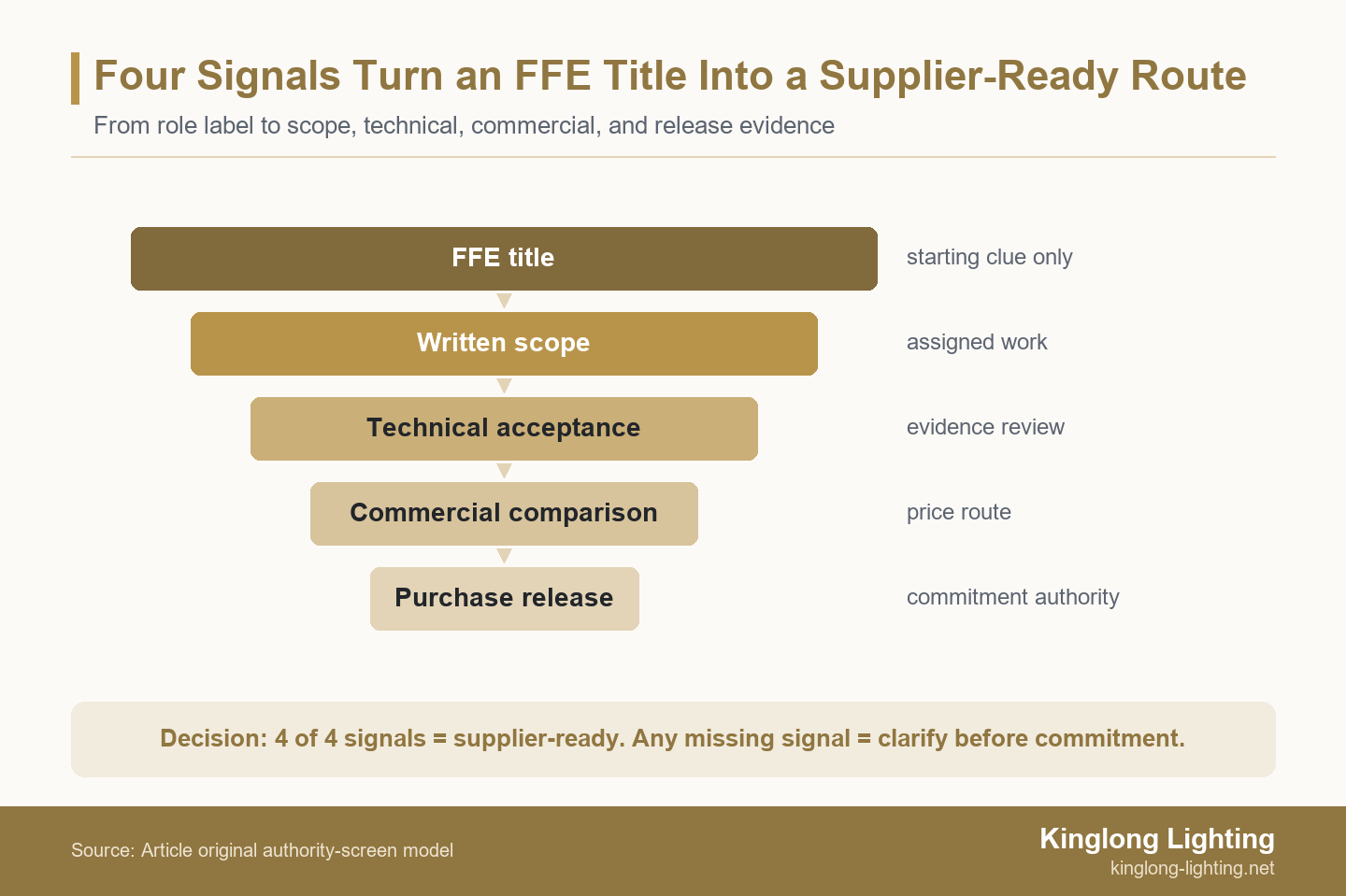
- Written scope: What exact fixture, finish, quantity, interface, and response version is being requested?
- Technical acceptance owner: Who can say the submitted evidence meets the current brief or identify a condition?
- Commercial comparison owner: Who can confirm that suppliers are being compared on the same pricing and delivery assumptions?
- Purchase-release authority: Who is named to take the next commercial commitment?
A delegation of procurement authority can be written authority that states roles and responsibilities. For example, a buyer seeking a procurement delegation from the U.S. General Services Administration must document that delegated authority. That is not a hospitality-project rule, but it supports the discipline of asking for a written signal rather than relying on position or email tone. See GSA’s delegation guidance.
A procurement approving authority can act within a formally delegated approval level. The same boundary appears in other formal systems: an authority matrix or delegated signature may establish who can take a specified procurement action, while technical and commercial inputs remain distributed. The United Nations Procurement Manual offers one such public example. Apply the question, not its policy: which project record authorizes this next commitment?
Respond conditionally until the missing signal is resolved
A supplier can progress technical or commercial work while clearly labelling the response as conditional on the unresolved approval signal. For example, a supplier can prepare drawings against a stated brief, provide an indicative commercial comparison, or reserve time for a sample review without presenting any of those actions as acceptance of a changed order.
Use plain labels: “technical response pending consultant acceptance,” “commercial comparison subject to like-for-like scope confirmation,” or “revision pending authorized purchase release.” State the document version, the open item, the owner expected to resolve it, and the consequence if it changes. This is clearer than waiting silently for a title holder to reply, and it preserves a clean route back when the scope evolves.
Illustrative scenario: a revised lobby finish splits technical acceptance from commercial release
A changed lighting line item can require a controlled reset even when both an FFE consultant and procurement manager are active. The aim is not to restart an entire package. It is to identify the affected record and reconnect it to the people who can accept the technical change and release any resulting commercial decision.
Reset only the affected decision path
The project should pause the changed lobby line, confirm technical and commercial owners, reissue the revision, and resume only on a matched record set. An illustrative 96-room hotel renovation has an FFE consultant coordinating technical acceptance and an owner-side procurement manager organizing the bid comparison. The lighting package covers 84 decorative fixtures across guestrooms, a lobby, and a lounge, with three suppliers asked to price the same issued specification. Two suppliers have returned prices, but a consultant has issued a revised lobby finish note after the comparison sheet was prepared.
The consultant’s revised note changes the visible finish reference for 12 lobby fixtures. The procurement comparison still lists the earlier finish and does not identify who may accept the revised technical response or authorize a commercial change. The title labels do not resolve the conflict: the consultant may be the right technical reviewer, while the procurement manager may own the comparison process, but neither record establishes the commercial release for the revised package.
Pause only the affected 12-fixture lobby comparison, confirm the technical acceptance owner and commercial-release owner, then reissue the revised line item to every bidder. Record the new finish reference, list the consultant’s technical acceptance requirement, and request like-for-like repricing. That lets the unaltered guestroom and lounge lines continue while the changed decision path is rebuilt.
Attach the final selection or purchase-order authorization to the corrected comparison record. Resume the affected selection only when the current brief, technical response, commercial comparison, and authorized release refer to the same lobby line item. This composite example shows a controlled reset; it does not describe a Kinglong project, a hotel client, a pricing outcome, or a universal approval sequence.
Give the lighting supplier a handoff packet, not an ambiguous title
A controlled authority-and-brief packet lets a supplier answer the right technical and commercial question without assuming buyer-side approval rights. Begin with the current issue set, an itemized fixture schedule, relevant drawings, and a short statement of what decision the response should support. That tells the supplier whether to prepare a technical clarification, a priced option, a comparison-ready offer, or a conditional revision.
Use project examples carefully. They may help a team frame questions about application context, finish direction, or scale, but they do not prove that the current project shares the same scope, approval route, or acceptance standard. Teams should return from any example to the issued brief and its named decision owners, then review lighting project examples by application context.
Then provide four named fields: the technical evidence contact, the commercial comparison contact, the person who receives a supplier nomination, and the person or function holding purchase release. Add document numbers, deadlines, and a change log for any item that could affect quantities, finish, interface, or delivery assumptions. A supplier can then keep comments, drawings, samples, and commercial alternatives attached to the correct decision path instead of spreading them across unrelated email threads.
Before a response is circulated, match every drawing, sample note, pricing sheet, and schedule statement to the same reference bundle. Mark whether the item is confirmed, conditional, or awaiting a decision. If the technical reviewer asks for a change, identify whether the commercial comparison must be refreshed and which contact should send the revised basis to all suppliers. If procurement changes a delivery assumption, show the consultant exactly where that affects the technical response. These small controls stop a valid comment from becoming an unrecorded change instruction.
For a custom decorative fixture, the brief also needs the information that makes a response testable: design intent, dimensions, materials or finish references, mounting or ceiling interfaces, sample expectations, quantity split, and any site or programme constraints already known. Before a supplier develops that response, FFE teams can map a custom-lighting development brief.
A four-item pre-quote path for FFE teams
Four named inputs let the project move from title ambiguity to a supplier-ready request. Send them together whenever the team asks for a quotation, a revision, a sample response, or a commercial comparison.
- Current brief: issue date, version, affected fixtures, drawings, and open assumptions.
- Technical route: the person who accepts evidence, plus the format and timing of that review.
- Commercial route: the person who compares offers and the basis on which suppliers should price.
- Release route: the named person or function that can authorize the next commercial commitment, or the escalation path if that authority is still pending.
Ask the supplier to repeat these four fields at the top of its response. A mismatch becomes visible before price, sample work, or production assumptions are treated as approved. If one field is unknown, specify the response as conditional and name the question that must be closed.
At the review, keep the clarification narrow. Confirm whether the current version is technically accepted, whether all bidders received the same commercial basis, and whether the next commitment is an instruction, a recommendation, or a request for further evidence. Record the answer beside the affected fixture line. That makes a revision traceable without turning every open question into a stop on the entire package.
For a scoped discussion of a hospitality or custom-lighting request, Kinglong Lighting can request a scoped authority-and-brief review.
Frequently Asked Questions
Can an FFE consultant approve a lighting supplier?
An FFE consultant can approve a supplier only when the project’s appointment or delegated authority explicitly grants that right. A consultant may still be the essential person for technical acceptance, samples, finish interpretation, or a recommendation. Ask for the written scope and the record that shows whether its role ends at review, continues to nomination, or includes a defined approval. Do not treat detailed technical comments alone as a commercial instruction.
Does procurement always issue the purchase order?
Not always; the purchase order follows the entity’s commercial process and the person or function holding delegated release authority. Procurement may prepare, compare, negotiate, or administer the order while a project director, owner representative, operator, contractor, or another delegated signatory approves the commitment. The supplier should ask who may issue the next binding instruction and make sure the quotation still matches the brief and commercial comparison used for that decision.
What should a lighting supplier ask before quoting?
Ask for the current brief, the technical acceptance contact, the commercial comparison contact, and the person who can authorize the next commitment. Request the document version, fixture list, relevant drawings, pricing assumptions, response deadline, and any known change log. If the team cannot name one of those contacts, the supplier can still offer a preliminary response, but it should identify the missing approval signal and avoid treating the result as a final commercial basis.
When should a supplier pause a hospitality lighting response?
Pause when the brief, decision owner, or approval stage changes and the team cannot identify which record governs the response. A revised finish, quantity, interface, delivery split, or commercial condition can affect only one line or the whole package. Hold the affected line, confirm who accepts the change and who releases its commercial impact, then reissue the same current basis to every supplier being compared. This limits delay while protecting comparability and traceability.