An IP rating can be useful evidence for a chandelier, but it is not a location approval by itself. The code describes a stated ingress-protection test result for a stated object and configuration. A wet-area project asks a wider question: does that result still describe the complete fixture after its canopy, cable entry, joints, mounting orientation, and real water exposure are considered? Treat the IP record as the beginning of the review, not the last line of the specification.
For a project team, the practical test is simple. Put the test report, the complete assembly drawing, and the installation exposure description side by side. If all three name the same fixture condition, the record may support the next review. If one document refers to a different object or leaves an interface unnamed, keep the location decision on hold until the gap is resolved. That discipline prevents a short IP label from carrying a claim it was never asked to prove.
Read the IP code as a bounded test result
IEC 60529 is the standard family for degrees of protection provided by enclosures using the IP Code. The key word for a chandelier buyer is enclosure: the record has value only when it identifies what was tested and how that item was configured. A report may be strong evidence for a named enclosure or protected part, yet remain silent about an adjacent cable entry, decorative body, ceiling cup, or mounting condition. The report’s scope is therefore a boundary, not a blank cheque for every part connected to it.
IEC’s public IP ratings overview helps explain why the designation should be read with its test context. IEC provides public explanatory context for IP ratings alongside IEC 60529. In plain language, ingress protection means protection against the entry of objects or water within the conditions of the stated test. The IP code is the designation attached to that test; it is not a universal description of a chandelier in every installed position. Ask the supplier to point to the tested object, the report revision, and any conditions that define the configuration before treating the code as project evidence.
This distinction matters most when an IP rating chandelier is decorative rather than a sealed utility fitting. A decorative fixture often has several visible interfaces: a canopy-to-ceiling connection, a cable entry, a stem or chain joint, a body seam, and a lower shade or diffuser. The question is not whether those features are inherently unsuitable. It is whether the evidence packet identifies the same interfaces that the project will expose.
Do not let one IP code carry three decisions
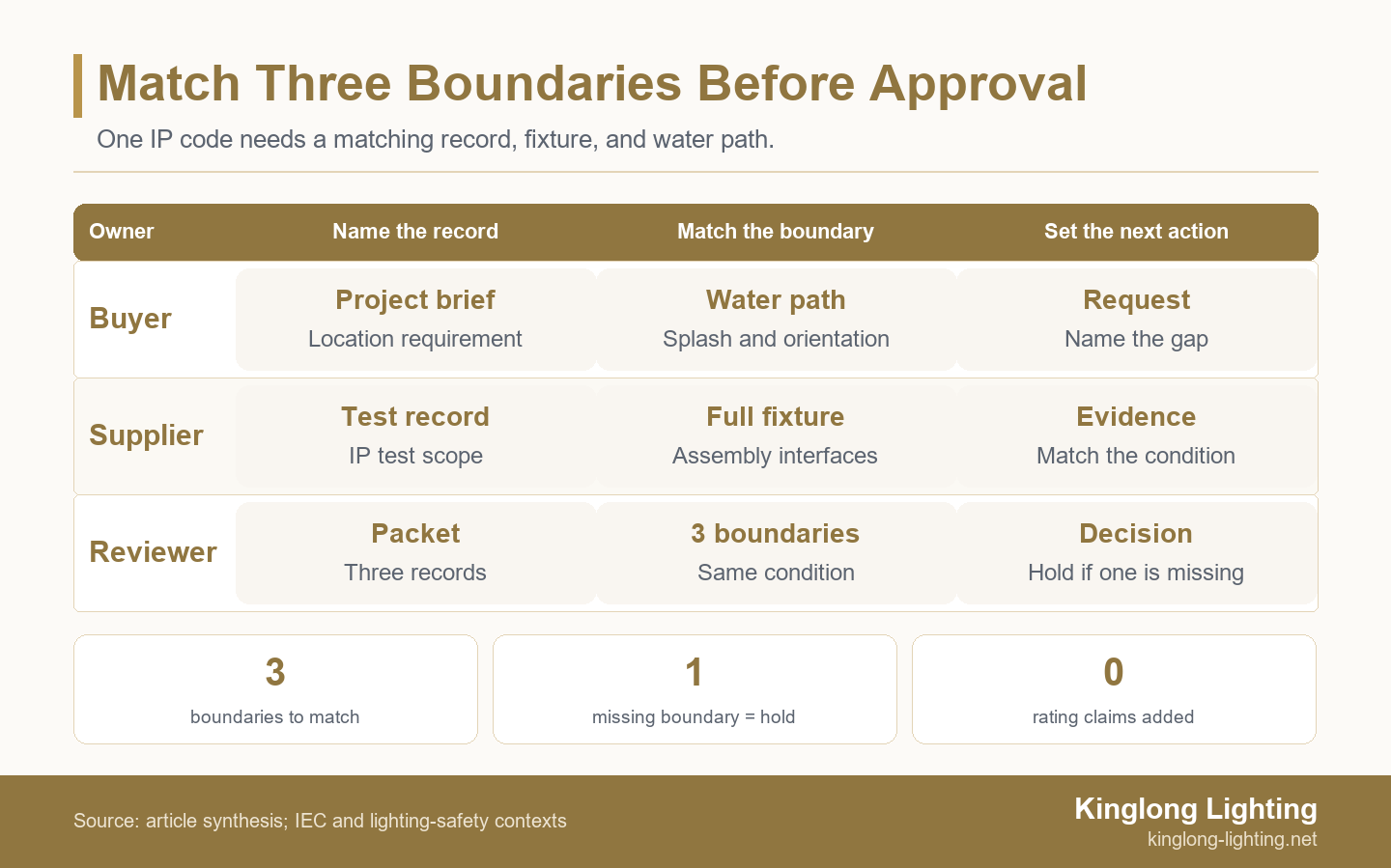
A wet-area decision requires a match among test scope, complete product assembly, and installed water path. This is a project decision aid, not a certification scheme: it asks whether three descriptions point to the same fixture condition. The test-scope boundary names what the record covers. The assembly boundary names the full chandelier and its exposed interfaces. The water-path boundary describes how water can reach those interfaces after installation. When the three descriptions align, the team has a coherent basis for review; when they do not, an IP code cannot safely fill the gap.
- Matched: the report, drawing, and installation brief identify the same relevant assembly and exposure condition.
- Partial: one record is useful, but it does not name an interface, orientation, or exposure condition that matters to the project.
- Hold: a missing or conflicting boundary could change the wet-area decision, so the team requests targeted evidence before release.
The confusion usually starts when each party owns only one document. A supplier may have a test record, a designer may have an elevation, and an electrical coordinator may know the actual water exposure. None of those papers is defective simply because it is partial. The failure comes from treating a partial record as if it covers all three boundaries. Keeping the documents separate until they are compared makes the missing condition visible early, when a drawing change or evidence request is still manageable.
An IP result is usable for a wet-area chandelier decision only when the tested scope, the supplied assembly, and the planned water path describe the same condition.
Map every water path in the installed chandelier
Project installation requirements can be separate from the scope of an enclosure test. In the United States, OSHA’s wiring-methods rule is an installation context, not an IP-code conversion table. That separation is useful for every project: an ingress record does not replace the review of how conductors, fittings, mounting hardware, and the completed fixture are installed. Confirm the applicable jurisdiction, project specification, and responsible reviewer rather than asking an IP label to answer a local installation question.
A water path is simply the route water can take toward an installed fixture interface under the actual exposure condition. Start with possible water routes: direct rain, wind-driven splash, cleaning water, roof runoff, condensation, or incidental spray. Then trace the route across the fixture rather than stopping at the visible shade. A covered entrance can still receive angled rain; a canopy may reduce direct fall but not splash from a hard surface below; and an upward-facing cup can hold water differently from a downward-facing one. Describe the exposure in words and drawings that a report reviewer can compare with the tested configuration.
That detail is particularly helpful when a decorative fixture is part of an entrance, terrace, courtyard, or covered outdoor dining area. A project team can use the Kinglong Lighting hospitality page to review a hospitality lighting project context while translating the visual brief into an exposure description. The design question and evidence question can move together without implying that a hospitality setting is automatically wet-area approved.
Use a three-record package before approving a wet-area fixture
An ingress record, a product or location record, and an installation record answer different parts of the approval decision. The first says what the ingress test covered. The second identifies the lighting-product or market context that the project may need to consider. The third describes the installation condition actually proposed. Putting all three in one review packet does not create a rating or replace a required listing; it makes the scope of each record clear enough for the responsible reviewer to see what is present and what is missing.
| Record | What it should name | Decision it can inform | What it cannot settle alone |
|---|---|---|---|
| Ingress record | Tested object, configuration, stated IP code, relevant conditions | Whether the named test scope matches the claimed protection boundary | Every installation or location requirement |
| Product or location record | Applicable product standard, listing, project requirement, or local review path | Which additional evidence the project may require | Whether a different assembly or exposure is covered |
| Installation record | Full assembly, orientation, cable entry, mounting detail, and water path | Whether the planned condition is the condition being reviewed | A missing test result or product record |
A luminaire standard context is different from simply reading an IP-code label. UL 1598 is published as a luminaire standard, which illustrates the distinction between a lighting-product standard context and an ingress designation. The article does not say which standard applies to a particular country, project, or chandelier. It does show why a buyer should ask for the record that addresses the project’s actual product and location question instead of extending a code beyond its documented scope.
NEMA publishes enclosure-type guidance. NEMA publishes guidance on enclosure types. This is another reason not to collapse different enclosure vocabularies into a single promise. Do not convert an IP label into a NEMA type, or the reverse, unless the project has an appropriate documented basis. The useful action is smaller and safer: record which terminology the project requirement uses, then request evidence that speaks directly to that requirement.
Illustrative scenario: the courtyard canopy mismatch
The illustrative courtyard scenario treats a report that identifies only one of three required boundaries as partial evidence, not a wet-area approval. It is not a Kinglong Lighting project, product rating, or certification determination. Its purpose is to show how a plausible IP44 report can still leave a project team without an answer about the completed chandelier in the place where it will be mounted. Once the missing items are explicit, the team can map the evidence into a custom chandelier specification instead of relying on a label alone.
What the project team did next
The project team holds the wet-area decision until the evidence packet names the exact complete fixture and planned water exposure. The hold is not a verdict that the design fails. It is a boundary on what the current paperwork can support, and it keeps the approval discussion tied to an identifiable fixture condition.
This illustrative hotel team is reviewing decorative pendants for a courtyard canopy where wind-driven splash can reach the lower assemblies. Design, procurement, and electrical coordination are all involved because the fixture must remain visually coherent while the water exposure is being described accurately.
The brief covers 16 pendants beneath one canopy. It asks for evidence suitable for the intended wet-area review, so the team needs records that identify the complete pendant build rather than a generic category or a single protected component.
The supplier has supplied a document labelled IP44. The project is ready to review the finish, dimensions, and suspension, but it has not yet confirmed that the report covers the entire pendant assembly in the planned mounted orientation.
First, the IP44 document names an enclosure rather than the full pendant. It does not state whether the relevant cable entry, ceiling cup, decorative body connection, and lower assembly are part of the tested object.
Second, the drawing does not state whether splash can reach the cable entry or collect near the ceiling cup. The canopy reduces direct exposure, but it does not by itself describe the route water may take after wind, cleaning, or runoff conditions are considered.
The evidence covers one of the three boundaries: a bounded test record exists. The complete fixture and installed water path remain unnamed. Calling the evidence coverage 1 of 3 does not measure product performance; it is a simple way to show that two decision-critical descriptions are still absent.
The team holds the wet-area approval. It does not reject the 16 pendants or claim that IP44 is inadequate in every setting. It pauses the location claim until the report, drawing, and exposure description can be compared as one condition.
The revision request names the full assembly, exposed interfaces, mounting orientation, and expected water path. The supplier can then provide matching product or installation evidence, clarify the tested configuration, or the project can revise the location requirement if the intended condition is outside the available evidence.
Release the location claim only when the final packet identifies the same assembly and exposure condition described in the project brief. The reviewer should be able to trace each material interface in the drawing back to an evidence record or see plainly that a separate review is still needed.
All names, counts, and decisions in this scenario are illustrative. They do not assert a supplier result, a local-code interpretation, or an outcome for any Kinglong Lighting project.
Hand over a wet-area evidence packet, not just IP44
A wet-area evidence handoff should name the test scope, complete assembly, mounting orientation, cable-entry detail, water exposure description, and location requirement. A concise packet is more useful than a long email thread because it gives the supplier, designer, and reviewer one shared object to compare. It also makes a limitation visible without turning it into an accusation: a missing document is simply a request for evidence or a reason to revise the proposed condition.
Installation documentation belongs in that handoff too. NFPA’s electrical education resources keep the electrical-safety and code context distinct from the ingress notation. The responsible local reviewer determines how that context applies to the named location; the packet makes the review more specific by stating the mounting plane, orientation, cable route, exposed joints, expected water pattern, and project requirement.
- State the project condition. Name the mounting location, the expected water exposure, and the requirement the team is trying to satisfy.
- Attach the full fixture record. Include the drawing or bill of materials that identifies the pendant, canopy, cable entry, joints, and orientation under review.
- Attach the ingress record. Preserve the report revision, tested object, configuration, and stated code rather than quoting only the code.
- Mark every mismatch. Flag an unnamed interface, changed component, different orientation, or exposure condition that cannot yet be compared.
- Assign the next evidence owner. Ask for a focused clarification, additional record, or specification change; do not ask another team to infer the missing scope.
- Set the release sentence. State that the project may proceed with the location claim only when the three boundaries match or the responsible reviewer accepts a documented alternative.
This handoff can be used during a concept review, submittal review, or final coordination meeting. It does not make Kinglong Lighting or any other supplier the authority for a local approval. After the relevant fixture condition and open questions are named, the team can request a wet-area evidence review.
Common buyer questions about IP-rated chandeliers
The FAQ preserves the difference between an ingress-protection result and a location-specific installation decision. Use the same three-boundary comparison for each question: what was tested, what complete assembly will be supplied, and what water path will the project create? If one answer changes, the earlier record may still be useful, but its scope must be checked again.
Frequently Asked Questions
Does IP44 mean a chandelier is approved for every wet area?
No. IP44 is a defined ingress-protection result, not universal approval for every wet-area assembly and installation. Before using it in a project decision, confirm that the report covers the complete chandelier, its relevant exposed interfaces, and the mounted water path. A local product or installation requirement may call for separate evidence.
What should an IP test report identify for a chandelier?
It should identify the tested object, claimed code, configuration, and conditions that defined the test scope. For a decorative pendant, compare those details with the canopy, cable entry, joints, body, shade, mounting orientation, and any exposed interfaces in the supplied drawing. If the report only names part of that assembly, treat it as partial evidence.
Can a covered courtyard use the same evidence as an exposed facade?
Not automatically. A canopy may change direct rain exposure but still allow wind-driven splash, runoff, or cleaning water to reach different fixture interfaces. Compare the actual orientation, water path, and full assembly with the report’s stated configuration. The two locations may require different evidence even when the chandelier design appears similar.
When should a project hold a wet-area chandelier approval?
Hold the approval when the report does not cover the complete assembly, an exposed interface is unnamed, the installation orientation differs from the evidence, or the expected water path has not been documented. The next step is focused: request the missing record, clarify the scope, or revise the specified condition before releasing the location claim.