Accelerated aging tests can help chandelier buyers compare material behavior in weeks instead of waiting years, but the phrase can easily be oversold. A test can accelerate selected stress factors such as UV, heat, humidity, corrosion, or cycling. It does not recreate every real ownership condition.
For decorative lighting, this is important because aging can be visual, electrical, mechanical, or service-related. Brass may change color, acrylic may yellow, leather may dry, coatings may lose gloss, LEDs may shift, and crystal assemblies may loosen. One test cannot answer all of those questions.
Kinglong Lighting can help buyers use accelerated aging evidence as part of the custom chandelier workflow, alongside samples, cleaning rules, environment notes, and replacement planning.
Key Takeaways
- Acceleration is selective: Tests compress chosen stress factors, not the full life of the chandelier.
- Failure mode comes first: Choose UV, humidity, corrosion, heat, cycling, or handling stress based on the expected risk.
- Before-and-after comparison matters: Color, gloss, haze, cracking, and deformation should be documented visually.
- Weeks are not automatically years: Correlation depends on material, method, environment, and acceptance criteria.
- Results should guide use boundaries: Evidence should shape finish choice, maintenance, warranty language, and replacement rules.
Choose the stress by the likely failure mode
Accelerated aging should reveal how a material fails, not pretend to fast-forward the whole building.
The buyer should begin with the concern. Is the risk yellowing, corrosion, color shift, cracking, gloss loss, thermal deformation, driver stress, or cleaning damage?
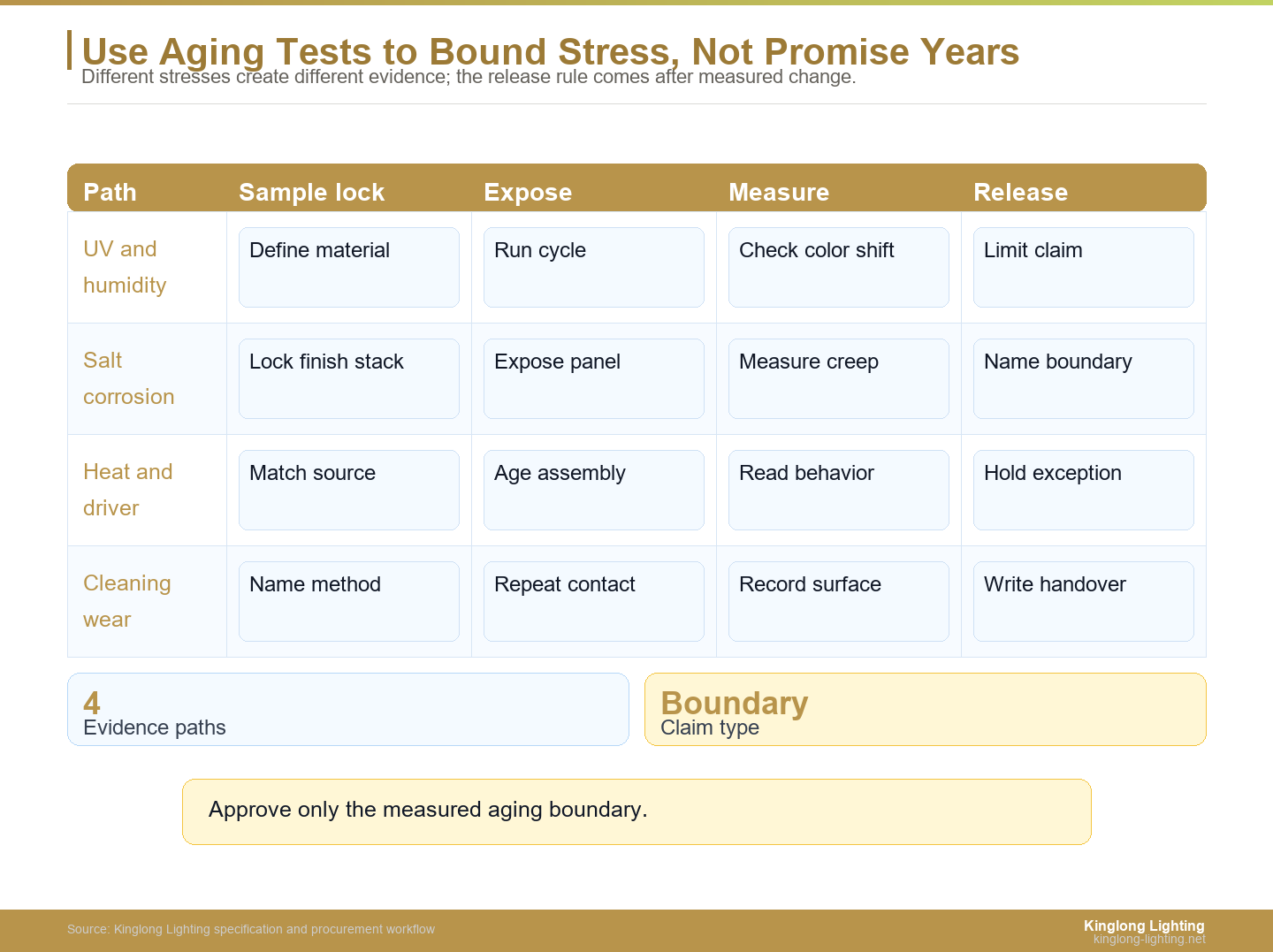
According to ASTM G154 accelerated weathering standard page, accelerated weathering tests expose materials to controlled UV and moisture cycles that need careful interpretation. For project buyers, the practical action is to match accelerated exposure evidence to the specific material and stress being evaluated.
UV and humidity target visible surface change
Acrylic, resin, coatings, and some finishes may need UV or condensation-style evidence when sunlight, skylights, or bright interiors are relevant. The buyer should read the result as surface behavior under that stress.
If the chandelier is in a windowless interior, the same UV evidence may be less important than cleaning or heat behavior.
In practice, make this a accelerated aging evidence visibility gate: judge the sample under the room light, normal viewing distance, and cleaning condition. The decision rule is to document the threshold before release, then review any mismatch within 7 days if the owner-visible effect or maintenance cost changes.
Corrosion needs a different stress path
Metal finishes facing salt, humidity, or coastal air need corrosion-oriented evidence rather than only UV aging.
According to ASTM B117 salt spray standard page, salt spray testing is a controlled corrosion exposure method and should not be treated as a direct lifetime promise. For project buyers, the practical action is to keep corrosion exposure evidence separate from UV aging and read each test within its own method.
In practice, make this a accelerated aging evidence visibility gate: judge the sample under the room light, normal viewing distance, and cleaning condition. The decision rule is to document the threshold before release, then review any mismatch within 7 days if the owner-visible effect or maintenance cost changes.
Do not translate accelerated weeks into exact years
The marketing temptation is to say a few weeks equal ten years. The more responsible claim is narrower: the material was exposed to defined stress and compared before and after.
According to ISO/IEC 17025 overview, laboratory competence, valid results, and report acceptance depend on method and scope. For project buyers, the practical action is to check whether a material report identifies the sample, method, date, scope, and claim it actually supports.
Correlation depends on the material and environment
Some materials respond predictably to a stress model, while others fail through mixed conditions that are hard to compress. Cleaning chemicals, hands, dust, vibration, and repairs may matter more than the selected stress.
The buyer should ask what the test accelerates and what it leaves outside the model.
In practice, make this a accelerated aging evidence visibility gate: judge the sample under the room light, normal viewing distance, and cleaning condition. The decision rule is to document the threshold before release, then review any mismatch within 7 days if the owner-visible effect or maintenance cost changes.
Accreditation does not remove interpretation
According to CNAS English site, accreditation is a signal that a laboratory or inspection body has been assessed against recognized competence requirements. For project buyers, the practical action is to treat accredited context as confidence while still reading the exact sample and stress condition.
A well-run test can still be overclaimed if the buyer applies it to the wrong material, environment, or warranty statement.
In practice, make this a accelerated aging evidence visibility gate: judge the sample under the room light, normal viewing distance, and cleaning condition. The decision rule is to document the threshold before release, then review any mismatch within 7 days if the owner-visible effect or maintenance cost changes.
Before-and-after documentation makes the result usable
Aging evidence is most useful when the buyer can see what changed. Numbers alone may miss the visible luxury issue.
According to DOE LED lighting page, LED products differ in direction, color behavior, heat, lifetime, and application fit. For project buyers, the practical action is to review decorative materials under the specified light source and room condition, not as isolated samples.
Photographs should use the same setup
Before-and-after photos should use the same light, background, angle, and distance. Otherwise color shift, gloss loss, haze, or cracking may be exaggerated or hidden by the review setup.
This is especially important for brass, acrylic, resin, glass, leather, and decorative coatings that are judged by appearance.
In practice, make this a accelerated aging evidence visibility gate: judge the sample under the room light, normal viewing distance, and cleaning condition. The decision rule is to document the threshold before release, then review any mismatch within 7 days if the owner-visible effect or maintenance cost changes.
Color metrics need material context
Color data can help, but the buyer still needs to see the effect on the approved sample board and installed scene.
According to DOE TM-30 FAQ, color quality needs more precise language than warm, cool, or beautiful when materials are being approved. For project buyers, the practical action is to interpret color-related evidence beside the actual light source and material palette.
In practice, make this a accelerated aging evidence visibility gate: judge the sample under the room light, normal viewing distance, and cleaning condition. The decision rule is to document the threshold before release, then review any mismatch within 7 days if the owner-visible effect or maintenance cost changes.
Use aging results to set use boundaries
The result should not sit in a folder. It should shape where the material is used, how it is cleaned, and what claims the project makes.
According to UL 1598 standard page, decorative chandeliers are still luminaires that need product evidence and qualified installation review. For project buyers, the practical action is to connect material evidence to the complete luminaire file and service boundary.
A material can pass one environment and fail another
A finish may be acceptable for indoor dry use but not spa humidity. An acrylic may work in shaded decorative use but not near high heat. Leather may need cleaning and humidity boundaries.
The buyer should write the acceptable use condition into the release note, not only approve the sample.
In practice, make this a accelerated aging evidence visibility gate: judge the sample under the room light, normal viewing distance, and cleaning condition. The decision rule is to document the threshold before release, then review any mismatch within 7 days if the owner-visible effect or maintenance cost changes.
Warranty language should follow evidence
Aging tests can support warranty discussion, but the warranty should not promise conditions the test did not model.
The responsible file states the tested stress, observed change, accepted use, and maintenance requirement.
In practice, treat this as a accelerated aging evidence evidence gate: keep the report, sample ID, method, date, and claim boundary together. The decision rule is to accept only what the document actually proves, then flag any missing proof within 7 days before the buyer signs production release.
In practice, treat this as a accelerated aging evidence evidence gate: keep the report, sample ID, method, date, and claim boundary together. The decision rule is to accept only what the document actually proves, then flag any missing proof within 7 days before the buyer signs production release.
Compare alternatives instead of chasing a perfect result
Accelerated aging is often strongest as a comparison tool. It can show which finish, acrylic, coating, or assembly performs better under the same stress.
According to ILAC MRA and signatories page, international recognition of accredited test results depends on the accreditation body and recognition relationship. For project buyers, the practical action is to confirm evidence expectations when aging results must be accepted by international stakeholders.
Relative performance can guide material selection
If two acrylic diffusers are exposed under the same method and one yellows less, the buyer has useful comparative evidence. The result still needs to be connected to cost, availability, and appearance.
The best choice is not always the highest lab score. It is the option that balances room appearance, stress resistance, serviceability, and project budget.
In practice, make this a accelerated aging evidence visibility gate: judge the sample under the room light, normal viewing distance, and cleaning condition. The decision rule is to document the threshold before release, then review any mismatch within 7 days if the owner-visible effect or maintenance cost changes.
Replacement planning closes the aging loop
Kinglong Lighting can connect aging results to spare strategy, cleaning rules, and the decorative lighting collections so future replacement does not restart the material decision.
This is how a short test becomes long-term ownership value.
In practice, make this a accelerated aging evidence service gate with 3 records: part code, spare quantity, and replacement match rule. The decision rule is to confirm the future repair path before shipment so a small breakage does not become a cost, delay, or owner trust problem.
In practice, make this a accelerated aging evidence service gate with 3 records: part code, spare quantity, and replacement match rule. The decision rule is to confirm the future repair path before shipment so a small breakage does not become a cost, delay, or owner trust problem.
Accelerated aging evidence table
Use this table to connect stress tests to buyer decisions.
| Decision area | Owner risk if vague | Evidence to request | Acceptance action |
|---|---|---|---|
| UV exposure | Buyer treats weeks as exact years | Method, sample, before-after photos | Compare surface change |
| Humidity or corrosion | Wrong stress is used | Environment, metal stack, acceptance rule | Choose test by failure mode |
| Color shift | Lighting setup distorts review | Same light, background, angle | Document visible change fairly |
| Use boundary | Result becomes broad warranty | Tested stress, accepted condition | Write use limitations |
| Replacement | Aged material cannot be matched | Sample archive, spare plan, part code | Protect service path |
A 10-year claim reading scenario
Imagine a supplier says a finish passed an accelerated aging test equivalent to ten years. The buyer should not accept or reject the phrase immediately. The buyer should ask which stress was accelerated, which material was tested, what changed, and how the equivalence was justified.
If the test was UV-focused and the project risk is coastal corrosion, the evidence may be interesting but incomplete. If the test compared two coatings under the same UV and humidity cycle, it may be very useful for selecting the better coating.
A practical reading rule is to replace exact-year language with stress-language: exposed to this method, for this duration, with these observed changes. That phrasing is less dramatic and much more useful.
The limitation is that real ownership includes cleaning, handling, repair, and replacement. Aging evidence should guide those rules instead of pretending they do not exist.
Aging evidence should be tied to an acceptance threshold
Accelerated aging evidence becomes useful when the buyer knows what amount of change is acceptable. Without a threshold, the same before-and-after result can be described as normal, disappointing, or unacceptable by different stakeholders.
According to ASTM G154 accelerated weathering standard page, accelerated weathering tests expose materials to controlled UV and moisture cycles that need careful interpretation. For project buyers, the practical action is to connect accelerated exposure to the observed change and the acceptance threshold.
Define visible change in buyer language
The buyer should decide whether the concern is yellowing, gloss loss, haze, cracking, color drift, surface chalking, delamination, or deformation. Each concern needs a different observation method and a different tolerance.
A finish that changes slightly on a hidden upper arm may be acceptable, while the same change on a close-view dining chandelier may fail the design promise.
In practice, make this a accelerated aging evidence visibility gate: judge the sample under the room light, normal viewing distance, and cleaning condition. The decision rule is to document the threshold before release, then review any mismatch within 7 days if the owner-visible effect or maintenance cost changes.
Use reference samples to prevent subjective debate
Aging review should compare the tested sample with the approved first-day sample and an agreed reject reference when possible. This gives the buyer and supplier a shared visual language.
The record should include photos, lighting setup, duration, stress type, and final decision. That makes the evidence usable when the project team changes.
In practice, approve this as a accelerated aging evidence sample gate: record the master sample, the viewing distance, and one acceptable variation boundary. The decision rule is to compare the delivered batch within 7 days and hold the supplier to a written correction path if the visible result or replacement cost changes.
The result should update maintenance and warranty boundaries
An aging test should not only support material selection. It should shape how the owner cleans, inspects, replaces, and describes the chandelier during operation.
According to UL 1598 standard page, decorative chandeliers are still luminaires that need product evidence and qualified installation review. For project buyers, the practical action is to store aging evidence in the luminaire file with use and service boundaries.
Maintenance can become the missing stress factor
Many aging methods do not model aggressive cleaning, hand oils, dust abrasion, installation scratches, or replacement handling. If those risks are realistic, the handover file should address them directly.
This keeps the buyer from assuming that a test result covers owner behavior it never measured.
In practice, make this a accelerated aging evidence service gate with 3 records: part code, spare quantity, and replacement match rule. The decision rule is to confirm the future repair path before shipment so a small breakage does not become a cost, delay, or owner trust problem.
Warranty language should follow the tested condition
If the test supports indoor dry use, the warranty or service note should not imply wet-area, high-UV, or coastal performance. If the material is accepted with expected patina, that change should be stated clearly.
The strongest file says what was tested, what changed, what use is approved, and which conditions remain outside the evidence.
In practice, treat this as a accelerated aging evidence evidence gate: keep the report, sample ID, method, date, and claim boundary together. The decision rule is to accept only what the document actually proves, then flag any missing proof within 7 days before the buyer signs production release.
When aging evidence should change material selection
Aging evidence should affect the specification when the observed change touches the buyer’s visible promise, maintenance reality, or replacement plan.
According to DOE LED lighting page, LED products differ in direction, color behavior, heat, lifetime, and application fit. For project buyers, the practical action is to review decorative materials under the specified light source and room condition, not as isolated samples.
Change the material when the visible promise is threatened
If acrylic yellows in a way that changes warm-white glow, or a coating loses gloss on a close-view surface, the buyer should consider another material, finish, or protected location.
A lab result is especially persuasive when the change is visible under the same light and viewing distance used for sample approval.
In practice, make this a accelerated aging evidence visibility gate: judge the sample under the room light, normal viewing distance, and cleaning condition. The decision rule is to document the threshold before release, then review any mismatch within 7 days if the owner-visible effect or maintenance cost changes.
Keep the material when the change is acceptable and documented
Some materials are expected to patina, soften, or shift slightly. The buyer can keep the material if the change is part of the design language and the owner accepts the maintenance boundary.
The key is to document the expected change before installation, not after a complaint turns normal aging into a dispute.
In practice, make this a accelerated aging evidence visibility gate: judge the sample under the room light, normal viewing distance, and cleaning condition. The decision rule is to document the threshold before release, then review any mismatch within 7 days if the owner-visible effect or maintenance cost changes.
How Kinglong Lighting uses aging evidence responsibly
Kinglong Lighting can support accelerated aging decisions by connecting samples, exposure evidence, use boundaries, cleaning rules, and spare planning inside the custom chandelier workflow.
If a buyer needs to review aging evidence, the useful next action is to send the aging test review brief with the material, expected environment, claimed lifespan, sample photos, and acceptance concern.
Before relying on accelerated aging evidence
Use this short action list before the next approval meeting. It is intentionally practical, because vague approval language is the usual source of later rework.
- Identify the failure mode being accelerated.
- Check sample, method, duration, and acceptance criteria.
- Compare before-and-after photos under the same setup.
- Avoid turning weeks into exact years without context.
- Write use, cleaning, and replacement boundaries.
For a project-specific aging evidence check, Kinglong Lighting can review the material, expected environment, claimed lifespan, sample photos, and acceptance concern before the buyer relies on accelerated aging results.
FAQ
Can accelerated aging simulate ten years of chandelier use?
It can compress selected stress factors, but it cannot recreate every real ownership condition or prove exact service years.
Which chandelier materials need aging review?
Acrylic, resin, coatings, brass finishes, leather, metalwork, LEDs, and exterior-facing materials may need aging review depending on use.
What should buyers request with an aging test?
Request sample identity, method, duration, before-and-after photos, acceptance criteria, and the claim the test supports.
How should aging evidence affect a project?
It should shape material choice, use boundaries, cleaning rules, warranty language, and replacement planning.